
SCHEDULE 14A
(Rule 14a-101)
INFORMATION REQUIRED
IN PROXY STATEMENT
SCHEDULE 14A
INFORMATION
Proxy Statement
Pursuant to Section 14(a) of the
Securities Exchange Act of 1934 (Amendment No. )
Securities Exchange Act of 1934 (Amendment No. )
Filed by the Registrant
[x]
Filed by a Party other than the Registrant [_]
Check the appropriate box:
[_] Preliminary Proxy Statement [_] Soliciting Material Under Rule
[_] Confidential, For Use of the 14a-12
Commission Only (as permitted
by Rule 14a-6(e)(2))
[x] Definitive Proxy Statement
[_] Definitive Additional Materials
Filed by a Party other than the Registrant [_]
Check the appropriate box:
[_] Preliminary Proxy Statement [_] Soliciting Material Under Rule
[_] Confidential, For Use of the 14a-12
Commission Only (as permitted
by Rule 14a-6(e)(2))
[x] Definitive Proxy Statement
[_] Definitive Additional Materials
COMPUTER SCIENCES CORPORATION
------------------------------------------------------------------------------------------------------------------------------------------------------
------------------------------------------------------------------------------------------------------------------------------------------------------
(Name of Registrant as
Specified In Its Charter)
------------------------------------------------------------------------------------------------------------------------------------------------------
(Name of Person(s)
Filing Proxy Statement, if Other Than the Registrant)
Payment of Filing Fee
(Check the appropriate box):
[x] No fee required.
[_] Fee computed on table below per Exchange Act Rules 14a-6(i)(4) and 0-11.
[x] No fee required.
[_] Fee computed on table below per Exchange Act Rules 14a-6(i)(4) and 0-11.
1) Title of
each class of securities to which transaction applies:
____________________________________________________________________________________
2) Aggregate number of securities to which transaction applies:
3) Per unit price or other underlying value of transaction computed pursuant to Exchange Act Rule 0-11 (set forth the
amount on which the filing fee is calculated and state how it was determined):
4) Proposed maximum aggregate value of transaction:
____________________________________________________________________________________
5) Total fee paid:
[_] Fee paid previously with preliminary materials:
[_] Check box if any part of the fee is offset as provided by Exchange Act Rule 0-11(a)(2) and identify the filing for which
the offsetting fee was paid previously. Identify the previous filing by registration statement number, or the form or
schedule and the date of its filing.
____________________________________________________________________________________
1) Amount previously paid:
____________________________________________________________________________________
2) Form, Schedule or Registration Statement No.:
____________________________________________________________________________________
3) Filing Party:
____________________________________________________________________________________
4) Date Filed:
____________________________________________________________________________________
2) Aggregate number of securities to which transaction applies:
3) Per unit price or other underlying value of transaction computed pursuant to Exchange Act Rule 0-11 (set forth the
amount on which the filing fee is calculated and state how it was determined):
4) Proposed maximum aggregate value of transaction:
____________________________________________________________________________________
5) Total fee paid:
[_] Fee paid previously with preliminary materials:
[_] Check box if any part of the fee is offset as provided by Exchange Act Rule 0-11(a)(2) and identify the filing for which
the offsetting fee was paid previously. Identify the previous filing by registration statement number, or the form or
schedule and the date of its filing.
____________________________________________________________________________________
1) Amount previously paid:
____________________________________________________________________________________
2) Form, Schedule or Registration Statement No.:
____________________________________________________________________________________
3) Filing Party:
____________________________________________________________________________________
4) Date Filed:
| Computer Sciences Corporation | |
 |
Notice of 2010 Annual Meeting of
Stockholders
The 2010 Annual Meeting of Stockholders will be
held on Monday, August 9, 2010, at 10:00 a.m. Eastern Time, at the
headquarters of the Company, 3170 Fairview Park Drive, Falls Church,
Virginia 22042. The purpose of the meeting is to vote on:
If pending federal legislation mandating
majority voting in the uncontested election of directors is adopted prior
to the Annual Meeting, then implementation of the proposals to amend the
Restated Articles of Incorporation will no longer be conditioned on the
approval of both proposals. See “Note Regarding Pending Federal
Legislation” on page 49.
Only stockholders of record at the close of
business on June 14, 2010, will be entitled to vote at the meeting and any
postponements or adjournments thereof.
Your vote is important. Whether or not you plan
to attend the meeting, we encourage you to read this Proxy Statement and
vote as soon as possible. Information on how to vote is contained in this
Proxy Statement. In addition, voting instructions are provided in the
Notice of Internet Availability of Proxy Materials, or, if you requested
printed materials, the instructions are printed on your proxy card and
included in the accompanying Proxy Statement. You can revoke a proxy at
any time prior to its exercise at the Annual Meeting by following the
instructions in the Proxy Statement.
|
| By Order of the Board of Directors, | |
 |
|
| William L. Deckelman, Jr. Vice President, General Counsel and Secretary |
|
|
Falls Church,
Virginia
June 25, 2010 |
TABLE OF CONTENTS
| ABOUT THE ANNUAL MEETING | 1 |
| HOW DO I VOTE? | 6 |
| CORPORATE GOVERNANCE | 7 |
| Board of Directors | 7 |
| Corporate Governance Guidelines, Codes of Ethics and Equity Grant Policy | 7 |
| Director Attendance at Meetings | 7 |
| Chairman of the Board of Directors and Lead Director | 7 |
| Executive Sessions of Non-Management Directors | 8 |
| Communicating with the Board or the Lead Director | 8 |
| Director Independence | 8 |
| Mandatory Retirement of Directors | 9 |
| Resignation of Employee Directors | 9 |
| Board Committees | 9 |
| Board Diversity | 10 |
| Stockholder Recommendations | 11 |
| Director Nomination Process | 11 |
| Oversight of Related Party Transactions | 11 |
| Oversight of Risk Management | 12 |
| Director Compensation | 13 |
| PROPOSAL 1. ELECTION OF DIRECTORS | 15 |
| Certain Litigation | 17 |
| STOCK OWNERSHIP | 18 |
| Equity Ownership Guidelines | 19 |
| AUDIT COMMITTEE REPORT | 20 |
| EXECUTIVE COMPENSATION | 20 |
| Compensation Committee Report | 20 |
| Compensation Discussion and Analysis | 20 |
| Executive Summary | 20 |
| Compensation Consultants | 22 |
| Process | 23 |
| Elements of Compensation | 25 |
| Equity Ownership Guidelines | 31 |
| Tax Deductibility of Compensation | 31 |
| Perquisites | 31 |
| Compensation Recoupment Policy | 32 |
| Summary Compensation Table | 32 |
| Grants of Plan‑Based Awards | 35 |
| Outstanding Equity Awards at Fiscal Year-End | 37 |
| Option Exercises and Stock Vested | 39 |
| Pension Benefits | 40 |
| Fiscal Year 2010 Nonqualified Deferred Compensation | 42 |
| Potential Payments Upon Change in Control and Termination of Employment | 42 |
i
|
INFORMATION ABOUT PROPOSALS 2 AND 3 CONCERNING PROPOSED
AMENDMENTS
TO CSC’S RESTATED
ARTICLES OF INCORPORATION
|
48 |
|
Note Regarding Pending Federal Legislation |
49 |
| PROPOSAL 2. APPROVAL OF AMENDMENTS TO RESTATED ARTICLES OF | |
| INCORPORATION TO ELIMINATE CUMULATIVE VOTING | 49 |
|
Vote Required and Recommendation of the Board of Directors |
50 |
| PROPOSAL 3. APPROVAL OF AMENDMENTS TO RESTATED ARTICLES OF | |
| INCORPORATION TO IMPLEMENT MAJORITY VOTING FOR UNCONTESTED | |
| ELECTIONS OF DIRECTORS | 50 |
|
Vote Required and Recommendation of the Board of Directors |
52 |
| PROPOSAL 4. APPROVAL OF 2010 NON-EMPLOYEE DIRECTOR INCENTIVE PLAN | 52 |
| Shares Available for Issuance | 52 |
| Eligibility | 53 |
| Administration | 53 |
| Types of Awards | 53 |
| Transferability | 53 |
| Change in Control | 53 |
| Adjustments | 54 |
| Plan Amendments | 54 |
| Federal Income Tax Treatment | 54 |
| Section 409A | 55 |
| Other Information | 55 |
| Vote Required | 55 |
| PROPOSAL 5. RATIFICATION OF INDEPENDENT AUDITORS | 56 |
| Fees | 56 |
| Pre-Approval Policy | 56 |
| Vote Required | 56 |
| ADDITIONAL INFORMATION | 57 |
| Section 16(a) Beneficial Ownership Reporting Compliance | 57 |
| Business for 2011 Annual Meeting | 57 |
| Householding; Availability of 2010 Annual Report and Proxy Statement | 58 |
| APPENDIX A. INDEPENDENCE STANDARDS | A-1 |
| APPENDIX B. SELECTIONS FROM THE RESTATED ARTICLES OF INCORPORATION | |
| INDICATING PROPOSED CHANGES DISCUSSED IN PROPOSALS 2 AND 3 | B-1 |
| APPENDIX C. SELECTIONS FROM THE BYLAWS INDICATING PROPOSED CHANGES | |
| DISCUSSED IN PROPOSALS 2 AND 3 | C-1 |
|
APPENDIX D. SECTION 2 OF
THE CORPORATE GOVERNANCE GUIDELINES INDICATING
PROPOSED CHANGES
DISCUSSED IN PROPOSALS 2 AND 3
|
D-1 |
| APPENDIX E. 2010 NON-EMPLOYEE DIRECTOR INCENTIVE PLAN | E-1 |
ii

Computer Sciences Corporation
3170 Fairview Park Drive
Falls Church, Virginia 22042
(703) 876-1000
June 25, 2010
____________________
PROXY STATEMENT
____________________
PROXY STATEMENT
____________________
We are providing these proxy materials in
connection with the 2010 Annual Meeting of Stockholders (the “Annual Meeting”)
of Computer Sciences Corporation (“CSC” or the “Company” and sometimes referred
to with the pronouns “we”, “us” and “our”). The Notice of Internet Availability
of Proxy Materials, this proxy statement, any accompanying proxy card or voting
instruction card and our 2010 Annual Report to Stockholders, which includes our
2010 Annual Report on Form 10-K, were first made available to stockholders on or
about June 25, 2010. This proxy statement contains important information for you
to consider when deciding how to vote on the matters brought before the Annual
Meeting. Please read it carefully.
We are delivering proxy materials for the
Annual Meeting under the United States Securities and Exchange Commission’s
“Notice and Access” rules. These rules permit us to furnish proxy materials,
including this proxy statement and our 2010 Annual Report, to our stockholders
by providing access to such documents on the Internet instead of mailing printed
copies. Most stockholders received a Notice of Internet Availability of Proxy
Materials (the “Notice”), which provides instructions on how you may access and
review all of the proxy materials on the Internet. The Notice also instructs you
as to how you may submit your proxy on the Internet. More information about
Notice and Access is set forth below.
ABOUT THE ANNUAL MEETING
Who is soliciting my vote?
The Board of Directors of CSC (sometimes
referred to herein as the “Board”) is soliciting your vote at the 2010 Annual
Meeting.
When will the meeting take
place?
The Annual Meeting will be held on Monday,
August 9, 2010 at 10:00 a.m., Eastern Time, at the headquarters of the Company,
3170 Fairview Park Drive, Falls Church, Virginia 22042.
What is the purpose of the Annual Meeting?
You will be voting on:
- election of each of the nine
nominees as directors of CSC;
- amendment of the Restated Articles
of Incorporation of the Company (the “Restated Articles”) to eliminate
cumulative voting in the election of
directors;
- amendment of the Restated Articles to implement a majority voting standard for uncontested elections of directors;
- approval of the 2010 Non-Employee
Director Incentive Plan;
- ratification of the selection of
Deloitte & Touche LLP as our auditors for Fiscal 2011;
and
- any other business that may properly come before the meeting.
The implementation of the proposals to amend
the Restated Articles to eliminate cumulative voting in the election of
directors and to implement a majority voting standard for uncontested elections
of directors is conditioned upon stockholder approval of both proposals. Please
see “Note Regarding Pending Federal Legislation” on page 49 for a
discussion of the impact of the adoption of such legislation on the conditions
relating to the approval of such proposals.
What are the Board of Directors’
recommendations?
The Board recommends a vote:
- for the
election of each of the nine nominees for director;
- for the
amendment of the Restated Articles to eliminate cumulative voting in the
election of directors;
- for the
amendment of the Restated Articles to implement a majority voting standard for
uncontested elections of
directors;
- for the
approval of the 2010 Non-Employee Director Incentive Plan;
- for the
ratification of the selection of Deloitte & Touche LLP as our auditors for
Fiscal 2011; and
- for or against other matters that come before the Annual Meeting, as the proxy holders deem advisable.
Who is entitled to vote at the Annual Meeting?
The Board of Directors set June 14, 2010, as
the record date for the Annual Meeting (the “record date”). All stockholders who
owned CSC common stock at the close of business on June 14, 2010, may attend and
vote at the Annual Meeting and any postponements or adjournments
thereof.
Why did I receive a notice in the mail
regarding the Internet availability of proxy materials this year instead of a
paper copy of proxy materials?
Under the “Notice and Access” rules of the
United States Securities and Exchange Commission (the “SEC”) we are permitted to
furnish proxy materials, including this proxy statement and our 2010 Annual
Report, to our stockholders by providing access to such documents on the
Internet instead of mailing printed copies. Most stockholders will not receive
printed copies of the proxy materials unless they request them. Instead, the
Notice, which was mailed to most of our stockholders, will instruct you as to
how you may access and review all of the proxy materials on the Internet. The
Notice also instructs you as to how you may submit your proxy on the Internet.
If you would like to receive a paper or electronic copy of our proxy materials,
you should follow the instructions for requesting such materials in the Notice.
Any request to receive proxy materials by mail or electronically will remain in
effect until you revoke it.
Can I vote my shares by filling out and
returning the Notice?
No. The Notice identifies the items to be
voted on at the Annual Meeting, but you cannot vote by marking the Notice and
returning it. The Notice provides instructions on how to vote by (i) Internet,
(ii) telephone, (iii) requesting and returning a paper proxy card or voting
instruction card, or (iv) submitting a ballot in person at the meeting.
2
Why didn’t I receive a Notice in the mail
regarding the Internet availability of proxy materials?
If you previously elected to access proxy
materials over the Internet, you will not receive a Notice in the mail. You
should have received an email with links to the proxy materials and online proxy
voting. Additionally, if you previously requested paper copies of the proxy
materials or if applicable regulations require delivery of the proxy materials,
you will not receive the Notice.
If you received a paper copy of the proxy
materials or the Notice by mail, you can eliminate all such paper mailings in
the future by electing to receive an email that will provide Internet links to
these documents. Opting to receive all future proxy materials online will save
us the cost of producing and mailing documents to your home or business and help
us conserve natural resources. See http://www.icsdelivery.com/csc to request complete electronic delivery.
Enrollment for electronic delivery is effective until cancelled.
How many votes do I have?
You will have one vote for each share of our
common stock you owned at the close of business on the record date, provided
those shares are either held directly in your name as the stockholder of record
or were held for you as the beneficial owner through a broker, bank or other
nominee. Holders of CSC stock are entitled to cumulate their votes for the
election of directors if, on or prior to 10:00 a.m., Eastern Time, on August 7,
2010, at least one stockholder has notified CSC’s Chief Executive Officer or
Secretary in writing of a desire that voting for the election of directors be
cumulative, and at the Annual Meeting, prior to the commencement of voting for
the election of directors, an announcement of the giving of such notice has been
made by the Chairman or the Secretary of the meeting or by or on behalf of the
stockholder giving such notice.
Under cumulative voting, each stockholder may
allocate among the director nominees, in any manner desired, a total number of
votes equal to the number of directors to be elected multiplied by the number of
shares held. If cumulative voting is effective at the Annual Meeting and a
stockholder elects to cumulate votes but does not allocate the votes to specific
director nominees, the proxy holders named in the proxy will have the discretion
to cumulate votes in any manner, and to vote for less than all of the director
nominees indicated on the proxy, in order to elect the maximum number of the
director nominees set forth in Proposal 1 on page 15.
As described under “PROPOSAL 2. APPROVAL OF AMENDMENTS TO RESTATED ARTICLES OF INCORPORATION
TO ELIMINATE CUMULATIVE VOTING” and “PROPOSAL 3. APPROVAL OF AMENDMENTS TO RESTATED
ARTICLES OF INCORPORATION TO IMPLEMENT MAJORITY VOTING FOR UNCONTESTED ELECTIONS
OF DIRECTORS,” the Board
is recommending that stockholders approve amendments to the Restated
Articles that eliminate the ability of a stockholder to select cumulative voting
in any election of directors and implement a majority voting standard for the
election of directors in uncontested elections. The implementation of each
proposal is conditioned upon stockholder approval of both proposals. Please see
“Note Regarding Pending Federal Legislation” on page 49 for a
discussion of the impact of the adoption of such legislation on the conditions
relating to the approval of such proposals. In connection with Proposals 2 and
3, the Board, on the recommendation of the Nominating/Corporate Governance
Committee, has unanimously adopted resolutions that contingently approved
amendments to the Company’s Bylaws (the “Bylaws”) that make necessary conforming
changes to reflect the elimination of cumulative voting and the implementation
of majority voting in connection with uncontested elections of directors
and the Corporate Governance Guidelines that implement a resignation policy
for directors that do not receive the requite majority vote in an uncontested
election. If the amendments to the Restated Articles set forth in Proposals 2
and 3 are approved by stockholders by the requisite stockholder vote, cumulative
voting will not be available in any future director elections after the 2010
Annual Meeting, a majority voting standard will apply to all future uncontested
director elections and a plurality voting standard will continue to apply in all
future contested director elections.
What is the difference between holding shares
as a stockholder of record and beneficial owner?
Most of our stockholders hold their shares
through a broker, bank or other nominee rather than directly in their own name.
As summarized below, there are some differences between shares held of record
and those owned beneficially.
3
Stockholder of Record. If your shares are registered directly in your name with our transfer
agent, BNY Mellon Shareowner Services, you are considered the stockholder of
record with respect to those shares, and the Notice or these proxy materials are
being sent directly to you. As the stockholder of record, you have the right to
grant your voting proxy directly to us, to submit proxies electronically or by
telephone or to vote in person at the Annual Meeting. If you have requested
printed proxy materials, we have enclosed a proxy card for you to
use.
Beneficial Owner. If your shares are held in a stock brokerage
account or by a bank or other nominee, you are considered the beneficial owner
of shares held in “street name,” and the Notice or these proxy materials are
being forwarded to you by your broker, bank or nominee who is considered the
stockholder of record with respect to those shares. As the beneficial owner, you
have the right to direct your broker, bank or nominee on how to vote and are
also invited to attend the Annual Meeting. However, since you are not the
stockholder of record, you may not vote these shares in person at the Annual
Meeting, unless you request, complete and deliver a legal proxy from your
broker, bank or nominee. If you requested printed proxy materials, your broker,
bank or nominee has enclosed a voting instruction card for you to use in
directing the broker, bank or nominee regarding how to vote your shares.
How many votes must be present to hold the
Annual Meeting?
A majority of our issued and outstanding
shares entitled to vote at the Annual Meeting as of the record date must be
present at the Annual Meeting in order to hold the Annual Meeting and conduct
business. This is called a “quorum.” Shares are counted as present at the Annual
Meeting if you are present and vote in person at the Annual Meeting or by
telephone or on the Internet or a proxy card has been properly submitted by you
or on your behalf. Both abstentions and broker non-votes are counted as present
for the purpose of determining the presence of a quorum.
As of the record date there were
154,311,617 shares of CSC common stock outstanding.
How many votes are required to elect directors
and adopt the other proposals?
Directors are elected by a plurality of the
votes cast. This means that the nine individuals nominated for election to the
Board of Directors who receive the most “FOR” votes (among votes properly cast
in person, electronically, by telephone or by proxy) will be elected. In
director elections, stockholders may either vote “FOR,” or withhold voting
authority with respect to director nominees. Shares voting “withhold” are
counted for purposes of determining a quorum. However, if you withhold authority
to vote with respect to the election of some or all of the nominees, your shares
will not be voted with respect to those nominees indicated. Therefore,
“withhold” votes will not affect the outcome of the election of
directors.
The affirmative “FOR” vote of a majority of
the issued and outstanding shares of common stock is required to approve
Proposals 2 and 3, which contemplate amendments to CSC’s Restated Articles.
Abstentions and broker non-votes will have the same effect as votes against
Proposals 2 and 3. The implementation of each proposal is conditioned upon
stockholder approval of both proposals. For more information, see “Note
Regarding Pending Federal Legislation” on page 49 and the descriptions of
Proposals 2 and 3 on pages 49 to 52.
The affirmative “FOR” vote of a majority of
the votes cast (i.e., of the votes “FOR” or “AGAINST”) is required to approve
the 2010 Non-Employee Director Incentive Plan and to ratify the appointment of
independent auditors. Abstentions are counted as present for quorum purposes but
will not be counted for purposes of determining whether a matter has been
approved. Therefore, abstentions will have no effect on the outcome of the vote
on these proposals.
What if I don’t give specific voting
instructions?
Stockholders of
Record. If you are a
stockholder of record and you:
- Indicate when voting by Internet
or by telephone that you wish to vote as recommended by our Board of
Directors; or
- Return a signed proxy card but do not indicate how you wish to vote,
then your shares will
be voted in accordance with the recommendations of the Board of Directors on all
matters presented in this proxy statement and as the proxy holders may determine
in their discretion regarding any other matters properly presented for a vote at
the meeting. If you indicate a choice with respect to any matter to be acted
upon on your proxy card or voting instruction card, the shares will be voted in
accordance with your instructions.
4
Beneficial Owners.
If you hold shares beneficially in street name and do not provide your broker
with voting instructions, your shares may constitute “broker non-votes” on
certain proposals. Generally, broker non-votes occur on a non-routine proposal
where a broker is not permitted to vote on that proposal without instructions
from the beneficial owner, and instructions are not given. Broker non-votes are
considered present at the Annual Meeting, but not as voting on a matter. Thus,
broker non-votes are counted as present for purposes of determining the
existence of a quorum, but are not counted for purposes of determining whether a
matter has been approved. Thus, broker non-votes will not affect the outcome of
the election of directors, the approval of the 2010 Non-Employee Director
Incentive Plan or the ratification of the appointment of independent auditors.
Abstentions and broker non-votes will have the same effect as votes against
Proposals 2 and 3.
Your broker will vote your street name shares
at the Annual Meeting with respect to (i) the election of directors, (ii) the
amendments to the Restated Articles that eliminate the ability of a
stockholder to select cumulative voting in any election of directors, (iii) the
amendments to the Restated Articles that implement a majority voting
standard for the election of directors in uncontested elections and (iv) the
approval of the 2010 Non-Employee Director Incentive Plan, only if you
instruct your broker how to vote. You should instruct your broker how to vote.
If you do not provide your broker with instructions, under the rules of the New
York Stock Exchange, your broker will not be authorized to vote your street name
shares with respect to Proposal 1, Proposal 2, Proposal 3 and Proposal 4.
Your broker, at his or her discretion, may
vote your street name shares on the ratification of the independent auditors if
you do not provide voting instructions.
Can I change my vote after I voted?
Yes. Even if you voted by telephone or on the
Internet or if you requested paper proxy materials and signed the proxy card or
voting instruction card in the form accompanying this proxy statement, you
retain the power to revoke your proxy or change your vote. You can revoke your
proxy or change your vote at any time before it is exercised by giving written
notice to the Corporate Secretary of CSC, specifying such revocation. You may
change your vote by a later-dated vote by telephone or on the Internet or timely
delivery of a valid, later-dated proxy or by voting by ballot at the Annual
Meeting. However, please note that if you would like to vote at the Annual
Meeting and you are not the stockholder of record, you must request, complete
and deliver a legal proxy from your broker, bank or nominee.
What does it mean if I receive more than one
Notice, proxy or voting instruction card?
It generally means your shares are registered
differently or are in more than one account. Please provide voting instructions
for all Notices, proxy cards and voting instruction cards you receive.
Are there other matters to be acted upon at
the meeting?
The Company does not know of any matter to be
presented at the Annual Meeting other than those described in this proxy
statement. If, however, other matters are properly presented for action at the
Annual Meeting, the proxy holders named in the proxy will have the discretion to
vote on such matters in accordance with their best judgment.
Who is paying for the solicitation of
proxies?
CSC is making this solicitation and will pay
the entire cost of preparing, assembling, printing, mailing and distributing
these proxy materials and soliciting votes. Our officers and employees may,
without any compensation other than the compensation they receive in their
capacities as officers and employees, solicit proxies personally or by
telephone, facsimile, e-mail or further mailings. We will, upon request,
reimburse brokerage firms and others for their reasonable expense in forwarding
proxy materials to beneficial owners of CSC stock. We have engaged the services
of Morrow & Co., LLC, 470 West Avenue, Stamford, CT 06902, with respect to
proxy soliciting matters at an expected cost of approximately $8,000, not
including incidental expenses.
What if I have any questions about voting,
electronic delivery or Internet voting?
Questions regarding voting, electronic
delivery or Internet voting should be directed to Investor Relations at
800.542.3070 or e-mail address, investorrelations@csc.com.
5
HOW DO I VOTE?
Your vote is important. You may vote on the
Internet, by telephone, by mail or by attending the Annual Meeting and voting by
ballot, all as described below. The Internet and telephone voting procedures are
designed to authenticate stockholders by use of a control number and to allow
you to confirm that your instructions have been properly recorded. If you vote
by telephone or on the Internet, you do not need to return your Notice, proxy
card or voting instruction card. Telephone and Internet voting facilities are available now and will be
available 24 hours a day until 11:59 p.m., Eastern Time, on August 8,
2010.
Vote on the Internet
If you have Internet access, you may submit
your proxy by following the instructions provided in the Notice, or if you
requested printed proxy materials, by following the instructions provided with
your proxy materials and on your proxy card or voting instruction card. On the
Internet voting site, you can confirm that your instructions have been properly
recorded. If you vote on the Internet, you can also request electronic delivery
of future proxy materials.
Vote by Telephone
You can also vote by telephone by following
the instructions provided on the Internet voting site, or if you requested
printed proxy materials, by following the instructions provided with your proxy
materials and on your proxy card or voting instruction card.
Vote by Mail
If you elected to receive printed proxy
materials by mail, you may choose to vote by mail by marking your proxy card or
voting instruction card, dating and signing it, and returning it to Broadridge
Financial Solutions, Inc. in the postage-paid envelope provided. If the envelope
is missing, please mail your completed proxy card or voting instruction card to
CSC, c/o Broadridge Financial Solutions, Inc., 51 Mercedes Way, Edgewood, New
York 11717. Please allow sufficient time for mailing if you decide to vote by
mail.
Voting at the Annual
Meeting
The method or timing of your vote will not
limit your right to vote at the Annual Meeting if you attend the Annual Meeting
and vote in person. However, if your shares are held in the name of a bank,
broker or other nominee, you must obtain a legal proxy, executed in your favor,
from the holder of record to be able to vote at the Annual Meeting. You should
allow yourself enough time prior to the Annual Meeting to obtain this proxy from
the holder of record.
The shares voted electronically, by telephone
or represented by the proxy cards received, properly marked, dated, signed and
not revoked, will be voted at the Annual Meeting.
6
CORPORATE GOVERNANCE
Board of Directors
The Board of Directors is elected by the
stockholders to oversee the management of the business of the Company. The
Company’s senior management has the authority and responsibility for the
day-to-day operations of the business.
Corporate Governance Guidelines, Codes of
Ethics and Equity Grant Policy
The Board has adopted the
following:
- Corporate Governance Guidelines
(the “Guidelines”) that govern the structure and functioning of the
Board and its
committees;
- a Code of Ethics and Standards of
Conduct for all directors of CSC and all employees of CSC and its subsidiaries;
- an additional Code of Ethics for
the Chief Executive Officer (“CEO”), Chief Financial Officer (“CFO”)
and Chief Accounting Officer
(“CAO”); and
- an Equity Grant Policy that sets forth the process for issuing equity securities to CSC directors and employees.
All four documents, along with the charters of
CSC’s Audit, Compensation and Nominating/Corporate Governance Committees and
CSC’s other key governance documents, are available on the Company’s Website,
www.csc.com, under “Corporate Governance.” They are also
available to any person, without charge, by calling 800.542.3070 or writing to:
Investor
Relations
CSC
3170 Fairview Park Drive
Falls Church, Virginia 22042
CSC
3170 Fairview Park Drive
Falls Church, Virginia 22042
The Company will promptly disclose
on its Website (i) any waiver of a director or executive officer’s compliance
with the Code of Ethics and Standards of Conduct, and (ii) any amendment or
waiver of the Code of Ethics for the CEO, CFO or CAO.
Director Attendance at
Meetings
As set forth in the Guidelines, directors are
expected to attend all meetings of the Board and the Board committees upon which
they serve, and all annual meetings of the Company’s stockholders at which they
are standing for election or re-election as directors. The Board held 13
meetings during the fiscal year ended April 2, 2010 (“Fiscal Year
2010” or
“Fiscal
2010”). Each
director attended at least 77% of the aggregate number of meetings of the Board
and the Board committees of which he or she was a member during Fiscal Year
2010, and each of the directors then serving attended the 2009 Annual Meeting of
Stockholders.
Chairman of the Board of Directors and Lead
Director
The Board has the authority to elect the
Chairman and to determine whether the offices of Chairman and CEO should be
combined or separated. At this time, the Board has decided to combine the
offices of CEO and Chairman, coupled with a lead independent director position
(the “Lead Director”) to strengthen
corporate governance. The Board believes that the combination of the Chairman
and CEO positions is an effective leadership model for the Company as it
enhances executive decision making and is appropriate in Mr. Laphen’s case,
given his more than 30 years of experience with the Company and his familiarity
with the global aspects of the Company’s business and operations.
7
While the Board acknowledges that in some
instances combining the two roles may foster dominance of a board by management,
the Board believes that governance processes in place at CSC are a sufficient
counterbalance to any such tendency and are designed to ensure independent
oversight and protect against the possibility of undue influence by management.
In particular, the Board has designated a Lead Director with the following
duties and responsibilities:
- presiding over executive
sessions;
- chairing meetings of the Board of
Directors in the absence of the Chairman of the Board;
- acting as a liaison between the
independent directors and the Chairman of the Board;
- coordinating with the Chairman of
the Board regarding meeting agendas and schedules;
- coordinating with the Chairman of
the Board regarding information flow to the Board;
- being available for consultation
and communication with stockholders, as appropriate; and
- calling meetings of the independent directors (executive sessions) as appropriate.
Other governance processes include executive
sessions of the independent directors before and after every board meeting,
annual evaluations by the independent directors of the Chairman and CEO’s
performance, succession planning, annual Board and committee self assessments
and the governance processes contained in the Guidelines and the charters of the
various committees of the Board, certain of which are described in this proxy
statement.
Executive Sessions of Non-Management
Directors
The non-management directors regularly meet in
executive session prior to the commencement and after the conclusion of each
regularly scheduled Board meeting, and at such additional times as they may
determine. During Fiscal Year 2010, they held eight executive sessions. As
provided in the Guidelines, the independent directors designate the Lead
Director who presides over executive sessions and who has other responsibilities
as set forth in the Guidelines and listed above. As a general matter, the Lead
Director serves for a term of two years, and may not serve for more than two
consecutive terms. Irving W. Bailey, II is currently the Lead Director, a
position he will hold through the 2011 Annual Meeting of
Stockholders.
Communicating with the Board or the Lead
Director
Stockholders and other interested parties may
communicate with the Board, individual directors, the non-management directors
as a group, or with the Lead Director, by writing in care of the Corporate
Secretary, Computer Sciences Corporation, 3170 Fairview Park Drive, Falls
Church, Virginia 22042. The Corporate Secretary reviews all submissions and
forwards to members of the Board all appropriate communications that in his
judgment are not offensive or otherwise objectionable or do not constitute
commercial solicitations.
Director Independence
The Guidelines provide that a director is
“independent” if he or she satisfies the New York Stock Exchange (“NYSE”)
requirements for director independence (as set forth in Appendix A) and the
Board of Directors affirmatively determines that the director has no material
relationship with CSC (either directly, or as a partner, stockholder or officer
of an organization that has a relationship with CSC).
As stated above, our Chief Executive Officer
is the Chairman of the Board. The Board has determined that each of the
remaining eight directors – Irving W. Bailey, II, David J. Barram, Stephen L.
Baum, Rodney F. Chase, Judith R. Haberkorn, F. Warren McFarlan, Chong Sup Park
and Thomas H. Patrick – is independent.
8
Mandatory Retirement of
Directors
Under our Bylaws, directors must retire by the
close of the first annual meeting of stockholders held after they reach age 72,
unless the Board determines that it is in the best interests of CSC and its
stockholders for the director to continue to serve until the close of a
subsequent annual meeting. The Board has determined upon recommendation of the
Nominating/Corporate Governance Committee that it is in the best interests of
the Company for Dr. Warren McFarlan, who is age 72, to continue to serve until
the 2011 Annual Meeting.
Resignation of Employee
Directors
Under our Guidelines, the CEO must offer to
resign from the Board when he or she ceases to be a CSC employee.
Board Committees
The Board of Directors has three standing
committees: the Audit Committee, the Compensation Committee and the
Nominating/Corporate Governance Committee.
Committee Qualifications and Membership. Each director serving on the Audit
Committee, Compensation Committee or Nominating/Corporate Governance Committee
must be independent. In addition:
- Each Audit Committee member must
meet heightened independence criteria under the rules and regulations
of the NYSE and the SEC relating to
audit committees, and must be financially literate. No member of the Audit Committee may simultaneously serve
on the audit committees of more than three other public companies unless the Board determines that
such simultaneous service would not impair the member’s ability to effectively serve on the Audit
Committee. One member of the Committee serves on no other public company audit committees, two serve on one
other public company audit committee and one serves on three other public company audit committees. The
Board has determined that such simultaneous service does not impair the ability of the members of the
Audit Committee who serve on the other public company audit committees to effectively serve in their CSC
Audit Committee roles.
- Each Compensation Committee member must be a “non-employee director” for purposes of Rule 16b-3 promulgated under the Securities Exchange Act of 1934, as amended (the “Exchange Act”) and an “outside director” for purposes of Section 162(m) of the Internal Revenue Code of 1986, as amended (the “Internal Revenue Code”).
The three standing committees are
currently constituted as set forth below:
| Nominating/ | ||||||
| Corporate | ||||||
| Independent | Audit | Compensation | Governance | |||
| Directors | Committee | Committee | Committee | |||
| Irving W. Bailey, II | X | |||||
| David J. Barram | X | Chair | ||||
| Stephen L. Baum | X | X | ||||
| Rodney F. Chase | Chair | X | ||||
| Judith R. Haberkorn | X | |||||
| F. Warren McFarlan | X | X | ||||
| Chong Sup Park | Chair | |||||
| Thomas H. Patrick | X |
The Board has determined
that:
- each committee member satisfies
all applicable requirements for membership on that committee;
and
- each of the four Audit Committee members qualifies as an “audit committee financial expert” for purposes of the rules of the SEC.
9
Audit Committee.
The Audit Committee oversees the accounting and financial reporting processes
and related internal control framework of the Company, and audits of the
Company’s
financial statements and internal controls over financial reporting. The
Committee assists the Board of Directors in its oversight of the integrity of
the Company’s financial statements, the Company’s compliance with legal and
regulatory requirements, the independent auditors’ qualifications and
independence, and the performance of the Company’s internal audit function and
independent auditors. The Committee is directly responsible for the appointment,
compensation, retention and oversight of the independent auditors. A report of
the Committee is included on page 20 of this proxy statement. During the
last fiscal year, the Committee held five meetings.
Anyone with questions or complaints regarding
accounting, internal accounting controls or auditing matters may communicate
them to the Audit Committee by calling CSC’s Open Line (800.822.5527). Calls may
be confidential or anonymous. All such questions and complaints will be
forwarded to the Audit Committee for its review and will be simultaneously
reviewed and addressed under the direction of the Vice President, Internal
Audit. The Audit Committee may direct special treatment, including the retention
of outside advisors, for any concern communicated to it. CSC’s Code of Ethics
and Standards of Conduct prohibits retaliation against CSC employees for any
report or communication made in good faith through the Open Line.
Compensation Committee. The Compensation Committee reviews and approves the corporate goals and
objectives relevant to the Chief Executive Officer’s compensation, evaluates
performance in light of those goals and objectives and, together with the other
independent directors, determines his compensation based on that evaluation. The
Committee also approves the compensation of all other senior executives, based
on compensation recommendations of CSC management and benchmarking studies from
outside consultants, and recommends to the Board the compensation of directors
for service on the Board and its committees. In addition, the Committee
administers all stock incentive plans, and makes recommendations to the Board
regarding incentive compensation plans and equity-based plans. A report of the
Committee is included on page 20 of this proxy statement. During the last
fiscal year, the Committee held 11 meetings.
Compensation Committee Interlocks and Insider
Participation. None of the
members of the Compensation Committee was at any time during Fiscal Year 2010,
or at any other time, one of our officers or employees. No executive officer of
the Company served or serves on the compensation committee or board of any
company that employed or employs any member of the Compensation Committee or
Board.
Nominating/Corporate Governance Committee. The Nominating/Corporate Governance
Committee assists the Board of Directors in identifying and evaluating
candidates for election or re-election as directors, and in shaping the
corporate governance of the Company. The Committee recommends the membership and
chairman of each Board committee, and monitors the continuing qualification of
directors to serve as Board and committee members. Periodically, the Committee
assesses Board size, structure and operations, and reviews the Company’s
significant corporate governance documents. The Committee oversees the
orientation and education of directors, and the Board’s annual self-evaluation
of its performance. During the last fiscal year, the Committee held four
meetings.
Director Nomination
Process
The Board believes that all
directors should have the attributes listed below. Specifically:
- They should exhibit the highest
professional and personal ethics and values.
- They should have had a successful
career that demonstrates senior level management and leadership experience in
a public company, government or a major academic institution.
- They (other than employee
directors) should meet the standards of independence set forth in the
Guidelines.
- They should be financially
literate.
- They should be able to serve on the Board for a sustained period of time after they are first elected, preferably for at least five years.
10
- They should be able to devote
sufficient time and energy to the performance of their duties as a CSC
director, and serve on no more than four other public company boards, if
retired, and three if not retired.
- They should not hold any position
or have any relationship that would cause CSC to violate any applicable legal
requirement.
- They should be able to effectively, consistently and appropriately take into account and balance the legitimate interests and concerns of all CSC stockholders and other stakeholders.
In evaluating potential director nominees, the
Nominating/Corporate Governance Committee first screens them for these
attributes. The Committee then considers the contribution they would make to the
quality of the Board’s decision making and effectiveness. The Committee has
retained third-party search firms to identify qualified director candidates and
to assist the Committee in evaluating candidates that have been identified by
others.
Board Diversity
The Company’s policy on Board diversity is set
forth in the Guidelines, which provide that Board membership should reflect
diversity in many respects, by including, for example, persons diverse in
geography, gender and ethnicity. In addition, the Committee seeks to maintain a
mix of individuals who possess experience in the sectors in which the Company
operates, such as international business, technology, health care, government
service and public policy, as well as those having backgrounds as executives in
operations, finance, accounting, marketing and sales.
Stockholder
Recommendations
The Committee will consider potential director
candidates recommended by stockholders who own in excess of 1% of the Company’s
outstanding shares. Stockholder recommendations should be submitted to the
Nominating/ Corporate Governance Committee, in care of the Corporate Secretary,
Computer Sciences Corporation, 3170 Fairview Park Drive, Falls Church, Virginia
22042, within the time period described in “ADDITIONAL INFORMATION; Business for
2011 Annual Meeting” on page 57. The submission should include the
following:
- evidence of the stockholder’s
current CSC stockholdings;
- sufficient information to permit
the Committee to evaluate the candidate pursuant to the criteria described
above;
- a detailed description of any
relationship or understanding between the stockholder and the candidate;
and
- the consent of the candidate to serve if nominated and elected.
Stockholder recommendations made in accordance
with the foregoing will be evaluated by the Committee in the same manner in
which the Committee evaluates other nominees.
In addition, CSC’s Bylaws permit stockholders
to nominate directors for election at an annual stockholders meeting. To
nominate a director, the stockholder must comply with the information
requirements and the advance notice deadlines set forth in CSC’s Bylaws. See
“ADDITIONAL INFORMATION; Business for 2011 Annual Meeting” on page
57.
Oversight of Related Party
Transactions
The Company has adopted a written policy
requiring the approval of the Nominating/Corporate Governance Committee of all
transactions in excess of $120,000 between the Company and any related person
(“interested transactions”). For the purposes of this policy, a related person
is any person who was in any of the following categories at any time during
Fiscal Year 2010:
- A director or executive officer of
the Company;
- Any nominee for director;
11
- Any immediate family member of a
director or executive officer, or of any nominee for director. Immediate
family members are any child, stepchild, parent, stepparent, spouse, sibling,
mother-in-law, father-in-law, son-in-law, daughter-in-law, brother-in-law, or
sister-in-law of such director, executive officer or nominee for director, and
any person (other than a tenant or employee) sharing the household of such
director, executive officer or nominee for director; and
- Any person who was in any of the
following categories when a transaction in which such person had a
direct or indirect material
interest occurred or existed:
- Any beneficial owner of more
than 5% of the Company’s common stock; or
- Any immediate family member of any such beneficial owner, which means any child, stepchild, parent, stepparent, spouse, sibling, mother-in-law, father-in-law, son-in-law, daughter-in-law, brother-in-law, or sister-in-law of such security holder, and any person (other than a tenant or employee) sharing the household of such security holder.
- Any beneficial owner of more
than 5% of the Company’s common stock; or
A transaction includes, but is not limited to,
any financial transaction, arrangement or relationship (including any
indebtedness or guarantee of indebtedness) or any series of similar
transactions, arrangements or relationships.
In determining whether to approve an
interested transaction, the Nominating/Corporate Governance Committee will take
into account, among other factors it deems appropriate, whether the interested
transaction is on terms no less favorable than terms generally available to an
unaffiliated third party under the same or similar circumstances and the extent
of the related party’s interest in the transaction. No director will participate
in any discussion or approval of an interested transaction for which he or she
(or an immediate family member) is a related party, except that the director
will provide all material information concerning the interested transaction to
the Nominating/ Corporate Governance Committee.
There have been no transactions since April 4,
2009, nor are there any currently proposed transactions, in which the Company
was or is to be a participant and the amount involved exceeds $120,000, which
required the approval of the Nominating/Corporate Governance Committee under the
Company’s interested transaction policy or in which any related person had, has
or will have a direct or indirect material interest and which is required to be
disclosed under applicable SEC rules.
Oversight of Risk
Management
As part of its oversight responsibility, the
Board oversees and maintains the Company’s governance and compliance processes
and procedures to promote the highest standards of responsibility, ethics and
integrity. The Board oversees the identification, assessment and management of
the Company’s risk. In order for the Company to
identify and mitigate the Company’s risk exposures, the Company maintains an
Enterprise Risk Management Committee (the “ERM Committee”) that (i) identifies
risks in the strategic, operational, financial reporting and compliance domains,
for the Company as a whole, as well as for each business unit, and (ii)
evaluates the effectiveness of existing mitigation strategies. The ERM Committee
is composed of the direct reports to the Chairman and CEO, and regularly reviews
and assesses internal processes and controls for ongoing compliance with
internal policies and legal regulatory requirements, as well as for potential
weaknesses that could result in a failure of an internal control process. The
ERM Committee meets periodically and reports potential areas of risk to the
Board and its committees.
In fulfilling its oversight role,
the Board delegates certain risk management oversight responsibility to the
Board’s committees. The Audit
Committee oversees risks related to accounting, financial reporting processes
and internal controls of the Company as well as reviews the Company’s policies
and practices with respect to risk assessment and risk management. During the
Audit Committee review, the Committee discusses the Company’s major risk
exposures and the steps that have been taken to monitor and control such
exposures with management and meets separately with management, internal
auditors and independent auditors. The Audit Committee reports the results of
its review to the Board. The Compensation Committee monitors the risks
associated with succession planning and leadership development as well as
compensation plans, including evaluating the effect of the Company’s
compensation plans may have on risk decisions. The Nominating/Corporate
Governance Committee monitors the risks related to the Company’s governance
structure and process. Each committee reports to the Board any significant
issues and recommendations discussed during the committee meetings.
12
Director Compensation
Cash Compensation.
Non-management directors receive an annual retainer of $60,000 and a meeting fee
of $2,000 for each day of attendance, in person or telephonically, at any
meeting of the Board of Directors or any of its committees, or at any executive
session of the non-management directors, provided that no more than one meeting
fee is paid for any day. Mr. Laphen, the sole management
director, does not receive any compensation for service on the
Board.
The Chairs of the Audit Committee,
Compensation Committee and Nominating/Corporate Governance Committee also
receive an annual fee of $20,000, $15,000 and $10,000, respectively. The Lead
Director receives an annual fee of $35,000.
Amounts payable in cash may be deferred
pursuant to the Company’s Deferred Compensation Plan, which is described on page
42.
Restricted Stock Units. Each non-management director was awarded 2,600 restricted stock units
(“RSUs”) on August 11, 2009. The RSUs vest in full at the 2010 Annual Meeting.
When a CSC director ceases to serve on the Board, the RSUs are automatically
redeemed for shares of CSC stock and dividend equivalents (plus interest) with
respect to those shares. The number of shares to be delivered upon redemption is
equal to the number of RSUs that are vested at the time the director ceases to
serve on the Board. At the director’s election, the RSUs may be redeemed (i) as
an entirety, upon the day the director ceases to serve on the Board, or (ii) in
substantially equal amounts upon the first five, ten or fifteen anniversaries of
that day.
The following table sets forth for each of the
non-management directors certain information with respect to compensation earned
in Fiscal Year 2010.
| Change in Pension | ||||||||||||
| Value and Nonqualified | ||||||||||||
| Fees Earned or | Stock | Deferred Compensation | ||||||||||
| Name | Paid in Cash1 ($) | Awards2 ($) | Earnings3 ($) | Total ($) | ||||||||
| (a) | (b) | (c) | (d) | (e) | ||||||||
| Irving W. Bailey, II | 132,111 | 127,322 | 41,358 | 300,791 | ||||||||
| David J. Barram | 102,556 | 127,322 | — | 229,878 | ||||||||
| Stephen L. Baum | 102,889 | 127,322 | 28,053 | 258,264 | ||||||||
| Rodney F. Chase | 109,111 | 127,322 | — | 236,433 | ||||||||
| Judith R. Haberkorn | 160,000 | 4 | 127,322 | — | 287,322 | |||||||
| F. Warren McFarlan | 115,500 | 127,322 | 10,232 | 253,054 | ||||||||
| Chong Sup Park | 171,833 | 4 | 127,322 | 3,975 | 303,130 | |||||||
| Thomas H. Patrick | 88,000 | 127,322 | — | 215,322 | ||||||||
| 1. | Column (b) reflects all cash compensation earned during Fiscal Year 2010, whether or not payment was deferred pursuant to the Deferred Compensation Plan. |
13
| 2. | Column (c) reflects the grant date fair value computed in accordance with Financial Accounting Standards Board Accounting Standards Codification Topic 718 – Compensation – Stock Compensation (“FASB ASC Topic 718”) in connection with the RSUs granted on August 11, 2009. For a discussion of the assumptions made in the valuation of restricted stock and RSUs, reference is made to the section of Note 1 of the Company’s 2010 Annual Report filed on Form 10-K providing details of the Company’s accounting under FASB ASC Topic 718. The aggregate number of stock awards outstanding at fiscal year-end are as follows: |
| Aggregate | ||||
| Stock Awards | ||||
| Outstanding | ||||
| Name | as of April 2, 2010 | |||
| Irving W. Bailey, II | 23,852 | |||
| David J. Barram | 13,200 | |||
| Stephen L. Baum | 20,919 | |||
| Rodney F. Chase | 19,640 | |||
| Judith R. Haberkorn | 7,100 | |||
| F. Warren McFarlan | 25,210 | |||
| Chong Sup Park | 7,800 | |||
| Thomas H. Patrick | 14,600 | |||
| 3. | Column (d) reflects that portion of the interest credited to the director during Fiscal Year 2010 under the Deferred Compensation Plan which is considered to be at above-market rates pursuant to SEC rules. The non-management directors do not have a pension plan. | |
| 4. | Including fees paid for service on the special committee of the Board in connection with the review of a stockholder demand. See “Proposal 1 – Election of Directors” on page 15. | |
14
PROPOSAL 1
ELECTION OF DIRECTORS
The Board of Directors consists of nine
directors. The Nominating/Corporate Governance Committee has recommended to the
Board, and the Board has approved, the nomination of all nine incumbent
directors for reelection at the Annual Meeting, to hold office until their
successors have been elected and qualified. It is intended that the accompanying
proxy, if executed and returned with no voting instructions indicated, will be
voted for the election to the Board of the nine director nominees named in this
proxy statement.
Votes may not be cast for more than nine
director nominees. Directors are elected by plurality vote of the stockholders.
Therefore, the nine persons receiving the highest number of “FOR” votes at the
Annual Meeting will be elected as directors.
The Board of Directors recommends a
vote FOR each of its nine director nominees.
The biographies of each of the nominees below
contains information as of the date of this proxy statement regarding the
person’s service as a director, business experience, director positions held
currently or at any time during the last five years.
Each of the nominees has a strong reputation
and experience in areas relevant to the strategy and operations of the Company’s
businesses, particularly industries and growth segments that the Company serves,
such as technology, financial services, international business and government,
as well as key geographic markets where it operates. Each of the nominees holds
or has held senior executive positions in large, complex organizations or
has relevant operating experience or experience in a major academic institution.
In these positions, they have also gained experience in core management skills,
such as strategic and financial planning, public company financial reporting,
corporate governance, risk management, thought leadership, executive management
and leadership development. Each of our directors also has experience serving on
boards of directors and board committees of other public companies.
The Board also believes that each of the
nominees has other key attributes that are important to an effective board:
integrity and demonstrated high ethical standards; sound judgment; analytical
skills; the ability to engage management and each other in a constructive and
collaborative fashion; diversity of origin, background, experience, and thought;
and the commitment to devote significant time and energy to service on the Board
and its Committees. In addition each of the nominees possesses the attributes
listed above under “Corporate Governance--Director Nomination Process” on page
10.
 |
Irving W. Bailey, II. Age 69. Senior Advisor, since 2005, and
Managing Director, from 2001 to 2005, of Chrysalis Ventures, LLC, a
private equity fund. Former Chairman and Chief Executive Officer of
Providian Corporation, retired as of 1997. Mr. Bailey is also Vice
Chairman and since 2004 has been a director of AEGON N.V. and of Hospira,
Inc. He has been a director of CSC since 1992. Mr. Bailey has extensive
executive experience in the financial services sector, notably as a Chief
Executive Officer of a major U.S. financial services
firm.
|
|
 |
David J. Barram. Age 66. Chairman, since 2007, and Chief
Executive Officer, from 2006 to 2007, of Mobibucks Corporation, a provider
of an alternate payment system and electronic loyalty card and coupon
system. Mr. Barram also served as a director of Pope & Talbot, Inc.
from 2001 to 2008 and NetIQ Corporation from 2002 to 2006. Former
Administrator of the U.S. General Services Administration, retired as of
2000. He has been a director of CSC since 2004. In addition to experience
in a leadership role in the federal government, Mr. Barram has extensive
executive experience in the technology sector and in finance, notably as
the former CFO of Silicon Graphics and Apple Computer.
|
|
 |
Stephen L. Baum. Age 69. Former Chairman of Sempra Energy, a
publicly held energy-services company, retired as of January, 2006. Prior
thereto, Chairman and Chief Executive Officer of Sempra Energy from 2000
to 2005, and President from 2000 to 2004. Since 2008, Mr. Baum has been a
director of TransAlta Corporation and formerly served as a director of
Enterprise Products Partners from February 2006 to October 2006. In
addition, he served from 2007 to 2010 as a Senior Advisor to Sky Fuel,
Inc., a solar energy company. He has been a director of CSC since 1999.
Mr. Baum has extensive public company executive officer experience in the
energy and technology sectors, as well as strong finance and strategic
planning skills.
|
15
 |
Rodney F. Chase. Age 67. Non-Executive Chairman, since
2005, of Petrofac Ltd., a provider of facilities solutions to the oil and
gas industry. Former Deputy Group Chief Executive and Managing Director,
from 1992 to 2003, of BP p.l.c., an oil and gas company. Since 2002, Mr.
Chase has served as Deputy Chairman of Tesco p.l.c. Since 2005, he has
served as a director of Nalco Company and, and since 2005, Tesoro
Corporation. He has been a director of CSC since 2001. Mr. Chase has
extensive chief executive and operational experience in a major
international energy company, as well as strong skills in finance and
strategic planning.
|
|
 |
Judith R. Haberkorn. Age 63. Retired President of Consumer
Sales and Service, Verizon Communications (formerly Bell Atlantic),
provider of broadband, wireline and wireless communications for business,
government and consumers, from 1998 to 2000. Since 1997, Ms. Haberkorn has
served as a director of Armstrong World Industries. Since 2006, she has
served as a director of Express Jet Holdings, Inc. and formerly served as
a director of Enesco from 1993 to 2007 and MCI from 2003 to 2006. She has
been a director of CSC since November 2007. Ms. Haberkorn has extensive
branding, sales and marketing experience in a major U.S. technology
company, as well as strong executive management and leadership
experience.
|
|
 |
Michael W. Laphen. Age 59. Chairman of the Company since
July 2007, and President and Chief Executive Officer since May 2007.
President and Chief Operating Officer from 2003 to May 2007, Corporate
Vice President from August 2001 to April 2003, and President of the
European Group from August 2000 to March 2003. He has been a director of
CSC since February 2007. Mr. Laphen has more than 30 years of experience
with the Company, including executive and senior management positions that
have provided a comprehensive mix of technical, financial and general
management experiences in diverse commercial, public sector, and
international markets.
|
|
 |
F. Warren McFarlan. Age 72. Professor, Harvard University,
Graduate School of Business Administration since 1973. Currently, he is
the Albert H. Gordon Professor of Business Administration, Emeritus.
He was the T. J. Dermot Dunphy Baker Foundation Professor from 2004 to
2009, and Senior Associate Dean and Director of Harvard’s Asia-Pacific
Initiative from 2000 to 2004. Since 2000, Dr. McFarlan has served as a
director of Li & Fung Limited and from 2005 to 2009 as a director of
thinkorswim Group Inc., formerly known as INVESTools Inc. He has been a
director of CSC since 1989. Dr. McFarlan is internationally recognized as
a thought leader in the fields of change management, globalization and
information technology. His current work involves business trends and
opportunities in China.
|
|
 |
Chong Sup Park. Age 62. Former Chairman and CEO of
Maxtor Corporation, from November 2004 to May 2006, prior to its
acquisition by Seagate Technology, a manufacturer and designer of hard
disk drives. He also served as a director of Maxtor Corporation from
February 1994 to May 2006 and has served as a director of Seagate
Technology since May 2006. Since 2008, Dr. Park has served as a director
of Brooks Automation, Inc. Since 2007, he has served as a director of
Ballard Power Systems Inc and formerly served as a director for Stats
ChipPAC Ltd. from 2004 to 2007 and Smart Modular Technologies, Inc. from
2008 to 2010. He has been a director of CSC since July 2007. Dr. Park has
more than 30 years of executive experience in the technology industry,
including as the Chief Executive Officer of a worldwide computer products
and components company and has strong entrepreneurial, organizational and
strategic planning skills.
|
|
 |
Thomas H. Patrick. Age 66. Chairman, since 2004, of New Vernon
Capital LLC, a private equity fund. Former Executive Vice Chairman,
Finance and Administration, from 2002 to 2003, and Executive Vice
President and Chief Financial Officer, from 2000 to 2002, of Merrill Lynch
& Co., Inc., an investment banking and securities brokerage. Since
2000, Mr. Patrick has served as a director of Deere & Company. Since
1982, he has served as a director of Baldwin & Lyons, Inc., and
formerly served as a director of Options Express from 2005 to 2006. He has
been a director of CSC since 2004. Mr. Patrick has extensive experience in
corporation finance and accounting, including as a Chief Financial Officer
of a major financial services
firm.
|
16
Certain Litigation
Several shareholders of the Company have made
demands on the Board of Directors of the Company or filed purported class or
derivative actions against both the Company, as nominal defendant, as well as
certain of CSC’s executive officers and directors. These actions, which are
described below, generally allege that certain of the individual defendants
breached their fiduciary duty to the Company by purportedly “backdating” stock
options granted to CSC executives, improperly recording and accounting for
allegedly backdated stock options, producing and disseminating disclosures that
improperly recorded and accounted for the allegedly backdated options, engaging
in acts of corporate waste, and committing violations of insider trading laws.
They allege that certain of the defendants were unjustly enriched and seek to
require them to disgorge their profits.
A state law claim, Allbright v. Bailey et al., Case No. BC353316, was filed on June 1, 2006 in Los Angeles County
Superior Court and was consolidated with a subsequently filed case in the same
court, Jones v. Bailey et al., Case No. BC354686. In July 2008, Superior
Court Judge Carl West dismissed the consolidated case with prejudice. The
statutory time for filing a notice of appeal has passed.
On August 23, 2006, Laborers’ International Union v. Bailey, et al., CV 06-5288, a shareholder derivative action,
was filed in U.S. District Court in Los Angeles. Thereafter, two additional
nearly identical derivative suits were filed in the same court. All three
federal derivative actions were ultimately consolidated into one action entitled
In re CSC Shareholder Derivative
Litigation, CV 06-5288. On
August 9, 2007, Judge Mariana Pfaelzer granted a motion to dismiss based on
demand futility and dismissed an amended complaint with prejudice. On appeal,
the United States Court of Appeals for the Ninth Circuit affirmed the judgment
of dismissal, which judgment is final.
On September 24, 2007, a stockholder made a
demand to the Board of Directors to cause the Company to pursue claims against
certain individuals, including current and former officers and directors of CSC,
with respect to alleged stock option backdating. Action on this demand was
delayed until the decision of the Ninth Circuit in the foregoing federal
derivative case became final. On March 2, 2009, the stockholder made a renewed
demand to the Board. On May 20, 2009, the Board formed a special committee
comprised solely of independent directors not named in the stockholder demand to
investigate and review the demand and recommend to the Board how to respond
thereto. On February 8, 2010, the special committee recommended that the Board
refuse to pursue the claims asserted in the stockholder demand, and the Board
adopted that recommendation. The stockholder has been notified of the Board’s
decision.
On August 15, 2006, a federal ERISA class
action alleging stock options backdating at the Company and miscellaneous
violations of ERISA fiduciary duties with respect to CSC’s 401(k) plan was filed
in the U.S. District Court in the Eastern District of New York entitled
Quan, et al. v. CSC, et al., CV 06-3927. On September 21, 2006, a
related ERISA class action was filed in the same court entitled Gray, et al. v. CSC, et al., CV 06-5100. The complaints named as defendants the Company, the
Company’s Retirement and Employee Benefits Plans Committee and various directors
and officers. The two ERISA actions were consolidated and, on February 28, 2007,
plaintiffs filed an amended ERISA class action complaint. On January 8, 2008,
the District Court granted a motion to transfer the consolidated cases to the
United States District Court in Los Angeles, California, where the two cases
were consolidated before Judge Otero in Case No. CV 08-2398-SJO. Class
certification was granted on December 29, 2008. Defendants and plaintiffs each
filed motions for summary judgment on May 4, 2009, and supplemental briefs
thereafter. On July 13, 2009, the District Court entered an Order granting
summary judgment in favor of the Company and the other defendants. Briefing on
plaintiffs’ appeal was completed on January 11, 2010. Oral
argument occurred on June 10, 2010.
On May 29, 2009, a class action lawsuit
entitled Shirley Morefield vs. Computer Sciences
Corporation, et al., Case
# A-09-591338-C, was brought in state court in Clark County, Nevada, against the
Company and certain current and former officers and directors asserting claims
for declarative and injunctive relief related to stock option backdating. The
alleged factual basis for the claims is the same as that which was alleged in
the prior derivative actions discussed above. The defendants deny the
allegations in the Complaint. On April 30, 2010, the Company filed a motion to
dismiss with the court.
17
STOCK OWNERSHIP
The following table provides
information on Common Stock beneficially owned as of June 14, 2010,
by:
- each person or group believed by the
Company to own beneficially more than 5% of the outstanding Common
Stock;
- each of the five executive officers named
in the Summary Compensation Table on page 32 (the “Named Executive
Officers” or the “NEOs”);
- each of the current directors of the
Company; and
- all executive officers and directors, as a group.
Unless otherwise indicated, each person or
group has sole voting and investment power with respect to all shares
beneficially owned.
| Name and Address | Number of Shares | |||||||
| of Beneficial Owner1 | Beneficially Owned | Percent of Class | ||||||
| BlackRock, Inc. | 16,318,326 | 2 | 10.57 | %2 | ||||
| 40 East 52nd Street | ||||||||
| New York, NY 10022 | ||||||||
| Dodge & Cox | 11,940,636 | 3 | 7.74 | %3 | ||||
| 555 California Street, 40th Floor | ||||||||
| San Francisco, California 94104 | ||||||||
| The Vanguard Group | 7,907,627 | 4 | 5.12 | 4 | ||||
| 100 Vanguard Blvd. | ||||||||
| Malvern, Pennsylvania 19355 | ||||||||
| Michael W. Laphen | 653,455 | 5,7 | 6 | |||||
| Michael J. Mancuso | 23,745 | 5 | 6 | |||||
| William L. Deckelman, Jr. | 23,360 | 5 | 6 | |||||
| Randy E. Phillips | 36,473 | 5 | 6 | |||||
| Nathan Siekierka | 100,934 | 5,8 | 6 | |||||
| Irving W. Bailey, II | 30,852 | 9 | 6 | |||||
| David J. Barram | 13,200 | 9 | 6 | |||||
| Stephen L. Baum | 22,919 | 9 | 6 | |||||
| Rodney F. Chase | 19,640 | 9 | 6 | |||||
| Judith R. Haberkorn | 7,100 | 9 | 6 | |||||
| F. Warren McFarlan | 30,010 | 9 | 6 | |||||
| Chong Sup Park | 7,800 | 9 | 6 | |||||
| Thomas H. Patrick | 14,600 | 9 | 6 | |||||
| All executive officers and directors of the Company, | ||||||||
| as a group (15 persons) | 1,116,580 | 5,9,10 | 6 | |||||
| 1. | Unless otherwise indicated, the address of each person or group is c/o Computer Sciences Corporation, 3170 Fairview Park Drive, Falls Church, Virginia 22042. | |
| 2. | This information, which is not within the direct knowledge of the Company, has been derived from a Schedule 13G/A filed with the SEC on May 10, 2010. Based upon information contained in the filing, BlackRock, Inc. has sole voting and investment power with respect to these shares. | |
| 3. | This information, which is not within the direct knowledge of the Company, has been derived from a Form 13F filed with the SEC on May 13, 2010. Based upon information contained in the filing, Dodge & Cox has sole voting power with respect to 11,276,736 of these shares, shared voting power with respect to 24,600 of these shares and sole investment power with respect to 11,940,636 of these shares. | |
18
| 4. | This information, which is not within the direct knowledge of the Company, has been derived from a Form 13F filed with the SEC on May 6, 2010. Based upon information contained in the filing, The Vanguard Group has sole voting power with respect to 309,478 of these shares, sole investment power with respect to 7,681,992 of these shares and shared investment power with respect to 225,635 of these shares. | |
| 5. | With respect to Messrs. Laphen, Mancuso, Deckelman, Phillips, Siekierka, and all executive officers and directors of the Company as a group, includes 536,971; 23,674; 23,353; 36,334; 69,361 and 689,693 shares of common stock, respectively, subject to employee options which were outstanding on June 14, 2010, and currently are exercisable or which are anticipated to become exercisable within 60 days thereafter. These shares have been deemed to be outstanding in computing the Percent of Class. | |
| With respect to Messrs. Laphen, Mancuso, Deckelman, Phillips, Siekierka and all executive officers and directors of the Company as a group, includes 15,152; 0; 0; 0; 1,515; and 16,667 shares of unvested restricted stock outstanding on June 14, 2010 which are anticipated to vest within 60 days thereafter. Holders of unvested restricted stock have sole voting power, but no investment power, with respect thereto. With respect to Messrs. Laphen, Mancuso, Deckelman, Phillips, Siekierka and all executive officers and directors of the Company, as a group, includes 2,274; 71; 7; 139; 950 and 3,441 shares of common stock, respectively, which are held for the accounts of such persons under the Company’s Matched Asset Plan and with respect to which such persons had the right, as of June 14, 2010, to give voting instructions to the Committee administering the Plan. | ||
| 6. | Less than 1%. | |
| 7. | Mr. Laphen and his wife share voting and investment power with respect to 6,916 of these shares. | |
| 8. | Mr. Siekierka and his wife share voting and investment power with respect to 600 of these shares. | |
| 9. | With respect to Mr. Bailey, Mr. Barram, Mr. Baum, Mr. Chase, Ms. Haberkorn, Mr. McFarlan, Dr. Park, Mr. Patrick and all executive officers and directors of the Company, as a group, includes 23,852; 13,200; 20,919; 19,640; 7,100; 25,210; 7,800; 14,600; and 132,321 shares of Common Stock, respectively, which shares are subject to director RSUs that were outstanding on June 14, 2010, and which shares would, pursuant to such RSUs, be distributed to such directors if their directorships were to terminate on August 10, 2010. These shares have been deemed to be outstanding in computing the Percent of Class. | |
| 10. | The executive officers and directors, as a group, have sole voting and investment power with respect to 989,916 of these shares, shared voting and/or investment power with respect to 7,516 of these shares, and no voting or investment power with respect to 340 of these shares. | |
Equity Ownership Guidelines
Under stock ownership guidelines adopted by
the Board of Directors, Board members, other than the CEO, have an equity
ownership requirement of five times the annual retainer to be achieved over a
three year period. RSUs, as well has directly held shares, are taken into
account for purposes of determining whether requirements have been met. Stock
ownership guidelines for the executive officers, including the CEO, are
described under “Compensation Discussion and Analysis - Equity Ownership
Guidelines.”
19
AUDIT COMMITTEE REPORT
The Audit Committee
reviewed and discussed with management and Deloitte & Touche LLP, the
Company’s independent auditors, the Company’s audited financial statements for
the Fiscal Year ended April 2, 2010, management’s assessment of the
effectiveness of the Company’s internal control over financial reporting and
Deloitte & Touche LLP’s evaluation of the Company’s internal control over
financial reporting. The Audit Committee also discussed with the independent
auditors the materials required to be discussed by Statement on Auditing
Standards No. 61, Communication with Audit
Committees, as amended and adopted by the Public Company Accounting Oversight Board
(“PCAOB”) in Rule 3200T. In addition, the Audit Committee received from Deloitte
& Touche LLP the written disclosures and the letter required by the
applicable requirements of the PCAOB, and discussed with them their
independence.
Based on such review and
discussions, the Audit Committee recommended to the Board of Directors, and the
Board approved, the inclusion of the audited financial statements in the
Company’s Annual Report on Form 10-K for the Fiscal Year ended April 2, 2010 for
filing with the SEC.
The Audit Committee also
appointed Deloitte & Touche LLP as the Company’s independent auditors for
the Fiscal Year ending April 1, 2011, and recommended to the Board of Directors
that such appointment be submitted to the Company’s stockholders for
ratification.
Rodney F. Chase, Chair
Stephen L. Baum
David J. Barram
Thomas H. Patrick
Stephen L. Baum
David J. Barram
Thomas H. Patrick
EXECUTIVE COMPENSATION
Compensation Committee
Report
The Compensation Discussion and Analysis set
forth below discusses the Company’s executive compensation programs and
policies. The Compensation Committee has reviewed and discussed the Compensation
Discussion and Analysis with management. Based on this review and discussion,
the Committee recommended to the Board that the Compensation Discussion and
Analysis be included in this proxy statement.
Chong Sup Park, Chair
Irving W. Bailey, II
Judith R. Haberkorn
F. Warren McFarlan
Irving W. Bailey, II
Judith R. Haberkorn
F. Warren McFarlan
Compensation Discussion and
Analysis
The Board of Directors and the Compensation
Committee (the “Committee”) are responsible for the executive compensation
program at CSC. The Committee has primary responsibility for evaluating and
overseeing the implementation of the executive compensation programs at CSC,
including approving the compensation package for the Named Executive Officers.
In addition, the Committee recommends the CEO’s compensation package to the
independent directors of the Board of Directors who retain final approval
authority. The Committee also reports regularly to the Board of Directors
regarding changes to executive compensation.
Executive Summary
As the global economy struggled to recover
from the financial crisis, our markets and our clients operated, throughout
Fiscal 2010, in a difficult environment. Within our commercial markets, clients
focused on controlling costs and shut down, slowed or significantly delayed
transformational programs and projects. Overall, client discretionary spending
was curtailed, and they applied pressure to seek greater price, cost and cash
flow advantage from contracts already in hand. In response to these economic and
market place challenges, CSC management continued to monitor and control
internal operations and recommended to the Compensation Committee a
base
20
salary freeze affecting all NEO positions and many other
employees globally. The Committee accepted management’s proposal as prudent,
despite the strong, positive business results that had been achieved. In
addition, the Committee:
- Made annual long-term
grants at market median grant value levels;
- Revised the revenue performance metric in our performance share plan to
measure growth relative to a peer group of 31 domestic and international
companies with whom the Company competes for business; and
- Added free cash flow as a performance metric for our annual cash incentive award.
These decisions are described more
fully below.
CSC is committed to attracting and retaining
highly qualified executives, motivating these executives to achieve our business
objectives, rewarding strong performance, and aligning the interests of our
executives with those of our stockholders. We have a “pay-for-performance”
philosophy that is reflected in our compensation arrangements, in which a
significant portion of our executives’ total direct compensation is variable or
“at-risk” based on Company and individual performance.

| * | at target annual incentive and equity grant values. |
Our compensation
programs are designed to:
- provide our executives with total
compensation opportunities that are competitive for comparable positions at
companies with whom we compete for talent;
- tie a significant portion of each
executive’s compensation to the Company’s performance against various
pre-established financial and operational goals;
- provide awards with upside
opportunity for exceptional performance and downside risk for
underperformance;
- manage total compensation costs in
support of our financial status and performance;
- align the interests of the
executives with those of our stockholders by making equity based incentives
a major component of
compensation; and
- provide a mix of awards with performance criteria designed to mitigate excessive risk by focusing on long term financial performance.
Consistent with its general policy of at-will
employment, CSC does not enter into employment agreements with any U.S.-based
executives, except its CEO.
Base salary and incentives, including annual
and long-term incentives, are generally targeted at the 50th percentile of
market competitive data, but the actual percentile will differ based on the
degree to which Company performance varies from target and individual goal
achievement. The Committee evaluates and determines each executive’s
compensation annually relative to this standard.
21
Best Practices
The Compensation Committee reviews best
practices in governance and executive compensation on an ongoing basis. In the
last three years, CSC has:
- Adopted a compensation recoupment
or “clawback” policy that permits the Company to recover performance
based compensation from executive
officers (including the NEOs) whose fraud or intentional illegal
conduct materially contributed
to a financial restatement;
- Reduced the number of performance measures in the annual incentive plan (AMIP) from seven to four in order to focus on the performance measures that CSC believes matter most in driving stockholder value at CSC;
- Implemented a new long-term
performance plan that rewards results relative to performance measures
and goals that drive our share
value. The performance share plan uses revenue growth relative to our
competitors and return on
invested capital (ROIC) goals over a three-year performance
cycle;
- Eliminated tax gross-ups on excise
taxes that may become due upon an involuntary termination as a result
of a change in control for new
participants in the Company’s severance plan;
- Redefined the criteria for peer
companies that are used to benchmark executive compensation in order to
focus on competitors for talent with
common core technologies and in a relevant range of revenues compared
to CSC;
- Closed the Supplemental Executive
Retirement Plan (SERP) to new participants and transitioned to a performance-oriented defined contribution
post-employment plan for new participants. The new plan (Career Shares) provides grants of CSC stock
that do not vest until retirement;
- Implemented equity ownership
guidelines for senior executives. Executives have five years to reach
the guideline ownership
level;
- Decided to phase out its
automobile allowance over the next two years; and
- Eliminated tax gross ups for the financial counseling benefit.
It is the intent of the Committee to
continue to improve our practices in compensation and governance. For Fiscal
2011, the Committee is refining its approach to determine individual pay
decisions by incorporating a broader range of individual performance factors and
considerations, consistent with competitor pay practices and our pay for
performance philosophy.
Compensation Consultants
To assist the Compensation Committee in
discharging its responsibilities, the Committee’s practice has been to retain an
independent compensation consultant. In Fiscal 2010, Towers Perrin reported
directly to the Compensation Committee as an independent consultant. In this
role, Towers Perrin advised the Committee on executive compensation matters
generally, including advising on trends and best practices in the design,
composition and policies of executive compensation programs and providing
commentary and advice on management proposals to the Committee. For Fiscal 2010,
fees paid to Towers Perrin for advising the Compensation Committee on executive
and director compensation were $ 277,907. Other than the work it performed in
Fiscal 2010 for the Compensation Committee, Towers Perrin did not provide any
consulting services to CSC or its executive officers. CSC did, however,
participate in several of Towers Perrin’s standard non-customized compensation
and career track surveys in and outside of the US at a total cost of
approximately $60,000.
In Fiscal 2009, CSC entered into a three-year
contract with Watson Wyatt & Co. (“Watson Wyatt”) to provide pension plan
administration and related services to certain of CSC’s foreign subsidiaries
(the “Watson Wyatt Services”). The Compensation Committee has reviewed but did
not pre-approve the Watson Wyatt Services. On
22
January 3,
2010, Towers Perrin merged with Watson Wyatt to form Towers Watson & Co.
(“Towers Watson”). Since the January merger, Towers Watson has continued to
provide the Watson Wyatt Services to CSC. Fees paid in Fiscal 2010 for these
services amounted to approximately $1 million.
Since the actuarial services with Watson
Wyatt and most of the
consulting services provided by Towers Perrin to the Committee relating to
Fiscal 2010 compensation decisions were provided before the combination with
Watson Wyatt, the Compensation Committee believed there was no conflict of
interest during the compensation review period. However, as a result of the
merger, the Compensation Committee is currently exploring various alternatives
to ensure the independence of its compensation consultant going forward.
CSC management has
engaged Hewitt Associates for consulting advice on various compensation issues,
including peer company benchmarking studies. Fees paid to Hewitt Associates in
Fiscal 2010 were approximately $28,037.
Role of Compensation
Consultant
In Fiscal 2010, the Committee’s consultant
attended all of the Committee’s meetings in which executive compensation
decisions were discussed. During Fiscal 2010, the consultant advised the
Committee on:
- the peer group and recommended
changes in light of acquisitions in the industry
- competitive pay levels and
trends
- long-term incentive grant value
guidelines and practices
- modification of the revenue
performance measure in the performance share plan and transition to the new
plan measure
- proxy disclosure rule changes related to executive compensation
- proxy recommendations relating to
executive pay from shareholder groups
- pay for newly-hired executives
- executive severance packages
- the impact of elimination of excise tax gross-up payments on change in
control severance benefits for new severance plan participants
- clawback policies, trends, and practices
Process
For Fiscal 2010, the Committee selected 19
companies to use as peers in two peer groups: 13 primary peers for use in
benchmarking pay levels and practices (the “primary peer group”) and six other
peers for use only in benchmarking pay practices (the “secondary peer group” and
together with the primary peer group, the “peer group”). The members of the
primary peer group were selected using several criteria: annual
revenues approximately 50% to 200% of CSC’s annual revenues, a common
core technology which includes information technology services or technical
systems, and competition with CSC for executive talent.
The members of the primary peer
group are set forth below
|
|
|
23
The peer companies selected for the secondary
peer group were: Dell, Oracle Corporation, Unisys Corp., Hewlett-Packard
Company, International Business Machines Corp., and Lockheed Martin
Corporation.
After reviewing general trends in executive
pay and those in the primary peer group, the Committee provided management with
the following guidance for Fiscal 2010 executive compensation
actions.
| Compensation Element | Fiscal 2010 Guidance | |
|
Salary
|
|
|
|
Annual Incentive
Plan
|
|
|
|
Long-Term
Incentive Plan
|
|
|
|
Post-employment
Compensation |
|
The annual review process also includes an
evaluation of pay levels in the competitive marketplace. During the Fiscal 2010
executive compensation analysis, the Committee reviewed a study prepared by its
independent consultant, Towers Watson, and another study, commissioned by CSC
management, from Hewitt Associates, both of which evaluate pay levels among
CSC’s primary peer group companies. Using survey data, the studies identify, for
each position, a range of pay, including quartiles within the range for: (i)
salary; (ii) annual incentive pay; (iii) long-term incentive pay; and (iv) total
compensation.
Based on guidance provided by the Committee in
the February meeting and the analysis of competitive compensation levels, CSC
management submits compensation recommendations for executives, including the
NEOs other than the CEO, to the Committee in its early May meeting. The
Committee: (i) reviews these recommendations; (ii) makes compensation decisions;
and (iii) develops its recommendation for the CEO’s compensation package.
The independent directors of the Board review
the Committee’s recommendations and determine the CEO’s compensation package in
the Board meeting held in the later part of
May.
____________________
____________________
| 1 | ROIC is calculated by multiplying profit before interest expense, special items, and after tax expense by the investment base turnover. Investment base turnover equals revenues divided by average debt and equity for the period. |
24
Elements of Compensation
The executive compensation program at CSC is
comprised of six principal elements: (i) base salary; (ii) annual incentive pay;
(iii) long-term incentive pay; (iv) post-employment and executive retirement
plan compensation; (v) severance benefits; and (vi) perquisites.
Set forth below is
a chart showing the elements of compensation, primary purpose of such
compensation and what the compensation element rewards or
reflects.
| Compensation Element | Primary Purpose | What Compensation Element Rewards / Reflects | ||
|
Base
Salary
|
|
|
||
|
Annual
Cash
Incentive Awards |
|
|
||
|
Long-term
Equity
Incentives (Stock Options and Performance Share Awards) |
|
|
||
|
Restricted Stock
Unit
Awards |
|
|
| Benefits
(Defined Benefit Pension Plan for Executives Hired Before 1/1/08, Career Shares and Defined Contribution Savings Plans) and Perquisites |
|
|
||
| Severance Plan |
|
|
25
The percentage mix
of compensation elements paid to the CEO and the other NEOs is shown
below.
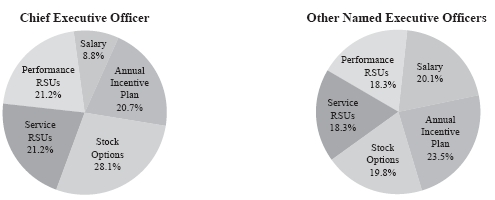
The Committee makes decisions for each element
of compensation in the context of the total compensation package to be awarded
to each NEO and the relationship of that element to other elements of
compensation. In light of the objectives described above to provide compensation
that is competitive and performance based, the Committee does not view aggregate
amounts earned or benefits accumulated by an executive from prior service with
the Company as a significant factor in making compensation decisions.
Total direct compensation (base salary, annual
incentive and long term incentive) is targeted to the 50th percentile of direct
compensation awarded to executives in similar positions in companies in the
primary peer group. In Fiscal 2010, total direct compensation for Mr. Laphen was
two percent above market median. For Messrs. Mancuso and Siekierka, total direct
compensation was 13 percent and 10 percent below market median, respectively.
For Messrs. Deckelman and Phillips, total direct compensation was five percent
and 14 percent above market median, respectively.
Both the criteria used and the decisions
reached for Fiscal 2010 for each component of compensation are described below.
1. Salary
Salary is determined by the Committee taking
into account the level of responsibility assumed by the executive, performance
in position during the previous fiscal year and competitive pay practices for
comparable positions in the marketplace. Base salaries are targeted at the
50th percentile of
salaries paid to executives in comparable positions at companies in the primary
peer group.
Generally, base salaries for the
NEOs were below or approximately at the market median in Fiscal 2010. Mr.
Laphen’s base salary was 10% below the market median, Mr. Mancuso’s base salary
was 15% below the market median, Mr. Deckelman’s base salary was 11% below the
market median and Mr. Siekierka’s base salary was 10% below the market median.
Mr. Phillip’s base salary was approximately at the market median, exceeding it
by 2%.
During Fiscal 2010, the Company, like a number
of the peer group companies, instituted a salary freeze for CSC employees
generally (with certain limited exceptions) as a result of the uncertainty
caused by the worldwide economic dislocation in Fiscal 2009. Notwithstanding the
significant gap between the base salaries of the NEOs, other than Mr. Phillips,
and the market median, the Committee, on management’s recommendation, determined
that in light of the salary freeze, no base salary adjustments would be made for
the NEOs in Fiscal 2010.
2. Annual Incentive Compensation
CSC’s annual incentive plan, the Annual
Management Incentive Plan (the “AMIP”), rewards executives only if financial
results achieved at the end of the year reach certain minimum threshold levels
relative to financial goals established at the outset of the fiscal year. Awards
earned under the AMIP are payable in cash.
The Committee: (i) sets the annual incentive
target percentage for each participant and approves the financial measures and
target performance levels for the AMIP at the outset of the fiscal year; and
(ii) approves the financial results and associated AMIP payout for each NEO
after the end of the fiscal year. The Fiscal 2010 AMIP award is subject to
adjustment by the Committee to omit the effects of extraordinary items, gain or
loss on the disposal of a business segment (other than provisions for operating
losses or income during the phase-out period), unusual or
26
infrequently
occurring events and transactions that have been publicly disclosed and the
cumulative effects of changes in accounting principles, all as determined in
accordance with generally accepted accounting principles. In addition, the
Committee retains the ability to adjust downward the amount of an award payable
under the AMIP.
Calculation of the AMIP payout for each
financial measure is determined using two graduated schedules. These schedules
provide reduced payouts for results that fall below target performance levels,
down to a threshold level. No payouts are earned for performance results below
the threshold level. Similarly, increased payouts are provided, up to a maximum,
if results exceed target performance levels. Threshold, on-target and maximum
payout percentages are indicated below.
| EARNINGS PER SHARE | ALL OTHER MEASURES | |||||||||||
| Achievement1 | Payout2 | Achievement1 | Payout2 | |||||||||
| Maximum | ≥108.5% | 150.0% | ≥120.0% | 150.0% | ||||||||
| On-Target | 100.0% | 100.0% | 100.0% | 100.0% | ||||||||
| Threshold | 87.5% | 50.0% | 75.0% | 50.0% | ||||||||
| Below Threshold | <87.5% | 0.0% | <75.0% | 0.0% | ||||||||
| 1. | Percentage of target performance level | |
| 2. | Percentage of target payout | |
Actual payouts are determined by extrapolating
between multiple achievement/payout points interspersed between the points
listed in the table above.
The table below sets forth the four financial
measures used in the Fiscal 2010 AMIP for the NEOs, as well as the purpose and
relative weight of each in determining AMIP compensation at fiscal year end.
These measures were the same as those adopted in Fiscal 2009 with the exception
of free cash flow, which replaced Days Sales Outstanding (DSO) as a performance
measure. The Committee decided to adopt free cash flow as a measure to emphasize
the importance of liquidity and profitability in light of economic conditions,
including the difficulties experienced in the global credit
markets.
| Financial | ||||||
| Measures | Description | Weight | Purpose | |||
| Revenue | Revenue targets require sustaining and growing current business as well as capturing new business. | 30% | Primary measure
of growth |
|||
| Operating Income (“OI”) |
OI targets incentivize executives to manage costs effectively while delivering service commitments. | 30% | Key component
of profitability |
|||
| Earnings
Per Share (“EPS”) |
EPS targets incentivize executives to look beyond their area of responsibility to realize opportunities for synergy and collaboration that support corporate goals. | 20% | Primary measure
of Company-wide performance |
|||
| Free Cash Flow (“FCF”) |
Free Cash Flow targets incentivize executives to increase liquidity and profitability | 20% | Key component of capital affecting ROI |
|||
Fiscal 2010 AMIP target performance levels
(goals) and performance results for each AMIP financial measure are presented in
the table below.
27
FISCAL YEAR 2010 AMIP GOALS AND PERFORMANCE RESULTS
| Goal | Performance | ||||||||||||||||||
| Weight | (millions, except | (millions, except | Achievement | Payout | |||||||||||||||
| Financial Measurement | % | per share data) | per share data) | % | % | ||||||||||||||
| Revenue1 | 30 | $ | 16,907 | $ | 16,096 | 95.20 | 90 | ||||||||||||
| Operating Income2 | 30 | $ | 1,418 | $ | 1,415 | 99.75 | 100 | ||||||||||||
| Earnings Per Share3 | 20 | $ | 4.25 | $ | 5.30 | 124.70 | 150 | ||||||||||||
| Free Cash Flow | 20 | $ | 600 | $ | 811 | 135.20 | 150 | ||||||||||||
| Total | 100 | Weighted Average Total | 117 | ||||||||||||||||
____________________
| 1. | Excludes revenue from acquisitions. | |
| 2. | Consists of income before corporate General and Administrative expense, minority interest expense, earnings from equity method investments, interest expense and income, goodwill impairment and other income expense. | |
| 3. | Consists of operating cash flow less investing cash flow. | |
Under the terms of the AMIP awards for Fiscal 2010,
100% achievement of the OI measure was necessary to achieve greater than
100% payout for the Revenue and Free Cash Flow measures. Actual OI
achievement was 99.75%. The Committee decided to exercise discretion to round
the OI achievement factor upward to recognize and reward superior performance
and positive strategic progress in the challenging economic environment
experienced in Fiscal 2010. Specifically, the Committee noted outstanding
performance in Earnings Per Share and Free Cash Flow (notwithstanding unbudgeted
pension plan contributions of $193 million), as well as significant achievements
consistent with the Company’s growth plan in new business awards and record new
bookings, 70% of which was attributable to new logos and services. In addition,
the Committee noted that performance aligned well with stockholder interests, in
that the Company’s stock price increased 38% year over year.
The following annual
incentive compensation awards for each NEO approved by the Compensation
Committee and by the independent directors of the Board for Mr. Laphen were
based on Fiscal 2010 performance results and the weighted average payout
percentage from the table above. Target awards are set based on the 50th
percentile relative to awards provided to executives having similar positions in
companies in the primary peer group. Amounts that would have been paid at target
are set forth in the table below. Actual amounts paid are also set forth below
and reflect the adjustment made by the Committee and described
above.
FISCAL YEAR 2010 ANNUAL INCENTIVE COMPENSATION
| TARGET | PAYOUT | |||||||||
| Percent | Percent | |||||||||
| (of Salary) | Amount | (of Salary) | Amount | |||||||
| Michael W. Laphen | 200% | $ | 2,100,000 | 234% | $ | 2,457,000 | ||||
| Michael J. Mancuso | 100% | $ | 585,000 | 117% | $ | 684,100 | ||||
| William L. Deckelman, Jr. | 100% | $ | 494,000 | 117% | $ | 577,700 | ||||
| Randy E. Phillips | 100% | $ | 416,000 | 117% | $ | 486,500 | ||||
| Nathan Siekierka | 100% | $ | 370,400 | 117% | $ | 433,100 | ||||
3. Long-Term Incentive Compensation
The long-term incentive component of CSC’s executive compensation program
is designed to balance short-term risk by rewarding executives for sustained
increases in stockholder value. In addition, the vesting feature of long-term
compensation creates a significant retention incentive for executives. Long-term
incentive awards are granted under our various equity incentive plans, which
have been approved by the Company’s stockholders, and in accordance with our
Equity Grant Policy. All awards are granted using a value-based methodology
consistent with CSC’s Equity Grant Policy.
The long-term incentive component of the
executive compensation program consists of stock option grants, service-vested
RSU grants and performance vested RSU (“Performance Shares”) grants as described
below.
- Stock option grants become exercisable or “vest” at the rate of one-third of the total grant on each of the first three anniversaries of the date of grant.
28
- Service-vested RSU grants vest 100% on the
third anniversary of the grant date and are payable in shares of CSC common stock.
- Performance Shares vest at the end of a three-year performance period. The number of shares which release at the end of the performance period range from zero to two times the target number of shares based on achievement of performance targets established at the outset of the performance period. Performance vested RSU grants are payable in shares of CSC common stock.
Fiscal 2010
Awards. The long-term
incentive component of executive compensation at CSC is designed to: (i) create
a reward opportunity directly linked to shareholder value through stock price
performance; (ii) focus executive attention on sustained performance over a
multi-year period; (iii) in the case of the Performance Shares, further leverage
the alignment with stockholders by increasing the number of shares delivered if
results exceed performance targets during the multi-year performance period and
(iv) provide retention value for the Company.
Long term incentive awards are targeted
at the 50th
percentile of awards provided to executives having similar positions in
companies in the primary peer group. For Fiscal 2010, long term incentives
awarded to Mr. Laphen were approximately at the market median, lagging it by two
percent. Long term incentives awarded to Mr. Mancuso and Mr. Siekierka were 14%
and 17% below the market median, respectively. Long term incentives awarded to
Mr. Deckelman and Mr. Phillips were 42% and 35% above the market median,
respectively.
Consistent with CSC’s pay-for-performance
philosophy, the Committee decided for the Fiscal 2010 awards to increase the “at
risk” portion of the long term incentive plan for all NEOs to the same levels
used in Fiscal 2009 for the CEO and CFO. Accordingly, the percentage of the plan
awarded as stock options was increased from 35% to 40% and the percentage
awarded as service vested RSUs was reduced from 35% to 30%. As a result the
aggregate value of long term incentive compensation was divided between the
three forms of pay with 40% of the aggregate value granted as stock options, 30%
as service-vested RSUs and 30% as performance vested RSUs.
Two performance measures were selected
for the Fiscal 2010 Performance Shares award: revenue and ROIC. Revenue was
chosen to focus executives on growing CSC’s share of the IT services market over
the long term. ROIC was chosen to encourage profitable and quality growth, with
ROIC being the more heavily weighted of the two factors. However, at the end of
Fiscal 2009 and as further described below, the Committee determined that due to
the global financial dislocation occurring during that fiscal year and the
resulting unfavorable and unpredictable market conditions affecting global
companies generally, including the Company and its customers, a revenue target
based on an absolute percentage increase was inappropriate and not necessarily indicative of CSC’s success in
increasing market share relative to its peers. Therefore, the revenue factor was
redesigned to correlate with market share performance more directly by
measuring CSC’s revenue performance relative to the revenue
performance of an index of companies2 that compete with CSC
in the commercial and public sector markets (the “Peer Index”). The number of
shares which vest ranges from zero if revenue underperforms the index by
3% and ROIC drops to 8.5% to two times the number of target shares if
revenue exceeds the index by 3% and ROIC reaches 11.5%. For a recipient to
receive a payout of the target number of shares awarded the Company would be
required to achieve 10% ROIC and a revenue performance over the term
of the award that exceeds by one percent the revenue performance of the
Peer Index.
One-Time Award. The same concerns
described above led the Committee to reevaluate the revenue target of three
years compound annual growth rate of 7% established for the Fiscal 2009 grant of
Performance Shares. Due to the global financial dislocation occurring during
that fiscal year and the resulting unfavorable and unpredictable market
conditions affecting global companies generally, including the Company and its
customers, the Committee concluded that this metric was unachievable. It was
clear to the Committee that no release of shares could
realistically
____________________
| 2 | The index consists of companies with which we compete for business in the public sector and in the commercial sector. The commercial sector companies are: Accenture Ltd., Automatic Data Processing, Inc., ATOS Origin, Cap Gemini, CGI Group, Inc., Cognizant Technology Solutions Corp., Convergys Corporation, Deutsche TeleKom-Systems Solutions, HP Services (EDS), IBM Global Services, Siemens – IT Solutions and Services, Syntel Inc, TCS, Unisys – Services and Wipro Ltd. The public sector companies are: Boeing - Global Services and Support, CACI International Inc., Dynamics Research Corp, General Dynamics Corp. – Information Systems and Technology, L-3 Communications Holdings Inc. – Government Services, Aircraft Modernization and Maintenance, Lockheed Martin – Information Systems & Global Services, ManTech International, MAXIMUS, Inc., NCI, Inc., Northrop Grumman – Information Systems, Technical Services, Raytheon – Intelligence and Information Systems, Technical Services, Network Centric Systems, SAIC, Inc., SRA International Inc, and Stanley, Inc. |
29
occur at the end of the three-year performance
period for this award. Therefore, in May 2009, the Committee determined to
cancel the 2009 award of Performance Shares and to replace the canceled grant
with a new Performance Share award having a two-year performance period
commencing in Fiscal 2010 (the “One-Time Award”). The Committee retained the
original metrics of revenue and ROIC. However, like the 2010 Performance Share
Award, the revenue factor was redesigned to measure CSC’s revenue
performance relative to the revenue performance of the Peer Index.
Similar to the 2010 Performance Shares award, under the One-Time Award, the
number of shares which vest range from zero if revenue underperforms the index
by 3% and ROIC drops to 8.5% to two times the number of target shares if
revenue exceeds the index by 3% and ROIC reaches 11.5%.
The Committee considered a number of
factors in its decision to cancel the Performance Award and issue the One-Time
Award. First, the Committee noted that the purpose of the original Performance
Share award was to motivate and retain executives, and that due to the extreme
distress in the global economy and factors out of the control of the Company or
management, the award was not realistically achievable, and therefore the award
had failed in its essential purpose. Second, the Committee considered that the
original award design did not reflect the best approach to measure market growth
and performance in the difficult market environment facing the Company at this
time. The use of the Peer Index to measure revenue was, in the Committee’s view,
a more appropriate way to drive and measure long-term market share growth in an
environment of market volatility and difficult market conditions. Third, the
Committee believed that the target levels of performance for the One-Time
Award while generally difficult to achieve are critically important to
achieve for the Company’s success and the likelihood of attaining these goals is
not assured. Fourth, the award is not retroactive, and performance during Fiscal
2009 is not taken into account for purposes of the One-Time Award. Instead, the
One-Time Award will permit executives to achieve roughly two-thirds of the value
of the canceled award if target performance is met.
No Performance Shares vested in
Fiscal 2010.
4. Post-Employment Compensation
The NEOs participate in one or more
of the three post-employment compensation plans described below.
- The broad-based Pension Plan is an ERISA qualified, voluntary and contributory career average defined benefit plan which offers post retirement income based on a combination of employee and company contributions. The Pension Plan was frozen for most participants, including the NEOs, effective July 10, 2009. No further accruals occurred after this date. Additional details regarding this plan can be found on page 41.
- The broad-based CSC Matched Asset Plan (“MAP”) is an ERISA qualified, voluntary and
defined contribution 401(k)
plan with company match on a portion of employee contributions and directed
investment alternatives. As a
result of the freezing of the Employee Pension Plan, the Company made a
discretionary contribution in Fiscal 2010 to the MAP for pension plan
participants who were at least age 50 on April 3, 2009.
- The unfunded CSC Deferred Compensation Plan, offered to approximately 1,200 executives each year, allows participants to defer receipt of annual incentive compensation and, in some cases, salary. Additional details regarding this plan can be found on page 42.
The NEOs are also able to
participate in one of the following nonqualified retirement
programs:
- The Supplemental Executive Retirement Plan (“SERP”) and the Excess Plan
are unfunded defined
benefit plans which the Board
closed to new participants as of October 28, 2007. Of the NEOs, only Mr.
Laphen and Mr. Siekierka are
participants in these plans. Additional details regarding the SERP and the
Excess Plan can be found on
page 41.
- Career RSU (“Career Shares”) grants for certain line and corporate executives who are not participants in the SERP and the Excess Plan, including Messrs. Mancuso, Deckelman and Phillips, each of whom received a Career Share grant in Fiscal Year 2010. The Committee determined to maintain the value of these Career Share grants at Fiscal 2009 levels, i.e., 25% of base salary and annual incentive compensation. Career Shares are RSUs which vest upon a recipient reaching age 65 or age 55 or older with 10 years of service, or as otherwise determined by the Compensation Committee. They are released as shares of CSC stock at the rate of 10% of the shares granted on each of the ten anniversaries of the retirement date.
30
5. Severance and Change in Control
Compensation
Except as provided in the following
paragraphs, CSC does not have a severance policy for either the wider population
of employees or its executives, including the NEOs.
A severance arrangement is included in Mr.
Laphen’s employment agreement. Additional details are provided on page 47.
This severance feature only applies to terminations absent a change in control;
these payments do not apply if Mr. Laphen becomes eligible for payments under
the Company’s Severance Plan for Senior Management and Key Employees (the
“Severance Plan”) in the event of a change in control.
CSC maintains the
Severance Plan for a select group of executives, including each of the NEOs,
that provides reasonable income and benefits continuity protection to the
executive for the limited case in which the employment of an NEO is terminated
without cause or for good reason during a specified window of time following the
change in control. The Severance Plan is intended to preserve executive
productivity and encourage retention in an actual or potential change in control
of the Company. We believe the importance of these benefits increases with the
position and level of responsibility of the executive.
Generally, no benefit is
paid under the Severance Plan unless an executive’s employment is terminated
without cause or for good reason during a specified period following a change of
control. The payments and benefits under the Severance Plan and the incremental
increase in payments and benefits from other plans that accelerate upon a change
in control, such as RSU and stock option grants and SERP and the Excess Plan,
potentially subject executives to an excise tax on excess parachute payments
under the Internal Revenue Code. The Plan contains an excise tax “gross up”
feature, which was eliminated for persons who became participants in the Plan in
Fiscal 2009 and who become participants thereafter. Of the NEOs, only Mr.
Laphen, and Mr. Siekierka, are entitled to an excise tax “gross up” under the
Plan, since they were participants prior to Fiscal 2009. Additional details
regarding the Severance Plan can be found on page 44.
Equity Ownership Guidelines
The Committee has adopted equity ownership
guidelines for senior level executives, including the NEOs. Under the
guidelines, equity ownership to be achieved over a five-year period is as
follows: CEO, 700% of salary; CFO, 250% of salary, and corporate vice president,
200% of salary. RSUs, shares held in the MAP, Career Shares and Performance
Shares, as well as directly held shares, are taken into account for purposes of
determining whether guidelines have been met. The Committee reviews compliance
with the guidelines on an annual basis. All NEOs are currently in compliance
with the ownership guidelines.
Tax Deductibility of
Compensation
Section 162(m) of the Internal Revenue Code
generally limits the annual tax deduction to $1 million per person for
compensation paid to the Company’s CEO and certain other highly compensated
executive officers. Qualifying “performance based compensation” is not subject
to this limit. The Company’s incentive plans
permit the Compensation Committee to design awards to the NEOs that meet
the requirements of Section 162(m).
The Committee, in granting awards, considers
the impact of the Section 162(m) deduction limitation. However, as noted
above, compensation decisions are made, among other things, to ensure market
competitiveness and to reward outstanding performance. Sometimes this results in
compensation amounts being non-deductible under Section 162(m). For example,
since the CEO’s salary is above the $1,000,000 threshold, a portion of his
salary and his perquisites is not deductible by the Company. In addition,
the adjustment described above to the AMIP approved by the Committee made a
portion of the award to the CEO and the General Counsel non-deductible under
Section 162(m). The effect of the loss of such deduction was not
significant.
Perquisites
The NEOs participate in benefit plans that are
available to all employees generally, including life insurance, medical and
dental plans and short and long term disability plans. In addition, CSC provides
a limited number of perquisites to senior executives, including the NEOs. The
NEOs are eligible to receive reimbursement for financial counseling. Tax
gross-ups on financial counseling services have been eliminated effective Fiscal
2011. The NEOs also participate in an automobile program, which has been offered
to other members of senior management and which is being phased out over the
next two years. Members of senior management, including the NEOs, are also
31
entitled to relocation benefits. The CEO may use Company owned
or leased aircraft for personal purposes in his own discretion and, at times, is
advised to use such aircraft for personal travel for security reasons. The CEO
is taxed on the value of this usage according to IRS rules. No tax gross-up is
provided for personal usage of corporate aircraft. Security services are also
provided to the CEO. See notes to the Summary Compensation Table.
We believe the perquisites provided
to the NEOs are reasonable and competitive.
Compensation Recoupment
Policy
In Fiscal 2010, the Board
adopted a compensation recoupment or “clawback” policy that permits the Company
to recover performance based compensation from executive officers (including the
NEOs) whose fraud or intentional illegal conduct materially contributed to a
financial restatement. The policy allows for the recovery of the after tax
portion of the difference between compensation awarded or paid to the executive
and the amount which would have been paid had it been calculated based on the
restated financial statements. Claw back provisions are also contained in the
Company’s equity grant agreements, which provide for forfeiture of awards or
gains if a recipient breaches the non competition or non solicitation of
employee provisions of such agreements.
Summary Compensation Table
The following table provides information on
the compensation of the Named Executive Officers in the Fiscal Years ended April
2, 2010, April 3, 2009 and March 28, 2008.
| Change in | ||||||||||||||||||||||
| Pension | ||||||||||||||||||||||
| Value and | ||||||||||||||||||||||
| Nonqualified | ||||||||||||||||||||||
| Non-Equity | Deferred | |||||||||||||||||||||
| Stock | Option | Incentive Plan | Compensation | All Other | ||||||||||||||||||
| Fiscal | Salary2 | Awards3 | Awards4 | Compensation5 | Earnings6 | Compensation7 | Total | |||||||||||||||
| Name & Principal Position1 | Year | ($) | ($) | ($) | ($) | ($) | ($) | ($) | ||||||||||||||
| (a) | (b) | (c) | (d) | (e) | (f) | (g) | (h) | (i) | ||||||||||||||
| Michael W. Laphen | 2010 | 1,050,000 | 5,039,322 | 3,342,614 | 2,457,000 | 3,462,606 | 175,801 | 15,527,343 | ||||||||||||||
| Chairman, President | 2009 | 1,057,692 | 4,036,127 | 2,181,654 | 2,142,400 | — | 150,438 | 9,568,311 | ||||||||||||||
| and Chief Executive | 2008 | 962,348 | 2,510,480 | 5,153,008 | 1,966,100 | 2,506,412 | 160,461 | 13,258,809 | ||||||||||||||
| Officer | ||||||||||||||||||||||
| Michael J. Mancuso | 2010 | 585,000 | 1,117,359 | 665,113 | 684,100 | — | 26,352 | 3,077,924 | ||||||||||||||
| Vice President and | 2009 | 202,500 | 963,861 | 523,404 | 198,900 | — | 4,863 | 1,893,528 | ||||||||||||||
| Chief Financial Officer | ||||||||||||||||||||||
| William L. Deckelman, Jr. | 2010 | 494,000 | 963,832 | 449,320 | 577,700 | 29,228 | 48,512 | 2,562,592 | ||||||||||||||
| Vice President, General | 2009 | 498,750 | 662,809 | 399,160 | 504,000 | 29,437 | 528,358 | 2,622,514 | ||||||||||||||
| Counsel & Secretary | ||||||||||||||||||||||
| Randy E. Phillips | 2010 | 416,000 | 811,695 | 378,368 | 486,500 | 28,886 | 211,730 | 2,333,179 | ||||||||||||||
| Vice President, | 2009 | 420,000 | 589,315 | 336,146 | 424,400 | 25,932 | 850,257 | 2,646,050 | ||||||||||||||
| Corporate Development | ||||||||||||||||||||||
| Nathan Siekierka | 2010 | 370,400 | 507,882 | 336,904 | 433,100 | 1,355,343 | 64,959 | 3,068,588 | ||||||||||||||
| Vice President, | 2009 | 370,673 | 459,670 | 299,293 | 377,900 | 262,230 | 128,366 | 1,898,132 | ||||||||||||||
| Human Resources | ||||||||||||||||||||||
| 1. | Mr. Laphen was elected Chief Executive Officer effective May 22, 2007, and was elected Chairman effective as of the close of the Annual Meeting on July 30, 2007. He served as President throughout Fiscal Years 2008, 2009 and 2010, and continues to serve in all three roles. | |
| Mr. Mancuso was elected Vice President and Chief Financial Officer effective December 1, 2008. | ||
| 2. | The amounts shown in Column (c) reflect all salary earned during the fiscal year, whether or not payment was deferred pursuant to the Deferred Compensation Plan. | |
32
| 3. | The amounts shown in Column (d) reflect the aggregate grant date fair value computed in accordance with FASB ASC Topic 718 for restricted stock and RSUs granted during the fiscal year. |
| Pursuant to SEC rules, the amounts shown exclude the impact of estimated forfeitures. For a discussion of the assumptions made in the valuation of restricted stock and RSUs, reference is made to the section of Note 1 of the Company’s 2010 Annual Report filed on Form 10-K providing details of the Company’s accounting under FASB ASC Topic 718. None of the Named Executive Officers forfeited shares of restricted stock or RSUs during Fiscal Year 2010. | ||
| A portion of the stock awards granted during Fiscal Year 2010 and Fiscal Year 2009 consisted of performance vested RSU grants. The amounts shown in Column (d) for Fiscal Year 2009 include the One-Time Award granted in Fiscal Year 2010 which replaced the 2009 awards of Performance Shares canceled in May 2009. For all Performance Shares, the amounts in Column (d) reflect the value at the grant date based upon the probable outcome of their respective performance conditions. See “Compensation Discussion and Analysis – Elements of Compensation – 3. Long-Term Incentive Compensation – Fiscal 2010 Awards” and “Compensation Discussion and Analysis – Elements of Compensation – 3. Long-Term Incentive Compensation – One-Time Award.” The maximum grant date value of 2010 stock awards is as follows: | ||
| 2010 Stock Awards | |||||
| Name | at Maximum Value | ||||
| Michael W. Laphen | $ | 7,558,983 | |||
| Michael J. Mancuso | $ | 1,618,713 | |||
| William L. Deckelman, Jr. | $ | 1,302,519 | |||
| Randy E. Phillips | $ | 1,096,932 | |||
| Nathan Siekierka | $ | 761,823 | |||
| 4. | The amounts shown in Column (e) reflect the aggregate grant date fair value computed in accordance with FASB ASC Topic 718 for stock options granted during the fiscal year. The amount shown for Mr. Laphen for Fiscal Year 2008 includes stock options granted upon his promotion to CEO and which vest at the rate of one-sixth of the total grant on each of the first six anniversaries of the date of grant. | |
| Pursuant to SEC rules, the amounts shown exclude the impact of estimated forfeitures. For a discussion of the assumptions made in the valuation of stock options, reference is made to the section of Note 1 of the Company’s 2010 Annual Report filed on Form 10-K providing details of the Company’s accounting under FASB ASC Topic 718. None of the Named Executive Officers forfeited stock options during Fiscal Year 2010. | ||
| 5. | The amounts shown in Column (f) reflect all amounts earned during the fiscal year under the AMIP, whether or not payment was deferred pursuant to the Deferred Compensation Plan. | |
| 6. | The amounts shown in Column (g) for Fiscal Year 2010 reflect the sum of (i) the aggregate annual change in the actuarial present value of the Named Executive Officer’s accumulated benefit under the Pension Plan, SERP and the Excess Plan plus (ii) the Named Executive Officer’s above market or preferential earnings during the fiscal year under the Deferred Compensation Plan, as follows: | |
| Annual Increase in | Annual Increase in | Annual Increase in | Preferential Earnings | |||||||||||||||||||||
| Accumulated Benefit | Accumulated Benefit | Accumulated Benefit | Under Deferred | |||||||||||||||||||||
| Under Pension Plan | Under SERP | Under Excess Plan | Compensation Plan | |||||||||||||||||||||
| Name | at April 2, 2010 | at April 2, 2010 | at April 2, 2010 | During Fiscal Year 2010 | Total | |||||||||||||||||||
| Michael W. Laphen | $ | 266,837 | $ | 3,014,240 | $ | 181,529 | — | $ | 3,462,606 | |||||||||||||||
| Michael J. Mancuso | — | — | — | — | — | |||||||||||||||||||
| William L. Deckelman, Jr. | $ | 28,161 | — | — | $ 1,067 | $ | 29,228 | |||||||||||||||||
| Randy E. Phillips | $ | 28,886 | — | — | — | $ | 28,886 | |||||||||||||||||
| Nathan Siekierka | $ | 165,939 | $ | 1,154,079 | $ | 11,756 | $23,569 | $ | 1,355,343 | |||||||||||||||
| 7. | The Company provided the following perquisites and other personal benefits, or property, to all NEOs, except as otherwise indicated: personal use of Company aircraft (Mancuso and Laphen), financial planning assistance, relocation (Deckelman, Phillips and Siekierka), tax reimbursement on financial planning assistance and tax |
33
reimbursement on
relocation (Deckelman, Phillips and Siekierka), security (Laphen), pay in lieu
of excess accrued vacation, and automobile. In addition, the Company provides to
the Named Executive Officers, matching contributions to the Company’s defined
contribution plan and premiums for life insurance policies for the benefit of
the Named Executive Officers, none of whom has, or will receive or has been
allocated, an interest in any cash surrender value under these policies. Column
(h) includes the total dollar amount of all other compensation, perquisites and
other property paid to the Named Executive Officers. The incremental cost of
each perquisite representing more than 10% of the value of all of an executive’s
perquisites or, if greater, more than $25,000 and the amount of any payments for
tax reimbursements, matching contributions to the defined contribution plan and
life insurance premiums paid for each Named Executive Officer in Fiscal Year
2010 are set forth below.
Amounts paid in
Fiscal Year 2010, valued on the basis of the aggregate incremental cost to the
Company and included in Column (h), include the following for each of the Named
Executive Officers.
Mr. Laphen: automobile, $27,316; personal use of aircraft, $106,981; tax
reimbursement for financial planning assistance, $5,825; matching contribution
to the defined contribution plan, $6,231; discretionary company contribution to
the defined contribution plan, $7,350; and life insurance premiums, $2,400. The
incremental cost of Mr. Laphen’s use of Company aircraft is based on the
variable costs to the Company, including fuel costs, on-board catering,
landing/ramp fees and other miscellaneous variable costs. This calculation does
not include fixed costs which do not change based on usage, such as
depreciation, leasing costs, and flight crew salaries.
Mr. Mancuso: tax reimbursement for financial planning assistance, $1,540;
matching contribution to the defined contribution plan,
$3,788; discretionary company contribution to the defined contribution
plan, $0; and life insurance premiums, $1,404.
Mr. Deckelman: tax reimbursements for financial planning assistance,
$4,700; tax reimbursement on relocation, $1,187; matching contribution to the
defined contribution plan, $3,975; discretionary company contribution to the
defined contribution plan, $7,350; and life insurance premiums, $1,186.
Mr. Phillips: tax reimbursements for financial planning assistance,
$5,825; relocation, $103,429; tax reimbursement on relocation $56,000; matching
contribution to the defined contribution plan, $4,800; discretionary company
contribution to the defined contribution plan, $7,350; and life insurance
premiums $998.
Mr. Siekierka: tax reimbursements for financial planning assistance,
$5,825, tax reimbursement for relocation, $202; matching contribution to the
defined contribution plan, $4,973; discretionary company contribution to
the defined contribution plan, $7,350; and life insurance premiums,
$890.
34
Grants of Plan-Based Awards
The following table provides information on
AMIP awards, RSUs and stock options granted to the Named Executive Officers in
the Fiscal Year ended April 2, 2010.
| All Other | All Other | |||||||||||||||||||||||||||||||||||
| Stock | Option | Grant | ||||||||||||||||||||||||||||||||||
| Awards; | Awards; | Exercise | Date Fair | |||||||||||||||||||||||||||||||||
| Number of | Number of | or Base | Value of | |||||||||||||||||||||||||||||||||
| Estimated Future Payouts Under | Estimated Future Payouts Under | Shares of | Securities | Price of | Stock and | |||||||||||||||||||||||||||||||
| Non-Equity Incentive Plan Awards1 | Equity Incentive Plan Awards2,3 | Stock or | Underlying | Option | Option | |||||||||||||||||||||||||||||||
| Grant | Approval | Threshold | Target | Maximum | Threshold | Target | Maximum | Units4 | Options | Awards | Awards2 | |||||||||||||||||||||||||
| Name | Date | Date | ($) | ($) | ($) | (#) | (#) | (#) | (#) | (#) | ($/Sh) | ($) | ||||||||||||||||||||||||
| (a) | (b) | (c) | (d) | (e) | (f) | (g) | (h) | (i) | (j) | (k) | (l) | (m) | ||||||||||||||||||||||||
| Michael W. Laphen | ||||||||||||||||||||||||||||||||||||
| AMIP | 1,050,000 | 2,100,000 | 3,150,000 | |||||||||||||||||||||||||||||||||
| RSUs – Service | 5/26/2009 | 5/20/2009 | 59,821 | 2,519,661 | ||||||||||||||||||||||||||||||||
| RSUs – 2-year | ||||||||||||||||||||||||||||||||||||
| Performance | 5/26/2009 | 5/20/2009 | 4,558 | 45,578 | 91,156 | 1,919,745 | ||||||||||||||||||||||||||||||
| RSUs – 3-year | ||||||||||||||||||||||||||||||||||||
| Performance | 5/26/2009 | 5/20/2009 | 5,982 | 59,821 | 119,642 | 2,519,661 | ||||||||||||||||||||||||||||||
| Stock Option | 5/26/2009 | 5/20/2009 | 195,653 | 42.12 | 3,342,614 | |||||||||||||||||||||||||||||||
| Michael J. Mancuso | ||||||||||||||||||||||||||||||||||||
| AMIP | 292,500 | 585,000 | 877,500 | |||||||||||||||||||||||||||||||||
| RSUs – Service | 5/26/2009 | 5/19/2009 | 11,903 | 501,354 | ||||||||||||||||||||||||||||||||
| RSUs – 2-year | ||||||||||||||||||||||||||||||||||||
| Performance | 5/26/2009 | 5/19/2009 | 1,058 | 10,581 | 21,162 | 445,672 | ||||||||||||||||||||||||||||||
| RSUs – 3-year | ||||||||||||||||||||||||||||||||||||
| Performance | 5/26/2009 | 5/19/2009 | 1,190 | 11,903 | 23,806 | 501,354 | ||||||||||||||||||||||||||||||
| RSUs - Career Shares | 5/26/2009 | 5/19/2009 | 2,722 | 114,651 | ||||||||||||||||||||||||||||||||
| Stock Option | 5/26/2009 | 5/19/2009 | 38,931 | 42.12 | 665,113 | |||||||||||||||||||||||||||||||
| William L. | ||||||||||||||||||||||||||||||||||||
| Deckelman, Jr. | ||||||||||||||||||||||||||||||||||||
| AMIP | 247,000 | 494,000 | 741,000 | |||||||||||||||||||||||||||||||||
| RSUs – Service | 5/26/2009 | 5/19/2009 | 8,041 | 338,687 | ||||||||||||||||||||||||||||||||
| RSUs – 2-year | ||||||||||||||||||||||||||||||||||||
| Performance | 5/26/2009 | 5/19/2009 | 536 | 5,361 | 10,722 | 225,805 | ||||||||||||||||||||||||||||||
| RSUs – 3-year | ||||||||||||||||||||||||||||||||||||
| Performance | 5/26/2009 | 5/19/2009 | 804 | 8,041 | 16,082 | 338,687 | ||||||||||||||||||||||||||||||
| RSUs - Career Shares | 5/26/2009 | 5/19/2009 | 6,801 | 286,458 | ||||||||||||||||||||||||||||||||
| Stock Option | 5/26/2009 | 5/19/2009 | 26,300 | 42.12 | 449,320 | |||||||||||||||||||||||||||||||
| Randy E. Phillips | ||||||||||||||||||||||||||||||||||||
| AMIP | 208,000 | 416,000 | 624,000 | |||||||||||||||||||||||||||||||||
| RSUs – Service | 5/26/2009 | 5/19/2009 | 6,772 | 285,237 | ||||||||||||||||||||||||||||||||
| RSUs – 2-year | ||||||||||||||||||||||||||||||||||||
| Performance | 5/26/2009 | 5/19/2009 | 451 | 4,514 | 9,028 | 190,130 | ||||||||||||||||||||||||||||||
| RSUs – 3-year | ||||||||||||||||||||||||||||||||||||
| Performance | 5/26/2009 | 5/19/2009 | 677 | 6,772 | 13,544 | 285,237 | ||||||||||||||||||||||||||||||
| RSUs - Career Shares | 5/26/2009 | 5/19/2009 | 5,727 | 241,221 | ||||||||||||||||||||||||||||||||
| Stock Option | 5/26/2009 | 5/19/2009 | 22,147 | 42.12 | 378,368 | |||||||||||||||||||||||||||||||
| Nathan Siekierka | ||||||||||||||||||||||||||||||||||||
| AMIP | 185,200 | 370,400 | 555,600 | |||||||||||||||||||||||||||||||||
| RSUs – Service | 5/26/2009 | 5/19/2009 | 6,029 | 253,941 | ||||||||||||||||||||||||||||||||
| RSUs – 2-year | ||||||||||||||||||||||||||||||||||||
| Performance | 5/26/2009 | 5/19/2009 | 402 | 4,020 | 8,040 | 169,322 | ||||||||||||||||||||||||||||||
| RSUs – 3-year | ||||||||||||||||||||||||||||||||||||
| Performance | 5/26/2009 | 5/19/2009 | 603 | 6,029 | 12,058 | 253,941 | ||||||||||||||||||||||||||||||
| Stock Option | 5/26/2009 | 5/19/2009 | 19,720 | 42.12 | 336,904 | |||||||||||||||||||||||||||||||
35
| 1. | The amounts shown in Columns (d), (e) and (f) reflect the threshold, target and maximum amounts which would be earned under the AMIP for Fiscal 2010. Actual amounts earned for Fiscal 2010 are set forth in column (f) of the Summary Compensation Table. | |
| 2. | RSUs-2-year Performance granted in Fiscal Year 2010 replace RSUs-3-year Performance granted in Fiscal Year 2009 which were cancelled in May 2009. See “Compensation Discussion and Analysis - Elements of Compensation - 3. Long-Term Incentive Compensation - One-Time Award.” | |
| 3. |
The number of shares which vest ranges from zero if
revenue underperforms the Peer Index by 3% and ROIC drops to 8.5% to two
times the number of target shares if revenue exceeds the Peer Index by 3%
and ROIC reaches 11.5%. The threshold number contained in Column (g)
represents achievement of 10% of target, but the actual payment could
range down to zero.
|
|
| 4. | Career Share RSUs vest upon reaching age 65, or age 55 or older with 10 years of service, or as otherwise determined by the Compensation Committee. They are released as shares of CSC stock at the rate of 10% of the shares granted on each of the first ten anniversaries of the retirement date. | |
36
Outstanding Equity Awards at Fiscal Year-End
The following table provides
information on unexercised stock options, and unvested RSUs and restricted stock
held by the Named Executive Officers on April 2, 2010. Shaded awards represent
stock options, RSUs and restricted stock granted as all or part of an AMIP
award. The practice of granting equity as all or part of an AMIP award was
discontinued after payment of the Fiscal Year 2006 AMIP award.
| Option Awards | Stock Awards | |||||||||||||||||||||||
| Equity | ||||||||||||||||||||||||
| Equity | Incentive | |||||||||||||||||||||||
| Incentive | Plan Awards: | |||||||||||||||||||||||
| Plan Awards: | Market or | |||||||||||||||||||||||
| Number of | Payout Value | |||||||||||||||||||||||
| Number of | Number of | Number of | Unearned | of Unearned | ||||||||||||||||||||
| Securities | Securities | Shares or | Market Value | Shares, Units | Shares, Units | |||||||||||||||||||
| Underlying | Underlying | Units of | of Shares or | or Other | or Other | |||||||||||||||||||
| Unexercised | Unexercised | Option | Stock | Units of Stock | Rights That | Rights That | ||||||||||||||||||
| Options | Options | Exercise | Option | That Have | That Have | Have Not | Have Not | |||||||||||||||||
| (#) | (#) | Price | Expiration | Not Vested | Not Vested | Vested | Vested | |||||||||||||||||
| Name | Exercisable | Unexercisable | ($) | Date | (#) | ($) | (#) | ($) | ||||||||||||||||
| (a) | (b) | (c) | (d) | (e) | (f) | (g) | (h) | (i) | ||||||||||||||||
| Michael W. Laphen | 195,653 | 1 | 42.12 | 5/26/2019 | ||||||||||||||||||||
| 39,861 | 79,721 | 2 | 48.61 | 5/27/2018 | ||||||||||||||||||||
| 83,334 | 41,666 | 3 | 55.23 | 6/18/2017 | ||||||||||||||||||||
| 100,000 | 4 | 55.15 | 6/15/2017 | |||||||||||||||||||||
| 70,000 | 55.35 | 5/22/2016 | ||||||||||||||||||||||
| 60,000 | 44.30 | 5/23/2015 | ||||||||||||||||||||||
| 50,000 | 39.04 | 5/12/2014 | ||||||||||||||||||||||
| 50,000 | 32.41 | 4/01/2013 | ||||||||||||||||||||||
| 35,000 | 46.90 | 6/30/2010 | ||||||||||||||||||||||
| 15,000 | 46.90 | 5/03/2010 | ||||||||||||||||||||||
| 2,031 | 8.29 | 5/05/2013 | ||||||||||||||||||||||
| 59,821 | 5 | 3,245,289 | ||||||||||||||||||||||
| 59,821 | 6 | 3,245,289 | ||||||||||||||||||||||
| 45,578 | 7 | 2,472,607 | ||||||||||||||||||||||
| 43,538 | 8 | 2,361,937 | ||||||||||||||||||||||
| 45,455 | 9 | 2,465,934 | ||||||||||||||||||||||
| 16,970 | 10 | 920,622 | ||||||||||||||||||||||
| 7,273 | 11 | 394,560 | ||||||||||||||||||||||
| Michael J. Mancuso | 38,931 | 1 | 42.12 | 5/26/2019 | ||||||||||||||||||||
| 10,697 | 21,394 | 12 | 36.66 | 1/15/2019 | ||||||||||||||||||||
| 11,903 | 5 | 645,738 | ||||||||||||||||||||||
| 11,903 | 6 | 645,738 | ||||||||||||||||||||||
| 10,581 | 7 | 574,019 | ||||||||||||||||||||||
| 14,135 | 13 | 766,824 | ||||||||||||||||||||||
| William L. Deckelman, Jr. | 26,300 | 1 | 42.12 | 5/26/2019 | ||||||||||||||||||||
| 7,293 | 14,586 | 2 | 48.61 | 5/27/2018 | ||||||||||||||||||||
| 8,333 | 14 | 44.91 | 2/15/2018 | |||||||||||||||||||||
| 6,801 | 15 | 368,954 | ||||||||||||||||||||||
| 8,041 | 5 | 436,224 | ||||||||||||||||||||||
| 8,041 | 6 | 436,224 | ||||||||||||||||||||||
| 5,361 | 7 | 290,834 | ||||||||||||||||||||||
| 1,024 | 15 | 55,552 | ||||||||||||||||||||||
| 7,966 | 8 | 432,156 | ||||||||||||||||||||||
| 11,133 | 16 | 603,966 | ||||||||||||||||||||||
37
| Option Awards | Stock Awards | |||||||||||||||||||||||
| Equity | ||||||||||||||||||||||||
| Equity | Incentive | |||||||||||||||||||||||
| Incentive | Plan Awards: | |||||||||||||||||||||||
| Plan Awards: | Market or | |||||||||||||||||||||||
| Number of | Payout Value | |||||||||||||||||||||||
| Number of | Number of | Number of | Unearned | of Unearned | ||||||||||||||||||||
| Securities | Securities | Shares or | Market Value | Shares, Units | Shares, Units | |||||||||||||||||||
| Underlying | Underlying | Units of | of Shares or | or Other | or Other | |||||||||||||||||||
| Unexercised | Unexercised | Option | Stock | Units of Stock | Rights That | Rights That | ||||||||||||||||||
| Options | Options | Exercise | Option | That Have | That Have | Have Not | Have Not | |||||||||||||||||
| (#) | (#) | Price | Expiration | Not Vested | Not Vested | Vested | Vested | |||||||||||||||||
| Name | Exercisable | Unexercisable | ($) | Date | (#) | ($) | (#) | ($) | ||||||||||||||||
| (a) | (b) | (c) | (d) | (e) | (f) | (g) | (h) | (i) | ||||||||||||||||
| Randy E. Phillips | 22,147 | 1 | 42.12 | 5/26/2019 | ||||||||||||||||||||
| 6,142 | 12,283 | 2 | 48.61 | 5/27/2018 | ||||||||||||||||||||
| 16,667 | 8,333 | 17 | 39.11 | 1/15/2018 | ||||||||||||||||||||
| 5,727 | 18 | 310,690 | ||||||||||||||||||||||
| 6,772 | 5 | 367,381 | ||||||||||||||||||||||
| 6,772 | 6 | 367,381 | ||||||||||||||||||||||
| 4,514 | 7 | 244,885 | ||||||||||||||||||||||
| 1,504 | 18 | 81,592 | ||||||||||||||||||||||
| 6,708 | 8 | 363,909 | ||||||||||||||||||||||
| 12,784 | 19 | 693,531 | ||||||||||||||||||||||
| Nathan Siekierka | 19,720 | 1 | 42.12 | 5/26/2019 | ||||||||||||||||||||
| 5,469 | 10,936 | 2 | 48.61 | 5/27/2018 | ||||||||||||||||||||
| 8,334 | 4,166 | 3 | 55.23 | 6/18/2017 | ||||||||||||||||||||
| 10,000 | 55.35 | 5/22/2016 | ||||||||||||||||||||||
| 5,175 | 44.30 | 5/23/2015 | ||||||||||||||||||||||
| 5,175 | 39.04 | 5/12/2014 | ||||||||||||||||||||||
| 834 | 33.16 | 5/05/2013 | ||||||||||||||||||||||
| 1,666 | 38.51 | 5/05/2013 | ||||||||||||||||||||||
| 833 | 34.74 | 11/11/2012 | ||||||||||||||||||||||
| 1,667 | 29.35 | 11/11/2012 | ||||||||||||||||||||||
| 5,000 | 45.61 | 6/13/2012 | ||||||||||||||||||||||
| 9,000 | 34.90 | 4/25/2011 | ||||||||||||||||||||||
| 6,029 | 5 | 327,073 | ||||||||||||||||||||||
| 6,029 | 6 | 327,073 | ||||||||||||||||||||||
| 4,020 | 7 | 218,085 | ||||||||||||||||||||||
| 5,973 | 8 | 324,035 | ||||||||||||||||||||||
| 4,546 | 9 | 246,621 | ||||||||||||||||||||||
| 2,424 | 10 | 131,502 | ||||||||||||||||||||||
| 3,659 | 20 | 198,501 | ||||||||||||||||||||||
| 1. | One-third of this amount vests on each of May 26, 2010, May 26, 2011 and May 26, 2012. | |
| 2. | One-half of this amount vests on each of May 27, 2010 and May 27, 2011. | |
| 3. | All of this amount vested on June 18, 2010. | |
| 4. | One-third of this amount vests on each of June 15, 2011, June 15, 2012 and June 15, 2013. | |
| 5. | All of this amount vests on May 26, 2012. | |
| 6. | All of this amount vests on March 30, 2012. | |
| 7. | All of this amount vests on April 1, 2011. | |
38
| 8. | All of this amount vests on May 27, 2011. | |
| 9. | One-third of this amount vests on each of June 18, 2010, June 18, 2011 and June 18, 2012. | |
| 10. | One-half of this amount vests on each of May 22, 2010 and May 22, 2011. | |
| 11. | All of this amount vested on May 23, 2010. | |
| 12. | One-half of this amount vests on each of January 15, 2011 and January 15, 2012. | |
| 13. | All of this amount vests on January 15, 2012. | |
| 14. | All of this amount vests on February 15, 2011. | |
| 15. | All of this amount vests on January 14, 2018. | |
| 16. | One-third of this amount vests on each of February 15, 2011, February 15, 2012 and February 15, 2013. | |
| 17. | All of this amount vests on January 15, 2011. | |
| 18. | All of this amount vests on December 3, 2017. | |
| 19. | One-third of this amount vests on each of January 15, 2011, January 15, 2012 and January 15, 2013. | |
| 20. | All of this amount vests on September 19, 2010. | |
Option Exercises and Stock Vested
The following table provides information on
stock options held by the Named Executive Officers that were exercised and RSUs
and restricted stock held by the Named Executive Officers that vested, during
the Fiscal Year ended April 2, 2010.
| Option Awards | Stock Awards | |||||||||||||||
| Number of | Number of | |||||||||||||||
| Shares Acquired | Value Realized | Shares Acquired | Value Realized | |||||||||||||
| on Exercise | on Exercise | on Vesting | on Vesting | |||||||||||||
| Name | (#) | ($) | (#) | ($) | ||||||||||||
| (a) | (b) | (c) | (d) | (e) | ||||||||||||
| Michael W. Laphen | 106,265 | 1,320,353 | 36,366 | 1,419,690 | ||||||||||||
| Michael J. Mancuso | — | — | — | — | ||||||||||||
| William L. Deckelman, Jr. | 16,667 | 168,356 | — | — | ||||||||||||
| Randy E. Phillips | — | — | — | — | ||||||||||||
| Nathan Siekierka | 5,000 | 43,176 | 6,654 | 310,813 | ||||||||||||
The table above includes RSUs granted as all
or part of an AMIP award in prior fiscal years. The practice of granting equity
as all or part of an AMIP award was discontinued after payment of the Fiscal
Year 2006 AMIP award.
39
Pension Benefits
In addition to a tax-qualified Pension Plan,
the Company has a supplemental executive retirement plan and an excess benefit
plan feature (the “SERP” and the “Excess Plan”, respectively). Messrs. Mancuso,
Deckelman and Phillips do not participate in the SERP and the Excess
Plan.
The following table provides information on
the actuarial value of each Named Executive Officer’s accumulated benefit under
the Pension Plan, the SERP and the Excess Plan as of April 2, 2010, as
applicable, determined using the assumptions set forth in Note 10 of the
Company’s 2010 Annual Report filed on Form 10-K.
| Number of Years | Present Value of | Payments During | ||||||||||||
| Credited Service1 | Accumulated Benefit | Last Fiscal Year | ||||||||||||
| Name | Plan Name | (#) | ($) | ($) | ||||||||||
| (a) | (b) | (c) | (d) | (e) | ||||||||||
| Michael W. Laphen | Pension Plan | 20 | 1,048,134 | — | ||||||||||
| SERP | 33 | 8,679,417 | — | |||||||||||
| Excess Plan | 11 | 491,849 | — | |||||||||||
| Michael J. Mancuso | Pension Plan | NA | NA | NA | ||||||||||
| SERP | NA | NA | NA | |||||||||||
| Excess Plan | NA | NA | NA | |||||||||||
| William L. Deckelman, Jr. | Pension Plan | 2 | 57,597 | — | ||||||||||
| SERP | NA | NA | NA | |||||||||||
| Excess Plan | NA | NA | NA | |||||||||||
| Randy E. Phillips | Pension Plan | 2 | 56,261 | — | ||||||||||
| SERP | NA | NA | NA | |||||||||||
| Excess Plan | NA | NA | NA | |||||||||||
| Nathan Siekierka | Pension Plan | 17 | 627,702 | — | ||||||||||
| SERP | 36 | 3,155,179 | — | |||||||||||
| Excess Plan | 4 | 47,116 | — | |||||||||||
| 1. | The Number of Years Credited Service for each of the Named Executive Officers under the plans does not exceed such officer’s total years of service with the Company and its affiliates. The Number of Years Credited Service has the following meanings for the different plans above. For the Pension Plan, the Number of Years Credited Service means all years of service except for years for which any required employee contributions were not made. For the SERP, the Number of Years of Credited Service means all years of service with the Company and with any affiliates. For the Excess Plan, the Number of Years of Credited Service means the number of years since the executive’s entry into a predecessor supplemental executive retirement plan, of which the Excess Plan is a successor plan. |
40
Pension Plan. The
Pension Plan is a contributory, career average defined benefit plan. The Pension
Plan generally provides for annual retirement benefits, calculated on a single
life annuity basis, equal to 2.25% of the participant’s base salary during all
years of participation. The Pension Plan was “frozen” for most participants,
including all NEOs, effective July 10, 2009 and no new accruals will occur after
that date.
Pursuant to Internal Revenue Code
requirements, the maximum benefits payable under the Pension Plan and the
maximum base salary used to compute Pension Plan benefits are limited each year.
For calendar year 2010, the maximum annual benefit is $195,000 and the maximum
base salary is $245,000. To the extent that an additional benefit that would be
payable under the Pension Plan absent these limitations (the “Excess Benefit”)
is not paid under the Pension Plan, that Excess Benefit is paid under the Excess
Plan to persons who participate in those Plans. However, compensation for
periods of time prior to the executive’s date of first participation in the
Excess Plan is disregarded and not taken into account. Normal retirement under
the Pension Plan is age 65 or older, and there is a 6% reduction in benefits for
each year by which a participant’s age at retirement is less than
65.
SERP. The SERP is
an unfunded plan which provides a retirement benefit to a participant for his or
her lifetime in an annual amount equal to 50% of the participant’s average cash
compensation for the highest three (of the last five) fiscal years (“highest
three fiscal years”) for which a bonus has been determined, less 100% of the
amount of Company-provided defined benefit plan benefits. For purposes of this
calculation:
| (i) | “Average cash compensation” means the sum of (a) the average base salary earned during the highest three fiscal years, plus (b) the lesser of (1) the average bonus earned during the highest three fiscal years or (2) 100% of the average base salary rate on the last day of each of the highest three fiscal years. | ||
| (ii) | “Company-provided defined benefits” means the aggregate amount the participant is entitled to receive on a periodic basis, for life, from governmental or private pension or defined benefit pension plans or similar vehicles, but only to the extent attributable to contributions or funding by the Company. This amount is generally equal to the sum of (a) 50% of the amount of primary Social Security benefits payable at the time of determination, (b) the amount of the Pension Plan benefits attributable to Company funding, and (c) 100% of Excess Plan benefits. | ||
As indicated above, the SERP benefit is
subject to offsets from other Company pension plans and government plans, and
these offset amounts are subject to change. However, the SERP benefit, in
conjunction with Company-funded benefits and government-funded benefits, will
not be less than 50% of the participant’s average cash compensation for the
highest three fiscal years for which a bonus has been determined, as described
above. Upon the participant’s death, a spousal benefit of 50% of the
participant’s benefit is payable for the spouse’s lifetime.
Payment of the SERP benefit commences upon
normal retirement at age 62 or older with at least 12 years of continuous
employment, or upon early retirement at age 55 or older with at least ten years
of continuous employment. There is a potential six-month delay in payments under
the SERP to certain specified employees (as determined under Section 409A of the
Internal Revenue Code) for amounts deemed to be deferred on or after January 1,
2005. The SERP provides for the crediting of interest during any such payment
delay period. The amount of the SERP benefit payable will be reduced by 5% for
each year by which a participant’s age at retirement is less than 62, and by
1/12 for each year by which the participant’s period of continuous employment is
less than 12 years. If the participant’s age plus years of service at retirement
is 85 or more, however, the reduction for age less than 62 shall be 2.5% per
year, rather than 5% per year.
The Company pays a participant’s FICA taxes
attributable to SERP benefits and pays the participant a tax gross-up to cover
the federal, state and local income taxes on the amount of the FICA tax payment.
Additional benefits may be payable following a
Change in Control, as discussed below under “Potential Payments Upon Change in
Control and Termination of Employment; SERP and Excess Plan.”
Excess Plan. The Excess Plan is a separate, unfunded plan
for SERP participants, providing a retirement benefit which generally restores
the shortfall of Pension Plan benefits resulting from Internal Revenue Code
limits prospectively from the date of first participation as described above
under “Pension Plan.” See “Potential Payments Upon Change in Control and
Termination of Employment; SERP and Excess Plan” below for a description of the circumstances following a Change in
Control under which a participant may, in accordance with a prior election,
receive a lump sum payment equal to the present value of all remaining Excess
Plan benefits and/or any spousal benefits in lieu of any further payments under
the Excess Plan, subject to the potential six-month delay (due to Section 409A
of the Internal Revenue Code) discussed above and the crediting of interest
during such delay period.
41
Fiscal Year 2010 Nonqualified Deferred
Compensation
The Deferred Compensation Plan is an unfunded,
nonqualified plan which permits participants to defer U.S. federal and most
state income tax on all or any part of their AMIP award, all or any part of
their salary in excess of a specified amount ($245,000 for calendar years 2009
and 2010) or amounts payable in cash to non-management directors for Board
services. Amounts deferred are credited each year with a return equal to the 120
month rolling average yield to maturity of the Merrill Lynch U.S. Corporate, A
Rated, 15+ Years Index, calculated as of December 31 of the preceding year.
Participants elect when they wish to receive distributions of their Deferred
Compensation Plan account balances upon termination of employment on or after
age 62, death, disability, change in control or a date certain. If participants
terminate employment prior to age 62, the full value of their account is paid to
them as a lump sum on or about 30 days after termination. There is a potential
six-month delay in payments under the Deferred Compensation Plan to certain
specified employees (as determined under Section 409A of the Internal Revenue
Code) for amounts deferred on or after January 1, 2005 (as determined under
Section 409A). The Deferred Compensation Plan provides for the crediting of
interest during any such payment delay period.
The following table summarizes, for each
Named Executive Officer, the contributions and earnings under the Deferred
Compensation Plan in Fiscal Year 2010 and the aggregate account balance as of
April 2, 2010. There were no contributions by the Company, or withdrawals or
distributions by any of the Named Executive Officers during Fiscal Year 2010.
| Executive | Aggregate | |||||||||||||||
| Contributions | Aggregate Earnings | Withdrawals/ | Aggregate Balance | |||||||||||||
| in Last FY | in Last FY | Distribution | at Last FYE | |||||||||||||
| Name | ($) | ($) | ($) | ($) | ||||||||||||
| (a) | (b) | (c) | (d) | (e) | ||||||||||||
| Michael W. Laphen | — | — | — | — | ||||||||||||
| Michael J. Mancuso | — | — | — | — | ||||||||||||
| William L. Deckelman, Jr. | 50,400 | 2,874 | — | 53,274 | ||||||||||||
| Randy E. Phillips | — | — | — | — | ||||||||||||
| Nathan Siekierka | 377,900 | 62,465 | — | 1,042,910 | ||||||||||||
The Summary Compensation Table included in
this proxy statement includes for each of the Named Executive Officers the
preferential earnings during the fiscal year under the Deferred Compensation
Plan. In this proxy statement, such amounts (which are a subset of the amounts
set forth in Column (c) of this table) are included in Column (g) of the Summary
Compensation Table on page 32 and are described in note 6 to that
table. The Executive Contributions set forth on Column (b) of this table are not
reported as compensation in the Summary Compensation Table.
Potential Payments Upon Change in Control and
Termination of Employment
Change in Control Benefits
The table below reflects the value of
compensation and benefits that would become payable to each of the Named
Executive Officers under plans and arrangements existing as of April 2, 2010, if
a change in control had occurred on that date and, in circumstances explained
below, the executive’s employment had terminated. These amounts are reported
based upon the executive’s compensation and service levels as of such date and,
if applicable, based on the Company’s closing stock price on that date. These
benefits are in addition to benefits available prior to the occurrence of any
termination of employment, including under then-exercisable stock options,
retirement plans and deferred compensation plans, and benefits available
generally to salaried employees, such as distributions under the Company’s
401(k) plan. In addition, in connection with any actual termination of
employment or change in control transaction, the Company may determine to enter
into an agreement or to establish an arrangement providing additional benefits
or amounts, or altering the terms of benefits described below, as the
Compensation Committee determines appropriate.
42
The actual amounts that would be paid upon a
Named Executive Officer’s termination of employment or in connection with a
change in control can be determined only at the time of any such event. Due to
the number of factors that affect the nature and amount of any benefits provided
upon the events discussed below, any actual amounts paid or distributed may be
higher or lower than reported below. Factors that could affect these amounts
include the timing during the year of any such event, the Company’s stock price
and the executive’s age.
The benefits payable as a result of
a change in control as reported in the columns of this table are as
follows:
- Cash Severance Benefit: Under the
Severance Plan, upon an
involuntary termination or a voluntary termination for good reason within
a specified number of years
following a change in control, participants are paid a multiple of base salary
plus average annual
AMIP;
- Benefits Continuation: The
Severance Plan provides that upon an involuntary termination or a
voluntary termination for good
reason within a specified number of years following a change in control,
participants also receive the
continuation of medical benefits for a specified period following the
termination of employment;
- SERP and Excess Plan: The amounts
reported in the table below are the increased value in the lump sum
benefit payable under terms in the
SERP and the Excess Plan providing that upon an involuntary termination
or a voluntary termination within
specified periods following a change in control, benefits from the SERP
shall not be less than those that
would be payable if the participant were age 62 or older and had at
least 12 years of continuous
employment and as if the participant was 100% vested in benefits accrued
under the SERP and benefits
from the Excess Plan shall not be less than those that would be payable as if
the participant was 100% vested
in benefits accrued under that Plan;
- Equity Awards: The amounts
reported in the table below are the intrinsic value of stock options,
restricted stock and RSU awards
(including Performance Shares and Career Shares) that vest upon a change in
control regardless of whether
the executive officer’s employment terminates; and
- Excise Tax and Gross Up: The Severance Plan provides that the Company would reimburse participants for all excise taxes they would be required to pay as a consequence of a change in control. The excise tax gross up provisions have been eliminated for new participants in the Plan.
Additional information regarding the
conditions under which these benefits are payable and the definitions used under
the arrangements for determining whether an event triggering the benefit has
occurred are discussed further following the table.
| Cash | Early Vesting of: | |||||||||||||||||||||||
| Severance | Benefits | Stock | Restricted | Excise Tax & | Aggregate | |||||||||||||||||||
| Benefit | Continuation | SERP | Excess | Options | Stock/RSUs | Gross Up | Payments | |||||||||||||||||
| Name | ($) | ($) | ($) | Plan | ($) | ($) | ($) | ($) | ||||||||||||||||
| Michael W. Laphen | 8,335,900 | 28,415 | 1,960,943 | — | 2,822,897 | 15,106,238 | 8,005,943 | 36,260,336 | ||||||||||||||||
| Michael J. Mancuso | 2,340,000 | 3,467 | N/A | N/A | 848,553 | 2,632,319 | N/A | 5,824,339 | ||||||||||||||||
| William L. Deckelman, Jr. | 1,996,000 | 22,169 | N/A | N/A | 479,114 | 2,623,910 | N/A | 5,121,193 | ||||||||||||||||
| Randy E. Phillips | 1,680,800 | 15,972 | N/A | N/A | 464,081 | 2,429,369 | N/A | 4,590,222 | ||||||||||||||||
| Nathan Siekierka | 1,361,000 | 15,743 | 263,267 | — | 300,883 | 1,772,890 | 1,013,488 | 4,727,271 | ||||||||||||||||
| Totals | 15,713,700 | 85,766 | 2,224,210 | — | 4,915,528 | 24,564,726 | 9,019,431 | 56,523,361 | ||||||||||||||||
43
Severance Plan for Senior Management and Key
Employees
Each of the Named Executive Officers
participates in the Severance Plan, which provides certain benefits to
participants in the event of a Change of Control (as defined below) of the
Company.
If there were a Change of Control
and any of them either:
- had a voluntary termination of
employment for Good Reason (as defined below) within two years afterward,
or
- had an involuntary termination of employment, other than for death, disability or Cause (as defined below), within three years afterward,
then he would receive
a one-time payment and medical benefits during a specified period after
termination.
The amount of the one-time payment
is equal to a multiple of the participant’s then-current annual base salary,
plus the average of the three most recent annual AMIP awards paid or determined.
The multiple is two for Messrs. Mancuso, Deckelman, Phillips and Siekierka, and
three for Mr. Laphen. The number of years after termination of employment during
which a participant would receive medical benefits is equal to the same
applicable multiples.
The Severance Plan also provides that the
Company would reimburse participants for all excise taxes they would be required
to pay as a consequence of a Change of Control. The excise tax gross up has been
eliminated for persons who become participants in the Plan in Fiscal Year 2009
and thereafter. Of the Named Executive Officers, only Messrs. Laphen, and
Siekierka are entitled to the excise tax gross up.
There is a potential six-month delay in
payments and benefits provided under the Severance Plan to certain specified
employees (as determined under Section 409A). The Severance Plan provides for
the crediting of interest during any such payment or benefits delay period.
For purposes of the Severance Plan,
the following definitions apply:
- “Change of Control” means the
consummation of a “change in the ownership” of the Company, a “change
in effective control” of the Company
or a “change in the ownership of a substantial portion of the assets”
of the Company, in each case,
as defined under Section 409A of the Internal Revenue Code.
- A participant’s termination of employment with the Company is deemed for “Good Reason” if it occurs within six months of any of the following without the participant’s express written consent:
- A substantial change in the
nature, or diminution in the status, of the participant’s duties or position
from those in effect immediately prior to the Change of
Control;
- A reduction by the Company in the
participant’s annual base salary as in effect on the date of a Change of
Control or as in effect thereafter if such compensation has been increased and
such increase was approved prior to the Change of Control;
- A reduction by the Company in the
overall value of benefits provided to the participant, as in effect on the
date of a Change of Control or as in effect thereafter if such benefits have
been increased and the increase was approved prior to the Change of
Control;
- A failure to continue in effect
any stock option or other equity-based or non-equity based incentive
compensation plan in effect immediately prior to the Change of Control, or a
reduction in the participant’s participation in any such plan, unless the
participant is afforded the opportunity to participate in an alternative
incentive compensation plan of reasonably equivalent value;
- A failure to provide the participant the same number of paid vacation days per year available to him or her prior to the Change of Control, or any material reduction or the elimination of any material benefit or perquisite enjoyed by the participant immediately prior to the Change of Control;
44
- Relocation of the participant’s
principal place of employment to any place more than 35 miles from the
participant’s previous principal place of employment;
- Any material breach by CSC of any
provision of the Severance Plan or of any agreement entered into pursuant to
the Severance Plan or any stock option or restricted stock
agreement;
- Conduct by the Company, against
the participant’s volition, that would cause the participant to commit
fraudulent acts or would expose the participant to criminal liability;
or
- Any failure by the Company to obtain the assumption of the Severance Plan or any agreement entered into pursuant to the Severance Plan by any successor or assign of CSC;
provided that for
purposes of bullets 2 through 5 above, “Good Reason” will not exist (i) if the
aggregate value of all salary, benefits, incentive compensation arrangements,
perquisites and other compensation is reasonably equivalent to the aggregate
value of salary, benefits, incentive compensation arrangements, perquisites and
other compensation as in effect immediately prior to the Change of Control, or
as in effect thereafter if the aggregate value of such items has been increased
and such increase was approved prior to the Change of Control, or (ii) if the
reduction in aggregate value is due to reduced performance by the Company, the
business unit of the Company for which the participant is responsible, or the
participant, in each case applying standards reasonably equivalent to those
utilized by the Company prior to the Change of Control.
- “Cause” means:
- fraud, misappropriation,
embezzlement or other act of material misconduct against the Company or
any of its
affiliates;
- conviction of a felony involving
a crime of moral turpitude;
- willful and knowing violation of
any rules or regulations of any governmental or regulatory body material to
the business of the Company; or
- substantial and willful failure to render services in accordance with the terms of the Severance Plan (other than as a result of illness, accident or other physical or mental incapacity), provided that (i) a demand for performance of services has been delivered to the participant in writing by or on behalf of CSC’s Board of Directors at least 60 days prior to termination identifying the manner in which the Board believes that the participant has failed to perform and (ii) the participant has thereafter failed to remedy such failure to perform.
- fraud, misappropriation,
embezzlement or other act of material misconduct against the Company or
any of its
affiliates;
SERP and Excess Plan
If there were a Change in Control (as defined
below) and a participant in the SERP and the Excess Plan, either:
- had an involuntary termination of
employment or a voluntary termination of employment for Good Reason (as
defined below), within three years afterwards, or
- had any voluntary termination of employment (including by death) more than one but within three years afterwards,
then payment of
benefits under the SERP, would commence upon termination of employment and would
be calculated as if the participant were age 62 or older and had at least 12
years of continuous employment and as if the participant were 100% vested in
such benefits and payment of benefits under the Excess Plan would commence upon
termination of employment and would be calculated as if the participant was 100%
vested in such benefits. Within 30 days after individuals first become
participants in the SERP and the Excess Plan, they have the opportunity to elect
to receive, upon a termination of employment prior to the third anniversary of a
Change in Control, a lump sum payment equal to the present value of all
remaining SERP and Excess Plan benefits, including spousal benefits. This lump
sum payment is in lieu of any further payments under those plans and is subject
to the potential six month delay (due to Section 409A of the Internal Revenue
Code) discussed previously and the crediting of interest during such delay
period.
45
For purposes of the SERP and the
Excess Plan, the following definitions apply:
- “Change in Control” has the same
meaning as described above (for a Change of Control) under “Severance Plan for Senior
Management and Key Employees”; and
- “Good Reason” has the same meaning as described above under “Severance Plan for Senior Management and Key Employees,” excluding the last bullet.
Stock Options, RSUs and Restricted Stock
Equity Issued as an AMIP Award in Prior Years. In prior fiscal years, CSC had a program
pursuant to which some or all of an AMIP award was paid in the form of RSUs
(Fiscal Year 2006), restricted stock (Fiscal Year 2005) or discounted stock
options with an exercise price equal to 25% of the market value of the
underlying shares on the grant date (Fiscal Year 2004 and earlier)
(collectively, “AMIP Equity Securities”). All outstanding AMIP Equity Securities
are currently vested.
Non-AMIP Equity Securities. All stock options, RSUs and restricted stock awards held by the Named
Executive Officers that were not issued as payment of AMIP awards (collectively,
“Non-AMIP Equity Securities”) provide for accelerated vesting in full upon a
Change in Control (as defined in “Severance Plan for Senior Management and Key
Employees” above),
although in some cases the accelerated vesting can be prevented by action of the
Compensation Committee. Stock options and RSUs, including Performance Shares and
Career Shares, granted after Fiscal Year 2009, provide for accelerated vesting
in full upon a Change in Control, defined as a change in ownership of the
Company, a change in effective control of the Company or a change in the
ownership of a substantial portion of the assets of the Company, in each case as
defined in Section 409A of the Internal Revenue Code.
The following table sets forth the intrinsic
value on April 2, 2010 of all Non-AMIP Equity Securities held by each of the
Named Executive Officers, which were not then vested, but which would have
vested on April 2, 2010, if there had been a Change in Control on that date,
assuming that the Compensation Committee took no action to prevent such
accelerated vesting.
Value of Non-AMIP Equity Awards Vesting Upon a
Change of Control
| Intrinsic Value1 | ||||||
| Name | Type of Non-AMIP Equity Securities | ($) | ||||
| (a) | (b) | (c) | ||||
| Michael W. Laphen | RSUs | 14,711,678 | ||||
| Restricted Stock | 394,560 | |||||
| Stock Options | 2,822,897 | |||||
| Michael J. Mancuso | RSUs | 2,632,319 | ||||
| Stock Options | 848,553 | |||||
| William L. Deckelman, Jr. | RSUs | 2,623,910 | ||||
| Stock Options | 479,114 | |||||
| Randy E. Phillips | RSUs | 2,429,369 | ||||
| Stock Options | 464,081 | |||||
| Nathan Siekierka | RSUs | 1,574,389 | ||||
| Restricted Stock | 198,501 | |||||
| Stock Options | 300,883 | |||||
| 1. | The intrinsic value of RSUs and restricted stock, per share, is equal to the closing market price per share of CSC stock on April 2, 2010 ($54.25). The intrinsic value of a stock option, per share, is equal to the excess of (a) the closing market price of CSC stock on April 2, 2010 ($54.25), over (b) the option exercise price per share. |
46
Vesting of Equity Awards upon Other Terminations of
Employment
All AMIP Equity Securities which are stock
options and which are vested but unexercised upon termination of employment
remain exercisable until the earlier of (a) the option expiration date or (b)
the fifth anniversary of employment termination (for all terminations at age 62
or older other than for Cause), the third anniversary of employment termination
(for involuntary terminations without Cause, or voluntary terminations for Good
Reason, at age 61 or younger), the first anniversary of employment termination
(for terminations for death or permanent disability) or three months after
employment termination (for all other terminations).
All Non-AMIP Equity Securities provide for
accelerated vesting in full, unless the Compensation Committee determines
otherwise, upon retirement, other than for Cause (as defined below), at age 62
or older with at least ten years of service. Stock options other than AMIP
Equity Securities, which are vested but unexercised upon termination of
employment remain exercisable until the earlier of (a) the option expiration
date or (b) the fifth anniversary of employment termination (for all
terminations at age 62 or older other than for Cause), the first anniversary of
employment termination (for terminations due to death or permanent disability)
or three months after employment termination (for all other terminations).
“Cause” means:
- fraud, misappropriation,
embezzlement or other act of material misconduct against the Company or any of
its affiliates;
- conviction of a felony involving a
crime of moral turpitude;
- willful and knowing violation of
any rules or regulations of any governmental or regulatory body material to
the business of the Company; or
- substantial and willful failure to render services in accordance with the terms of his or her employment (other than as a result of illness, accident or other physical or mental incapacity), provided that (i) a demand for performance of services has been delivered to the Employee in writing by the Employee’s supervisor at least 60 days prior to termination identifying the manner in which such supervisor believes that the Employee has failed to perform and (ii) the Employee has thereafter failed to remedy such failure to perform.
There are provisions in the award agreements
for all stock options, RSUs, including Performance Shares and Career Shares, and
restricted stock, other than AMIP Equity Securities, which require the holder of
such securities to deliver to the Company an amount in cash equal to the
intrinsic value of the securities on the date (the “Realization Date”) they
vested (in the case of RSUs or restricted stock) or were exercised (in the case
of stock options) if the holder:
- competes with the Company after
voluntary termination of employment and prior to six months after the
Realization Date, or
- solicits the Company’s customers or solicits for hire or hires the Company’s employees, or discloses the Company’s confidential information, after voluntary or involuntary termination of employment and prior to one year after a Realization Date.
These forfeiture provisions do not apply if
there has been a Change in Control within three years prior to the employment
termination date.
Employment and Other Agreements
Currently, the Company is not a party to any
employment agreement with any of the Named Executive Officers, other than Mr.
Laphen.
Employment Agreement with Mr. Laphen. The Company and Mr. Laphen entered into an
employment agreement on September 10, 2007, pursuant to which the Company agreed
to employ Mr. Laphen as its Chairman and Chief Executive Officer through
September 10, 2013 at a minimum annual base salary of $1,000,000 and a minimum
target bonus of 200% of annual base salary. Mr. Laphen reports directly to the
Board of Directors, and his salary and target
47
incentive are subject
to annual review and increase by the Board. Mr. Laphen participates in the
Company’s employee benefits plans and its bonus, stock option and other
incentive compensation plans on terms no less favorable than those applying to
other senior officers of the Company.
Under the employment agreement, if Mr. Laphen
resigns for good reason (as defined) or is terminated by the Company without
cause (as defined) or with the consent of the Board, he will be entitled to
receive: (i) base salary through the date of termination; (ii) a pro rata annual
incentive based upon actual Company performance for the year; (iii) a severance
payment in an amount equal to the product of (a) two, multiplied by (b) the sum
of his annual base salary and target incentive immediately prior to termination;
(iv) reimbursement of COBRA premiums for continued medical, dental and vision
insurance for 18 months after termination, and (v) immediate vesting of all
stock options, restricted stock and RSUs, and extension of the stock option
exercise period until the earlier of the option expiration date or the second
anniversary of the employment termination date.
Accordingly, absent a Change in Control, if
Mr. Laphen’s employment had terminated on April 2, 2010 due to his resignation
for good reason (as defined) or termination by the Company without cause (as
defined) or with the consent of the Board, he would have received: (i) base
salary through the date of termination; (ii) his Fiscal Year 2010 annual
incentive as reported in the Summary Compensation Table on page 32; (iii) a
$6,300,000 severance payment; (iv) reimbursement of COBRA premiums, and (v)
immediate vesting of all unvested stock options, restricted stock and RSUs,
which on that date had an intrinsic value of $17,929,135, and extension of the
stock option exercise period as described above. In addition, he would be
entitled to annual payments of $128,934 under the Pension Plan, $51,578 under
the Excess Plan and $794,452 under the SERP, if he elected to commence receiving
such benefits at the earliest opportunity without a benefit reduction (age 65
for Pension Plan and Excess Plan benefits and age 62 for SERP benefits). If he
terminated employment as of April 2, 2010, and instead elected to commence
receiving benefits upon termination of employment, he would receive annual
payments of $85,741 under the Pension Plan, $34,299 under the Excess Plan and
$743,143 under the SERP. Under the employment agreement, if Mr. Laphen resigns
other than for good reason, or his employment is terminated by the Company for
cause, he will be entitled to receive base salary through the date of
termination.
Under the employment agreement, if Mr.
Laphen’s employment is terminated for disability or by death, he or his estate
will be entitled to receive: (i) base salary through the date of termination;
(ii) a pro rata annual incentive based upon actual Company performance for the
year; and (iii) immediate vesting of all stock options, restricted stock and
RSUs.
There will be a six-month delay in payments
and benefits provided under the employment agreement following certain
terminations of Mr. Laphen’s employment if such payments and benefits are
determined to be subject to the provisions of Section 409A of the Internal
Revenue Code at the time of termination. The employment agreement provides for
the crediting of interest during any such payment or benefits delay
period.
INFORMATION ABOUT PROPOSALS 2 AND 3 CONCERNING
PROPOSED AMENDMENTS TO
CSC’S RESTATED ARTICLES OF INCORPORATION
CSC’S RESTATED ARTICLES OF INCORPORATION
We are asking our stockholders to consider two
separate but related changes to the way in which candidates are elected as
directors. Nevada law mandates a plurality voting standard for director
elections for Nevada corporations unless the articles of incorporation or bylaws
require a different standard. Under the plurality voting standard, nominees
receiving the greatest number of votes are elected as directors regardless of
whether the election is contested or not. Pursuant to our existing Restated
Articles and Bylaws, if certain requirements are met, our stockholders have the
right at any annual meeting to utilize cumulative voting in the election of
directors, whether or not the election is contested. With cumulative voting,
each stockholder is entitled to the number of votes equal to the number of
shares held by such stockholder multiplied by the number of directors to be
elected to the Board at the meeting. The stockholder may cast all of such votes
for a single director or may distribute them among the nominees as such
stockholder determines. Thus, with cumulative voting, stockholders could cast
all of their votes “FOR” one nominee, instead of voting all shares “FOR” each
candidate, and thereby could elect a nominee that has not been supported by the
holders of a majority of the shares voting, in the aggregate, on the election of
directors.
48
The Board has determined that, after the 2010
Annual Meeting, it would be in the best interests of the Company and its
stockholders and consistent with recent governance trends at other large
publicly-held companies to require that, in an uncontested election, in order to
be elected to the Board, a director nominee must receive a greater number of
votes cast for such nominee’s election than votes cast against such nominee’s
election. If this majority voting standard is implemented, the Board believes
that cumulative voting, as currently allowed by the Restated Articles, will no
longer be compatible. As a result, the Board has unanimously recommended that
the stockholders approve amendments to the Restated Articles to eliminate
cumulative voting and to implement a majority voting standard for the election
of directors in uncontested elections. In contested elections, directors would
continue to be elected by a plurality vote of stockholders.
Note Regarding Pending Federal Legislation
The Board has determined that these two
proposals represent a carefully balanced and integrated approach to empowering
stockholders. Accordingly, the Board has conditioned the implementation of each
of Proposal 2 and Proposal 3 upon the approval of both proposals. Legislation
recently passed by the United States Senate, the Restoring American
Financial Stability Act of 2010, would, if adopted into law, mandate majority
voting in uncontested elections of directors at publicly-held companies (with
plurality voting in contested elections). Financial reform legislation recently
passed by the United States of House of Representatives, the Wall Street Reform
and Consumer Protection Act of 2009, does not include a comparable provision.
According to published reports, the House and the Senate have initiated
efforts to reconcile the two versions of financial reform, including the Senate
provision mandating majority voting. If this legislation is adopted mandating
majority voting in the uncontested election of directors prior to the Annual
Meeting, the Board has determined that implementation of the proposals would no
longer be contingent upon approval of both proposals. Regardless, because of the
incompatibility of the ability of a stockholder to exercise cumulative voting
and a majority voting standard in the election of directors, the Board
recommends that stockholders vote for each proposal. For more information, see
the descriptions of Proposals 2 and 3 on pages 49 to 52.
PROPOSAL 2
APPROVAL OF AMENDMENTS TO RESTATED ARTICLES OF
INCORPORATION TO
ELIMINATE CUMULATIVE VOTING
ELIMINATE CUMULATIVE VOTING
Under this Proposal 2, we are asking our
stockholders to approve amendments to the Restated Articles to eliminate
cumulative voting. In connection with Proposal 2, the Board, on the
recommendation of the Nominating/Corporate Governance Committee, has unanimously
adopted resolutions that contingently approve amendments to our Bylaws that make
necessary conforming changes to reflect the elimination of cumulative voting.
The actual text of the proposed amended Article FOURTH of the Restated Articles
(marked with deletions indicated by strike-outs and additions indicated by
underlining to indicate the proposed amendments) is attached to this proxy
statement as Appendix B. The actual text of the proposed revised Article II,
Section 8 of the Bylaws (marked with deletions indicated by strike-outs and
additions indicated by underlining to indicate the proposed amendments) is
attached to this proxy statement as Appendix C. The description of the proposed
amendments to the Restated Articles and Bylaws is only a summary of the material
terms of those provisions and is qualified by reference to the actual text as
set forth in Appendices B and C. The amendments to the Restated Articles and the
Bylaws will become effective upon filing of the amendments to the Restated
Articles with the Secretary of State of Nevada (which is expected to occur
promptly following the stockholder vote). If the proposed amendments to the
Restated Articles are not approved by stockholders, then the proposed amendments
to the Bylaws will automatically terminate and be of no force or effect.
As described under Proposal 3, we are also
asking stockholders to implement a majority voting standard for the election of
directors in uncontested elections. The elimination of cumulative voting for
directors in connection with the adoption of a majority voting standard is
consistent with our desire to reinforce the Board’s accountability to the
interests of a majority of our stockholders. The proposal to eliminate
cumulative voting is not in response to any
49
stockholder effort of
which we are aware to remove any director or otherwise gain representation on
the Board or to accumulate shares of our common shares or to obtain control of
CSC or our Board by means of a solicitation in opposition to management or
otherwise.
The Board believes that cumulative voting is
inconsistent with the objectives of a majority voting standard, because
cumulative voting empowers stockholders with less than a majority of the shares
to elect a director to the Board, even if the stockholders with a majority of
the shares do not agree, while majority voting seeks to hold directors
accountable to those with a majority of shares voting on the election of
directors. In addition, the Board believes cumulative voting could be
systematically incompatible with majority voting. To allow both cumulative and
majority voting could create an irreconcilable conflict. We do not believe that
forms of proxy cards and ballots in an election of directors, where cumulative
voting could be utilized, can effectively provide stockholders with instructions
as to how to vote “AGAINST” one or more nominees, as is specifically required in
an election subject to a majority voting standard. Accordingly, we believe that
cumulative voting and majority voting are fundamentally
incompatible.
A number of states and commentators that have
considered this issue have recognized this incompatibility. For example, the
Model Business Corporation Act, the California Corporations Code, the Utah
Revised Business Corporation Act and the Washington Business Corporation Act all
allow for the adoption of a majority voting standard, but only if cumulative
voting is not allowed. In addition, the North Dakota Publicly Traded
Corporations Act mandates a majority voting standard but only when cumulative
voting does not apply. The Board, therefore, has determined that it is necessary
to eliminate cumulative voting in connection with the adoption of the majority
voting standard.
Vote Required and Recommendation of the Board
of Directors
Approval of this Proposal 2 to amend the
Restated Articles to eliminate cumulative voting requires the affirmative vote
of the holders of a majority of the issued and outstanding shares of our common
stock. Abstentions and broker non-votes will have the same effect as votes
against the proposal. As noted above, if Proposal 2 is approved by our
stockholders, it will be implemented only if Proposal 3 is also approved.
Notwithstanding the foregoing, if pending federal legislation that would mandate
a majority voting standard in the uncontested election of directors at
publicly-held companies is adopted prior to the Annual Meeting, implementation
of Proposal 2 would no longer be conditioned upon stockholder approval of
Proposal 3. See “Note Regarding Pending Federal Legislation” above.
The Board of Directors recommends a vote FOR
the proposal to amend the Restated Articles
to eliminate cumulative voting.
to eliminate cumulative voting.
PROPOSAL 3
APPROVAL OF AMENDMENTS TO RESTATED ARTICLES OF
INCORPORATION TO
IMPLEMENT MAJORITY VOTING FOR UNCONTESTED ELECTIONS OF DIRECTORS
IMPLEMENT MAJORITY VOTING FOR UNCONTESTED ELECTIONS OF DIRECTORS
Under this Proposal 3, we are asking our
stockholders to approve amendments to the Restated Articles to implement a
majority voting standard for the election of directors in uncontested elections.
Unless the articles of incorporation or bylaws require a different standard,
Nevada law mandates a plurality voting standard for director elections for
Nevada corporations. Under the plurality voting standard, nominees receiving the
greatest number of votes are elected directors. In connection with Proposal 3,
the Board, on the recommendation of the Nominating/Corporate Governance
Committee, has unanimously adopted resolutions that contingently approve
amendments to our Bylaws that make necessary conforming changes to reflect the
implementation of a majority voting standard as well as amendments to our
Corporate Governance Guidelines that implement a director resignation policy for
directors that do not receive the requisite majority vote in an uncontested
election. The actual text of the proposed amended Article SEVENTH of the
Restated Articles (marked with deletions indicated by strike-outs and additions
indicated by underlining to indicate the proposed amendments) is attached to
this proxy statement as Appendix B. The actual text of the proposed revised
Article II, Section 8, Article III, Section 1 and Article III, Section 2 of the
Bylaws (marked with deletions indicated by strike-outs and additions indicated
by underlining to indicate the proposed amendments) is attached to this proxy
statement as Appendix C. The actual text of the proposed amended Section 2 of
the Corporate Governance Guidelines (marked with deletions indicated by
strike-outs and additions
50
indicated by
underlining to indicate the proposed amendments) is attached to this proxy
statement as Appendix D. The description of the proposed amendments to the
Restated Articles, Bylaws and Corporate Governance Guidelines is only a summary
of the material terms of those provisions and is qualified by reference to the
actual text as set forth in Appendices B, C and D. The amendments to the
Restated Articles, the Bylaws and the Corporate Governance Guidelines will
become effective upon filing of the amendments to the Restated Articles with the
Secretary of State of Nevada (which is expected to occur promptly following the
stockholder vote). If the proposed amendments to the Restated Articles are not
approved by stockholders, then the proposed amendments to the Bylaws and
Corporate Governance Guidelines will automatically terminate and be of no force
or effect.
Under the majority voting standard adopted by
the Board, subject to stockholder approval of this Proposal 3, in order for a
nominee to be elected to the Board in an “uncontested election,” the number of
votes cast “FOR” the nominee’s election must exceed the number of votes cast
“AGAINST” his or her election. Abstentions would not be considered as votes cast
“FOR” or “AGAINST” a nominee. An “uncontested election” is generally any meeting
of stockholders at which the number of nominees does not exceed the number of
directors to be elected and for which no stockholder has submitted notice of an
intent to nominate a candidate for election at such meeting in accordance with
the Bylaws, or, if such a notice has been submitted, on or before the 10th day
prior to the date that we file our definitive proxy statement relating to such
meeting with the SEC, each such notice has been (a) withdrawn, (b) determined by
the Board or a final court order not to be a valid and effective notice of
nomination, or (c) determined by the Board not to create a bona fide election
contest. In all director elections other than uncontested elections, which we
refer to as “contested elections,” the plurality voting standard would still
apply and the proposed director resignation policy would not apply.
The Board has concluded that the adoption of
the proposed majority voting standard in uncontested elections will give
stockholders a greater voice in determining the composition of the Board by
giving effect to stockholder votes against a nominee for director, and by
requiring more stockholder votes for a nominee to obtain or retain a seat on the
Board. The adoption of this standard in uncontested elections is intended to
reinforce the Board’s accountability to the interests of a majority of our
stockholders. The Board believes, however, that the plurality voting standard
should still apply in contested elections. If a majority voting standard is used
in a contested election, the possibility exists that either fewer candidates or
more candidates could be elected to the Board than the number of Board seats.
Because the proposed majority voting standard simply compares the number of
“FOR” votes with the number of “AGAINST” votes for each director nominee without
regard to the voting tally for any other candidates, it is not effective to
ensure that all Board seats are filled when there are more candidates than
available Board seats. Accordingly, the proposed majority voting standard
retains plurality voting in a contested election to avoid such results.
If Proposal 3 is approved by our stockholders
and implemented, the related proposed amendments to our Bylaws and our Corporate
Governance Guidelines to address the treatment of “holdover” terms for any
incumbent directors who fail to receive the required majority vote for
re-election in an uncontested election will become effective upon the filing of
the related Certificate of Amendment with the Nevada Secretary of State. If the
proposed amendments to the Restated Articles are not approved by stockholders,
then the proposed amendments to the Bylaws and Corporate Governance Guidelines
will automatically terminate and be of no force or effect.
Under Nevada law, an incumbent director who is
not re-elected remains in office until his or her successor is elected and
qualified, thereby continuing as a “holdover” director. The proposed amendments
to the Corporate Governance Guidelines will require any incumbent director in an
uncontested election who receives a greater number of votes against his or her
election than votes for such election, and who remains on the Board as a
holdover director in accordance with the Bylaws and Nevada law, to promptly
tender his or her resignation for consideration by the Nominating/Corporate
Governance Committee; provided, however, that any such resignation shall not
become effective unless and until accepted by the Board. Any incumbent director
who is also serving as an executive officer of the Company pursuant to a written
employment agreement which was in existence on August 9, 2010, and which
expressly provides for such director’s service both as an executive officer and
as a director and/or Chairman of the Board, will not be required to submit such
a resignation. Mr. Laphen, our Chairman, Chief Executive Officer and President,
is the only member of our Board that will be subject to this exception.
Under the proposed changes to the Corporate
Governance Guidelines, within 30 days following the certification of the
stockholder vote in an uncontested election, the Nominating/Corporate Governance
Committee will be required to make a recommendation to the Board as to the
treatment of any director that did not receive the requisite
51
majority vote, including whether to accept or
reject any such tendered resignation. Thereafter, the Board would determine
whether to accept the Nominating/Corporate Governance Committee’s recommendation
within 90 days following the certification of the election results, and publicly
disclose its decision and the rationale behind the decision.
Under the proposed changes to the Corporate
Governance Guidelines, the Nominating/Corporate Governance Committee, in making
its recommendation, and the Board in making its determination, may, in the
exercise of its business judgment and with due regard to its fiduciary duties to
the Company and its stockholders, consider any factors or other information it
deems relevant to such determination. Any incumbent director who receives a
greater number of votes against his or her election than votes for such election
in an uncontested election shall recuse himself or herself from voting on the
recommendation of the Nomination/Corporate Governance Committee and the
determination by the Board.
Vote Required and Recommendation of the Board
of Directors
Approval of this Proposal 3 to amend the
Restated Articles to implement a majority voting standard in uncontested
elections of directors requires the affirmative vote of the holders of a
majority of the issued and outstanding shares of our common stock. Abstentions
and broker non-votes will have the same effect as votes against the proposal. As
noted above, if Proposal 3 is approved by our stockholders, it will be
implemented only if Proposal 2 is also approved. Notwithstanding the foregoing,
if pending federal legislation that would mandate a majority voting standard in
the uncontested election of directors at publicly-held companies is adopted
prior to the Annual Meeting, implementation of Proposal 3 would no longer be
conditioned upon stockholder approval of Proposal 2. See “Note Regarding Pending
Federal Legislation” on page 49.
The Board of Directors recommends a vote FOR
the proposal to amend the Restated Articles to
implement a majority voting standard in uncontested elections of directors.
implement a majority voting standard in uncontested elections of directors.
PROPOSAL 4
APPROVAL OF 2010 NON-EMPLOYEE DIRECTOR
INCENTIVE PLAN
In 2006, the Board adopted and the
stockholders approved the 2006 Non-Employee Director Stock Incentive Plan (the
“2006 Plan”), which authorized the issuance of up to 100,000 shares of CSC stock
pursuant to equity incentives granted to non-employee directors.Since the
approval of the 2006 Plan, we granted 71,300 shares under such Plan, in the form
of restricted stock units (“RSUs”). Since only 28,700 shares of CSC stock remain
available under the 2006 Plan, the Board adopted the 2010 Non-Employee Director
Incentive Plan (the “2010 Plan”) on May 19, 2010 and is submitting it for
approval at the Annual Meeting. The 2010 Plan authorizes the issuance of up to
150,000 shares of CSC stock, which the Board believes will be sufficient for at
least the next five years, and takes into account the potential addition of new
board members and grant increases over at least that period.
The
2010 Plan is attached as Appendix E to this Proxy Statement. The following
summary of the 2010 Plan is qualified in its entirety by reference to the full
text of the 2010 Plan.
Shares Available for
Issuance
The maximum number of shares of CSC stock that
may be issued pursuant to awards granted under the 2010 Plan is 150,000, subject
to certain adjustments for corporate transactions, as described in “Adjustments”
below. Shares of CSC stock issued under the 2010 Plan may consist of newly
issued shares, treasury shares and/or shares purchased in the open market or
otherwise. Only shares of CSC stock actually issued pursuant to awards granted
under the 2010 Plan will be counted against the authorized shares. If an award
is settled or terminates by expiration, forfeiture, cancellation or otherwise
without the issuance of all shares originally covered by the award, then the
shares not issued will again be available for use under the 2010
Plan.
52
Eligibility
Each CSC director who is not an employee of
the Company or any of its subsidiaries is eligible for the grant of awards under
the 2010 Plan. As of June 14, 2010, there were eight non-employee
directors.
Administration
The 2010 Plan will be administered by the
Board or, in the Board’s discretion, a committee of the Board consisting of
three or more directors, each of whom is:
- “independent” for purposes of
CSC’s Corporate Governance Guidelines; and
- a “non-employee director” for purposes of SEC Rule 16b-3(b)(3).
The administrator of the 2010 Plan (the
“Administrator”) will have full and final authority to select the non-employee
directors to whom awards will be granted under the 2010 Plan, to grant awards
and to determine the terms and conditions of those awards.
Types of Awards
The 2010 Plan provides for the grant
of:
- restricted stock;
and
- RSUs
Subject to the 2010 Plan, the Administrator
will determine the terms and conditions of each award, which will be set forth
in an award agreement executed by CSC and the participant.
Restricted Stock and Restricted Stock Units. The 2010 Plan
authorizes the Administrator to grant awards of restricted stock and RSUs with
time-based vesting. An RSU represents the right to receive a specified number of
shares of CSC stock, or cash based on the market value of those shares, upon
vesting or at a later date permitted in the award agreement. The terms and
conditions of the restricted stock and RSUs will be determined by the
Administrator, subject to the requirements of the 2010 Plan. Among those
requirements are the following:
- Unless the Administrator
determines otherwise, all restricted stock will have full voting
rights;
- Rights to dividends or dividend
equivalents may be extended to and made part of any award of restricted
stock or RSUs, subject to such terms,
conditions and restrictions as the Administrator may establish;
and
- The Administrator may also establish rules and procedures for the crediting of interest on deferred cash payments and dividend equivalents for restricted stock and RSUs.
Transferability
Unless the Administrator determines otherwise,
no award, and no shares of CSC stock subject to an outstanding award as to which
any applicable restriction, performance or deferral period has not lapsed, may
be sold or transferred except by will or the laws of descent and distribution.
Change in Control
Unless an award agreement specifies
otherwise, upon the date of a change in control of CSC:
- all restrictions applicable to
outstanding restricted stock will lapse in full; and
- all outstanding RSUs will become fully vested.
53
Adjustments
If there is a reorganization, merger,
consolidation, recapitalization, restructuring, reclassification, dividend
(other than a regular, quarterly cash dividend) or other distribution, stock
split, reverse stock split or similar transaction, or a sale of substantially
all of CSC’s assets, then, unless the terms of the transaction provide
otherwise, the Administrator will make such adjustments as it deems appropriate
and proportionate in:
- the number and type of shares
subject to outstanding awards granted under the 2010 Plan, and the exercise or
purchase price per share; and
- the maximum number and type of shares authorized for issuance under the 2010 Plan.
Plan Amendments
The Board of Directors may amend or terminate
all or any part of the 2010 Plan at any time and in any manner, subject to the
following:
- CSC stockholders must approve any amendment or termination if (i) stockholder approval is requiredby the SEC, NYSE or any taxing authority, or (ii) the amendment or termination would materially increase the benefits accruing to non-employee directors or the maximum number of shares which may be issued under the 2010 Plan, materially modify the 2010 Plan’s eligibility requirements; and non-employee directors must consent to any amendment or termination that would impair their rights under outstanding awards.
The Administrator may amend the terms of any
outstanding award, but no such amendment may impair the rights of any
non-employee director without his or her consent.
Plan Duration. The 2010 Plan
became effective upon its adoption by the Board of Directors on May 19, 2010,
but no awards may be granted under the 2010 Plan until it has been approved by
CSC stockholders. No award may be granted under the 2010 Plan after May 18,
2020, but any award granted prior to that date may extend beyond that
date.
New Plan Benefits. Because benefits
under the 2010 Plan will depend on the Administrator’s actions and the fair
market value of CSC stock at various future dates, it is not possible to
determine the benefits that will be received by non-employee directors if the
2010 Plan is approved by CSC stockholders.
Federal Income Tax
Treatment
The following is a brief description of the
effect of U.S. federal income taxation upon a non-employee director and CSC with
respect to the grant and exercise of awards under the 2010 Plan, based on
federal income tax laws in effect on the date hereof. The following is only a
summary and therefore is not complete, does not discuss the income tax laws of
any state or foreign country in which a non-employee director may reside, and is
subject to change.
Restricted Stock. Pursuant to the
2010 Plan, non-employee directors may be granted restricted stock. Unless the
non-employee director makes a timely election under Section 83(b) of the
Internal Revenue Code, he or she will generally not recognize any taxable income
until the restrictions on the shares expire or are removed, at which time the
non-employee director will recognize ordinary income in an amount equal to the
excess of the fair market value of the shares at that time over the purchase
price for the restricted shares, if any. If the non-employee director makes an
election under Section 83(b) within 30 days after receiving shares of restricted
stock, he or she will recognize ordinary income on the date of receipt equal to
the fair market value of the shares on the date of grant. CSC will generally be
entitled to a deduction equal to the amount of ordinary income recognized by the
non-employee director.
54
Restricted Stock Units. Pursuant to the
2010 Plan, non-employee directors may be granted RSUs. The grant of an RSU is
generally not a taxable event for the non-employee director. In general, the
non-employee director will not recognize any taxable income until the shares of
CSC stock subject to the RSU (or cash equal to the value of such shares) are
distributed to him or her without any restrictions, at which time the
non-employee director will recognize ordinary income equal to the fair market
value of the shares (or cash) at that time. CSC will generally be entitled to a
deduction equal to the amount of ordinary income recognized by the non-employee
director.
Section 409A
Awards made under the 2010 Plan are intended
to comply with or be exempt from Section 409A of the Internal Revenue Code. If
any provision or award under the 2010 Plan would result in the imposition of an
additional tax under Section 409A, that Plan provision or award will be reformed
to avoid imposition of the additional tax and no action taken to comply with
Section 409A shall be deemed to adversely affect the non-employee director’s
rights to an award.
Other Information
The following table gives information about
our Common Stock that may be issued under our equity compensation plans as of
April 2, 2010.
| Number of | |||||||||||
| Number of | securities remaining | ||||||||||
| securities to be | available for future | ||||||||||
| issued upon | issuance under | ||||||||||
| exercise of | equity | ||||||||||
| outstanding | Weighted-average | compensation plans | |||||||||
| options, | exercise price of | (excluding | |||||||||
| warrants | outstanding options, | securities reflected | |||||||||
| and rights | warrants and rights | in column (a)) | |||||||||
| Plan category | (a) | (b) | (c) | ||||||||
| Equity compensation plans approved | |||||||||||
| by security holders | 18,267,840 | $ | 43.16 | 9,259,704 | 1 | ||||||
| Equity compensation plans not approved | |||||||||||
| by security holders | – | – | – | ||||||||
| Total | 18,267,840 | 9,259,704 | |||||||||
| 1 | Includes shares issuable under the 2001 Stock Incentive Plan. This plan permits shares to be issued pursuant to any type of arrangement that by its terms involves or might involve the issuance of Common Stock or derivative securities with an exercise or conversion privilege at a price related to the Common Stock or with a value derived from the value of the Common Stock, including, without limitation, sales, bonuses and other transfers of stock, restricted stock, stock options, reload stock options, stock purchase warrants, other rights to acquire stock, RSUs, other securities convertible into or redeemable for stock, stock appreciation rights, limited stock appreciation rights, phantom stock, dividend equivalents, performance units and performance shares, and any two or more of the foregoing in tandem or in the alternative. | |
| Also includes shares issuable under the 2006 Nonemployee Director Incentive Plan, and the 2007 and 2004 Incentive Plans. Each of these plans permits shares to be issued pursuant to stock options, restricted stock or RSUs, or pursuant to performance awards payable in shares of CSC stock, restricted stock, RSUs, or any combination of the foregoing. | ||
Vote Required
A majority of the votes cast at the
Annual Meeting is necessary for the approval of this proposal.
The Board of Directors recommends a vote FOR
approval of the 2010 Non-Employee Director
Incentive Plan.
Incentive Plan.
55
PROPOSAL 5
RATIFICATION OF INDEPENDENT
AUDITORS
The Audit Committee has appointed Deloitte
& Touche LLP as independent auditors for the fiscal year ending April 1,
2011. As a matter of good corporate governance, the Board of Directors is
submitting the appointment of Deloitte & Touche LLP for ratification at the
Annual Meeting. If stockholders do not ratify the appointment of the independent
auditors, the Audit Committee will evaluate the stockholder vote when
considering the selection of a registered public accounting firm for the audit
engagement for the 2012 Fiscal Year.
We expect that a representative of Deloitte
& Touche LLP will attend the Annual Meeting. He or she will have an
opportunity to make a statement, if desired, and will be available to respond to
appropriate questions.
Fees
The following table summarizes the aggregate
fees billed by the Company’s principal accounting firm, Deloitte & Touche
LLP, the member firms of Deloitte Touche Tohmatsu, and their respective
affiliates, which include Deloitte Consulting, for services provided during the
last two fiscal years:
| FY2010 | FY2009 | |||||
| Audit Fees1 | $ | 9,852,000 | $ | 10,742,000 | ||
| Audit-Related Fees2 | 1,548,080 | 4,071,000 | ||||
| Tax Fees3 | 9,563,000 | 4,782,000 | ||||
| All Other Fees4 | 217,000 | 11,500 | ||||
| $ | 21,180,080 | $ | 19,606,500 | |||
| 1. | Includes fees associated with the audit of our consolidated annual financial statements, review of our consolidated interim financial statements, statutory audits of international subsidiaries and the audit of our internal control over financial reporting. | |
| 2. | Consists primarily of fees for third party data center reviews, accounting research, employee benefit plan audits and the Company’s stock option investigation. | |
| 3. | Consists of fees for tax compliance and consultation, and expatriate tax services. | |
| 4. | Consists primarily of technical training services. | |
Pre-Approval Policy
The Audit Committee pre-approves all audit,
audit-related and tax and all other services to be provided by the independent
auditors. The Committee has delegated to its Chairman the authority to
pre-approve services to be provided by the independent auditors. The Chairman
reports each such pre-approval decision to the full Audit Committee at its next
scheduled meeting.
Vote Required
A majority of the votes cast at the
Annual Meeting is necessary for the approval of this proposal.
The Board of Directors recommends a vote FOR
the ratification of the appointment of Deloitte &
Touche LLP as independent auditors for Fiscal Year 2011.
Touche LLP as independent auditors for Fiscal Year 2011.
56
ADDITIONAL INFORMATION
Section 16(a) Beneficial Ownership Reporting
Compliance
Section 16(a) of the Exchange Act requires CSC
directors and executive officers, and persons who own more than 10% of the CSC
stock, to file with the SEC initial reports of ownership and reports of changes
in ownership of CSC stock and other equity securities of the Company. Executive
officers, directors and greater than 10% stockholders are required by SEC
regulations to furnish us with copies of all Section 16(a) forms they
file.
To our knowledge, based solely on a review of
information furnished to us, reports filed through us and representations that
no other reports were required, all Section 16(a) filing requirements applicable
to our executive officers, directors and greater than 10% beneficial owners were
complied with in a timely manner for transactions during the Fiscal Year ended
April 2, 2010.
Business for 2011 Annual
Meeting
Stockholder Proposals. For a stockholder proposal to be considered for inclusion in CSC’s proxy
statement for the 2011 Annual Meeting, the written proposal must be received by
CSC’s Corporate Secretary at our principal executive offices not later than
February 25, 2011. If the date of next year’s annual meeting is moved more than
30 days before or after the anniversary date of this year’s annual meeting, then
the deadline for inclusion of a stockholder proposal in CSC’s proxy statement is
instead a reasonable time before CSC begins to print and mail its proxy
materials. The proposal must comply with the requirements of SEC Rule 14a-8
regarding the inclusion of stockholder proposals in company-sponsored proxy
materials. Proposals should be addressed to:
Corporate Secretary
CSC
3170 Fairview Park Drive
Falls Church, Virginia 22042
Facsimile: (703) 641-3168
CSC
3170 Fairview Park Drive
Falls Church, Virginia 22042
Facsimile: (703) 641-3168
Stockholders seeking to nominate
directors at the 2011 Annual Meeting or who wish to bring a proposal before the
meeting that is not intended to be included in CSC’s proxy statement for the
2011 Annual Meeting must comply with the advance notice deadlines contained in
CSC’s Bylaws. The Bylaws provide that any such notice must be given not later
than the close of business on the 90th day and not earlier than the close of
business on the 120th day prior to the anniversary date of the preceding year’s
annual meeting. In addition, the Bylaws specify that in the event that the date
of the upcoming annual meeting is more than 30 days before or more than 60 days
after the anniversary date of the previous year’s annual meeting, notice by the
stockholder to be timely must be received not earlier than the close of business
on the 120th day prior to the upcoming annual meeting and not later than the
close of business on the later of (x) the 90th day prior to the upcoming annual
meeting and (y) the 10th day following the date on which public announcement of
the date of such upcoming meeting is first made. The term “public announcement”
means disclosure in a press release reported by the Dow Jones News Service,
Associated Press or a comparable national news service, in a document publicly
filed by CSC with the SEC, or in a notice pursuant to the applicable rules of an
exchange on which the securities of CSC are listed. For the 2011 Annual Meeting,
a stockholder’s notice, to be timely, must be delivered to, or mailed and
received at our principal executive offices:
- not earlier than the close of
business on April 11, 2011; and
- not later than the close of business on May 11, 2011.
57
Householding; Availability of 2010 Annual
Report and Proxy Statement
The SEC permits the Company to deliver a
single proxy statement and annual report to an address shared by two or more
stockholders. This delivery method, referred to as “householding,” can result in
significant cost savings for the Company. In order to take advantage of this
opportunity, the Company, and banks and brokerage firms that hold your shares,
have delivered only one proxy statement and annual report to multiple
stockholders who share an address unless one or more of the stockholders has
provided contrary instructions. The Company will deliver promptly, upon written
or oral request, a separate copy of the proxy statement and annual report to a
stockholder at a shared address to which a single copy of the documents was
delivered.
If you would like an additional copy of the 2010 Annual Report or this
proxy statement, these documents are available on the Company’s Website,
www.csc.com, under “Investor Relations/SEC Filings.” They are also available without
charge to any stockholder, upon request, by calling 800.542.3070 or writing
to:
Investor Relations
CSC
3170 Fairview Park Drive
Falls Church, VA 22042
CSC
3170 Fairview Park Drive
Falls Church, VA 22042
If you share the same address with other CSC
stockholders and would like to start or stop householding for your account, you
can call 800.542.1061 or write to: Householding Department, 51 Mercedes Way,
Edgewood, NY 11717, including your name, the name of your broker or other holder
of record and your account number(s).
If you consent to householding, your election
will remain in effect until you revoke it. If you revoke your consent, you will
be sent separate copies of documents mailed at least 30 days after receipt of
your revocation.
58
Appendix A
INDEPENDENCE STANDARDS
A director is “independent” if the Board of
Directors has determined that he or she has no material relationship with
Computer Sciences Corporation or any of its consolidated subsidiaries
(collectively, the “Company”), either directly, or as a partner, stockholder or
officer of an organization that has a relationship with the Company. For
purposes of this definition, the Board has determined that a director is not
“independent” if:
| 1. | The director is, or has been within the last three years, an employee of the Company, or an immediate family member of the director is, or has been within the last three years, an executive officer of the Company; | ||
| 2. | The director has received, or has an immediate family member who has received, during any 12-month period during the last three years, more than $120,000 in direct compensation from the Company (other than Board and committee fees, and pension or other forms of deferred compensation for prior service). Compensation received by an immediate family member for service as an employee (other than an executive officer) of the Company is not considered for purposes of this standard; | ||
| 3. | (a) The director, or an immediate family member of the director, is a current partner of the Company’s internal or external auditor; (b) the director is a current employee of the Company’s internal or external auditor; (c) an immediate family member of the director is a current employee of the Company’s internal or external auditor who participates in the firm’s audit, assurance or tax compliance (but not tax planning) practice; or (d) the director, or an immediate family member of the director, was within the last three years (but is no longer) a partner or employee of the Company’s internal or external auditor and personally worked on the Company’s audit within that time; | ||
| 4. | The director, or an immediate family member of the director, is, or has been within the last three years, employed as an executive officer of another company where any of the Company’s present executive officers serves or served at the same time on that company’s compensation committee; or | ||
| 5. | The director is a current employee, or an immediate family member of the director is a current executive officer, of a company that has made payments to, or received payments from, the Company for property or services in an amount that, in any of the last three fiscal years, exceeds the greater of $1 million or 2% of the other company’s consolidated gross revenues. | ||
An “immediate family”
member includes a director’s spouse, parents, children, siblings, mother and
father-in-law, sons and daughters-in-law, brothers and sisters-in-law, and
anyone (other than a domestic employee) who shares the director’s home.
A-1
Appendix B
Selections from the Restated Articles of
Incorporation Indicating Proposed Changes Discussed in Proposals 2 and
3
(i) Article FOURTH of
the Restated Articles would be amended pursuant to Proposal 2 as
follows:
FOURTH. The total number of shares of capital
stock which may be issued by the corporation is seven hundred fifty-one million
(751,000,000), of which seven hundred fifty million (750,000,000) shares shall
be Common Stock of the par value of one dollar ($1.00) per share (hereinafter
referred to as the “Common Stock”) and one million (1,000,000) shares shall be
Preferred Stock of the par value of one dollar ($1.00) per share (hereinafter
referred to as the “Preferred Stock”).
The designations and the powers, preferences
and rights, and the qualifications, limitations or restrictions of the shares of
each class of stock and the manner in which shares of stock are to be voted for
the election of directors are as follows:
PREFERRED
STOCK
The Preferred Stock shall be all of one class
but may be issued from time to time in one or more series, each of such series
to have such full or limited voting powers, if any, and such designations,
preferences and relative, participating, optional or other special rights or
qualifications, limitations or restrictions thereof as shall be stated and
expressed in a resolution or resolutions providing for the issue of such series
as may be adopted by the board of directors as hereinafter provided. Each share
of Preferred Stock shall rank on a parity with each other share of Preferred
Stock, regardless of series, with respect to the payment of dividends at the
respectively designated rates and with respect to the distribution of capital
assets according to the amounts to which the shares of the respective series are
entitled.
Authority is hereby expressly granted to and
vested in the board of directors, subject to the provisions of this Article
FOURTH, to authorize one or more series of Preferred Stock and, with respect to
each series, to fix by resolution or resolutions providing for the issue of such
series:
(a) the number of shares to constitute such series and the distinctive
designation thereof;
(b) the dividend rate on the shares of such series, dividend payment
dates, whether such dividends shall be cumulative, and, if cumulative, the date
or dates from which dividends shall accumulate;
(c) whether or not the shares of such series shall be redeemable, and, if
redeemable, the redemption prices which the holders of the shares of such series
shall be entitled to receive upon the redemption thereof;
(d) whether or not the shares of such series shall be subject to the
operation of retirement or sinking funds to be applied to the purchase or
redemption of such shares for retirement and, if such retirement or sinking fund
or funds be established, the annual amount thereof and the terms and provisions
relative to the operation thereof;
(e) whether or not the shares of such series shall be convertible into,
or exchangeable for, shares of any other class or classes or of any other series
of the same class of stock of the corporation and the conversion price or prices
or ratio or ratios or the rate or rates at which such exchange may be made, with
such adjustments relating to changes in the outstanding shares of such other
class or classes or series of the same class of stock into which it is
convertible or exchangeable for or otherwise, if any, as shall be stated and
expressed or provided in such resolution or resolutions;
(f) the preferences, if any, and the amounts thereof, which the shares of
such series shall be entitled to receive upon the voluntary and involuntary
dissolution of, or upon any distribution of the assets of, the
corporation;
(g) the voting power, if any, of the shares of such series, which voting
power may include, at the option of the board of directors, provisions for
increasing the number of directors by two or more and for the election of that
number of members of the board of directors by the holders of shares of such
series in the event that dividends payable on such series shall be in default in
an amount equivalent to six full quarter-yearly dividends on all shares of such
series at the time outstanding; and
(h) such other special rights and protective provisions as the board of
directors may deem advisable.
B-1
Notwithstanding the fixing of the number of
shares constituting a particular series upon the issuance thereof, the board of
directors may at any time thereafter authorize the issuance of additional shares
of the same series.
Holders of Preferred Stock shall be entitled
to receive, when and as declared by the board of directors, out of funds legally
available for the payment of dividends, dividends at the annual rates fixed by
the board of directors for the respective series and no more, payable on such
dates as the board of directors shall fix for the respective series as provided
in this Article FOURTH (hereinafter referred to as “dividend dates”), in
preference to dividends on any other class of stock of the corporation (except
with respect to any other class of stock ranking prior to or on a parity with
the Preferred Stock with respect to dividends), so that no cash payments or
distributions shall be made to holders of the Common Stock of the corporation or
any other class of stock ranking junior to the Preferred Stock with respect to
dividends unless all accrued dividends for past and current dividend periods on
all series of Preferred Stock entitled to cumulative dividends shall have been
declared and set apart for payment and dividends for the current dividend period
on all other series of Preferred Stock shall have been declared and set apart
for payment. No dividend in respect of any current dividend period shall be
declared and set apart for payment on any series of Preferred Stock unless there
shall be or have been declared and set apart for payment on all outstanding
shares of Preferred Stock (a) as to each series entitled to cumulative
dividends, the full cumulative dividends for all past dividend periods, and (b)
as to all series, dividends ratably in accordance with the sums which would be
payable on the shares of the respective series for the current dividend period
if all dividends for the current dividend period were declared and paid in full.
No dividend in respect of past dividend periods shall be declared and set apart
for payment on any series of Preferred Stock entitled to cumulative dividends
unless there shall be or have been declared and set apart for payment on all
outstanding shares of Preferred Stock entitled to cumulative dividends,
dividends ratably in accordance with the sums which would be payable on the
shares of the respective series entitled to cumulative dividends if all
dividends due for all past dividend periods were declared and paid in full.
Nothing contained in this Article FOURTH shall be deemed in any way to qualify
or limit the right of the corporation or any subsidiary of the corporation to
purchase or otherwise acquire at such time and for such consideration as the
corporation shall deem appropriate any shares of its capital stock; provided
that no shares of capital stock of the corporation shall be purchased or
redeemed, by the corporation or by any subsidiary of the corporation, at any
time when accrued dividends on any series of Preferred Stock entitled to
cumulative dividends, remain unpaid for any period to and including the last
preceding dividend date.
For the purposes of this Article FOURTH, and
of any resolutions fixing the terms of any series of Preferred Stock, the amount
of dividends “accrued” on any share of Preferred Stock of any series entitled to
cumulative dividends as at any dividend date shall be deemed to be the amount of
any unpaid dividends accumulated thereon to and including such dividend date,
whether or not earned or declared, and the amount of dividends “accrued” on any
share of Preferred Stock of any series entitled to cumulative dividends as at
any date other than a dividend date shall be calculated as the amount of any
unpaid dividends accumulated thereon to and including the last preceding
dividend date, whether or not earned or declared, plus an amount computed, on
the basis of a 360-day year, for the period after such last preceding dividend
date to and including the date as of which the calculation is made at the annual
dividend rate fixed for the shares of such series.
In the event that any series of Preferred
Stock shall be entitled to a preference upon the dissolution of, or upon any
distribution of the assets of, the corporation, then upon any such dissolution
or distribution, before any payment or distribution of the assets of the
corporation (whether capital or surplus) shall be made to or set apart for any
other class or classes of stock (except with respect to any other class of stock
ranking prior to or on a parity with the Preferred Stock with respect to
assets), the holders of such series of Preferred Stock shall be entitled to
payment of the amount of the preference, if any, payable upon such dissolution
or distribution as may be fixed by the board of directors for the shares of the
respective series as provided in this Article FOURTH before any payment or
distribution shall be made on any other class or classes of capital stock. If,
upon any such dissolution or distribution, the assets of the corporation
distributable among the holders of any such series of the Preferred Stock
entitled to a preference shall be insufficient to pay in full the preferential
amount aforesaid, then such assets, or the proceeds thereof, shall be
distributed among the holders of each such series of the Preferred Stock ratably
in accordance with the sums which would be payable on such distribution if the
preferential amount aforesaid were paid in full. The voluntary sale, conveyance,
exchange, lease, transfer, or other disposal (for cash, shares of stock,
securities or other consideration, or any combination of the foregoing) of all
or substantially all of the property and assets of the corporation, the merger
or consolidation of the corporation into or with any other corporation, or the
merger of any other corporation into it, shall not be deemed to be a dissolution
of, or a distribution of the assets of, the corporation, for the purpose of this
paragraph.
B-2
In the event that any series of Preferred
Stock shall be redeemable, then, at the option of the board of directors, the
corporation at any time or from time to time may redeem all, or any number less
than all, of the outstanding shares of any such series at the redemption price
thereof as may be fixed by the board of directors as provided in this Article
FOURTH (the sum so payable upon any redemption of Preferred Stock being herein
referred to as the “redemption price”); provided, that not less than 30 days
previous to the date fixed for redemption (hereinafter referred to as the
“redemption date”), a notice of the time and place thereof shall be mailed to
each holder of record of the shares so to be redeemed at his address as shown by
the records of the corporation; and provided further, that in case of redemption
of less than all of the outstanding shares of any series of Preferred Stock, the
board of directors shall determine the shares to be redeemed by lot or pro rata
in such manner as the board of directors deems equitable. At any time after
notice of redemption shall have been mailed as above provided to the holders of
the shares so to be redeemed, the corporation may deposit the aggregate
redemption price, in trust, with a bank or trust company, the name and address
of which shall be designated in such notice, for payment, on or before the
redemption date, of the redemption price for the shares called for redemption.
Upon the making of such deposit, or if no such deposit is made, then upon the
redemption date (unless the corporation shall default in making payment of the
redemption price), holders of the shares of Preferred Stock called for
redemption shall cease to be stockholders with respect to such shares
notwithstanding that any certificate for such shares shall not have been
surrendered, and thereafter such shares shall no longer be transferable on the
books of the corporation and such holders shall have no interest in or claim
against the corporation with respect to said shares, except the right (a) to
receive payment of the redemption price upon surrender of their certificates, or
(b) to exercise on or before the redemption date the rights, if any, not
theretofore expiring to convert the shares so called for redemption into, or to
exchange such shares for, shares of stock of any other class or classes or of
any other series of the same class of stock of the corporation. Any funds
deposited in trust as aforesaid which shall not be required for such redemption
because of the exercise of any right of conversion or otherwise subsequent to
the date of such deposit, shall be returned to the corporation forthwith. The
corporation shall be entitled to receive from any bank or trust company the
interest, if any, allowed on any moneys deposited as in this paragraph provided,
and the holders of any shares so redeemed shall have no claim to any such
interest. Any funds so deposited by the corporation and unclaimed at the end of
five years from the redemption date shall be repaid to the corporation upon its
request, after which repayment the holders of such shares who shall not have
made claim against such moneys prior to such repayment shall be deemed to be
unsecured creditors of the corporation, but only for a period of two years from
the date of such repayment (after which all rights of the holders of such shares
as unsecured creditors or otherwise shall cease), for an amount equivalent to
the amount deposited as above stated for the redemption of such shares and so
repaid to the corporation, but shall in no event be entitled to any
interest.
In order to facilitate the redemption of any
shares of Preferred Stock, the board of directors is authorized to cause the
transfer books of the corporation to be closed as to the shares to be
redeemed.
No shares of Preferred Stock which shall at
any time have been purchased by the corporation or redeemed, or which shall at
any time have been surrendered for conversion or exchange, or for cancellation
pursuant to any retirement or sinking fund provisions with respect to any series
of Preferred Stock, shall be reissued.
If the board of directors grants voting power
to the holders of shares of any series of Preferred Stock, the holders of shares
of such series shall be entitled to no more than one vote per share voting with
the holders of shares of the Common Stock at each annual or special meeting of
stockholders upon all matters upon which a vote is taken with the right to
cumulate votes in certain instances in the manner set forth herein except
that if the holders of shares of such series shall be entitled to elect two or
more directors, as a class, the holders of shares of such series shall not be
entitled to a vote for the election of any other directors of the corporation.
In the event that the Common Stock is subdivided, or increased by reason of a
dividend payable in shares of Common Stock, or combined, the number of votes to
which each share of such series shall be so entitled shall be increased, in the
case of a subdivision, or in the case of such a dividend, or reduced, in the
case of a combination, in the same proportion as the subdivision, increase by
dividend, or combination of the Common Stock.
The holders of Preferred Stock shall not be
entitled to any preemptive or preferential right to subscribe for or purchase
any shares of capital stock of the corporation or any securities convertible
into shares of capital stock of the corporation.
B-3
COMMON
STOCK
Each share of Common Stock shall be equal in
all respects to every other share of Common Stock of the corporation. Each share
of Common Stock shall be entitled to one vote per share at each annual or
special meeting of stockholders for the election of directors with the right to
cumulate votes in certain instances in the manner set forth
herein and upon any other matter coming before such meeting. Subject
to all the rights of the Preferred Stock, dividends may be paid upon the Common
Stock as and when declared by the board of directors out of any funds of the
corporation legally available therefor. Upon any liquidation, dissolution or
winding up of the corporation, whether voluntary or involuntary, and after the
holders of each series of the Preferred Stock shall have been paid in full, the
amounts to which they respectively shall be entitled under this Article FOURTH,
the remaining assets of the corporation shall be distributed pro rata to the
holders of the Common Stock.
The holders of Common Stock shall not be
entitled to any preemptive or preferential right to subscribe for or purchase
any shares of capital stock of the corporation or any securities convertible
into shares of capital stock of the corporation.
CUMULATIVE
VOTING
At all elections of
directors of this corporation, eachNo holder of shares
of capital stock possessing voting power shall be entitled to as many
votes as shall equal the number of his shares of stock multiplied by the number
of directors to be elected by such shares of stock and he may cast all of such
votes for a single director or may distribute them among the number to be voted
for by such shares of stock or any two or more of them as he may see
fithave the
right to cumulate his or her voting power in the election of
directors.
(ii) Article SEVENTH of the Restated
Articles would be amended pursuant to Proposal 3 as follows:
SEVENTH.
RESERVED At each
meeting of holders of shares of capital stock for the election of directors at
which a quorum is present, a nominee for election as a director in an
uncontested election shall be elected to the board of directors if the number of
votes cast for such nominee’s election exceeds the number of votes cast against
such nominee’s election. For purposes of this Article SEVENTH, abstentions will
not be considered votes cast for or against a nominee at the meeting.
Notwithstanding the foregoing, if the number of candidates exceeds the number of
directors to be elected, then, in that election, the nominees receiving the
greatest number of votes shall be elected.
For
purposes of this Article SEVENTH, an “uncontested election” means any meeting of
holders of shares of capital stock at which the number of nominees does not
exceed the number of directors to be elected and with respect to which no holder
of capital stock has submitted notice of an intent to nominate a candidate for
election at such meeting in accordance with the by-laws, as they may be amended
from time to time, or, if such a notice has been submitted with respect to such
meeting, on or before the tenth day prior to the date that the corporation files
its definitive proxy statement relating to such meeting with the Securities and
Exchange Commission (regardless of whether or not it is thereafter revised or
supplemented), each such notice with respect to such meeting has been (A)
withdrawn by its respective submitting stockholder in writing to the secretary
of the corporation, (B) determined not to be a valid and effective notice of
nomination (such determination to be made by the Board of Directors (or a
designated committee thereof) pursuant to the bylaws, or, if challenged in
court, by final court order) or (C) determined not to create a bona fide
election contest by the Board of Directors (or a designated committee
thereof).
B-4
Appendix C
Selections from the Bylaws Indicating Proposed
Changes Discussed in Proposals 2 and 3
(1) Article II,
Section 8 of the Bylaws has been amended by the Board conditioned upon approval
of Proposals 2 and 3 as follows:
Section 8. Cumulative
Voting. Except as otherwise
provided in the Articles of Incorporation, every stockholder of record of the
Corporation shall be entitled at each meeting of the stockholders to one vote
for each share of stock standing in his name on the books of the Corporation. At
all elections of directors of the Corporation, each holder of shares of capital
stock possessing voting power shall be entitled to as many votes as shall equal
the number of his or her shares of stock multiplied by the number of directors
to be elected, and may cast all of such votes for a single director or may
distribute them among the number to be voted for or any two or more of them, as
he or she may see fit. The stockholders of the Corporation and any proxyholders
for such stockholders are entitled to exercise the right to cumulative voting at
any meeting held for the election of directors if: (a) not less than forty-eight
(48) hours before the time fixed for holding such meeting, if notice of the
meeting has been given at least ten (10) days prior to the date of the meeting,
and otherwise not less than twenty-four (24) hours before such time, a
stockholder of the Corporation has given notice in writing to the Chief
Executive Officer or Secretary of the Corporation that such stockholder desires
that the voting at such election of directors shall be cumulative; and (b) at
such meeting, prior to the commencement of voting for the election of directors,
an announcement of the giving of such notice has been made by the chairman or
the secretary of the meeting or by or on behalf of the stockholder giving such
notice. Notice to stockholders of the requirements of the preceding sentence
shall be contained in the notice calling such meeting or in the proxy material
accompanying such notice.
Section 8. Election of
Directors. The Corporation’s Articles of Incorporation set forth voting
standards applicable in the election of directors at each meeting of
stockholders to elect directors.
(2) Article III,
Section 1 of the Bylaws has been amended by the Board conditioned upon approval
of Proposals 2 and 3 as follows:
Section 1.
Number of Directors. The exact number of directors that shall
constitute the authorized number of members of the Board shall be nine (9), all
of whom shall be at least 18 years of age. The authorized number of directors
may from time to time be increased to not more than fifteen (15) or decreased to
not less than three (3) by resolution of the directors of the Corporation
amending this Section of these Bylaws in compliance with Article VIII, Section 2
of these Bylaws. Except as provided in Section 2 of this Article III, each
director elected shall hold office until his or her successor is elected and
qualified or until his earlier death, removal
or resignation.
Directors need not be stockholders.
(3) Article III,
Section 2 of the Bylaws has been amended by the Board conditioned upon approval
of Proposals 2 and 3 as follows:
Section 2. Vacancies.
Vacancies, including those caused by (i) the death, removal, or resignation of
directors, (ii) the failure of stockholders to elect directors at any annual
meeting, and (iii) an increase in the number of directors, may be filled by a
majority of the remaining directors though less than a quorum. When one or more
directors shall give notice of resignation to the Board, effective at a future
date, the acceptance of such resignation shall not be necessary to make it
effective; provided, however, a resignation by
a director pursuant to a director resignation policy set forth from time to time
in the Corporation’s Corporate Governace Guidelines shall not be effective until
accepted by the Board. The Board shall have the
power to fillcause such vacancy or vacancies to take
effectbe filled when such resignation or resignations shall
become effective, and each director so appointed toshall hold office during the remainder of the term
of office of the resigning director or
directorsand until his or her successor is
elected and qualified or until his or her earlier death, removal or
resignation. The
directors of the Corporation may be removed from office by the vote of
stockholders representing not less than two-thirds (2/3) of the voting power of
the issued and outstanding stock entitled to voting power; provided , however ,
that any director or directors who constitute fewer than all of the incumbent
directors may not be removed from office at anyone time or as the result of
anyone transaction except upon the vote of stockholders owning sufficient shares
to prevent each director’s election to office at the time of
removal.
C-1
Appendix D
Section 2 of the Corporate Governance
Guidelines has been amended by the Board conditioned upon approval of Proposals
2 and 3 as follows:
* * *
2. Selection of Directors
The Company’s Restated Articles of
Incorporation provide, among other things, that, at each meeting of stockholders
for the election of directors at which a quorum is present, a nominee for
election as a director in an uncontested election shall be elected to the Board
if the number of votes cast for such nominee’s election exceeds the number of
votes cast against such nominee’s election. The Company’s Restated Articles also
provide that at any such meeting, if the number of candidates exceeds the number
of directors to be elected, then the nominees receiving the greatest number of
votes shall be elected.
Pursuant to the Company’s Restated
Articles, an “uncontested election” means any meeting of holders of shares of
capital stock at which the number of nominees does not exceed the number of
directors to be elected and with respect to which no holder of capital stock has
submitted notice of an intent to nominate a candidate for election at such
meeting in accordance with the Bylaws, as they may be amended from time to time,
or, if such a notice has been submitted with respect to such meeting, on or
before the tenth day prior to the date that the Company files its definitive
proxy statement relating to such meeting with the Securities and Exchange
Commission (regardless of whether or not it is thereafter revised or
supplemented), each such notice with respect to such meeting has been (A)
withdrawn by its respective submitting stockholder in writing to the secretary
of the Company, (B) determined not to be a valid and effective notice of
nomination (such determination to be made by the Board (or a designated
committee thereof) pursuant to the Bylaws, or, if challenged in court, by final
court order) or (C) determined not to create a bona fide election contest by the
Board (or a designated committee thereof).
All directors are elected
each year by the Company’s stockholders at the annual meeting of stockholders.
The Board recommends to the stockholders a slate of nominees for election
at the annual meeting. Between annual meetings, the Board may elect directors to
serve until the next annual meeting. The Nominating/Corporate Governance
Committee, with input from the Chief Executive Officer, selects and recommends
to the Board all director candidates for inclusion in the Board’s slate of
nominees at the annual meeting or for election by the Board between annual
meetings.
For uncontested elections, any
incumbent director who receives a greater number of votes against his or her
election than votes for such election, and who remains on the Board as a
holdover director in accordance with the Bylaws and Nevada law, shall promptly
tender his or her resignation for consideration by the Nominating/Corporate
Governance Committee; provided, however, that any such resignation shall not
become effective unless and until accepted by the Board. Any incumbent director
who is also serving as an executive officer of the Company pursuant to a written
employment agreement which was in existence on August 9, 2010, and which
expressly provides for such director’s service both as an executive officer and
as a director and/or Chairman of the Board, will not be required to submit such
a resignation.
Within 30 days following the
certification of the stockholder vote in an uncontested elections, the
Nominating/Corporate Governance Committee will make a recommendation to the
Board as to the treatment of any director that did not receive the requisite
majority vote, including whether to accept or reject any such tendered
resignation. Thereafter, the Board will determine whether to accept the
Nominating/Corporate Governance Committee’s recommendation within 90 days
following the certification of the election results, and publicly disclose its
decision and the rationale behind the decision.
The Nominating/Corporate Governance
Committee, in making its recommendation, and the Board in making its
determination, may, in the exercise of its business judgment and with due regard
to its fiduciary duties to the Company and its stockholders, consider any
factors or other information it deems relevant to such
determination.
Any Director who receives a greater
number of votes against his or her election than votes for such election in an
uncontested election shall recuse himself or herself from voting on the
above-noted recommendation of the Nominating/Corporate Governance Committee or
the above-noted determination of the Board.
* *
*
D-1
Appendix E
COMPUTER SCIENCES
CORPORATION
2010 NON-EMPLOYEE DIRECTOR INCENTIVE
PLAN
SECTION 1. PURPOSE
The purpose of this 2010 Non-Employee
Director Incentive Plan (“Plan”) of Computer Sciences Corporation, a Nevada
corporation (the “Company”), is to enable the Company to attract, retain and
motivate its Non-Employee Directors by providing for or increasing their
proprietary interests in the Company.
SECTION 2. CERTAIN
DEFINITIONS
As used in this Plan, the following terms
have the meanings set forth below:
| (a) | “Administrator” means that administrator of the Plan as described in Section 3. | ||
| (b) | “Award” means any Restricted Stock or RSU. | ||
| (c) | “Award Agreement” means any written or electronic agreement, contract, or other instrument or document evidencing any Award granted hereunder, in a form approved by the Administrator that is executed or acknowledged by both the Company and the Participant. | ||
| (d) | “Board” means the Board of Directors of the Company. | ||
| (e) | “Change in Control” means a “change in control,” as defined in Section 409A. | ||
| (f) | “Code” means the Internal Revenue Code of 1986, as amended from time to time, and any successor thereto. | ||
| (g) | “Dividend Equivalents” means an amount equal to dividends and other distributions (or the economic equivalent thereof) that are payable to stockholders of record on a like number of Shares. | ||
| (h) | “Exchange Act” means the Securities Exchange Act of 1934, as amended. | ||
| (i) | “Fair Market Value” means, with respect to any property, the market value of such property determined by such methods or procedures as shall be established from time to time by the Administrator. Unless the Administrator shall determine otherwise, the Fair Market Value of a Share on any day means the last sale price, regular way, of a Share on such day (or in case the principal United States national securities exchange on which the Shares are listed or admitted to trading is not open on such date, the next preceding date upon which it is open), or in case no such sale takes place on such day, the average of the closing bid and asked prices, regular way, in either case as reported in the principal consolidated transaction reporting system with respect to securities listed or admitted to trading on the principal United States national securities exchange on which the Shares are listed or admitted to trading. | ||
| (j) | “Fiscal Year” means a fiscal year of the Company. | ||
| (k) | “Non-Employee Director” means a director of the Company who is not an employee of the Company or any of its subsidiaries. | ||
| (l) | “Participant” means a Non-Employee Director who is selected by the Administrator to receive an Award under this Plan. | ||
| (m) | “Restricted Stock” means any Share issued hereunder with the restriction that the holder may not sell, assign, transfer, pledge or otherwise encumber such Share, and with such other restrictions as the Administrator, in its sole discretion, may impose, which restrictions may lapse separately or in combination at such time or times, in installments or otherwise, as the Administrator may deem appropriate. | ||
| (n) | “Restricted Stock Unit” or “RSU” means a right granted hereunder to receive a specified number of Shares, or cash based on the Fair Market Value of such Shares, upon vesting or at a later date permitted in the Award Agreement. | ||
E-1
| (o) | “Section 409A” means Section 409A of the Code, together with the regulations and other Treasury department guidance promulgated thereunder. | ||
| (p) | “Section 409A Transaction” means a “change in ownership or effective control of a corporation” or a “change in the ownership of a substantial portion of the assets of a corporation” as defined in Section 409A. | ||
| (q) | “Shares” means shares of the Common Stock, par value $1.00 per share, of the Company, as adjusted in accordance with Section 5(d) hereof. | ||
SECTION 3. ADMINISTRATION
This Plan shall be administered by the
Board or, in the Board’s discretion, a committee of the Board (the Board or such
Committee, the “Administrator”) consisting of at least three directors, each of
whom is (i) “independent” for purposes of the Company’s Corporate Governance
Guidelines; and (ii) a “non-employee director” for purposes of Rule 16b-3(b)(3)
promulgated under the Exchange Act.
Subject to the provisions of this Plan,
the Administrator shall be authorized and empowered to do all things necessary
or desirable in connection with the administration of this Plan, including,
without limitation, the following:
| (a) | adopt, amend and rescind rules and regulations relating to this Plan; | ||
| (b) | determine which persons are Non-Employee Directors, and to which of such Non-Employee Directors, if any, Awards shall be granted hereunder; | ||
| (c) | grant Awards to Non-Employee Directors and determine the terms and conditions thereof, including the number of Shares and/or the amount of cash issuable pursuant thereto; | ||
| (d) | determine whether, to what extent and under what circumstances Awards may be settled in cash, Shares or other property, or canceled or suspended; | ||
| (e) | determine whether, and the extent to which adjustments are required pursuant to Section 5(d) hereof; and | ||
| (f) | interpret and construe this Plan and the terms and conditions of all Awards granted hereunder. | ||
Decisions of the Administrator shall be
final, conclusive and binding upon all persons and entities, including the
Company, all stockholders of the Company, all Non-Employee Directors, all
Participants and all persons claiming under Award Agreements.
SECTION 4. ELIGIBILITY
Any Non-Employee Director shall be
eligible to be selected as a Participant.
SECTION 5. SHARES SUBJECT TO THIS
PLAN
| (a) | The maximum aggregate number of Shares that may be issued pursuant to all Awards granted under this Plan shall be 150,000, subject to adjustment as provided in Section 5(d) hereof. | ||
| (b) | In connection with the granting of an Award, the number of Shares available for issuance under this Plan shall be reduced by the number of Shares in respect of which the Award is granted or denominated. | ||
| (c) | Whenever any outstanding Award (or portion thereof) expires, is cancelled or is otherwise terminated for any reason without having been exercised or payment having been made in the form of Shares, the number of Shares available for issuance under this Plan shall be increased by the number of Shares allocable to the expired, cancelled or otherwise terminated Award (or portion thereof). To the extent that any Award is forfeited, the Shares subject to such Awards will not be counted as shares delivered under this Plan. Awards valued by reference to Common Stock that may be settled in equivalent cash value will count as Shares delivered to the same extent as if the Award were settled in Shares. | ||
E-2
| (d) | If the outstanding securities of the class then subject to this Plan are increased, decreased or exchanged for or converted into cash, property and/or a different number or kind of securities, or if cash, property and/or securities are distributed in respect of such outstanding securities, in either case as a result of a reorganization, merger, consolidation, recapitalization, restructuring, reclassification, dividend (other than a regular, quarterly cash dividend) or other distribution, stock split, reverse stock split or the like, or if substantially all of the property and assets of the Company are sold, then, unless the terms of such transaction shall provide otherwise, the Administrator shall make appropriate and proportionate adjustments, as of the date of such transaction, in: | ||||
| (i) | the number and type of shares or other securities or cash or other property that may be acquired pursuant to outstanding Awards; and | ||||
| (ii) | the maximum number and type of shares or other securities that may be issued pursuant to all Awards granted under this Plan, as set forth in Section 5(a) hereof. | ||||
SECTION 6. RESTRICTED STOCK AND RESTRICTED
STOCK UNITS
Restricted Stock and RSUs may be granted
hereunder to Participants. All Restricted Stock and RSUs shall be subject to the
following terms and conditions, and to such additional terms and conditions, not
inconsistent with the provisions of this Plan, as the Administrator shall deem
desirable:
| (a) | Restrictions. The restrictions applicable to each grant of Restricted Stock and the vesting provisions applicable to each grant of RSUs shall be determined by the Administrator, in its sole discretion, and shall be based on the Participant’s continued service as a Non-Employee Director (“time-based vesting”). | ||
| (b) | Accelerated Vesting. The vesting of Restricted Stock or RSUs may, in the sole discretion of the Administrator, be accelerated in the event of the Participant’s death or termination of service as a Non- Employee Director, or may be accelerated pursuant to Section 7 hereof upon a Change in Control. | ||
| (c) | Voting and Dividends. Rights to dividends or Dividend Equivalents may be extended to and made part of any Award consisting of Restricted Stock or RSUs, subject to such terms, conditions and restrictions as the Administrator may establish. The Administrator may also establish rules and procedures for the crediting of interest on deferred cash payments and Dividend Equivalents for Awards consisting of Restricted Stock or RSUs. Unless the Administrator, in its sole discretion, shall determine otherwise, all Restricted Stock shall have full voting rights. | ||
| (d) | Stock Certificates. Restricted Stock issued hereunder may be evidenced in such manner as the Administrator, in its sole discretion, shall deem appropriate, including, without limitation, book-entry registration or the issuance of a stock certificate or certificates registered in the name of the Participant and bearing an appropriate legend referring to the terms, conditions and restrictions applicable to such Restricted Stock. | ||
SECTION 7. CHANGE IN
CONTROL
Notwithstanding any other provision of this Plan to the contrary, unless
an Award Agreement shall specify otherwise, upon the date of a Change in
Control:
| (a) | all restrictions applicable to outstanding Restricted Stock shall lapse in full; and | ||
| (b) | all outstanding RSUs that have not vested in full on or prior thereto shall be fully vested. | ||
E-3
SECTION 8. AMENDMENTS AND
TERMINATION
The Board may amend, alter, suspend,
discontinue or terminate this Plan or the terms of any outstanding Award, or any
portion thereof, at any time and in any manner; provided, however, that no such
amendment, alteration, suspension, discontinuation or termination shall be made
without:
| (a) | the approval of the Company’s stockholders, if: | ||||
| (i) | such approval is necessary to qualify for or comply with any tax or regulatory requirement for which or with which the Board deems it necessary or desirable to qualify or comply, | ||||
| (ii) | such approval is required by the New York Stock Exchange or the Securities and Exchange Commission, or | ||||
| (iii) | such amendment, alteration, suspension, discontinuation or termination would materially increase the benefits accruing to Participants, materially increase the maximum number of shares or other securities which may be issued under this Plan, materially modify this Plan’s eligibility requirements; and | ||||
| (b) | the consent of each Participant whose rights under any outstanding Award would be impaired by such action. | ||||
SECTION 9. GENERAL
PROVISIONS
| (a) | Nontransferability of Awards. Unless the Administrator determines otherwise at the time the Award is granted or thereafter no Award, and no Shares subject to an outstanding Award as to which any applicable restriction or deferral period has not lapsed, may be sold, assigned, transferred, pledged or otherwise encumbered, except by will or the laws of descent and distribution; provided, however, that if so permitted by the Administrator, a Participant may designate a beneficiary to receive his or her rights under any Award after his or her death. | ||||
| (b) | Award Entitlement. No Non-Employee Director or Participant shall have any claim to be granted any Award under this Plan, and there is no obligation for uniformity of treatment of Non-Employee Directors or Participants under this Plan. | ||||
| (c) | Requirement of Award Agreement. The prospective recipient of any Award under this Plan shall not, with respect to such Award, be deemed to have become a Participant, or to have any rights with respect to such Award, unless and until both the Company and such recipient shall have executed an Award Agreement evidencing the Award and the recipient shall have delivered a copy thereof to the Company. | ||||
| (d) | Termination, Forfeiture and Disgorgement. The Administrator shall have full power and authority to determine whether, to what extent and under what circumstances any Award shall be terminated or forfeited, or the Participant should be required to disgorge to the Company any amounts attributable to the Award. Such circumstances may include, without limitation, the following actions by a Participant: | ||||
| (i) | competing with the Company or participating in any enterprise that competes with the Company; and | ||||
| (ii) | using or disclosing, other than as expressly authorized by the Company or a Subsidiary, any confidential business information or trade secrets that the Participant obtains during the course of his or her service as a Non-Employee Director. | ||||
| (e) | Compliance with Securities Laws. No Award granted hereunder shall be construed as an offer to sell securities of the Company, and no such offer shall be outstanding, unless and until the Administrator, in its sole discretion, has determined that any such offer, if made, would be in compliance with all applicable requirements of the U.S. federal securities laws and any other laws to which such offer, if made, would be subject. | ||||
E-4
| (f) | Award Deferrals. The Administrator shall have full power and authority to establish procedures in compliance with Section 409A, if applicable, pursuant to which the payment or settlement of any Award may be deferred. | ||
| (g) | Governing Law. The validity, construction and effect of this Plan and any rules and regulations relating to this Plan shall be determined in accordance with the laws of the State of Nevada and applicable U.S. federal law. | ||
| (h) | Severability. If any provision of this Plan is or becomes or is deemed invalid, illegal or unenforceable in any jurisdiction, or would disqualify this Plan or any Award under any law deemed applicable by the Administrator, such provision shall be construed or deemed amended to conform to applicable laws, or, if it cannot be construed or deemed amended without, in the determination of the Administrator, materially altering the intent of this Plan, it shall be stricken and the remainder of this Plan shall remain in full force and effect. | ||
SECTION 10. SECTION 409A
Notwithstanding anything in this Plan to the
contrary, if any Plan provision or Award under this Plan would result in the
imposition of an additional tax under Section 409A, that Plan provision or Award
will be reformed to avoid imposition of the additional tax, including that any
Award subject to 409A held by a specified employee that is settled upon
termination of employment (for reasons other than death) shall be delayed in
payment until the expiration of six months, and no action taken to comply with
Section 409A shall be deemed to adversely affect the Participant’s rights to an
Award. Awards made under this Plan are intended to comply with or be exempt from
Section 409A, and ambiguous provisions hereof, if any, shall be construed and
interpreted in a manner consistent with such intent. No payment, benefit or
consideration shall be substituted for an Award if such action would result in
the imposition of taxes under Section 409A.
SECTION 11. TERM OF PLAN
This Plan is effective as of May 19,
2010, the date upon which it was approved by the Board; provided, however, that
no Award may be granted under this Plan until it has been approved by the
stockholders of the Company. No Award may be granted under this Plan
after May 18, 2020, but any award granted prior to that date may extend
beyond that date.
E-5
 |
| CSC INVESTOR RELATIONS 3170 FAIRVIEW PARK DRIVE FALLS CHURCH, VA 22042 |
| VOTE BY INTERNET - www.proxyvote.com |
| Use the Internet up until 11:59 p.m. Eastern Daylight Time on August 8, 2010 to transmit your voting instructions and to enroll for electronic delivery of subsequent stockholder communications. Have your proxy card in hand when you access the web site and follow the instructions to obtain your records and to create an electronic voting instruction form. |
| ELECTRONIC DELIVERY OF FUTURE STOCKHOLDER COMMUNICATIONS |
| If you would like to reduce the costs incurred by Computer Sciences Corporation in mailing proxy materials, you can consent to receiving all future proxy statements, proxy cards and annual reports electronically via e-mail or the Internet. To sign up for electronic delivery, please follow the instructions above to vote using the Internet and, when prompted, indicate that you agree to receive or access stockholder communications electronically in future years. |
| VOTE BY PHONE - 1.800.690.6903 |
| To transmit your voting instructions, use any touch-tone telephone up until 11:59 p.m. Eastern Daylight Time on August 8, 2010. Have your proxy card in hand when you call and then follow the instructions. |
| VOTE BY MAIL |
| Mark, sign and date your proxy card and return it in the postage-paid envelope provided or return to Computer Sciences Corporation, c/o Broadridge, 51 Mercedes Way, Edgewood, NY 11717. |
| Note: Proxy voting instructions for shares held in the Company's Matched Asset Plan must be given by 11:59 p.m. Eastern Daylight Time on August 4, 2010. |
| TO VOTE, MARK BLOCKS BELOW IN BLUE OR BLACK INK AS FOLLOWS: | M25503-P98582 | KEEP THIS PORTION FOR YOUR RECORDS | ||
| DETACH AND RETURN THIS PORTION ONLY | ||||
| THIS PROXY CARD IS VALID ONLY WHEN SIGNED AND DATED. | ||||
| COMPUTER SCIENCES CORPORATION | For All |
Withhold
All |
For
All Except |
|||||||
| The Board of Directors recommends a vote "FOR" Proposals 1, 2, 3, 4 and 5. | ||||||||||
| o | o | o | ||||||||
| Vote On Directors | ||||||||||
| 1. | To elect nine nominees to the CSC Board of Directors | |||||||||
| Nominees: | ||||||||||
| 01) | Irving W. Bailey, II | 06) | Michael W. Laphen | |||||||
| 02) | David J. Barram | 07) | F. Warren McFarlan | |||||||
| 03) | Stephen L. Baum | 08) | Chong Sup Park | |||||||
| 04) | Rodney F. Chase | 09) | Thomas H. Patrick | |||||||
| 05) | Judith R. Haberkorn | |||||||||
|
To withhold authority to vote for any individual
nominee(s), mark “For All Except” and write the number(s) of the
nominee(s) on the line below.
|
||||
|
|
||||
| Vote on Proposals | For | Against | Abstain | |||
| 2. | Approval of amendments to Restated Articles of Incorporation to eliminate cumulative voting | o | o | o | ||
| 3. | Approval of amendments to Restated Articles of Incorporation to implement majority voting for uncontested elections of directors | o | o | o | ||
| Each of Proposals 2 and 3 is mutually conditioned upon approval of both proposals as set forth in the related proxy statement. | ||||||
| Vote on Proposals | For | Against | Abstain | |||
| 4. | Approval of the 2010 Non-Employee Director Incentive Plan | o | o | o | ||
| 5. | To ratify the appointment of independent auditors | o | o | o | ||
| For address changes and/or comments, please check this box and write them on the back where indicated. | o | ||||
| Please indicate if you plan to attend this meeting. | o | o | |||
| Yes | No | ||||
| Please sign, date and return this Proxy promptly whether or not you plan to attend the meeting. If signing for a corporation or partnership, or as an agent, attorney or fiduciary, indicate the capacity in which you are signing. If you do attend the meeting and elect to vote by ballot, such vote will supersede this Proxy. | |||||||
| Signature [PLEASE SIGN WITHIN BOX] | Date | Signature (Joint Owners) | Date | ||||
IMPORTANT NOTICE TO
STOCKHOLDERS
VOTING PREVENTS
ESCHEATMENT
Most states have escheatment laws which
require CSC to transfer stockholder accounts when they meet that state's
criteria for abandoned property. These laws require CSC to issue a replacement
stock certificate to the applicable state and the certificate in the
stockholder's possession is cancelled on the records of CSC's transfer agent.
While the specified number of years varies by state, escheatment generally
occurs if you have not voted during a three-year period and you have not
contacted CSC's Shareholder Services department or CSC's transfer agent during
that time. After delivery to the state, the stock often is sold and claimants
are given only the proceeds of the sale, which may or may not be to your
benefit, depending on the subsequent trend of the stock price. In addition, it
can take many months to retrieve custody of the stock or the proceeds of its
sale.
Therefore, it is very important that you vote
and that CSC has your current address. If you have moved, please provide your
new address to CSC's transfer agent: BNY Mellon Shareowner Services, P.O. Box
358015, Pittsburgh, Pennsylvania 15252-8015; telephone 800.676.0654; and
Internet address: www.BNYMellon.com\shareowner\isd. Please inform BNY Mellon
Shareowner Services if you have multiple accounts or hold stock under more than
one name.
For additional information, the CSC
Shareholder Services and automated literature request line is available at
telephone 800.542.3070.
Note: CSC employees are requested to notify the CSC Service Center
(telephone 877.612.2211) of any address change or their local Human Resources
representative if not supported by the CSC Service Center.
Important Notice Regarding the Availability of Proxy Materials for the
Annual Meeting:
The Notice and Proxy Statement and Annual Report are available at www.proxyvote.com.
The Notice and Proxy Statement and Annual Report are available at www.proxyvote.com.
| M25504-P98582 |
COMPUTER SCIENCES CORPORATION
ANNUAL MEETING OF STOCKHOLDERS, AUGUST 9, 2010
The undersigned hereby appoints
MICHAEL W. LAPHEN, MICHAEL J. MANCUSO and WILLIAM L. DECKELMAN, JR., and each of
them, with full power of substitution and discretion in each of them, as the
proxy or proxies of the undersigned to represent the undersigned and to vote all
shares of Common Stock of Computer Sciences Corporation which the undersigned
would be entitled to vote if personally present at the Annual Meeting of
Stockholders to be held at Computer Sciences Corporation, 3170 Fairview
Park Drive, Falls Church, Virginia 22042, at 10:00 a.m., Eastern Daylight Time,
on August 9, 2010, and at any adjournments or postponements thereof, and to
consider and to vote on any other matter properly coming before the
meeting.
If more than one of such proxies or substitutes shall be present and vote, a majority thereof shall have the powers hereby granted, and if only one of them shall be present and vote, he shall have the powers hereby granted.
This card also provides voting instructions for shares, if any, held in the Company's Matched Asset Plan.
THIS PROXY WILL BE VOTED AS DIRECTED HEREIN, OR IF NO DIRECTION IS INDICATED, WILL BE VOTED FOR 1) THE ELECTION OF DIRECTORS, 2) APPROVAL OF AMENDMENTS TO RESTATED ARTICLES OF INCORPORATION TO ELIMINATE CUMULATIVE VOTING, 3) APPROVAL OF AMENDMENTS TO RESTATED ARTICLES OF INCORPORATION TO IMPLEMENT MAJORITY VOTING FOR UNCONTESTED ELECTIONS OF DIRECTORS, 4) APPROVAL OF 2010 NON-EMPLOYEE DIRECTOR INCENTIVE PLAN AND 5) RATIFICATION OF THE APPOINTMENT OF INDEPENDENT AUDITORS. SHARES ALLOCATED TO THIS ACCOUNT AND HELD IN THE COMPANY'S MATCHED ASSET PLAN AND NOT TIMELY VOTED WILL BE VOTED AS PROVIDED ABOVE, UNLESS THE BANK OF NEW YORK (THE TRUSTEE FOR THOSE SHARES) DETERMINES TO VOTE THOSE SHARES OTHERWISE, CONSISTENT WITH ITS OBLIGATIONS UNDER ERISA.
THIS PROXY IS SOLICITED ON BEHALF OF THE BOARD OF DIRECTORS OF THE COMPANY.
THIS PROXY MAY BE REVOKED AT ANY TIME PRIOR TO THE VOTING THEREOF.
NOTE: THIS PROXY MUST BE SIGNED AND DATED ON THE REVERSE SIDE.
If more than one of such proxies or substitutes shall be present and vote, a majority thereof shall have the powers hereby granted, and if only one of them shall be present and vote, he shall have the powers hereby granted.
This card also provides voting instructions for shares, if any, held in the Company's Matched Asset Plan.
THIS PROXY WILL BE VOTED AS DIRECTED HEREIN, OR IF NO DIRECTION IS INDICATED, WILL BE VOTED FOR 1) THE ELECTION OF DIRECTORS, 2) APPROVAL OF AMENDMENTS TO RESTATED ARTICLES OF INCORPORATION TO ELIMINATE CUMULATIVE VOTING, 3) APPROVAL OF AMENDMENTS TO RESTATED ARTICLES OF INCORPORATION TO IMPLEMENT MAJORITY VOTING FOR UNCONTESTED ELECTIONS OF DIRECTORS, 4) APPROVAL OF 2010 NON-EMPLOYEE DIRECTOR INCENTIVE PLAN AND 5) RATIFICATION OF THE APPOINTMENT OF INDEPENDENT AUDITORS. SHARES ALLOCATED TO THIS ACCOUNT AND HELD IN THE COMPANY'S MATCHED ASSET PLAN AND NOT TIMELY VOTED WILL BE VOTED AS PROVIDED ABOVE, UNLESS THE BANK OF NEW YORK (THE TRUSTEE FOR THOSE SHARES) DETERMINES TO VOTE THOSE SHARES OTHERWISE, CONSISTENT WITH ITS OBLIGATIONS UNDER ERISA.
THIS PROXY IS SOLICITED ON BEHALF OF THE BOARD OF DIRECTORS OF THE COMPANY.
THIS PROXY MAY BE REVOKED AT ANY TIME PRIOR TO THE VOTING THEREOF.
NOTE: THIS PROXY MUST BE SIGNED AND DATED ON THE REVERSE SIDE.
| Address Changes/Comments: | |||
| (If you noted any Address Changes/Comments above, please mark corresponding box on the reverse side.) | |||
PROXY
If you do not timely vote
by Internet, telephone or mailing your completed proxy card, or by attending the
meeting and voting by ballot, these shares cannot be voted except for non-voted
shares allocated to this MAP account, which will be voted as set forth
above.