
UNITED STATES
SECURITIES AND EXCHANGE COMMISSION
SECURITIES AND EXCHANGE COMMISSION
WASHINGTON, D.C. 20549
FORM 10-K
(Mark One)
x | ANNUAL REPORT PURSUANT TO SECTION 13 OR 15(d) OF THE SECURITIES EXCHANGE ACT OF 1934 |
For the fiscal year ended March 30, 2012
OR
o | TRANSITION REPORT PURSUANT TO SECTION 13 OR 15(d) OF THE SECURITIES EXCHANGE ACT OF 1934 |
For the transition period from to
Commission File No.: 1-4850
 | COMPUTER SCIENCES CORPORATION | |
(Exact name of Registrant as specified in its charter) | ||
Nevada | 95-2043126 |
(State of incorporation or organization) | (I.R.S. Employer Identification No.) |
3170 Fairview Park Drive | |
Falls Church, Virginia | 22042 |
(Address of principal executive offices) | (zip code) |
Registrant's telephone number, including area code: (703) 876-1000 | |
Securities registered pursuant to Section 12(b) of the Act: | |
Title of each class: | Name of each exchange on which registered |
Common Stock, $1.00 par value per share | New York Stock Exchange |
Preferred Stock Purchase Rights | |
Securities registered pursuant to Section 12(g) of the Act: None | |
Indicate by check mark if the registrant is a well-known seasoned issuer, as defined in Rule 405 of the Securities Act. x Yes o No
Indicate by check mark if the registrant is not required to file reports pursuant to Section 13 or Section 15(d) of the Act. o Yes x No
Indicate by check mark whether the Registrant (1) has filed all reports required to be filed by Section 13 or 15(d) of the Securities Exchange Act of 1934 during the preceding 12 months (or for such shorter period that the registrant was required to file such reports), and (2) has been subject to such filing requirements for the past 90 days. x Yes o No
Indicate by check mark whether the registrant has submitted electronically and posted on its corporate website, if any, every Interactive Data File required to be submitted and posted pursuant to Rule 405 of Regulation S-T during the preceding 12 months (or for such shorter period that the registrant was required to submit and post such files). x Yes o No
Indicate by check mark if disclosure of delinquent filers pursuant to Item 405 of Regulation S-K is not contained herein, and will not be contained, to the best of Registrant’s knowledge, in definitive proxy or information statements incorporated by reference in Part III of this Form 10-K or any amendment to this Form 10-K. x
Indicate by check mark whether the registrant is a large accelerated filer, an accelerated filer, or a non-accelerated filer or a smaller reporting company.
Large accelerated filer x | Accelerated filer o | Non-accelerated filer o | Smaller reporting company o |
Indicate by check mark whether the registrant is a shell company (as defined in Rule 12b-2 of the Exchange Act).
o Yes x No
As of September 30, 2011, the aggregate market value of stock held by non-affiliates of the Registrant was approximately $4,154,635,958.
There were 155,201,837 shares of the Registrant’s common stock outstanding as of May 4, 2012.
DOCUMENTS INCORPORATED BY REFERENCE
Portions of the Registrant’s definitive Proxy Statement for its 2012 Annual Meeting of Stockholders, which will be filed with the Securities and Exchange Commission within 120 days after March 30, 2012, are incorporated by reference into Part III hereof.
TABLE OF CONTENTS
Item | Page | ||
1. | |||
1A. | |||
1B. | |||
2. | |||
3. | |||
4. | |||
5. | |||
6. | |||
7. | |||
7A. | |||
8. | |||
9. | |||
9A. | |||
9B. | |||
10. | |||
11. | |||
12. | |||
13. | |||
14. | |||
PART IV | |||
15. | |||
i
PART I
Item 1. | Business |
INTRODUCTION AND HISTORY
General
Computer Sciences Corporation, a Nevada corporation (CSC or the Company), is one of the world leaders in the information technology (IT) and professional services industry. Since it was founded more than 50 years ago in 1959, the Company has helped clients use IT more efficiently in order to improve their operations and profitability, focus on core competencies, and achieve business results such as increased agility and top-line growth.
The Company’s clients generally comprise governments and commercial enterprises that rely upon the use of information services and associated systems for the conduct of their operations. These clients commonly engage with industry specialists for the development, deployment, and ongoing operation of IT services and IT-enabled business operations.
CSC’s business strategy centers on maintaining proficiency and favorable cost profiles related to designing, implementing, and/or operating critical information-based systems for our clients. Increasingly, these systems serve highly-interconnected user populations (which are increasingly mobile in nature), and rely upon complex sources of data and high-performance computing and storage assets.
CSC offers a broad array of services to clients in the commercial and government markets and specializes in applying contemporary practices towards the employment of IT in order to achieve the strategic objectives of its customers. CSC’s service offerings include IT and business process outsourcing, emerging services such as cloud computing and cybersecurity protection, and a variety of other IT and professional services.
IT outsourcing involves operating all or a portion of a customer’s technology infrastructure, including systems analysis, applications development, network operations, end-user computing and data center management. CSC also provides business process outsourcing, managing key transactional business functions for clients, such as procurement and supply chain, call centers and customer relationship management, credit services, claims processing and logistics. In addition, CSC provides an array of emerging services in the areas of Infrastructure as a Service (IaaS), Software as a Service (SaaS), Business Process as a Service (BPaaS), Platform as a Service (PaaS), Cyber Security Managed Services and other emerging technologies and associated service delivery models.
IT and professional services include systems integration, management consulting, technology consulting and other professional services. Systems integration encompasses designing, developing, implementing and integrating complete information systems. Consulting and professional services include advising clients on the strategic acquisition and utilization of IT and on business strategy, security, modeling, simulation, engineering, operations, change management and business process reengineering.
The Company also licenses sophisticated software systems including SaaS offerings for the financial services, healthcare and other industry-specific markets and provides a broad array of end-to-end business solutions that meet the needs of large commercial and government clients. The Company focuses on delivering results by combining industry-specific knowledge and process design and improvement expertise with innovative, high-quality global delivery models to provide flexible and scalable solutions. To do so, CSC draws on its vast experience in designing, building and maintaining large, complex, mission-critical systems and applies this knowledge to today’s business challenges.
While it maintains more than 100 vendor alliances to have access to the latest technology, CSC generally does not operate through exclusive agreements with hardware or software providers and believes this vendor neutrality enables it to better identify and manage solutions specifically tailored to each client’s needs.
Major Markets
CSC provides its services to clients around the world and in many commercial industries, as well as to governments of the U.S. federal, state, and local segments, in addition to other governments. The Company delivers these services through three broad service lines or sectors: North American Public Sector (NPS), Managed Services Sector (MSS), and Business
1
Solutions and Services (BSS). Geographically, CSC has major operations throughout North America, Europe, Asia and Australia. Segment and geographic information are included in Note 15 to the Consolidated Financial Statements for the year ended March 30, 2012. For a discussion of risks associated with our foreign operations, see Item 1A "Risk Factors".
The Company’s NPS line of business, providing IT-related and mission/operations-related services to the U.S. federal government since 1961, is a leading federal contractor and is one of its major IT service providers. CSC serves a broad federal customer base, including most civil departments and branches of the military, as well as the Department of Homeland Security and NASA. The Company provides a broad spectrum of services to the U.S. federal government, ranging from traditional systems integration and outsourcing to complex project management and technical services. Key offerings include enterprise modernization, telecommunications and networking, managed services, base and range operations, and training and simulation.
The Company’s MSS line of business provides information systems outsourcing services to clients in a broad array of industries, including aerospace and defense, automotive, chemical and natural resources, consumer goods, financial services, healthcare, manufacturing, retail and distribution, telecommunications, and technology. CSC's services are delivered through allocation of resources located both on a client's premises and through CSC's leveraged service centers around the world.
The Company’s BSS line of business also serves a broad array of industries, providing industry specific solutions in areas such as consulting and systems integration, business process outsourcing, and intellectual property-based software to chemical, energy and natural resources; financial services; technology and consumer; manufacturing; healthcare; and public sector organizations. In addition, BSS provides professional technology staffing services in Australia, computer equipment repair and maintenance services in Asia, and credit reporting services in the United States.
During the last three fiscal years, the Company’s revenue mix by line of business was as follows:
2012 | 2011 | 2010 | ||||||
North American Public Sector | 36 | % | 37 | % | 38 | % | ||
Managed Services Sector | 42 | 41 | 41 | |||||
Business Solutions and Services | 23 | 23 | 22 | |||||
Subtotal | 101 | 101 | 101 | |||||
Eliminations | (1 | ) | (1 | ) | (1 | ) | ||
Total Revenues | 100 | % | 100 | % | 100 | % | ||
Fiscal 2012 Overview
During fiscal 2012, CSC announced new business contract awards, or bookings, valued at approximately $19.3 billion, comprised of $9.5 billion in MSS segment awards, $6 billion of NPS awards and $3.8 billion of awards with BSS. For NPS, announced values for indefinite delivery and indefinite quantity (IDIQ) awards represent the expected contract value at the time a task order is awarded under the contract. The bookings value of MSS announced awards is estimated at the time of contract signing and includes optional contract years. New contract bookings are recorded using then existing projections of service volumes and then existing currency exchange rates, and are not subsequently adjusted for volume or currency fluctuations. The announced values for BSS line of business awards are based on firm commitments.
A weak global economy throughout much of fiscal 2012 continued to cause soft demand for IT discretionary spending, which affects demand for the Company's products and services and in turn, may have an impact on the financial condition of the Company. Therefore, the Company continues to closely monitor client demand in order to appropriately respond to changing environments. The response of professional and IT service providers, including CSC, has been to continue exercising cost discipline, with careful management of headcount, capital expenditures, and other resources. Many of our government customers continue to experience uncertainty about their fiscal budgets due to the Budget Control Act of 2011. As a result, large program awards are delayed and customers are shifting to smaller and shorter term contracts.
In future periods, CSC’s results of operations and financial condition may be negatively affected by conditions in the various global markets in which the Company operates, or client budget constraints. The current economic environment increases the pressure on both businesses and governments around the world to adapt.
2
Economic conditions could impact the credit quality of CSC's receivables portfolio and, therefore, the level of provision for bad debts. CSC continues to review credit policies and collection efforts in both the origination of new business and the evaluation of existing projects.
Contract terminations, cancellations or delays could result from our performance or factors that are beyond our control, including the business, financial condition of the client, changes in ownership, management at our clients, changes in client strategies, the economy or markets generally. When contracts are terminated, we lose the anticipated revenues and might not be able to eliminate associated costs simultaneous with contract termination and the contract assets may become impaired. Consequently, our profit margins in subsequent periods could be lower than expected.
Currency fluctuations will continue to have an effect on both revenue and profit. The Company’s hedging program, however, attempts to mitigate some balance sheet risk, economic risk, and margin erosion.
Acquisitions and Divestitures
Acquisitions
During fiscal 2012, CSC acquired iSOFT Group Limited (iSOFT), a publicly-held company listed on the Australian Securities Exchange, for cash consideration of $200 million, and the assumption of debt of $315 million, of which $298 million was repaid immediately after the acquisition, in the Company's BSS segment. The acquisition complements and strengthens CSC's software products, healthcare integration and services portfolio, and its healthcare research and development capabilities as iSOFT provides advanced application solutions across both the public and private sectors.
In addition, CSC acquired three privately-held companies for an aggregate $201 million during fiscal 2012, the largest being the acquisition of AppLabs for $171 million in CSC's MSS segment, and the other two acquisitions in the NPS and BSS segments. The AppLabs acquisition enhances the Company's capabilities in application testing services and complements CSC's expertise in financial services, healthcare, manufacturing, chemical, energy, and natural resources and technology and consumer verticals. The acquisitions in the NPS and BSS segments enhance the Company's offerings in the healthcare information technology and financial services industries.
During fiscal 2011, CSC acquired four privately-held companies for $156 million; two of the acquisitions were made in CSC’s NPS segment and two in the BSS segment.
The NPS segment acquisitions enhanced the Company’s offerings and position in the key areas of cybersecurity and intelligence, surveillance and reconnaissance solutions, sensor integration, and in-theater analysis and exploitation.
The BSS segment acquisitions expanded CSC’s presence in the life sciences sector by enhancing its service offerings to include integrated, end-to-end business solutions for electronic regulatory submissions, integrating other acquired expertise with CSC’s established Cloud/SaaS capabilities, and expanding CSC’s presence and offerings in the chemical, energy and natural resources markets.
Divestitures
During fiscal 2011, CSC completed the divestiture of two immaterial businesses within its NPS segment whose ultimate customer is the U.S. federal government, one during the second quarter for consideration of approximately $56 million and another during the fourth quarter for consideration of approximately $65 million. Both of these divestitures were driven by governmental Organizational Conflict of Interest concerns. These divestitures have been reflected as discontinued operations in our financial statements.
For further discussion of these acquisitions and divestitures see Notes 3 and 4 to the Consolidated Financial Statements.
Competition
The IT and professional services markets in which CSC competes are not dominated by a single company or a small number of companies. A substantial number of companies offer services that overlap and are competitive with those offered by the Company. Some of these are large industrial firms, including computer manufacturers and major aerospace firms that may have greater financial resources than CSC and, in some cases, may have greater capacity to perform
3
services similar to those provided by the Company. In addition, the increased importance of offshore labor centers has brought a number of foreign-based firms into competition with CSC. Offshore IT outsourcers selling directly to end-users have captured an increasing share of awards as they compete directly with U.S. domestic suppliers of these services. The Company continues to increase resources in offshore locations to somewhat mitigate this market development.
More recently, the accelerating demand for multi-tenant infrastructure services, commonly referred to as Cloud Computing offerings, is continuing to alter the landscape of competition. New entrants to our markets are offering service models that change the decision criteria and contracting expectations of our target market. The Company has responded to these changing market conditions with new offerings and contracting structures that are intended to position CSC favorably.
CSC’s ability to obtain business is dependent upon its ability to offer better strategic concepts and technical solutions, better value, a quicker response, more flexibility, better quality, a higher level of experience, or a combination of these factors. In the opinion of the Company’s management, CSC’s lines of business are positioned to compete effectively in the BSS, MSS and NPS markets based on its technology and systems expertise and large project management skills. It is also management’s opinion that CSC’s competitive position is enhanced by the full spectrum of IT and professional services it provides, from consulting to software and systems design, implementation and integration, to information technology and business process outsourcing to technical services, delivered to a broad commercial and government customer base.
EMPLOYEES
The Company has offices worldwide, and as of March 30, 2012, had approximately 98,000 employees. The services provided by CSC require proficiency in many fields, such as computer sciences, programming, telecommunications networks, mathematics, physics, engineering, astronomy, geology, operations, research, finance, economics, statistics and business administration.
U.S. SECURITIES AND EXCHANGE COMMISSION REPORTS
All of the Company’s Annual Reports on Form 10-K, Quarterly Reports on Form 10-Q, Current Reports on Form 8-K and all amendments to those reports, and other materials required to be filed with or furnished to the U.S. Securities and Exchange Commission (SEC) on or after January 19, 1995, are available free of charge through the Company’s Internet website, www.csc.com, or through the CSC Investor Relations Office at 1-800-542-3070. As soon as reasonably practical after the Company has electronically filed such material with or furnished it to the SEC, these items can be read and copied at the SEC’s Public Reference Room at 100 F Street, NE, Washington, DC 20549. Periodic reports, proxy statements, information statements, and other information filed with or furnished by the Company to the SEC are available on the SEC’s website, www.sec.gov, or by calling the SEC at 1-800-SEC-0330 (1-800-732-0330).
FORWARD-LOOKING AND CAUTIONARY STATEMENTS
All statements and assumptions contained in this Annual Report and in the documents attached or incorporated by reference that do not directly and exclusively relate to historical facts constitute “forward-looking statements” within the meaning of the Safe Harbor provisions of the Private Securities Litigation Reform Act of 1995. These statements represent current expectations and beliefs of CSC, and no assurance can be given that the results described in such statements will be achieved.
Forward-looking information contained in these statements include, among other things, statements with respect to CSC’s financial condition, results of operations, cash flows, business strategies, operating efficiencies or synergies, competitive position, growth opportunities, plans and objectives of management, and other matters. Such statements are subject to numerous assumptions, risks, uncertainties and other factors, many of which are outside of CSC’s control, which could cause actual results to differ materially from the results described in such statements. These factors include without limitation those listed below under Item 1A. Risk Factors.
Forward-looking statements in this Annual Report speak only as of the date of this Annual Report, and forward-looking statements in documents attached or incorporated by reference speak only as to the date of those documents. CSC does not undertake any obligation to update or release any revisions to any forward-looking statement or to report any events or circumstances after the date of this Annual Report or to reflect the occurrence of unanticipated events, except as required by law.
4
Item 1A. | Risk Factors |
Past performance may not be a reliable indicator of future financial performance. Future performance and historical trends may be adversely affected by the following factors, as well as other variables, and should not be relied upon to project future period results.
1. | Our business may be adversely impacted as a result of changes in demand, both globally and in individual market segments, for information technology outsourcing, business process outsourcing and consulting and systems integration services. In addition, worldwide economic weakness and uncertainty could adversely affect our revenue and expenses. |
Current weakness in worldwide economic conditions and political uncertainty may adversely impact our customers' demand for our services in the markets in which we compete, including our customers' demand for consulting, systems integration and other IT services. Our government customers' demand may also be affected by budgetary and political uncertainties, changing priorities, military conflicts and other events.
2. | We are the subject of ongoing SEC and Audit Committee investigations and an SEC comment letter process, which could divert management's focus, result in substantial investigation expenses and have an adverse impact on our reputation and financial condition and results of operations. |
On May 2, 2011, the Audit Committee commenced its investigation into certain accounting errors and irregularities, primarily in our Nordic region and in our operations in Australia. This investigation is also reviewing certain aspects of our accounting practices within our Americas Outsourcing operation and certain of our contracts that involve the percentage of completion accounting method, including our contract with the U.K. National Health Service (NHS). As a result of this investigation, we have recorded certain out of period adjustments to our historical financial statements and taken certain remedial measures. The SEC is conducting its own investigation into the foregoing areas as well as certain related disclosure matters. See Note 2 to the Consolidated Financial Statements for a discussion of these investigations and adjustments.
In addition, the SEC's Division of Corporation Finance has issued comment letters to the Company requesting, among other things, additional information regarding the Company's previously disclosed accounting adjustments, the Company's conclusions regarding the materiality of such adjustments and the Company's analysis of the effectiveness of its disclosure controls and procedures and its internal control over financial reporting. The Division of Corporation Finance's comment letter process is ongoing, and the Company is continuing to cooperate with that process.
The investigations being conducted by the SEC's Division of Enforcement and the Audit Committee, as well as the review of our financial disclosures by the SEC's Division of Corporation Finance, are continuing and could identify other accounting errors, irregularities and other areas of review. As a result, we have incurred and will continue to incur significant legal and accounting expenditures, and a significant amount of time of our senior management has been focused on these matters that otherwise would have been focused on the growth of our business. We are unable to predict how long the Division of Enforcement's investigation will continue or whether, at the conclusion of its investigation, the SEC will seek to impose fines or take other actions against us. In addition, we are unable to predict the timing of the completion of the Division of Corporation Finance's review of our financial disclosures or the outcome of such review. Publicity surrounding the foregoing or any enforcement action as a result of the SEC's investigation, even if ultimately resolved favorably for us, could have an adverse impact on our reputation, business, financial condition, results of operations or cash flows.
3. | We are currently in negotiations with the United Kingdom's NHS to modify the terms of our contractual relationship. Failure to conclude a satisfactory resolution could materially adversely affect our consolidated financial condition, results of operations and cash flows. |
CSC and the NHS are parties to a £2.9 billion (approximately $5.4 billion at originally announced exchange rates) contract under which the Company is developing and deploying an integrated electronic patient records system. As a result of unresolved and continuing discussions between the Company and the NHS concerning possible modifications to such contract, the Company materially impaired its net investment in the contract and recorded a $1.5 billion contract charge as of December 31, 2011. In connection with continuing contract discussions, on
5
March 2, 2012, CSC and the NHS entered into a non-binding letter of intent (the “letter of intent”) pursuant to which the parties agreed to a set of high-level principles regarding contract scope modifications and value reductions and expressed their mutual intention to enter into a binding interim agreement (the “interim agreement”) reflecting such principles. The letter of intent also included a Lorenzo-related standstill agreement. Discussions concerning the interim agreement are still ongoing. The interim agreement, if agreed, will form the basis of an amendment and restatement of the existing NHS contract to be negotiated by the parties. Entry into the interim agreement, and ultimately the amendment, will require U.K. government approvals. There can be no assurance that such approvals will be obtained. While the parties intended to conclude a binding interim agreement by March 30, 2012, as previously disclosed, no agreement has yet been reached. The parties have continued discussions concerning the interim agreement. The previously disclosed Lorenzo related standstill agreement remains in effect through June 1, 2012.
There can be no assurance that CSC and NHS will enter into the interim agreement or any amendment to the existing agreement or if the parties do not enter into the interim agreement or an amendment by June 1, 2012 that the Lorenzo-related standstill arrangement will be extended. Likewise, there can be no assurance that if the interim agreement or any amendment are negotiated and entered into, that such documents as finally negotiated will be on terms favorable to CSC or as provided in the letter of intent.
A significant delay in entering into the interim agreement or any amendment to the existing agreement or the execution of the interim agreement or any amendment on terms unfavorable to CSC could result in additional costs to CSC, which could be material. Failure to enter into the interim agreement, any amendment or other contract modifications could lead to material litigation between the Company and the NHS, including possible claims for breach of contract. Any of the foregoing circumstances could have a material adverse effect on CSC's consolidated financial position, results of operations and cash flows.
See Note 16 to the Consolidated Financial Statements for further discussion concerning the foregoing matters.
4. | Our largest customer, the U.S. federal government, accounts for a significant portion of our revenue and earnings. |
Our NPS segment generated approximately 36% of our revenue for fiscal 2012. While the pipeline for government projects continues to be generally less affected by economic downturns, the U.S. budget deficit, including deficit reduction measures, the cost of ongoing military conflicts, the cost of rebuilding infrastructure as a result of natural disasters, and the costs of other one-time adverse events such as the recent financial industry liquidity crisis, may reduce the U.S. federal government's demand and available funds for information technology projects, adversely impacting our NPS segment and our business. In addition, federal government budget uncertainty has resulted in a delay in government contract awards. Our revenue could be adversely affected by significant changes in federal spending priorities or policies, including:
◦ | decreases in spending by federal agencies we support; |
◦ | changes in funding priorities; |
◦ | use of government employees for services previously provided by third party contractors; |
◦ | failure of Congress to pass legislation necessary to fund pending projects or to continue to fund projects that extend over multiple years; or |
◦ | delays in payment of invoices due to policy changes. |
Any of these events could result in reductions to existing contracts and fewer future projects, which could adversely affect our results of operations and financial condition.
5. | Our contracts with the U.S. federal government contain provisions giving government customers certain rights that are unfavorable to us. Such provisions may materially and adversely affect our business and profitability. |
Federal government contracts contain provisions and are subject to laws and regulations that give the government rights and remedies not typically found in commercial contracts. Our exposure to the risks inherent in the government contracting process is material. These risks include government audits of billable contract costs and reimbursable expenses, project funding and requests for equitable adjustment, compliance with government reporting requirements as well as the consequences if improper or illegal activities are discovered.
6
If any of these should occur, our reputation may be adversely impacted and our relationship with the government agencies we work with may be damaged, resulting in a material and adverse effect on our profitability.
6. | Our ability to continue to develop and expand our service offerings to address emerging business demands and technological trends will impact our future growth. If we are not successful in meeting these business challenges, our results of operations and cash flows will be materially and adversely affected. |
Our ability to implement solutions for our customers incorporating new developments and improvements in technology which translate into productivity improvements for our customers and to develop service offerings that meet the current and prospective customers' needs are critical to our success. The markets we serve are highly competitive. Our competitors may develop solutions or services which make our offerings obsolete. Our ability to develop and implement up to date solutions utilizing new technologies which meet evolving customer needs in consulting and systems integration and technology outsourcing markets will impact our future revenue growth and earnings.
7. | Our primary markets, technology outsourcing and consulting and systems integration, are highly competitive markets. If we are unable to compete in these highly competitive markets, our results of operations will be materially and adversely affected. |
Our competitors include large, technically competent and well capitalized companies, some of which have emerged as a result of industry consolidation, as well as “pure play” companies that have a single product focus. This competition created by these companies may place downward pressure on operating margins in our industry, particularly for technology outsourcing contract extensions or renewals. As a result, we may not be able to maintain our current or achieve favorable operating margins for technology outsourcing contracts extended or renewed in the future.
Any reductions in margins will require that we effectively manage our cost structure. If we fail to effectively manage our cost structure during periods with declining margins, our results of operations will be adversely affected.
8. | Our ability to raise additional capital for future needs will impact our ability to compete in the markets we serve. |
In fiscal 2012, Standard and Poor's Rating Services ("S&P") downgraded the Company from A- to BBB+ with a negative credit watch. On May 17, 2012, Moody's Investors Service, Inc. downgraded the Company's senior unsecured rating to Baa2 from Baa1 with a stable outlook and confirmed its short term rating at Prime-2. On May 22, 2012, S&P and Fitch Ratings LTD ("Fitch") lowered the Company's credit rating to BBB with a negative outlook.
Our credit ratings are based upon information furnished by us or obtained by a rating agency from its own sources and are subject to revision, suspension or withdrawal by one or more rating agencies at any time. Rating agencies may review the ratings assigned to us due to developments that are beyond our control, including as a result of new standards requiring the agencies to reassess rating practices and methodologies.
If further downgrades in our credit ratings were to occur, it could result in higher interest costs for certain of our credit facilities. It would also cause our future borrowing costs to increase and limit our access to capital markets. Further downgrades could negatively impact the perception of the Company by lenders and other third parties. In addition, certain of the Company's major contracts provide customers with a right of termination in certain circumstances in the event of a rating downgrade below investment grade.
9. | We may be unable to identify future attractive acquisitions, which may adversely affect our growth. In addition, our ability to consummate and integrate acquisitions we consummate may materially and adversely affect our profitability if we fail to achieve anticipated revenue improvements and cost reductions. |
We intend to identify strategic acquisitions that will allow us to expand our operations. However, we may be unable to identify attractive candidates or complete acquisitions on terms favorable to us. In addition, our ability to successfully integrate the operations we acquire and leverage these operations to generate revenue and earnings growth will significantly impact future revenue and earnings as well as investor returns. Integrating
7
acquired operations is a significant challenge and there is no assurance that the Company will be able to manage the integrations successfully. Failure to successfully integrate acquired operations may adversely affect our cost structure thereby reducing our margins and return on investment.
10. | We could suffer additional losses due to asset impairment charges. |
We test our goodwill for impairment during the second quarter every year, and on an interim date should events or changes in circumstances indicate the carrying value of goodwill may not be recoverable in accordance with ASC 350 (Goodwill and Other Intangible Assets). If the fair value of a reporting unit is revised downward due to declines in business performance or other factors, an impairment under ASC 350 could result and a non-cash charge could be required. This could materially affect our reported net earnings.
We also test certain equipment and deferred cost balances associated with contracts when the contract is materially underperforming or is expected to materially underperform in the future, as compared to the original bid model or budget. If the projected cash flows of the particular contract are not adequate to recover the unamortized cost balance of the asset group, the balance is adjusted in the tested period based on the contract's fair value. These impairments could materially affect our reported net earnings.
11. | Our customers may experience financial difficulties or may request out-of-scope work, and we may not be able to collect our receivables, materially and adversely affecting our profitability. |
Over the course of a long-term contract, our customers' financial condition may change affecting their ability to pay their obligations and our ability to collect our fees for services rendered. Additionally, we may perform work for the federal government, for which we must file requests for equitable adjustment or claims with the proper agency to seek recovery in whole or in part for out-of-scope work directed or caused by the customers in support of their critical missions. While we may resort to other methods to pursue our claims or collect our receivables, these methods are expensive and time consuming and success is not guaranteed. Failure to collect our receivables or prevail on our claims would have an adverse affect on our profitability.
12. | If we are unable to accurately estimate the cost of services and the timeline for completion of contracts, the profitability of our contracts may be materially and adversely affected. |
Our commercial and federal government contracts are typically awarded on a competitive basis. Our bids are based upon, among other items, the cost to provide the services. To generate an acceptable return on our investment in these contracts, we must be able to accurately estimate our costs to provide the services required by the contract and to be able to complete the contracts in a timely manner. In addition, revenues from some of our contracts are recognized using the percentage-of-completion method, which requires estimates of total costs at completion, fees earned on the contract, or both. This estimation process, particularly due to the technical nature of the services being performed and the long-term nature of certain contracts, is complex and involves significant judgment. Adjustments to original estimates are often required as work progresses, experience is gained and additional information becomes known, even though the scope of the work required under the contract may not change. If we fail to accurately estimate our costs or the time required to complete a contract, the profitability of our contracts may be materially and adversely affected.
13. | We are defendants in pending litigation which may have a material and adverse impact on our profitability. |
As noted in Part I, Item 3, Legal Proceedings, we are currently party to a number of disputes which involve or may involve litigation. We are not able to predict the ultimate outcome of these disputes or the actual impact of these matters on our profitability. If we agree to settle these matters or judgments are secured against us, we may incur charges which may have a material and adverse impact on our liquidity and earnings.
14. | Our contracts with U.S. governmental agencies are subject to regulations, audits and cost adjustments by the U.S. government, which could materially and adversely affect our operations. |
We are engaged in providing services under contracts with agencies of the U.S. government. These contracts are subject to extensive legal and regulatory requirements and, from time to time, agencies of the U.S. government investigate whether our operations are being conducted in accordance with these requirements.
8
These investigations may include a review of our performance on contracts, pricing practices, cost structure and compliance with applicable laws and regulations. U.S. government investigations of us, whether related to the Company's federal government contracts or conducted for other reasons, could result in administrative, civil or criminal liabilities, including repayments, fines or penalties being imposed upon us, or could lead to suspension or debarment from future U.S. government contracting. In addition, we could suffer serious reputational harm.
15. | Our ability to provide our customers with competitive services is dependent on our ability to attract and retain qualified personnel. |
Our ability to grow and provide our customers with competitive services is partially dependent on our ability to attract and retain highly motivated people with the skills to serve our customers. As we noted above, the markets we serve are highly competitive and competition for skilled employees in the technology outsourcing and consulting and systems integration markets is intense for both on-shore and offshore locales. The loss of personnel could impair our ability to perform under certain of our contracts, which could have a material adverse effect on our consolidated financial position, results of operations and cash flows.
16. | Our ability to perform services for certain of our government clients is dependent on our ability to maintain necessary security clearances. |
Select U.S. and non-U.S. government clients require CSC to maintain security clearances for certain Company facilities used in performance of classified contracts. Employees who perform under certain government contracts are required to possess appropriate personnel security clearances for access to classified information granted by their respective governments. The competition for qualified personnel who possess security clearance is very competitive in certain public sector markets. In the event that a government customer were to revoke the facility and/or personal clearances of all or substantially all of the employees performing work under a classified contract, such revocation could be grounds for termination of the contract by the government customer. Similarly, if the Company was unable to hire sufficient qualified and cleared personnel to meet its contractual commitments, its contract could be terminated for non-performance. Under either circumstance such termination, depending on the contract value, could have a material adverse effect on the Company's consolidated financial position, results of operations and cash flows.
17. | Our international operations are exposed to risks, including fluctuations in exchange rates, which may be beyond our control. |
For fiscal 2012, approximately 38% of our recognized revenues were denominated in currencies other than the U.S. dollar. The exposure to currencies other than the U.S. dollar may impact our results as they are expressed in U.S. dollars. In particular, the uncertainty with respect to the ability of certain European countries to continue to service their sovereign debt obligations and the related European financial restructuring efforts may cause the value of the euro to fluctuate. Currency variations also contribute to variations in sales of products and services in impacted jurisdictions. For example, in the event that one or more European countries were to replace the euro with another currency, sales in that country or in Europe generally may be adversely affected until stable exchange rates are established. While currency risk, including exposure to fluctuations in currency exchange rates, is partially mitigated by largely matching costs with revenues in a given currency, our exposure to fluctuations in other currencies against the U.S. dollar increases as revenue in currencies other than the U.S. dollar increase and as more of the services we provide are shifted to lower cost regions of the world. We believe that the percentage of our revenue denominated in currencies other than the U.S. dollar will continue to represent a significant portion of our revenue. Also, we believe that some of our ability to match revenue and expenses in a given currency will decrease as more work is performed at offshore locations.
We operate in approximately ninety countries and our operations in these countries are subject to the local legal and political environments. Our operations are subject to, among other things, employment, taxation, statutory reporting, trade restrictions and other regulations. Notwithstanding our best efforts, we may not be in compliance with all regulations around the world and may be subject to penalties and/or fines as a result. These penalties or fines may materially and adversely impact our profitability.
9
18. | We may be exposed to negative publicity and other potential risks if we are unable to maintain effective internal controls. |
We are required under the Sarbanes-Oxley Act of 2002 to include a report of management on the Company's internal controls that contains an assessment by management of the effectiveness of our internal control over financial reporting. In addition, the public accounting firm auditing our financial statements must report on the effectiveness of our internal control over financial reporting. If we are unable to conclude that we have effective internal control over financial reporting or, if our independent registered public accounting firm is unable to provide us with an unqualified report as to the effectiveness of our internal control over financial reporting as of each fiscal year end, we may be exposed to negative publicity. The resulting negative publicity may materially and adversely affect our business and stock price.
19. | In the course of providing services to customers, we may inadvertently infringe on the intellectual property rights of others and be exposed to claims for damages. |
The solutions we provide to our customers may inadvertently infringe on the intellectual property rights of third parties resulting in claims for damages against us or our customers. Our contracts generally indemnify our clients from claims for intellectual property infringement for the services and equipment we provide under our contracts. The expense and time of defending against these claims may have a material and adverse impact on our profitability. Additionally, the publicity we may receive as a result of infringing intellectual property rights may damage our reputation and adversely impact our ability to develop new business.
20. | Generally our contracts contain provisions under which a customer may terminate the contract prior to completion. Early contract terminations may materially and adversely affect our revenues and profitability. |
Our contracts contain provisions by which customers may terminate the contract prior to completion of the term of the contract. These contracts generally allow the customer to terminate the contract for convenience upon providing written notice. In these cases, we seek, either by defined contract schedules or through negotiations, recovery of our property, plant, equipment, outsourcing costs, investments, and other intangibles. There is no assurance we will be able to fully recover our investments.
We may not be able to replace the revenue and earnings from these contracts in the short-term. In the long-term, our reputation may be harmed by the publicity generated from contract terminations.
21. | Our ability to compete in certain markets we serve is dependent on our ability to continue to expand our capacity in certain offshore locations. However, as our presence in these locations increases, we are exposed to risks inherent to these locations which may adversely impact our revenue and profitability. |
A significant portion of our application outsourcing and software development activities have been shifted to India, and we plan to continue to expand our presence there and in other lower cost locations. As such, we are exposed to the risks inherent to operating in India including (1) a highly competitive labor market for skilled workers which may result in significant increases in labor costs as well as shortages of qualified workers in the future, (2) the possibility that the U.S. federal government or the European Union may enact legislation which may provide significant disincentives to customers to offshore certain of their operations which would reduce the demand for the services we provide in India and may adversely impact our cost structure and profitability. In addition, India has recently experienced civil unrest and acts of terrorism and has been involved in confrontations with Pakistan. If India continues to experience this civil unrest or if its conflicts with Pakistan escalate, our operations in India could be adversely affected.
22. | Our performance on contracts, including those on which we have partnered with third parties, may be adversely affected if we or the third parties fail to deliver on commitments. |
Our contracts are increasingly complex, and in some instances, require that we partner with other parties including software and hardware vendors to provide the complex solutions required by our customers. Our ability to deliver the solutions and provide the services required by our customers is dependent on our and our partners' ability to meet our customers' delivery schedules. If we or our partners fail to deliver services or products on time,
10
our ability to complete the contract may be adversely affected, which may have a material and adverse impact on our revenue and profitability.
23. | Security breaches or service interruptions could expose us to liability or impair our reputation, which could cause significant financial loss. |
As a U.S. government contractor and a provider of information technology services operating in a number of regulated industries and countries, we handle sensitive data of our clients, including personal information and information relating to sensitive government functions. In the ordinary course of our business, we develop, install and maintain systems and networks that manage and store this data. The security and privacy of information stored or managed by our systems is subject to numerous international, U.S. federal and state laws. While we maintain information security policies and procedures designed to comply with relevant privacy and security laws and restrictions, if a system or network that we develop, install or maintain were to fail or experience a security breach or service interruption, we may be subject to significant legal and financial exposure, damage to our reputation, and loss of confidence in the security of our products and services.
24. | Changes in the Company's tax rates could affect its future results. |
The Company's future effective tax rates could be affected by changes in the mix of earnings in countries with differing statutory tax rates, changes in the valuation of deferred tax assets and liabilities, or by changes in tax laws or their interpretation. The Company is subject to the continuous examination of its income tax returns by the U.S. Internal Revenue Service and other tax authorities. The Company regularly assesses the likelihood of adverse outcomes resulting from these examinations to determine the adequacy of its provision for taxes. There can be no assurance that the outcomes from these examinations will not have a material adverse effect on the Company's financial condition and operating results.
The recently proposed international tax provisions and expiring temporary tax provisions may adversely affect our results. The Company has significant operations overseas, and the new proposals may adversely affect our costs and margins. Also, some of these proposals may cause the Company to be less globally competitive as a U.S. tax liability would increase costs of doing business globally.
The India Finance Bill of 2012 (the “Indian Finance Bill”) has been approved by both houses of the Indian Parliament and, if signed into law, could have an adverse material impact on the Company's tax liabilities.
25. | We may be adversely affected by disruptions in the credit markets, including reduced access to credit and higher costs of obtaining credit. |
The credit markets have historically been volatile and therefore it is not possible for the Company to predict the ability of its clients and customers to access short-term financing and other forms of capital. If a disruption in the credit markets were to occur, it could also pose a risk to the Company's business as customers and suppliers may be unable to obtain financing to meet payment or delivery obligations to the Company. In addition, customers may decide to downsize, defer or cancel contracts which could negatively affect revenue.
26. | Our foreign currency hedging program is subject to counterparty default risk. |
We enter into foreign currency forward contracts and options with a number of counterparties. As of March 30, 2012, we had outstanding foreign currency forward contracts with a notional value of $2,138 million and outstanding option contracts with a notional value of $785 million. The terms of these contracts are often customized and complex. As a result, we are subject to the risk that the counterparty to one or more of these contracts defaults on its performance under the contract. During an economic downturn, the counterparty's financial condition may deteriorate rapidly and with little notice and we may be unable to take action to protect our exposure. In the event of a counterparty default, we could incur significant losses, which may harm our business and financial condition. In the event that one or more of our counterparties becomes insolvent or files for bankruptcy, our ability to eventually recover any losses suffered as a result of that counterparty's default may be limited by the liquidity of the counterparty.
11
27. | We derive significant revenue and profit from contracts awarded through a competitive bidding process, which can impose substantial costs on us, and we will not achieve revenue and profit objectives if we fail to bid on such projects effectively. |
We derive significant revenue and profit from contracts that are awarded through a competitive bidding process. We expect that most of the government business we seek in the foreseeable future will be awarded through competitive bidding. Competitive bidding imposes substantial costs and presents a number of risks, including:
• | the substantial cost and managerial time and effort that we spend to prepare bids and proposals for contracts that may or may not be awarded to us; |
• | the need to estimate accurately the resources and costs that will be required to service any contracts we are awarded, sometimes in advance of the final determination of their full scope and design; |
• | the expense and delay that may arise if our competitors protest or challenge awards made to us pursuant to competitive bidding, and the risk that such protests or challenges could result in the requirement to resubmit bids, and in the termination, reduction, or modification of the awarded contracts; and |
• | the opportunity cost of not bidding on and winning other contracts we might otherwise pursue. |
28. | Catastrophic events or climate conditions may disrupt CSC's business. |
The Company and its customers are subject to various federal, state, local and foreign government requirements relating to the protection of the environment. Our revenues and results of operations may be adversely affected by the passage of climate change and other environmental legislation and regulations. For example, new legislation or regulations may result in increased costs directly for our compliance or indirectly to the extent that such requirements increase prices charged to us by vendors because of increased compliance costs. At this point, we are unable to determine the impact that climate change and other environmental legislation and regulations could have on our overall business.
Item 1B. | Unresolved Staff Comments |
On February 11, 2011, the Company received a letter from the Staff of the SEC's Division of Corporation Finance as part of its review of the Company's Form 10-Q for the fiscal quarter ended October 1, 2010 and Form 10-Q for the fiscal quarter ended December 31, 2010. The Company responded to that letter, which has been followed by a series of new letters with additional comments from the Staff on subsequent filings. The Company has responded to each of these letters with supplemental information and analyses to address the comments from the Staff. The Staff's comments have focused on a number of issues and have requested, among other things, additional information regarding the Company's previously disclosed accounting adjustments, the Company's conclusions regarding the materiality of such adjustments and the Company's analysis of the effectiveness of its disclosure controls and procedures and its internal control over financial reporting. As of the date of this annual report, the Company has not received confirmation from the Staff that its review process is complete. The Company intends to continue to work with the Staff and respond to any remaining comments. See Risk Factor number 2 under "Item 1A. Risk Factors" in this Annual Report.
12
Item 2. | Properties |
Following is a summary of properties owned and leased by CSC or its subsidiaries as of March 30, 2012:
Properties Owned | Approximate Square Footage | General Usage | |||
Blythewood, South Carolina | 456,000 | Computer and General Office | |||
Falls Church, Virginia | 401,000 | General Office | |||
Copenhagen, Denmark | 368,000 | Computer and General Office | |||
Aldershot, United Kingdom | 211,000 | General Office | |||
Newark, Delaware | 176,000 | Computer and General Office | |||
Chennai, India | 168,000 | Computer and General Office | |||
Daleville, Alabama | 150,000 | General Office | |||
Norwich, Connecticut | 144,000 | Computer and General Office | |||
Petaling Jaya, Malaysia | 126,000 | Computer and General Office | |||
Meriden, Connecticut | 118,000 | Computer and General Office | |||
Moorestown, New Jersey | 99,000 | General Office | |||
Berkeley Heights, New Jersey | 95,000 | Computer and General Office | |||
Maidstone, United Kingdom | 79,000 | Computer and General Office | |||
Jacksonville, Illinois | 60,000 | General Office | |||
Chesterfield, United Kingdom | 51,000 | General Office | |||
Vadodara, India | 47,000 | General Office | |||
Singapore, Singapore | 46,000 | General Office | |||
Tunbridge Wells, United Kingdom | 43,000 | Computer and General Office | |||
Sterling, Virginia | 41,000 | General Office | |||
Various other U.S. and foreign locations | 58,000 | General Office | |||
13
Properties Leased | Approximate Square Footage | General Usage | |||
Washington, D.C. area | 2,648,000 | Computer and General Office | |||
India | 2,492,000 | General Office | |||
Texas | 771,000 | Computer and General Office | |||
Australia & other Pacific Rim locations | 651,000 | Computer and General Office | |||
New Jersey | 607,000 | General Office | |||
Denmark | 561,000 | General Office | |||
Germany | 536,000 | General Office | |||
Georgia | 503,000 | General Office | |||
United Kingdom | 465,000 | Computer and General Office | |||
California | 422,000 | General Office | |||
Florida | 361,000 | General Office | |||
Michigan | 255,000 | General Office | |||
France | 242,000 | General Office | |||
New York | 229,000 | General Office | |||
Ohio | 226,000 | General Office | |||
North Carolina | 216,000 | General Office | |||
Illinois | 212,000 | General Office | |||
Wisconsin | 208,000 | General Office | |||
Alabama | 174,000 | General Office | |||
Minnesota | 172,000 | General Office | |||
Connecticut | 166,000 | Computer and General Office | |||
Canada | 158,000 | General Office | |||
Iowa | 157,000 | General Office | |||
Delaware | 154,000 | General Office | |||
Missouri | 141,000 | General Office | |||
Sweden | 139,000 | General Office | |||
China | 129,000 | General Office | |||
Spain | 126,000 | General Office | |||
Kansas | 114,000 | General Office | |||
Pennsylvania | 104,000 | General Office | |||
Italy | 101,000 | General Office | |||
Bulgaria | 101,000 | General Office | |||
Various other U.S. and foreign locations | 1,092,000 | Computer and General Office | |||
Upon expiration of its leases, the Company expects to obtain renewals or to lease alternative space. Lease expiration dates range from fiscal 2013 through 2028. We believe that all of the properties are well-maintained, suitable and adequate to meet current and anticipated requirements.
Item 3. | Legal Proceedings |
The information required by this Item is set forth in Note 19, Commitments & Contingencies of the Notes to the Consolidated Financial Statements under the caption “Contingencies”, contained in Part II - Item 8 of this filing. Such information is incorporated herein by reference and made a part hereof.
Item 4. | Mine Safety Disclosures |
Not applicable.
14
Executive Officers of the Registrant
Name | Age | Year First Elected as an Officer | Term as an Officer | Position Held With the Registrant | Family Relationship | |||||
J. Michael Lawrie | 58 | 2012 | Indefinite | President and Chief Executive Officer | None | |||||
Michael J. Mancuso | 69 | 2008 | (1) | Vice President and Chief Financial Officer(1) | None | |||||
Peter Allen | 51 | 2010 | Indefinite | President, Global Sales and Marketing | None | |||||
James D. Cook | 59 | 2010 | Indefinite | President, Business Solutions and Services Sector | None | |||||
Donald G. DeBuck | 54 | 2001 | Indefinite | Vice President and Controller | None | |||||
William L. Deckelman, Jr. | 54 | 2008 | Indefinite | Vice President, General Counsel and Secretary | None | |||||
Guy Hains | 60 | 2010 | Indefinite | President, International | None | |||||
Peter F. Minan | 50 | 2012 | Indefinite | Vice President, Internal Audit | None | |||||
Randy E. Phillips | 54 | 2008 | Indefinite | Vice President, Corporate Development | None | |||||
James W. Sheaffer | 66 | 2010 | Indefinite | President, North American Public Sector | None | |||||
Business Experience of Executive Officers
J. Michael Lawrie joined CSC as President and Chief Executive Officer on March 19, 2012. Prior to joining CSC, he served as the Chief Executive Officer of UK-based Misys plc, a leading global IT solutions provider to the financial services industry, from November 2006 to March 2012. Mr. Lawrie also served as the Executive Chairman of Allscripts-Misys Healthcare Solutions, Inc., from October 2008 to August 2010. From 2005 to 2006, Mr. Lawrie was a general partner with ValueAct Capital, a San Francisco-based private investment firm. He also served as Chief Executive Officer of Siebel Systems, Inc., an international software and solutions company, from 2004 to 2005. Mr. Lawrie also spent 27 years with IBM where he rose to Senior Vice President and Group Executive, responsible for sales and distribution of all IBM products and services worldwide. From 1998 to 2001, Mr. Lawrie was General Manager for IBM's business in Europe, the Middle East and Africa, which included operations in 124 countries and 90,000 employees. Prior to that, Mr. Lawrie served as General Manager of Industries for IBM's business operations in Asia Pacific, based in Tokyo. Mr. Lawrie is currently the lead independent, non-executive Director of Juniper Networks, Inc. and is also a Trustee of Drexel University, Philadelphia.
Michael J. Mancuso was elected Vice President and Chief Financial Officer in 2008. In June 2006, after 13 years' service, Mr. Mancuso retired from General Dynamics Corporation, a company engaged in the field of mission-critical information systems and technologies, land and expeditionary combat systems, armaments and munitions, shipbuilding and marine systems and business aviation. Mr. Mancuso had served as Senior Vice President and Chief Financial Officer of General Dynamics from 1994 to his retirement. Before joining General Dynamics, Mr. Mancuso spent seven years with United Technologies, where he served as Vice President and Chief Financial Officer for the Commercial Engine Business of the Pratt & Whitney Group. He joined United Technologies Defense and Space Systems Group in 1986 as Group Financial Manager, moved to the Aerospace and Defense Section in 1989 as Director, Financial Planning and Analysis, and spent three years as Vice President, Finance and Administration for the Hamilton Standard Division. His background also includes 21 years with General Electric. Mr. Mancuso currently serves on the board of directors for The Shaw Group Inc. and SPX Corporation. Mr. Mancuso retired from CSC as of the date of the filing of this Annual Report on Form 10-K.
Peter Allen has served as the Acting President of Managed Services Sector since September 2011, and President of Global Sales and Marketing since February 2010. He also served as President of Strategy and Business Development for Managed Services Sector from October 2009 to February 2010. Mr. Allen was a Managing Partner at Technology Partners International, Inc. (TPI) from July 2001 to October 2009. Mr. Allen served as the Chairman of Data Dimensions Inc. from January 2000 to June 2001 and Chief Executive Officer and President from December 1998 to June 2001.
James D. Cook was appointed President, Business Solutions and Services Sector in 2009. Mr. Cook has previously served as CSC’s President, Financial Services Sector from 2001 to 2009. Prior to joining CSC in 1995, Mr. Cook held a wide range of executive positions at Philip Morris, Kraft Foods, General Electric, and Chase Manhattan Bank.
15
Donald G. DeBuck was elected Vice President and Controller in 2001. Mr. DeBuck also served as CSC's interim Chief Financial Officer from January 2008 through November 2008. He was Assistant Corporate Controller from 1998 to 2001, and Vice President of Finance and Administration for CSC's Communications Industry Services organization from 1996 to 1998.
William L. Deckelman, Jr. was elected Vice President, General Counsel and Secretary in 2008. Prior to joining CSC, Mr. Deckelman served as Executive Vice President and General Counsel of Affiliated Computer Services Inc., since March 2000, and served as a director from 2000 to 2003, holding various executive positions there since 1989.
Guy Hains was appointed President, CSC International in 2009. Since his joining CSC in 1994, Mr. Hains has had a range of senior operational positions, including serving as Region President for UK, Holland and Scandinavia and as CSC's EMEA President from 2004 to 2009.
Peter F. Minan was elected Vice President, Internal Audit in March 2012. Mr. Minan recently retired from KPMG LLP, an international public accounting and advisory firm, after 28 years. While with KPMG, Mr. Minan held a number leadership positions in audit, accounting and operations. Most recently, he was partner-in-charge for KPMG's U.S. Climate Change and Sustainability Assurance Services and served as global lead audit partner for Fortune 500 multinational companies. Previously, he was national managing partner, U.S. Audit, and partner-in-charge of KPMG's Washington, DC/Baltimore audit practice.
Randy E. Phillips was elected Vice President, Corporate Development in 2008. Prior to joining CSC, Mr. Phillips served as President of China Corporate Development at Alcoa, Inc. since May 2006. From 2003 to 2006 Mr. Phillips served as Director of Corporate Development at Alcoa. Prior to joining Alcoa, he served as Vice President of Corporate Development at TRW Inc. from 1996 to 2003.
James W. Sheaffer was appointed President, North American Public Sector (NPS) in 2005. Mr. Sheaffer has previously served as Vice President for CSC's business area serving the United States Department of Treasury, including the Internal Revenue Service (2003-2005). Prior to joining the Company, Mr. Sheaffer spent 27 years at American Management Systems Inc, where he held a variety of senior executive positions.
(1) | Paul N. Saleh has been appointed as Vice President and Chief Financial Officer. Mr. Saleh joined CSC on May 23, 2012 and his service as the Company's Chief Financial Officer commenced upon the retirement of Michael J. Mancuso. Prior to joining the Company, Mr. Saleh, 55, served as the Chief Financial Officer of Gannett Co. Prior to his tenure at Gannett Co., from 2008 to 2010, Mr. Saleh was a Managing Partner at Menza Partners, an operational and financial advisory group focusing on media, telecommunications, and technology industries. Prior to that, he served as Chief Financial Officer of Nextel Communications from 2001 to 2007 and as Interim Chief Executive Officer of Sprint Nextel until 2008. He served as Senior Vice President and Chief Financial Officer of Walt Disney International where he held various other senior positions from 1997 to 2001. |
16
PART II
Item 5. | Market for the Registrant’s Common Equity, Related Stockholder Matters and Issuer Purchases of Equity Securities |
(a) | Holders |
Common stock of Computer Sciences Corporation is listed and traded on the New York Stock Exchange under the ticker symbol “CSC.”
As of May 4, 2012, the number of registered shareholders of Computer Sciences Corporation’s common stock was 7,044. The table shows the high and low sales prices of the Company’s common stock as reported on the composite tape of the New York Stock Exchange for each quarter during the last two fiscal years.
2012 | 2011 | |||||||||||||||
Fiscal Quarter | High | Low | High | Low | ||||||||||||
1st | $ | 51.43 | $ | 36.30 | $ | 55.86 | $ | 44.04 | ||||||||
2nd | 38.41 | 25.60 | 47.18 | 39.61 | ||||||||||||
3rd | 33.12 | 22.80 | 50.01 | 44.44 | ||||||||||||
4th | 33.80 | 23.27 | 56.61 | 45.45 | ||||||||||||
Cash dividends declared on our common stock for each quarter of fiscal 2012 and fiscal 2011 are included in Selected Quarterly Financial Data (Unaudited) of this Annual Report on Form 10-K. We expect to return excess cash flow to our stockholders from time to time through our common stock repurchase program described below or the payment of dividends. However, there can be no assurance that share repurchases will occur or future dividends will be declared or paid. Our share repurchase program and the declaration and payment of future dividends, the amount of any such share repurchases or dividends, and the establishment of record and payment dates for dividends, if any, are subject to final determination by our Board of Directors after its review of the then current strategy and financial performance and position, among other things.
(b) Purchases of Equity Securities
The following table provides information on a monthly basis for the fourth quarter ended March 30, 2012, with respect to the Company’s purchase of equity securities:
Period | Total Number of Shares Purchased (1) | Average Price Paid Per Share | Total Number of Shares Purchased as Part of Publicly Announced Plans or Programs | Approximate Dollar Value of Shares that May Yet be Purchased Under the Plans or Programs (2) | ||||
December 31, 2011 to January 27, 2012 | 6,998 | $24.16 | — | $935,013,016 | ||||
January 28, 2012 to February 24, 2012 | 1,285 | $32.96 | — | $935,013,016 | ||||
February 25, 2012 to March 30, 2012 | 2,959 | $31.55 | — | $935,013,016 | ||||
(1) | No shares of common stock in the quarter ended March 30, 2012 were tendered by employees in lieu of cash due to the Company in connection with the exercise of stock options. The Company accepted 11,242 shares of its common stock in the quarter ended March 30, 2012 from employees in lieu of cash due to the Company in connection with the issuance of shares of common stock related to vested RSUs. Such shares of common stock are stated at cost and held as treasury shares. |
(2) | On December 13, 2010, the Company publicly announced that its board of directors approved a new share repurchase program authorizing up to $1 billion in share repurchases of the Company’s outstanding common stock. CSC expects to implement the program through purchases made in open market transactions in compliance with Securities and Exchange Commission Rule 10b-18, subject to market conditions, and applicable state and federal legal requirements. Share repurchases will be funded with available cash. The timing, volume, and nature of share repurchases will be at the discretion of management, and may be suspended or discontinued at any time. CSC’s Board has not established an end date for the new repurchase program. The approximate amount for which shares may yet be purchased under this program at March 30, 2012 is $935 million. |
The Company did not repurchase any shares of its common stock in the fiscal quarter ended March 30, 2012.
17
(c) | Performance Graph |
The following graph compares the cumulative total return on CSC stock during the last five fiscal years with the cumulative total return on the Standard & Poor’s 500 Stock Index and the S&P North American Technology Services Index, formerly the Goldman Sachs Technology Services Index.
CSC Total Shareholder Return
(Period Ended March 30, 2012)
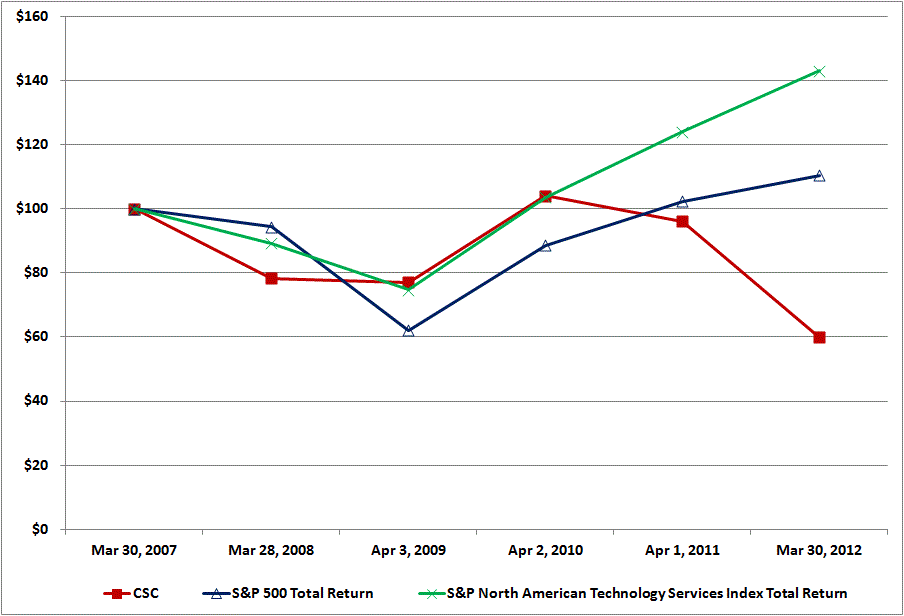
Indexed Return Chart (2007 = 100) | |||||||||||||||||
Return 2008 | Return 2009 | Return 2010 | Return 2011 | Return 2012 | CAGR | ||||||||||||
CSC Common Stock | -21.73 | % | -1.59 | % | 35.12 | % | -7.61 | % | -37.74 | % | -9.74 | % | |||||
S&P 500 Index | -5.62 | % | -34.23 | % | 42.85 | % | 15.36 | % | 8.00 | % | 2.01 | % | |||||
S&P North American Technology Services Index | -10.81 | % | -16.29 | % | 38.71 | % | 19.67 | % | 15.35 | % | 7.40 | % | |||||
Assumes $100 invested on March 31, 2007, in Computer Sciences Corporation Common Stock, the S&P 500 Index, and the S&P North American Technology Services Index, formerly the Goldman Sachs Technology Services Index. Indexed amounts and return percentages follow CSC fiscal years.
(d) | Equity Compensation Plans |
See Item 12 of this Annual Report on Form 10-K for information regarding our equity compensation plans.
18
Item 6. | Selected Financial Data |
COMPUTER SCIENCES CORPORATION
Five Year Review | ||||||||||||||||||||
Amounts in millions, except per share amounts | March 30, 2012 | April 1, 2011 | April 2, 2010 | April 3, 2009 | March 28, 2008 | |||||||||||||||
Total assets | $ | 11,189 | $ | 16,120 | $ | 16,455 | $ | 15,619 | $ | 15,880 | ||||||||||
Debt | ||||||||||||||||||||
Long-term, net of current maturities | 1,486 | 2,409 | 3,669 | 4,173 | 2,635 | |||||||||||||||
Short-term | 43 | 29 | 21 | 32 | 310 | |||||||||||||||
Current maturities | 1,211 | 141 | 54 | 30 | 529 | |||||||||||||||
Total | 2,740 | 2,579 | 3,744 | 4,235 | 3,474 | |||||||||||||||
Stockholders’ equity | 2,834 | 7,560 | 6,508 | 5,618 | 5,621 | |||||||||||||||
Working capital | 347 | 3,379 | 4,300 | 3,691 | 1,333 | |||||||||||||||
Property and equipment | ||||||||||||||||||||
At cost | 6,144 | 6,349 | 5,972 | 5,770 | 6,260 | |||||||||||||||
Accumulated depreciation and amortization | 3,703 | 3,853 | 3,731 | 3,417 | 3,495 | |||||||||||||||
Property and equipment, net | $ | 2,441 | $ | 2,496 | $ | 2,241 | $ | 2,353 | $ | 2,765 | ||||||||||
Current assets to current liabilities | 1.1:1 | 1.8:1 | 2.0:1 | 1.9:1 | 1.2:1 | |||||||||||||||
Debt to total capitalization | 49.2 | % | 25.4 | % | 36.5 | % | 43.0 | % | 38.2 | % | ||||||||||
Book value per share | $ | 18.28 | $ | 48.94 | $ | 42.27 | $ | 37.08 | $ | 37.19 | ||||||||||
Stock price range (high) | $ | 51.43 | $ | 56.61 | $ | 58.36 | $ | 50.52 | $ | 63.76 | ||||||||||
Stock price range (low) | $ | 22.80 | $ | 39.61 | $ | 35.95 | $ | 23.93 | $ | 36.91 | ||||||||||
19
Five Year Review | ||||||||||||||||||||
Fiscal Year | ||||||||||||||||||||
Amounts in millions, except per-share amount | 2012(4) | 2011(4) | 2010(4) | 2009 | 2008 | |||||||||||||||
Revenues | $ | 15,877 | $ | 16,042 | $ | 15,921 | $ | 16,432 | $ | 16,190 | ||||||||||
Costs of services (excludes depreciation and amortization, contract charge, settlement charge and restructuring costs of $137 (2012)) | 13,406 | 12,925 | 12,618 | 13,000 | 12,883 | |||||||||||||||
Costs of services – specified contract charge (excludes amount charged to revenue of $204)(1) | 1,281 | — | — | — | — | |||||||||||||||
Costs of services – settlement charge (excludes amount charged to revenue of $42)(2) | 227 | — | — | — | — | |||||||||||||||
Selling, general and administrative | 1,141 | 965 | 981 | 1,071 | 962 | |||||||||||||||
Depreciation and amortization | 1,152 | 1,073 | 1,095 | 1,179 | 1,192 | |||||||||||||||
Restructuring costs | 140 | — | — | — | 134 | |||||||||||||||
Goodwill impairment(3)(6) | 2,745 | — | — | 4 | - | |||||||||||||||
Interest, net | 138 | 131 | 225 | 220 | 150 | |||||||||||||||
Special items(7) | — | — | — | — | 22 | |||||||||||||||
Other (income) expense, net | (6 | ) | (20 | ) | (20 | ) | 8 | (58 | ) | |||||||||||
Total costs and expenses | 20,224 | 15,074 | 14,899 | 15,482 | 15,285 | |||||||||||||||
(Loss) income from continuing operations before taxes | (4,347 | ) | 968 | 1,022 | 950 | 905 | ||||||||||||||
Taxes on income (benefit) | (121 | ) | 243 | 192 | (173 | ) | 367 | |||||||||||||
(Loss) income from continuing operations | (4,226 | ) | 725 | 830 | 950 | 905 | ||||||||||||||
Income (loss) from discontinued operations | 1 | 34 | 4 | (173 | ) | 367 | ||||||||||||||
Net (loss) income | (4,225 | ) | 759 | 834 | 1,123 | 559 | ||||||||||||||
Less: | ||||||||||||||||||||
Net income attributable to noncontrolling interest, net of tax | 17 | 19 | 17 | 8 | 14 | |||||||||||||||
Net (loss) income attributable to CSC common shareholders | $ | (4,242 | ) | $ | 740 | $ | 817 | $ | 1,115 | $ | 545 | |||||||||
Earnings (loss) per common share: | ||||||||||||||||||||
Basic: | ||||||||||||||||||||
Continuing operations | $ | (27.38 | ) | $ | 4.57 | $ | 5.35 | $ | 7.37 | $ | 3.13 | |||||||||
Discontinued operations | 0.01 | 0.22 | 0.01 | - | 0.13 | |||||||||||||||
$ | (27.37 | ) | $ | 4.79 | $ | 5.36 | $ | 7.37 | $ | 3.26 | ||||||||||
Diluted: | ||||||||||||||||||||
Continuing operations | $ | (27.38 | ) | $ | 4.51 | $ | 5.27 | $ | 7.31 | $ | 3.08 | |||||||||
Discontinued operations | 0.01 | 0.22 | 0.01 | - | 0.12 | |||||||||||||||
$ | (27.37 | ) | $ | 4.73 | $ | 5.28 | $ | 7.31 | $ | 3.20 | ||||||||||
Cash dividend per common share(5) | $ | 0.80 | $ | 0.70 | $ | — | $ | — | $ | — | ||||||||||
Average common shares outstanding | 155.012 | 154.488 | 152.462 | 151.388 | 167.233 | |||||||||||||||
Average common shares outstanding assuming dilution | 155.012 | 156.605 | 154.754 | 152.614 | 170.168 | |||||||||||||||
(1) | Fiscal 2012 specified contract charge related to the Company’s contract with the U.K. National Health Service. See Note 16 of the Consolidated Financial Statements. |
(2) | Fiscal 2012 settlement charge related to the contract settlement with the Federal Government. See Note 17 of the Consolidated Financial Statements. |
(3) | Fiscal 2012 goodwill impairment charge related to MSS segment and two of the reporting units in the BSS segment. See Note 9 of the Consolidated Financial Statements. |
(4) | The Company recorded various out of period adjustments in fiscal 2012, 2011 and 2010 that should have been recorded in prior fiscal years. See Note 2 of the Consolidated Financial Statements. |
(5) | In Fiscal 2011, the Company implemented a regular quarterly dividend. |
(6) | Fiscal 2009 goodwill impairment charge related to an Asian reporting unit in the BSS segment. |
(7) | Fiscal 2008 special items represent charges for a global restructuring and for the retirement of the Company’s Chairman and Chief Executive Officer. |
20
Item 7. Management’s Discussion and Analysis of Financial Condition and Results of Operations
General
The following discussion and analysis provides information management believes is relevant to an assessment and understanding of the consolidated results of operations and financial condition of the Company. This discussion should be read in conjunction with the Company's consolidated financial statements and associated notes as of and for the year ended March 30, 2012.
There are three primary objectives of this discussion:
1. | Provide a narrative on the consolidated financial statements, as presented through the eyes of management; |
2. | Enhance the disclosures in the consolidated financial statements and footnotes by providing context within which the consolidated financial statements should be analyzed; and |
3. | Provide information to assist the reader in ascertaining the predictive value of the reported financial results. |
To achieve these objectives, the management discussion and analysis is presented in the following sections:
Overview - includes a description of the Company's business, how it earns revenue and generates cash, as well as a discussion of the economic and industry factors, key business drivers, key performance indicators and fiscal 2012 highlights.
Results of Operations - discusses year-over-year changes to operating results for fiscal 2010 to 2012, describing the factors affecting revenue on a consolidated and reportable segment basis, including new contracts, acquisitions and divestitures and currency impacts, and also by describing the factors affecting changes in the major cost and expense categories.
Financial Condition - discusses causes of changes in cash flows and describes the Company's liquidity and available capital resources.
Critical Accounting Estimates - discusses the significant accounting policies that require critical judgments and estimates.
Overview
CSC provides information technology and business process outsourcing, consulting, systems integration and other information technology services to its customers. The Company targets the delivery of these services within three broad lines of business or sectors: North American Public Sector (NPS), Managed Services Sector (MSS), and Business Solutions and Services (BSS).
The Company's reportable segments are as follows:
• | The NPS segment provides services to the U.S. federal government and its agencies, civil departments and branches of military, and operates principally within a regulatory environment subject to governmental contracting and accounting requirements, including Federal Acquisition Regulations, Cost Accounting Standards and audits by various U.S. federal agencies. |
• | The MSS segment provides large-scale infrastructure and application outsourcing solutions offerings as well as mid-size services delivery to customers globally. |
• | The BSS segment provides industry-specific consulting and systems integration services, business process outsourcing, and intellectual property-based software solutions. |
For additional information regarding our business segments, see Note 15 of the Consolidated Financial Statements.
21
Economic and Industry Factors
The Company's results of operations are impacted by economic conditions generally, including macroeconomic conditions. We are monitoring current macroeconomic and credit market conditions and levels of business confidence and their potential effect on our clients and on us. A severe and/or prolonged economic downturn could adversely affect our clients' financial condition and the levels of business activities in the industries and geographies in which we operate. This may reduce demand for our services or depress pricing of those services and have a material adverse effect on our new contract bookings and results of operations. Particularly in light of recent economic uncertainty, we continue to monitor our costs closely in order to respond to changing conditions and to manage any impact to our results of operations.
Our results of operations are also affected by levels of business activity and rates of change in the industries we serve, as well as by the pace of technological change and the type and level of technology spending by our clients. The ability to identify and capitalize on these market and technological changes early in their cycles is a key driver of our performance.
Revenues are driven by our ability to secure new contracts and to deliver solutions and services that add value to our clients. Our ability to add value to clients, and therefore generate revenues, depends in part on our ability to deliver market-leading service offerings and to deploy skilled teams of professionals quickly and on a global basis.
The BSS and MSS segment markets are affected by various economic and industry factors. The economic environment in the regions CSC serves will impact customers' decisions for discretionary spending on information technology (IT) projects. CSC is in a highly competitive industry which exerts downward pressure on pricing and requires companies to continually seek ways to differentiate themselves through several factors, including service offerings and flexibility. Management monitors industry factors including relative market shares, growth rates, billing rates, staff utilization rates and margins as well as macroeconomic indicators such as interest rates, inflation rates and foreign currency rates.
Outsourcing contracts are typically long-term relationships. Long-term, complex outsourcing contracts, including their consulting components, require ongoing review of the terms and scope of work, in order to meet clients' evolving business needs and our performance expectations.
More recently, the Company has implemented a strategy of promoting and selling defined solutions that require less customization and benefit from leveraged delivery at scale. Such solutions include our portfolio of Cloud-based Infrastructure-as-a-Service offerings, managed applications services and a range of discrete offerings for computing, storage, mobility and networking services.
The NPS segment market is also highly competitive and has unique characteristics. All U.S. government contracts and subcontracts may be modified, curtailed or terminated at the convenience of the government if program requirements or budgetary constraints change. In the event that a contract is terminated for convenience, the Company generally is reimbursed for its allowable costs through the date of termination and is paid a proportionate amount of the stipulated profit or fee attributable to the work performed. Shifting priorities of the U.S. government can also impact the future of projects. Management monitors government priorities and industry factors through numerous industry and government publications and forecasts, legislative activity, budgeting and appropriation processes and by participating in industry professional associations.
Business Drivers
Revenue in all three lines of business is generated by providing services on a variety of contract types lasting from less than six months to ten years or more. Factors affecting revenue include the Company's ability to successfully:
• | bid on and win new contract awards, |
• | satisfy existing customers and obtain add-on business and win contract re-competes, |
• | compete on services offered, delivery models offered, technical ability and innovation, quality, flexibility, global reach, experience, and results created, and |
• | identify and integrate acquisitions and leverage them to generate new revenues. |
Earnings are impacted by the above revenue factors and, in addition, the Company's ability to:
• | control costs, particularly labor costs, subcontractor expenses and overhead costs including healthcare, pension |
22
and general and administrative costs,
• | anticipate headcount needs to avoid staff shortages or excesses, |
• | accurately estimate various factors incorporated in contract bids and proposals, |
• | develop offshore capabilities and migrate compatible service offerings offshore, and |
• | manage foreign currency fluctuations related to international operations. |
Cash flows are affected by the above earnings factors and, in addition, by the following factors:
• | timely management of receivables and payables, |
• | investment opportunities available, particularly related to business acquisitions, dispositions and large outsourcing contracts, and |
• | the ability to efficiently manage capital including debt and equity instruments. |
Key Performance Indicators
The Company manages and assesses the performance of its business through various means, with the primary financial measures including new contract wins, revenue growth, margins, and cash flow.
New contract wins: In addition to being a primary driver of future revenue, new contract wins also provide management an assessment of the Company's ability to compete. The total level of wins tends to fluctuate from year to year depending on the timing of new or re-competed contracts, as well as numerous external factors.
Revenue growth: Year-over-year revenues tend to vary less than new contract wins, and reflect performance on both new and existing contracts. With a wide array of services offered, the Company is able to pursue additional work from existing customers. In addition, incremental increases in revenue will not necessarily result in linear increases in costs, particularly overhead and other indirect costs, thus potentially improving profit margins. Foreign currency fluctuations also impact revenue growth.
Margins: Margins reflect the Company's performance on contracts and ability to control costs. While the ratios of various cost elements as a percentage of revenue can shift as a result of changes in the mix of businesses with different cost profiles, a focus on maintaining and improving overall margins leads to improved efficiencies and profitability. Although the majority of the Company's costs are denominated in the same currency as revenues, increased use of offshore support also exposes CSC to additional margin fluctuations.
Cash flow: Primary drivers of the Company's cash flow are earnings provided by the Company's operations and the use of capital to generate those earnings. Also contributing to short term cash flow results are movements in current asset and liability balances. The Company also regularly reviews the U.S. Generally Accepted Accounting Principles (GAAP) cash flow measurements of operating, investing and financing cash flows, as well as the non-GAAP measure free cash flow.
23
Fiscal 2012 Highlights
Fiscal 2012 results were adversely impacted by certain large adjustments that reduced revenue and increased costs. These significant adjustments are listed below and described in detail later in this section and also in the Results of Operations section.
Impact of Adjustment | ||||||||||||
(Amounts in millions) | Favorable/(Unfavorable) | |||||||||||
Revenues | Costs | Loss from continuing operations before taxes | ||||||||||
Specified contract charge | $ | (204 | ) | $ | (1,281 | ) | $ | (1,485 | ) | |||
Settlement charge | (42 | ) | (227 | ) | (269 | ) | ||||||
Restructuring costs | — | (140 | ) | (140 | ) | |||||||
Goodwill impairment | — | (2,745 | ) | (2,745 | ) | |||||||
Asset impairments | — | (156 | ) | (156 | ) | |||||||
Net adjustments on contracts accounted for under the percentage of completion method | (83 | ) | (148 | ) | (231 | ) | ||||||
Legal and other fees on SEC and Audit Committee investigations | — | (67 | ) | (67 | ) | |||||||
Transaction and transition costs associated with acquisition of iSOFT | — | (23 | ) | (23 | ) | |||||||
The key operating results for fiscal 2012 include:
• | Revenues decreased $165 million or 1.0%, and decreased 2.9% on a constant currency basis(1). Of the 2.9% constant currency decrease, 1.5% was due to the reduction in revenue resulting from the charge associated with a U.K.’s National Health Service (NHS) contract and the settlement of claims associated with a U.S. Government contract. The revenue decrease was partially offset by an increase in revenue of 1.7% from the fiscal 2012 and fiscal 2011 acquisitions. |
• | Loss from continuing operations before taxes was $4,347 million, compared to income from continuing operations before taxes of $968 million in fiscal 2011, a decrease of $5,315 million, or 549.1%. |
• | Operating income(2) decreased 202.8% to a loss of $1,251 million as compared to operating income of $1,217 million in fiscal 2011, and operating income margins decreased to (7.9)% from 7.6% in the fiscal 2011. |
• | Net loss attributable to CSC common shareholders was $4,242 million, a decrease of $4,982 million, or 673.2%, as compared to the prior year. |
• | Diluted earnings (loss) per share (EPS) was $(27.37) for fiscal 2012, a decrease of $32.10 as compared to the prior year. For fiscal 2012, diluted EPS was comprised of $(27.38) from continuing operations and $0.01 from discontinued operations, as compared to $4.51 and $0.22, respectively, in the prior year. |
• | During the second quarter, the Company reached a definitive settlement agreement with the U.S. government in its contract claims asserted under the Contract Disputes Act of 1978 (CDA), and recorded a pre-tax charge of $269 million, which included a $42 million reduction of revenue. The charge reflected the write-down of claim related assets (unbilled receivables and deferred costs), offset by cash received of $277 million and the estimated fair value of a contract extension of $45 million. |
• | During the third quarter, the Company recorded a charge associated with the U.K. NHS contract of $1,485 million, which included a $204 million reduction of revenue. |
• | The Company recorded a goodwill impairment charge of $2,745 million during fiscal 2012. In the second quarter, the Company recorded an estimated goodwill impairment charge of $2,685 million, of which $2,074 million related to the MSS segment and $611 million related to the BSS segment. During the third quarter, the Company recorded a $60 million goodwill impairment, all of which related to the BSS segment. |
24
• | During the fourth quarter, the Company recorded restructuring costs of $140 million, of which $108 million is related to the MSS segment, $31 million is related to the BSS segment, and $1 million is related to the NPS segment. |
• | During fiscal 2012, the Company recorded $231 million of net adverse adjustments on long-term contracts accounted for under the percentage-of-completion method and $156 million of impairments of assets related primarily to outsourcing contracts with service delivery issues. |
• | The Company announced contract awards of $19.3 billion, including new MSS segment awards of $9.5 billion, NPS segment awards of $6.0 billion, and BSS segment awards of $3.8 billion. Total backlog(3) at the end of fiscal 2012 was $36.4 billion, an increase of $0.4 billion as compared to the backlog at the end of fiscal 2011 of $36.0 billion. Of the total $36.4 billion backlog, $10.2 billion is expected to be realized as revenue in fiscal 2013. Of the total $36.4 billion, $12.3 billion is not yet funded. |
• | Days Sales Outstanding (DSO)(4) was 70 days at March 30, 2012, an improvement from 79 days at April 1, 2011. |
• | Debt-to-total capitalization ratio(5) was 49.2% at year-end, an increase of 23.8% points from 25.4% at fiscal 2011 year end, reflecting the current year net loss attributable to CSC common shareholders of $4,242 million with corresponding impact on CSC stockholders' equity. |
• | Cash provided by operating activities was $1,176 million, as compared to $1,564 million during fiscal 2011. |
• | Cash used in investing activities was $1,308 million, as compared to $892 million during fiscal 2011. |
• | Cash used in financing activities was $581 million, as compared to $1,676 million during fiscal 2011. |
• | Free cash flow(6) of $59 million in fiscal 2012 was down from $629 million in fiscal 2011, driven primarily by the Company's operating performance and net cash outflows associated with a U.K. NHS contract, partially offset by cash received from the U.S. government upon settlement of contract claims. |
(1) | Selected references are made on a “constant currency basis” so that certain financial results can be viewed without the impact of fluctuations in foreign currency rates, thereby providing comparisons of operating performance from period to period. Financial results on a “constant currency basis” are calculated by translating current period activity into U.S. dollars using the comparable prior period’s currency conversion rates. This approach is used for all results where the functional currency is not the U.S. dollar. |
(2) | Operating income is a non-U.S. Generally Accepted Accounting Principle (GAAP) measure used by management to assess performance at the segments and on a consolidated basis. The Company’s definition of such measure may differ from other companies. We define operating income as revenue less costs of services, depreciation and amortization expense, and segment general and administrative (G&A) expense, excluding corporate G&A. Management compensates for the limitations of this non-GAAP measure by also reviewing income (loss) from continuing operations before taxes, which includes costs excluded from the operating income definition such as goodwill impairment, corporate G&A, interest and other income. A reconciliation of consolidated operating (loss) income to (loss) income from continuing operations before taxes is as follows: |
Twelve Months Ended | ||||||||||||
(Amounts in millions) | March 30, 2012 | April 1, 2011 | April 2, 2010 | |||||||||
Operating (loss) income | $ | (1,251 | ) | $ | 1,217 | $ | 1,395 | |||||
Corporate G&A | (219 | ) | (138 | ) | (168 | ) | ||||||
Interest expense | (176 | ) | (168 | ) | (252 | ) | ||||||
Interest Income | 38 | 37 | 27 | |||||||||
Goodwill impairment | (2,745 | ) | — | — | ||||||||
Other income (expense), net | 6 | 20 | 20 | |||||||||
(Loss) income from continuing operations before taxes | $ | (4,347 | ) | $ | 968 | $ | 1,022 | |||||
(3) | Backlog represents total estimated contract value of predominantly long-term contracts, based on customer commitments that the Company believes to be firm. Backlog value is based on contract commitments, management’s judgment and assumptions about volume of services, availability of customer funding and other factors. Backlog estimates for government contracts include both the funded and unfunded portions |
25
and all of the option periods. Backlog estimates are subject to change and may be affected by factors including modifications of contracts and foreign currency movements.
For NPS, announced award values for competitive indefinite delivery and indefinite quantity (IDIQ) awards represent the expected contract value at the time a task order is awarded under the contract. Announced values for non-competitive IDIQ awards represent management’s estimate at the award date. Business awards for MSS are estimated at the time of contract signing based on then existing projections of service volumes and currency exchange rates, and include option years. BSS award values are based on firm commitments. Beginning in fiscal 2012, we revised our estimation of BSS awards to account for larger business solution and service awards. Prior period awards and backlog have been revised to conform to the current year presentation.
(4) | DSO is calculated as total receivables at the fiscal period end divided by revenue-per-day. Revenue-per-day equals total revenues divided by the number of days in the fiscal period. Total receivables includes unbilled receivables but excludes tax receivables and long-term receivables. |
(5) | Debt-to-total capitalization ratio is defined as total current and long-term debt divided by total debt and equity, including noncontrolling interest. |
(6) | Free cash flow is a non-GAAP measure and the Company's definition of such measure may differ from that of other companies. We define free cash flow as equal to the sum of (1) operating cash flows, (2) investing cash flows, excluding business acquisitions, dispositions and investments (including short-term investments and purchase or sale of available for sale securities) and (3) payments on capital leases and other long-term asset financings. |
CSC’s free cash flow measure does not distinguish operating cash flows from investing cash flows as they are required to be presented in accordance with GAAP, and should not be considered a substitute for operating and investing cash flows as determined in accordance with GAAP. Free cash flow is one of the factors CSC management uses in reviewing the overall performance of the business. Management compensates for the limitations of this non-GAAP measure by also reviewing the GAAP measures of operating, investing and financing cash flows as well as debt levels measured by the debt-to-total capitalization ratio.
A reconciliation of free cash flow to the most directly comparable GAAP financial measure is presented below:
Twelve Months Ended | ||||||||||||
(Amounts in millions) | March 30, 2012 | April 1, 2011 | April 2, 2010 | |||||||||
Free cash flow | $ | 59 | $ | 629 | $ | 811 | ||||||
Net cash used in investing activities | 1,308 | 892 | 790 | |||||||||
Acquisitions, net of cash acquired | (374 | ) | (158 | ) | (5 | ) | ||||||
Business dispositions | 2 | 119 | 14 | |||||||||
Short-term investments | 4 | (9 | ) | — | ||||||||
Payments on capital leases and other long-term asset financings | 177 | 91 | 33 | |||||||||
Net cash provided by operating activities | $ | 1,176 | $ | 1,564 | $ | 1,643 | ||||||
Net cash used in investing activities | $ | (1,308 | ) | $ | (892 | ) | $ | (790 | ) | |||
Net cash used in provided by financing activities | $ | (581 | ) | $ | (1,676 | ) | $ | (487 | ) | |||
The Company has developed a broad, long-term revenue base which includes customers spread across multiple industries and geographic regions as well as service lines. A significant amount of CSC’s revenue is derived from long-term contracts including information technology outsourcing, build and maintain engagements and U.S. federal government engagements. This provides the Company with a base of revenue during periods when contract awards may slow or the market for certain services softens.
The Company’s significant wins and scope extensions during fiscal 2012 included the following:
NPS:
• | U.S. Army ($1.0 billion) |
• | State of Maryland ($297 million) |
• | U.S. Citizenship and Immigration Services ($291 million) |
MSS:
• | BAE Systems ($800 million) |
• | Educational Testing Service (over $200 million) |
BSS:
• | Financial services industry clients ($1.6 billion) |
• | Technology and consumer services industry clients ($863 million) |
26
• | Health services industry clients ($497 million) |
Cash and cash equivalents at March 30, 2012, was approximately $1.1 billion, down from $1.8 billion at April 1, 2011, a $744 million decrease. The decrease was a result of financing and investing cash outflows of $581 million and $1,308 million, respectively, during fiscal 2012, offset by operating cash inflows of $1,176 million. Net loss adjusted for non-cash charges drove the operating cash inflows, higher purchases of property and equipment and business acquisitions drove the investing cash outflows, and a repayment on the Company’s credit facility drove the financing outflows.
Cash and cash equivalents at April 1, 2011, was approximately $1.8 billion, down from $2.8 billion at April 2, 2010, a $947 million decrease. The decrease was a result of financing and investing cash outflows of $1.7 billion cash and $892 million, respectively, during fiscal 2011, offset by operating cash inflows of $1.6 billion. Net income drove the operating cash inflows, higher purchases of property and equipment and business acquisitions drove the investing cash outflows, and a repayment on the Company’s credit facility drove the financing outflows.
Results of Operations
Revenues
Revenues for the NPS, MSS, and BSS segments for fiscal 2012, fiscal 2011, and fiscal 2010 are as follows:
Twelve Months Ended | ||||||||||||||||||
March 30, 2012 | April 1, 2011 | April 2, 2010 | ||||||||||||||||
(Amounts in millions) | Amount | Percent Change | Amount | Percent Change | Amount | |||||||||||||
NPS | $ | 5,703 | (5.0 | )% | $ | 6,002 | (1.5 | )% | $ | 6,095 | ||||||||
MSS | 6,618 | 0.5 | 6,583 | 2.0 | 6,451 | |||||||||||||
BSS | 3,677 | 3.0 | 3,570 | 2.5 | 3,483 | |||||||||||||
Corporate | 13 | 14 | 17 | |||||||||||||||
Subtotal | 16,011 | (1.0 | ) | 16,169 | 0.8 | 16,046 | ||||||||||||
Eliminations | (134 | ) | (127 | ) | (125 | ) | ||||||||||||
Total Revenue | $ | 15,877 | (1.0 | )% | $ | 16,042 | 0.8 | % | $ | 15,921 | ||||||||
The major factors affecting the percent change in revenues are presented as follows:
Twelve Months Ended March 30, 2012 vs. April 1, 2011 | Acquisitions | Approximate Impact of Currency Fluctuations | Net Internal Growth | Total | ||||||||
NPS | 0.6 | % | — | (5.6 | )% | (5.0 | )% | |||||
MSS | 0.9 | 2.7 | % | (3.1 | ) | 0.5 | ||||||
BSS | 4.8 | 3.5 | (5.3 | ) | 3.0 | |||||||
Cumulative Net Percentage | 1.7 | % | 1.9 | % | (4.6 | )% | (1.0 | )% | ||||
Twelve Months Ended April 1, 2011 vs. April 2, 2010 | Acquisitions | Approximate Impact of Currency Fluctuations | Net Internal Growth | Total | ||||||||
NPS | 0.2 | % | — | (1.7 | )% | (1.5 | )% | |||||
MSS | — | (0.1 | )% | 2.1 | 2.0 | |||||||
BSS | 0.9 | (0.2 | ) | 1.8 | 2.5 | |||||||
Cumulative Net Percentage | 0.3 | % | (0.1 | )% | 0.6 | % | 0.8 | % | ||||
27
North American Public Sector
The Company’s North American Public Sector segment revenues were derived from the following sources:
Twelve Months Ended | ||||||||||||||||||
March 30, 2012 | April 1, 2011 | April 2, 2010 | ||||||||||||||||
Dollars in millions | Amount | Percent Change | Amount | Percent Change | Amount | |||||||||||||
Department of Defense(1) | $ | 3,863 | (10.0 | )% | $ | 4,290 | (2.8 | )% | $ | 4,414 | ||||||||
Civil agencies(1) | 1,618 | 7.3 | 1,508 | 2.4 | 1,473 | |||||||||||||
Other (2) | 222 | 8.8 | 204 | (1.9 | ) | 208 | ||||||||||||
Total | $ | 5,703 | (5.0 | )% | $ | 6,002 | (1.5 | )% | $ | 6,095 | ||||||||
(1) | Certain fiscal 2011 and fiscal 2010 amounts were reclassified from Department of Defense to Civil Agencies to conform to the current year presentation. |
(2) | Other revenues consist of foreign, state and local government work as well as commercial contracts performed by the NPS segment. |
Fiscal 2012
NPS segment revenue decreased $299 million, or 5.0% as compared to fiscal 2011. This decrease was due to its Department of Defense group (DOD) contracts, which had a $427 million, or 10.0% decrease. Partially offsetting the decline in revenue on DOD contracts were increases in revenue from contracts with Civil Agencies (Civil), which had a $110 million, or 7.3% increase, and increases in revenue from Other contracts, which had a $18 million, or 8.8% increase. Fiscal 2012 NPS revenue was adversely impacted by net $29 million of adjustments on certain long term contracts accounted for under the percentage of completion method. Of such adjustments, $39 million reduced revenue and $10 million increased revenue.
The decreases in revenue on DOD contracts, primarily with the U.S. Army and the U.S. Air Force, were due to a combination of completion of existing task orders, a contract termination and net reduction in scope and tasking on other existing contracts. In addition, revenue was adversely impacted by the contract claims settlement with the U.S. Federal Government in the second quarter of $42 million (see Note 17 to the Consolidated Financial Statements) and by a $14 million adjustment on a contract with the U.S. Air Force accounted for under the percentage of completion method due to a stop work order.
The increase in revenue from Civil Agencies was primarily due to contracts with the Department of Homeland Security (DHS), the Department of Human and Health Services (DHHS) and the Social Security Administration that commenced during the second half of fiscal 2011. These increases were partially offset by revenue that did not recur due to contract completions, primarily the U.S. Census support contract, as well as reduced scope on certain other contracts, primarily with the Environmental Protection Agency (EPA), Department of Transportation, Department of Energy and the Internal Revenue Service.
The increase in revenue from Other contracts was primarily due to higher revenue on a contract with a state agency for the development of a healthcare administration system. The higher revenue on this contract was partially offset by a $25 million adverse adjustment resulting from revised estimates under the percentage-of-completion accounting method. Of the $25 million revenue reduction, $16 million was recorded in the fourth quarter.
Many of our government customers continue to experience uncertainty about their fiscal budgets due to the Budget Control Act of 2011. As a result, large program awards are delayed and customers are shifting to smaller and shorter term contracts.
NPS won new contracts of $6.0 billion during fiscal 2012 compared to $5.5 billion during fiscal 2011.
Fiscal 2011
NPS segment revenue decreased 1.5%, or $93 million, for fiscal 2011 as compared to fiscal 2010. Excluding two small acquisitions made at the end of the second and third quarters of fiscal 2011, revenue decreased 1.7%. DOD revenue
28
declined slightly despite higher revenues on several programs. The increases were offset by contract completions, the adverse effects from reduced tasking on two U.S. Army contracts, as well as from the impact of a one-time, $65 million revenue benefit in fiscal 2010 from a claim settlement that did not repeat in fiscal 2011. Civil declines came primarily from contracts with the DHHS, the Department of Transportation and the EPA that either ended or experienced reductions in customer spending.
One factor affecting the overall year-over-year revenue decline was an ongoing uncertainty among many government customers about their fiscal budgets and potential budget cuts due to ongoing congressional debates and temporary continuing resolutions on the current budget. Also impacting the year-over-year change is the increasing trend in contested awards, thereby slowing the ultimate start date of many contracts. For example, CSC won a significant award with the Transportation Security Administration in fiscal 2010 but protests resulted in numerous delays of up to ten months. Another factor affecting many government contractors is the recent renewed government initiative to insource personnel rather than use external providers. The impact was not significant on CSC’s results given the nature of the types of services we provide, and we expect a diminished impact in the future as government agencies revisit the costs and benefits of such an initiative.
During fiscal 2011, the Company announced federal contract awards with a total value of $5.5 billion compared to $7.1 billion during fiscal 2010.
Managed Services Sector
Fiscal 2012
MSS segment revenue increased $35 million, or 0.5% as compared to fiscal 2011. In constant currency, revenue decreased $140 million, or 2.2%. The foreign currency impact was primarily due to the movement in the U.S. dollar against the Australian Dollar, the British Pound, the Euro and the Swiss Franc. MSS' second quarter acquisition of AppLabs (see Note 4 to the Consolidated Financial Statements) provided revenue of $60 million, or 0.9% of the revenue growth.
Excluding the impact of foreign currency effects and the acquisition, fiscal 2012 net internal revenue decreased $200 million, or 3.1% as compared to the prior year. This decrease was primarily due to net volume and scope reductions of approximately $140 million and contract conclusions and terminations of approximately $270 million, partially offset by revenue from new contracts of approximately $200 million. In addition, revenue was impacted by certain one-time adjustments, including adverse adjustments on long-term contracts accounted for under the percentage-of-completion method of $48 million and missed service level metrics of $10 million due to delays on certain outsourcing contracts, partially offset by a favorable adjustment on termination of a contract of $15 million. The MSS year-over-year revenue trend was also adversely impacted by out of period adjustments. The out of period revenue decreases recorded in fiscal 2012 and fiscal 2011 were $7 million and $33 million, respectively (see Notes 2 and 15 to the Consolidated Financial Statements).
During fiscal 2012, the Company announced contract awards with a total value of $9.5 billion compared to $5.0 billion during fiscal 2011. Fiscal 2012 new contracts awards include $5.1 billion of successful recompetes.
Fiscal 2011
MSS segment revenue grew $132 million, or 2.0% in fiscal 2011, and increased 2.1% excluding foreign currency effects. The overall MSS growth was primarily from a combination of new client engagements won in fiscal 2010 and 2011, which generated approximately $521 million revenue in fiscal 2011, as well as growth on existing accounts which contributed $297 million in year over year growth. Partly offsetting the increases were contract conclusions and terminations of $272 million plus volume and scope reductions on existing accounts totaling $384 million.
During fiscal 2011, the Company announced contract awards with a total value of $5.0 billion compared to $8.7 billion during fiscal 2010.
29
Business Solutions & Services
Fiscal 2012
BSS segment revenue increased $107 million, or 3.0% as compared to fiscal 2011. In constant currency, revenue decreased $18 million, or 0.5%. The foreign currency impact was primarily due to the movement in the U.S. dollar against the Australian Dollar, the British Pound and the Euro. The acquisition of iSOFT and the other fiscal 2012 and fiscal 2011 acquisitions provided $171 million, or 4.8% of the year-over-year revenue increase. Excluding the effect of foreign currency movements and acquisitions, BSS fiscal 2012 revenue decreased $189 million, or 5.3% over the prior year.
The lower net internal fiscal 2012 revenue was primarily due to a decrease in revenue on the U.K. NHS contract of $233 million, which was adversely impacted by the third quarter $204 million revenue write-down (see Note 16 to the Consolidated Financial Statements) and by fiscal 2011 milestone revenue of $23 million that did not recur in fiscal 2012. BSS' health vertical also had reduced revenue due to continuing softness in the life sciences market and certain project completions in North America. Both of these revenue decreases were partially offset by revenue increases in the other verticals of BSS' consulting group. The consulting group's growth was primarily in North America, which offset revenue shortfalls in other regions. The BSS year-over-year revenue trend was also adversely impacted by out of period adjustments. The out of period revenue adjustments recorded in fiscal 2012 and fiscal 2011 were revenue decreases of $15 million and revenue increases of $15 million, respectively (see Notes 2 and 15 to the Consolidated Financial Statements).
During fiscal 2012, BSS had contract awards of $3.8 billion compared to $3.5 billion in fiscal 2011.
Fiscal 2011
BSS segment revenue increased $87 million, or 2.5% in fiscal 2011, and increased 2.7% excluding foreign currency effects. Acquisitions accounted for approximately $29 million or 0.9% of the year-over-year increase. The remaining growth resulted primarily from increases in the BSS consulting business in financial services, which grew $58 million year over year, and from other consulting operations which were up $30 million, excluding acquisitions. Additional growth came from an Asia hardware resale business and an Australian IT staffing operation which contributed $23 million. Offsetting the increases was a revenue decline on the NHS by $46 million due to delays in milestone deliverables.
The financial services group benefited from increased business process outsourcing services as well as from higher software and project-related services. Other than healthcare-related operations, other consulting operations grew $60 million and were up by double digit rates in select regions, including Europe’s western region, Brazil and Australia, and were also up slightly in the U.S., while down in other regions across Europe. Healthcare-related consulting operations were down $30 million, however, primarily due to the conclusion of a major contract with a large insurance company and continued uncertainty in the U.S. marketplace regarding healthcare reform.
During fiscal 2011, BSS had contract awards of $3.5 billion compared to $3.4 billion in fiscal 2010.
30
Costs and Expenses
The Company’s total costs and expenses were as follows:
Twelve Months Ended | Percentage of Revenue | ||||||||||||||||||||
Dollars in millions | 2012 | 2011 | 2010 | 2012 | 2011 | 2010 | |||||||||||||||
Costs of services (excludes depreciation and amortization, specified contract charge, settlement charge and restructuring costs of $137 (2012)) | $ | 13,406 | $ | 12,925 | $ | 12,618 | 84.4 | % | 80.6 | % | 79.2 | % | |||||||||
Cost of services – specified contract charge (excludes amount charged to revenue of $204) | 1,281 | — | — | 8.1 | — | — | |||||||||||||||
Cost of services – settlement charge (excludes amount charged to revenue of $42) | 227 | — | — | 1.4 | — | — | |||||||||||||||
Selling, general and administrative (excludes restructuring costs of $3 (2012)) | 1,141 | 965 | 981 | 7.2 | 6.0 | 6.2 | |||||||||||||||
Depreciation and amortization | 1,152 | 1,073 | 1,095 | 7.3 | 6.7 | 6.9 | |||||||||||||||
Restructuring costs | 140 | — | — | 0.9 | — | — | |||||||||||||||
Goodwill impairment | 2,745 | — | — | 17.2 | — | — | |||||||||||||||
Interest expense, net | 138 | 131 | 225 | 0.9 | 0.8 | 1.4 | |||||||||||||||
Other (income) expense, net | (6 | ) | (20 | ) | (20 | ) | — | (0.1 | ) | (0.1 | ) | ||||||||||
Total | $ | 20,224 | $ | 15,074 | $ | 14,899 | 127.4 | % | 94.0 | % | 93.6 | % | |||||||||
Fiscal 2012
Total costs and expenses as a percentage of revenue for fiscal 2012 were 127.4%, up from 94.0% in fiscal 2011. The increase in the total costs and expenses ratio was primarily due to the goodwill impairment charge, the specified contract charge and the settlement charge, all of which were recorded prior to the fourth quarter, and the restructuring costs recorded during the fourth quarter of fiscal 2012. The total costs and expenses ratio was also impacted by certain out-of-period adjustments recorded during fiscal 2012, 2011 and 2010, as described below.
Cost of services, excluding depreciation and amortization, the specified contract charge, the settlement charge and the fourth quarter restructuring costs of $137 million, as a percentage of revenue increased 3.8% points to 84.4% from 80.6% in fiscal 2011, primarily as a result of certain adverse fourth quarter adjustments recorded by MSS as further discussed below. Selling, general and administrative expenses, excluding restructuring charges of $3 million, as a percentage of revenue increased 1.2 percentage points primarily due to the legal fees associated with the SEC and the Audit Committee's investigations of $67 million. Depreciation and amortization as a percentage of revenue increased 0.6 percentage points primarily due to higher capital expenditures on existing and new contracts.
Fiscal 2011
Costs and expenses as a percentage of revenue for fiscal 2011 was 94.0%, up from 93.6% in fiscal 2010. Cost of services rose 1.4 percentage points as a result of adverse adjustments in MSS and BSS including out of period adjustments primarily in MSS as further discussed below. Selling, general and administrative expense ratio and depreciation and amortization ratio both improved 0.2 percentage points as a result of ongoing cost and capital expenditure reduction initiatives. Other income of $20 million was primarily due to equity in earnings of unconsolidated affiliates and other miscellaneous gains.
31
Investigations and Out of Period Adjustments
Summary of Audit Committee and SEC Investigations Related to the Out of Period Adjustments
Background
As previously disclosed in fiscal 2011, the Company initiated an investigation into out of period adjustments resulting from certain accounting errors in our MSS segment, primarily involving accounting irregularities in the Nordic region. Initially, the investigation was conducted by Company personnel, but outside Company counsel and forensic accountants retained by such counsel later assisted in the Company’s investigation. On January 28, 2011, the Company was notified by the SEC’s Division of Enforcement that it had commenced a formal civil investigation relating to these matters, which investigation has subsequently been expanded to other matters subsequently identified by the SEC, including matters specified in subpoenas issued to the Company from time to time by the SEC’s Division of Enforcement as well as matters under investigation by the Audit Committee of the Board of Directors, as further described below. The Company is cooperating in the SEC’s investigation.
On May 2, 2011, the Audit Committee commenced an independent investigation into the matters relating to the MSS segment and the Nordic region, matters identified by subpoenas issued by the SEC’s Division of Enforcement, and certain other accounting matters identified by the Audit Committee and retained independent counsel to represent CSC on behalf of, and under the exclusive direction of, the Audit Committee in connection with such independent investigation. Independent counsel has retained forensic accountants to assist their work. Independent counsel also represents CSC on behalf of, and under the exclusive direction of, the Audit Committee in connection with the investigation by the SEC’s Division of Enforcement.
The Audit Committee’s investigation has been expanded to encompass (i) the Company’s operations in Australia, (ii) certain aspects of the Company’s accounting practices within its Americas Outsourcing operation, and (iii) certain of the Company’s accounting practices that involve the percentage of completion accounting method, including the Company’s contract with NHS. In the course of the Audit Committee's expanded investigation, accounting errors and irregularities have been identified. As a result, certain personnel have been reprimanded, suspended, terminated and/or resigned. All of these investigative activities are ongoing.
Any out of period adjustments identified, including items that self corrected within a fiscal year, by the Company to date are hereinafter identified in Note 2 to the Consolidated Financial Statements.
The Company believes the SEC also has expanded its investigation into the foregoing areas as well as into certain related disclosure matters. The SEC's investigative activities are ongoing. In addition, the SEC's Division of Corporation Finance has issued comment letters to the Company requesting, among other things, additional information regarding its previously disclosed adjustments in connection with the above-referenced accounting errors, the Company's conclusions relating to materiality of such adjustments, and the Company's analysis of the effectiveness of its disclosure controls and procedures and its internal control over financial reporting. The Division of Corporation Finance's comment letter process is ongoing, and the Company is continuing to cooperate with that process.
The investigations being conducted by the SEC's Division of Enforcement and the Audit Committee as well as the review of our financial disclosures by the SEC's Division of Corporation Finance are continuing and could identify other accounting errors, irregularities or other areas of review. As a result, we have incurred and will continue to incur significant legal and accounting expenditures, and a significant amount of time of our senior management has been focused on these matters that otherwise would have been focused on the growth of the Company. We are unable to predict how long the Division of Enforcement's and Audit Committee's investigations will continue or whether, at the conclusion of its investigation, the SEC will seek to impose fines or take other actions against us. In addition, we are unable to predict the timing of the completion of the Division of Corporation Finance's review of our financial disclosures or the outcome of such review. Publicity surrounding the foregoing or any enforcement action as a result of the SEC's investigation, even if ultimately resolved favorably for us, could have an adverse impact on our reputation, business, financial condition, results of operations or cash flows.
During fiscal 2011, the Company recorded $52 million of pre-tax adjustments that should have been recorded in prior fiscal years. The total out of period adjustments recorded in fiscal 2011 were comprised of $92 million of charges reducing income from continuing operations before taxes originating out of the Company’s MSS operations in the Nordic region,
32
and $40 million of adjustments increasing income from continuing operations before taxes, with $36 million of the $40 million within MSS.
The Company recorded $79 million of out of period adjustments in fiscal 2012, which included $13 million of charges in the Nordic region, $23 million of charges in the Company's operations in Australia, and $25 million of charges originating from the NHS contract in the Company's BSS segment. Additionally, $16 million and $2 million of charges were recorded in the NPS segment and other operations of the Company, respectively. The fiscal 2012 out of period adjustments primarily related to the Company’s MSS and BSS segments, with $37 million and $26 million within MSS and BSS, respectively.
Certain additional items have been identified but not yet recorded related to the NHS contract that could have an effect on the amount and the allocation of the out of period adjustments for fiscal 2012 and prior fiscal years. Management does not believe that the effect of these additional items is material to the Company's financial statements. However, the investigation into these additional items is ongoing, and the amount could change and the allocation across years is likely to change.
The rollover impact on income (loss) from continuing operations before taxes of the recorded out of period adjustments is attributable to the following prior fiscal years:
Increase/(Decrease) | ||||||||||||
(Amounts in millions) | Fiscal 2011 Adjustments | Fiscal 2012 Adjustments | Total Adjustments | |||||||||
Fiscal 2012 | $ | — | $ | 79 | $ | 79 | ||||||
Fiscal 2011 | 52 | (29 | ) | 23 | ||||||||
Fiscal 2010 | (48 | ) | (9 | ) | (57 | ) | ||||||
Fiscal 2009 (unaudited) | (3 | ) | (27 | ) | (30 | ) | ||||||
Prior fiscal years (unaudited) | (1 | ) | (14 | ) | (15 | ) | ||||||
Nordic Region
As noted above, during fiscal 2011, the Company commenced an investigation into accounting irregularities in the Nordic Region. Based upon the Company's investigation, review of the underlying documentation for certain transactions and balances, review of contract documentation and discussions with Nordic personnel, the Company attributes the majority of the $92 million pre-tax adjustments recorded in the Nordic region in fiscal 2011 to accounting irregularities arising from suspected intentional misconduct by certain former employees in our Danish subsidiaries. The Company attributes the $13 million in pre-tax adjustments recorded in the Nordic region in fiscal 2012 to miscellaneous errors and not to any accounting irregularities or intentional misconduct other than a $1 million operating lease adjustment noted in the first quarter of fiscal 2012 which was a refinement of an error previously corrected and reported in fiscal 2011.
Australia
In the course of the Australia investigation initiated in fiscal 2012, accounting errors and irregularities have been identified. As a result, certain personnel in Australia have been reprimanded, suspended, terminated and/or resigned. Based upon the information developed to date, and the Company’s assessment of the same, the Company has identified and recorded during fiscal 2012, $23 million of adjustments reducing income from continuing operations before taxes relating to its operations in Australia. Such adjustments have been categorized as either intentional accounting irregularities (“intentional irregularities”) or other accounting errors (“Other Errors”). Other accounting errors include both unintentional errors and errors for which the categorization is unclear. The categorizations were provided to the Company through the independent investigation. The impact of the adjustments on income (loss) from continuing operations before taxes is attributable to the following prior fiscal years:
33
Increase/(Decrease) | ||||||||||||||||||||
(Amounts in millions) | FY08 & Prior (unaudited) | FY09 (unaudited) | FY10 | FY11 | Total | |||||||||||||||
Intentional irregularities | $ | 10 | $ | (7 | ) | $ | (4 | ) | $ | 1 | $ | — | ||||||||
Other Errors | (7 | ) | (16 | ) | 3 | (3 | ) | (23 | ) | |||||||||||
$ | 3 | $ | (23 | ) | $ | (1 | ) | $ | (2 | ) | $ | (23 | ) | |||||||
Americas Outsourcing
In the course of the independent investigation of Americas Outsourcing accounting practices, accounting conventions used by Americas Outsourcing relating to intraperiod cost allocations were determined to be unintentional accounting errors. The errors did not have an impact on a fiscal year basis. The Company also determined that other operating units employed similar practices and made necessary corrections. The Company has determined that the impact of these corrections was not material on any fiscal year.
In addition to the adjustments discussed above, a $1 million out of period adjustment related to an understatement of a fiscal 2011 management incentive compensation expense disclosed in the first quarter of fiscal 2012 has been determined by the Company to be a $3 million out of period adjustment as a result of the investigation. This item included multiple components, a portion of which the Company previously considered not to be related to out of period errors. Based on the results of the independent investigation, the Company now attributes these adjustments to Other Errors, which include both unintentional errors and errors for which the categorization is unclear.
NHS
In fiscal 2012, $25 million of out of period adjustments reducing income from continuing operations related to the Company's NHS contract were identified and recorded. During the course of the investigation in fiscal 2012 of the percentage of completion accounting method used on the Company's NHS contract, certain accounting errors were identified related to costs incurred under the contract, which resulted in errors in the recognition of income from continuing operations that would have reduced by approximately $24 million the $1.5 billion write-off recorded by the Company in the third quarter of fiscal 2012. Although the Company has concluded that these errors do not appear to have any impact on amounts charged to the NHS, the errors have impacted the operating income recognized on the NHS contract. The exclusion of certain costs incurred under the contract caused the estimated margin at completion, which determines the operating income that is booked when revenue milestones are achieved, to be overstated. Although the Company has concluded that there is no cumulative impact as a result of the $1.5 billion charge relating to the NHS contract recorded as of December 30, 2011, operating income from fiscal year 2007 through and including fiscal 2011 has been overstated by a total of approximately $24 million and, therefore, the charge taken by the Company as of December 30, 2011 was overstated by approximately the same amount.
Certain additional items have been identified but not yet recorded related to the NHS contract that could have an effect on the amount and the allocation of the out of period adjustments for fiscal 2012 and prior fiscal years. Management does not believe that the effect of these additional items is material to the Company's financial statements. However, the investigation into these additional items is ongoing, and the amount could change and the allocation across years is likely to change.
Certain CSC finance employees based in the United Kingdom were aware prior to fiscal 2012 of the aforementioned errors, but those employees failed to appropriately correct the errors. Therefore, the Company has classified these errors as intentional. Such categorization was provided to the Company through the independent investigation. As a result, certain personnel have been suspended and additional disciplinary actions are being considered.
In addition to the NHS accounting errors discussed above, the Company identified and recorded a $1 million adjustment in fiscal 2012 to write off contract acquisition costs that were inappropriately capitalized in fiscal year 2008. The Company has classified this error as unintentional.
The investigation also identified a transaction which was treated as a cost item but should have been treated as a reduction in revenue. This has resulted in an overstatement of revenue and an overstatement of operating costs from
34
fiscal 2008 to fiscal 2012 of $6 million.
The impact on income (loss) from continuing operations before taxes of the $25 million of out of period adjustments identified in fiscal 2012 related to the Company's NHS contract is attributable to the following prior fiscal years:
(Amounts in millions) | Increase/(Decrease) | |||
Fiscal 2011 | $ | (8 | ) | |
Fiscal 2010 | (4 | ) | ||
Fiscal 2009 (unaudited) | (3 | ) | ||
Prior fiscal years (unaudited) | (10 | ) | ||
Fiscal 2012 Financial Impact Summary
As noted above, during fiscal 2012, the Company recorded various pre-tax adjustments reducing income from continuing operations before taxes by $79 million ($63 million, net of tax), that should have been recorded in prior fiscal years. The out of period adjustments recorded in fiscal 2012 were comprised principally of $13 million of charges in the Nordic region, $23 million of charges in the Company's operations in Australia, $25 million of charges originating from the NHS contract in the Company's BSS segment and $16 million in the NPS segment. The NPS adjustments were identified by the Company and were primarily related to percentage of completion accounting adjustments.
Certain additional items have been identified but not yet recorded related to the NHS contract that could have an effect on the amount and the allocation of the out of period adjustments for fiscal 2012 and prior years. Management does not believe that the effect of these additional items is material to the Company's financial statements. However, the investigation into these additional items is ongoing, and the amount could change and the allocation across years is likely to change.
The following table summarizes the cumulative effect on net income (loss) attributable to CSC common shareholders of the consolidated out of period adjustments recorded during fiscal 2012. Certain adjustments reflected below only impacted quarters (unaudited) within the annual period.
Quarter Ended | ||||||||||||||||||||
(Amounts in millions) | July 1, 2011 | September 30, 2011 | December 30, 2011 | March 30, 2012 | Total | |||||||||||||||
Nordics adjustments | $ | 4 | $ | 6 | $ | 2 | $ | 1 | $ | 13 | ||||||||||
Australia adjustments | — | 21 | 2 | — | 23 | |||||||||||||||
NHS adjustments | — | (1 | ) | 28 | (2 | ) | 25 | |||||||||||||
NPS adjustments | 3 | — | (4 | ) | 17 | 16 | ||||||||||||||
Other adjustments | 2 | (7 | ) | 6 | 1 | 2 | ||||||||||||||
Effect on income from continuing operations before taxes | 9 | 19 | 34 | 17 | 79 | |||||||||||||||
Taxes on income | (2 | ) | (4 | ) | (2 | ) | (8 | ) | (16 | ) | ||||||||||
Other income tax adjustments | 1 | 14 | (10 | ) | (5 | ) | — | |||||||||||||
Effect on net income attributable to CSC common shareholders | $ | 8 | $ | 29 | $ | 22 | $ | 4 | $ | 63 | ||||||||||
The following table summarizes the cumulative effect on fiscal 2012 of the net income (loss) attributable to CSC common shareholders of the consolidated out of period adjustments recorded in fiscal 2012. Certain adjustments reflected below only impacted quarters (unaudited) within the annual period.
35
Quarter Ended | ||||||||||||||||||||
(Amounts in millions) | July 1, 2011 | September 30, 2011 | December 30, 2011 | March 30, 2012 | Total | |||||||||||||||
Operating costs inappropriately capitalized | $ | 1 | $ | — | $ | — | $ | — | $ | 1 | ||||||||||
Misapplication of US GAAP | 1 | (1 | ) | 2 | (1 | ) | 1 | |||||||||||||
Miscellaneous errors | 2 | 7 | — | 2 | 11 | |||||||||||||||
Total Nordic adjustments | 4 | 6 | 2 | 1 | 13 | |||||||||||||||
Operating costs inappropriately capitalized | — | 11 | — | — | 11 | |||||||||||||||
Misapplication of US GAAP | — | 8 | — | 1 | 9 | |||||||||||||||
Miscellaneous errors | — | 2 | 2 | (1 | ) | 3 | ||||||||||||||
Total Australia adjustments | — | 21 | 2 | — | 23 | |||||||||||||||
NHS adjustments | — | (1 | ) | 28 | (2 | ) | 25 | |||||||||||||
NPS adjustments | 3 | — | (4 | ) | 17 | 16 | ||||||||||||||
Other adjustments | 2 | (7 | ) | 6 | 1 | 2 | ||||||||||||||
Effect on income from continuing operations before taxes | 9 | 19 | 34 | 17 | 79 | |||||||||||||||
Taxes on income | (2 | ) | (4 | ) | (2 | ) | (8 | ) | (16 | ) | ||||||||||
Other income tax adjustments | 1 | 14 | (10 | ) | (5 | ) | — | |||||||||||||
Effect on net income attributable to CSC common shareholders | $ | 8 | $ | 29 | $ | 22 | $ | 4 | $ | 63 | ||||||||||
The select line items of the Consolidated Statement of Operations for the twelve months ended March 30, 2012, impacted by the consolidated out of period adjustments under the rollover method are shown below.
Twelve Months Ended March 30, 2012 | ||||||||||||
(Amounts in millions, except per share amounts) | As Reported | Adjustments Increase/ (Decrease) | Amount Adjusted for Removal of Errors | |||||||||
Revenue | $ | 15,877 | $ | 27 | $ | 15,904 | ||||||
Costs of services (excludes depreciation and amortization, contract charge, settlement charge, and restructuring costs) | 13,406 | (32 | ) | 13,374 | ||||||||
Cost of services – specified contract charge (excludes amount charged to revenue of $204) | 1,281 | (18 | ) | 1,263 | ||||||||
Selling, general and administrative | 1,141 | 1 | 1,142 | |||||||||
Depreciation and amortization | 1,152 | (2 | ) | 1,150 | ||||||||
Interest expense | 176 | (3 | ) | 173 | ||||||||
Other (income) expense | (6 | ) | 2 | (4 | ) | |||||||
(Loss) income from continuing operations before taxes | (4,347 | ) | 79 | (4,268 | ) | |||||||
Taxes on income | (121 | ) | 16 | (105 | ) | |||||||
(Loss) income from continuing operations | (4,226 | ) | 63 | (4,163 | ) | |||||||
Income from discontinued operations, net of taxes | 1 | — | 1 | |||||||||
Net (loss) income attributable to CSC common shareholders | (4,242 | ) | 63 | (4,179 | ) | |||||||
EPS – Diluted | ||||||||||||
Continuing operations | $ | (27.38 | ) | $ | 0.41 | $ | (26.97 | ) | ||||
Discontinued operations | 0.01 | — | 0.01 | |||||||||
Total | $ | (27.37 | ) | $ | 0.41 | $ | (26.96 | ) | ||||
The Company has determined that the impact of the consolidated Australia, Nordic, NHS and other out of period adjustments recorded in fiscal 2012 is immaterial to the consolidated results, financial position and cash flows for fiscal
36
2012 and prior years. Consequently, the cumulative effect of these adjustments was recorded during fiscal 2012.
Effect of Adjustments on Prior Year Financial Statements
As noted above, during fiscal 2011, the Company recorded $52 million of pre-tax adjustments that should have been recorded in prior fiscal years. The total out of period adjustments recorded in fiscal 2011 were comprised of $92 million of charges reducing income from continuing operations before taxes originating out of the Company’s MSS operations in the Nordic region, and $40 million of adjustments increasing income from continuing operations before taxes, with $36 million of the $40 million within MSS. Based upon the Company's investigation, review of the underlying documentation for certain transactions and balances, review of contract documentation and discussions with Nordic personnel, the Company attributes the majority of the out of period adjustments identified and recorded in the Nordic region in fiscal 2011 to accounting irregularities arising from suspected intentional misconduct by certain former employees in our Danish subsidiaries. These accounting irregularities included the inappropriate capitalization of operating costs, the misapplication of US GAAP and miscellaneous errors.
The following table summarizes the cumulative effect on fiscal 2011 of the net income attributable to CSC common shareholders of the consolidated out of period adjustments recorded during fiscal 2011 and 2012. Certain adjustments reflected below only impacted quarters (unaudited) within the annual period.
Quarter Ended | ||||||||||||||||||||
(Amounts in millions) | July 2, 2010 | October 1, 2010 | December 31, 2010 | April 1, 2011 | Total | |||||||||||||||
Operating costs inappropriately capitalized | $ | 15 | $ | 38 | $ | 8 | $ | 6 | $ | 67 | ||||||||||
Misapplication of US GAAP | 4 | 3 | 6 | (1 | ) | 12 | ||||||||||||||
Miscellaneous errors | 1 | (1 | ) | 9 | (2 | ) | 7 | |||||||||||||
Total Nordic adjustments | 20 | 40 | 23 | 3 | 86 | |||||||||||||||
Operating costs inappropriately capitalized | — | (1 | ) | (1 | ) | — | (2 | ) | ||||||||||||
Misapplication of US GAAP | — | 1 | 3 | (1 | ) | 3 | ||||||||||||||
Miscellaneous errors | (4 | ) | 5 | (2 | ) | (3 | ) | (4 | ) | |||||||||||
Total Australia adjustments | (4 | ) | 5 | — | (4 | ) | (3 | ) | ||||||||||||
NHS adjustments | — | (1 | ) | (2 | ) | (5 | ) | (8 | ) | |||||||||||
NPS adjustments | 4 | 2 | (10 | ) | (7 | ) | (11 | ) | ||||||||||||
Other adjustments | (8 | ) | (6 | ) | (16 | ) | (11 | ) | (41 | ) | ||||||||||
Effect on income from continuing operations before taxes | 12 | 40 | (5 | ) | (24 | ) | 23 | |||||||||||||
Taxes on income | 2 | — | 8 | 9 | 19 | |||||||||||||||
Other income tax adjustments | (1 | ) | (13 | ) | (6 | ) | 17 | (3 | ) | |||||||||||
Effect on net income attributable to CSC common shareholders | $ | 13 | $ | 27 | $ | (3 | ) | $ | 2 | $ | 39 | |||||||||
The select line items of the Consolidated Statement of Operations for fiscal 2011 and fiscal 2010 impacted by the out of period adjustments, including those identified in fiscal 2012 under the rollover method are shown below.
37
Twelve Months Ended April 1, 2011 | ||||||||||||
(Amounts in millions, except per share amounts) | As Reported | Adjustments Increase/ (Decrease) | Amount Adjusted for Removal of Errors | |||||||||
Revenue | $ | 16,042 | $ | 18 | $ | 16,060 | ||||||
Costs of services (excludes depreciation and amortization) | 12,925 | (8 | ) | 12,917 | ||||||||
Selling, general and administrative | 965 | — | 965 | |||||||||
Depreciation and amortization | 1,073 | 3 | 1,076 | |||||||||
Interest expense | 168 | — | 168 | |||||||||
Other (income) expense | (20 | ) | — | (20 | ) | |||||||
Income from continuing operations before taxes | 968 | 23 | 991 | |||||||||
Taxes on income | 243 | (16 | ) | 227 | ||||||||
Income from continuing operations | 725 | 39 | 764 | |||||||||
Income from discontinued operations, net of taxes | 34 | — | 34 | |||||||||
Net income attributable to CSC common shareholders | 740 | 39 | 779 | |||||||||
EPS – Diluted | ||||||||||||
Continuing operations | $ | 4.51 | $ | 0.25 | $ | 4.76 | ||||||
Discontinued operations | 0.22 | — | 0.22 | |||||||||
Total | $ | 4.73 | $ | 0.25 | $ | 4.98 | ||||||
Twelve Months Ended April 2, 2010 | ||||||||||||
(Amounts in millions, except per share amounts) | As Reported | Adjustments Increase/ (Decrease) | Amount Adjusted for Removal of Errors | |||||||||
Revenue | $ | 15,921 | $ | (26 | ) | $ | 15,895 | |||||
Costs of services (excludes depreciation and amortization) | 12,618 | 32 | 12,650 | |||||||||
Selling, general and administrative | 981 | (2 | ) | 979 | ||||||||
Depreciation and amortization | 1,095 | (1 | ) | 1,094 | ||||||||
Interest expense | 252 | 2 | 254 | |||||||||
Other (income) expense | (20 | ) | — | (20 | ) | |||||||
Income from continuing operations before taxes | 1,022 | (57 | ) | 965 | ||||||||
Taxes on income | 192 | (2 | ) | 190 | ||||||||
Income from continuing operations | 830 | (55 | ) | 775 | ||||||||
Income from discontinued operations, net of taxes | 4 | — | 4 | |||||||||
Net income attributable to CSC common shareholders | 817 | (55 | ) | 762 | ||||||||
EPS – Diluted | ||||||||||||
Continuing operations | $ | 5.27 | $ | (0.36 | ) | $ | 4.91 | |||||
Discontinued operations | 0.01 | — | 0.01 | |||||||||
Total | $ | 5.28 | $ | (0.36 | ) | $ | 4.92 | |||||
The Company has determined that the net impact of the recorded out of period adjustments was immaterial to the consolidated results, financial position and cash flows for fiscal 2011. Consequently, the cumulative effect of these adjustments was recorded during fiscal 2011.
Goodwill Impairment
The Company initiated its annual goodwill impairment analysis at the beginning of the second quarter of fiscal 2012 and concluded that fair value was below carrying value for three reporting units: Managed Services Sector (MSS), Global Business Solutions (BSS-GBS) and the Healthcare Group (BSS-Health). Furthermore, at the end of the second quarter,
38
sufficient indicators existed to require performance of an additional, interim goodwill impairment analysis, and the BSS-GBS reporting unit again had a fair value that was below carrying value. Management believed that the decline in the estimated fair values of these reporting units was a result of several factors, including uncertainty about the Company's overall value as reflected in CSC's stock price decline over the first half of fiscal 2012, overall decline in the broader stock market as indicated by reduced performance metric multiples at comparable public companies, and decline in forecasted operating performance of these reporting units.
The September 30, 2011 interim goodwill testing also indicated that the fair values of two reporting units - BSS-Health and BSS-iSOFT - passed step one but were not considered to be substantially in excess of carrying values. BSS-Health had a fair value estimated to be approximately 6% in excess of its carrying value. For BSS-iSOFT, which was acquired during the second quarter and was a new reporting unit, fair value approximated carrying value due to the proximity of its acquisition to the second quarter interim goodwill impairment test. For the remaining reporting units with goodwill, fair values substantially exceeded carrying values.
During the process of conducting the second steps of the annual and the interim goodwill impairment tests, the Company identified significant unrecognized intangible assets (primarily customer relationship and technology assets) which, along with fair value changes to the carrying values of other assets and liabilities as well as the lower reporting unit fair values calculated in step one, resulted in an implied fair value of goodwill substantially below the carrying value of goodwill for the MSS, BSS-GBS and BSS-Health reporting units. As a result, the Company recorded a goodwill impairment charge of $2,685 million of which $2,074 million related to the MSS reporting unit, $453 million related to the BSS-GBS reporting unit, and $158 million related to the BSS-Health reporting unit. By the end of the second quarter, the Company was not able to complete all the analyses associated with the annual and the interim impairment goodwill impairment tests primarily because of the complexity and the effort required to fair value all the assets and liabilities of the three reporting units which are spread across the globe; consequently, the amount of goodwill impairment recorded at the end of the second quarter represented management's best estimate.
During the third quarter, the Company completed all analyses related to the annual and interim goodwill impairment tests, and identified adjustments that reduced the impairment loss recorded in the second quarter by $3 million. The entire adjustment was associated with the BSS-Health reporting unit, and resulted from finalizing tax estimates and customer/technology asset fair values. Thus, the total second quarter goodwill impairment loss was adjusted to $2,682 million.
At the end of the third quarter, the Company assessed whether there were any events or circumstances that would more likely than not reduce the fair value of a reporting unit below its carrying value. The Company concluded that such indicators were present for two of its reporting units, BSS-Health and BSS-iSOFT. With respect to BSS-Health, the loss of a significant customer, the failure to win some major bids for new business, and reduction in forecasted earnings was considered a triggering event for an interim goodwill impairment test. For BSS-iSOFT, the recent developments on the NHS contract were considered a triggering event (see Note 16). There were no triggering events for the remaining reporting units with goodwill.
In conducting the first step of the third quarter interim goodwill impairment test for the BSS-Health reporting unit, the factors stated above resulted in a reassessment of forecasted cash flow assumptions under an income approach, as well as a revised valuation using a market multiples fair value approach, which led the weighted average fair value of the reporting unit to be less than its carrying value, thus triggering the need to proceed to step two. For the BSS-iSOFT reporting unit however, the weighted average fair value was estimated to be greater than its carrying value due to better than forecast performance on the core iSOFT business (not related to the NHS contract).
During the process of conducting the second step of the third quarter interim goodwill impairment test for BSS-Health, the Company estimated the fair value of its tangible assets and identified unrecognized intangible assets, primarily customer relationship and technology assets, and recorded an impairment charge of $63 million. After recording the third quarter charge of $63 million, the BSS-Health reporting unit had no remaining goodwill as of December 30, 2011 (see Note 9 to the Consolidated Financial Statements).
At the end of the fourth quarter, the Company assessed if there were events or changes in circumstances that would more likely than not reduce the fair value of any of its reporting units below their carrying amounts. There were no such indicators for any of the reporting units with goodwill and therefore an interim goodwill test was not required to be performed.
39
Any further significant declines in CSC's stock price or any further significant adverse changes in the business climate or operating results could result in the need to perform additional impairment analysis of goodwill in future periods prior to the next annual test.
Cost of Services – Specified Contract Charge
As more fully discussed in Note 16 to the Consolidated Financial Statements, CSC and NHS are parties to a £2.9 billion (approximately $5.4 billion at originally announced exchange rates) contract under which the Company is developing and deploying an integrated electronic patient records system. The contract has been accounted for using the percentage of completion method based on management’s best estimates of total contract revenue and costs. As described more fully below, the Company recorded a charge of $1,485 million in the fiscal 2012 third quarter, with $204 million recorded as a reduction of revenue, in connection with the Company's ongoing negotiations with the NHS.
On February 4, 2011, NHS formally notified the Company that it believed the Company’s failure to achieve a key milestone constituted a breach of contract and NHS was considering its position on termination of all or parts of the contract; however, NHS subsequently clarified that its notice was not intended to suggest that termination is the only option which it was considering and, in fact, NHS was considering the full range of options it believed were available to NHS. Notwithstanding this dispute, both NHS and the Company continued discussions leading to agreement on the terms of a Memorandum of Understanding (MOU), the terms of which would ultimately be reflected in a contract amendment. Negotiation of the terms of the MOU were substantially completed in May 2011. Subsequent government reviews of the MOU occurred. In November 2011, the Company, the NHS and Cabinet officials resumed discussions on the MOU and the way forward, which included discussions regarding a proposed contract amendment with different scope modifications and contract value reductions than those contemplated by the MOU. In late December 2011, CSC was informed that neither the MOU nor the contract amendment then under discussion would be approved by the government. Notwithstanding the failure to reach agreement, CSC and the NHS continued discussions in 2012 regarding proposals advanced by both parties reflecting scope modifications and contract value reductions that differed materially from those contemplated by the MOU.
As a result of these discussions, CSC and the NHS entered into a non-binding letter of intent on March 2, 2012.
Under the letter of intent, the NHS and CSC have agreed to a set of high-level principles, which are intended to be reflected in a binding interim agreement to be entered into by the parties. The non-binding letter of intent contemplates that under the interim agreement, NHS will provide a commitment of a certain number of trusts, some to be named in the interim agreement and the remainder within six months, to receive the Lorenzo software product, which has been redefined into deployment units categorized as “base product” and “additional product” for pricing purposes. In addition to the amounts committed by NHS for the base product, additional amounts will be available from centrally available funds for additional products, supplemental trust activity and local configuration. The letter of intent also contemplates that the interim agreement will provide for a structured set of payments following certain product deliveries, as well as additional payments to CSC, which would cover, among other items, various deployments for the named trusts and payments for work already performed. Any payments would be made only if the binding interim agreement is entered into by the parties.
The letter of intent provides that the interim agreement will contain an optional purchase arrangement for those additional trusts (other than the committed named trusts) that choose to take a deployment of Lorenzo. Pricing will be the same as that applicable to the committed named trusts.
The letter of intent provides for an interim Lorenzo-related standstill arrangement and contemplates that a mutual release of all accrued claims with respect to the Lorenzo deployments will be included as part of the interim agreement. The interim agreement, if agreed, will form the basis of an amendment and restatement of the existing NHS contract to be negotiated by the parties. Entry into the interim agreement, and ultimately the amendment, will require U.K. government approvals. There can be no assurance that such approvals will be obtained.
While the parties intended to conclude a binding interim agreement by March 30, 2012, as previously disclosed, no agreement has yet been reached. The parties have continued discussions concerning the interim agreement. The previously disclosed Lorenzo-related standstill agreement remains in effect through June 1, 2012.
There can be no assurance that CSC and NHS will enter into the interim agreement or any amendment to the existing agreement or if the parties do not enter into the interim agreement or an amendment by June 1, 2012 that the Lorenzo-
40
related standstill arrangement will be extended. Likewise, there can be no assurance that if the interim agreement or any amendment are negotiated and entered into, that such documents as finally negotiated will be on terms favorable to CSC or as provided in the letter of intent.
The contract has been accounted for using the percentage of completion method based on management’s best estimates of total contract revenue and costs. While software development and deployment activities continue in cooperation with the NHS, because of the December 2011 communication rejecting the MOU referred to above, the proposals to significantly reduce the scope and value of the Lorenzo deployments, and the uncertainty over the results of these negotiations, CSC has revised its estimate of revenues and costs at completion under the percentage of completion method to include only those revenues reasonably assured of collection. As a result of this change in estimate, the Company recorded a $1,485 million contract charge as of December 30, 2011, including a $204 million reduction of revenue. This charge included the write-off of its work in process balance of $1,263 million, billed and unbilled receivables of $204 million and net other assets and liabilities of $18 million, resulting in no material remaining net assets. While the contract is in a cumulative loss position as of December 30, 2011, an additional forward loss is not evident and has not been accrued, but further losses could be incurred by CSC depending on the outcome of negotiations, the terms of any potential agreement, or if no agreement is concluded. The Company is unable to estimate the amount of such additional costs; however, such costs could be material. In addition, depending on the outcome of the negotiations, it is also reasonably possible that an agreement amending the terms of the NHS contract, if concluded, could result in a payment for the recovery of a portion of the amounts that have been written off as of March 30, 2012 and therefore generate a gain in the near term. However, there can be no assurance that an agreement with NHS will be concluded, that the terms of any such agreement would be favorable to CSC or as provided in the letter of intent, that any gain will be generated in the event such an agreement is concluded or that any recovery will occur.
Costs of Services – Settlement Charge
During the second quarter of fiscal 2012, the Company reached a settlement agreement with the U.S. Government in its contract claims asserted under the Contract Disputes Act of 1978 (CDA). Under the terms of the settlement, the Company received $277 million in cash and a five-year extension (four base years plus one option year) with an estimated total contract value of $1 billion to continue to support and expand the capabilities of the systems covered by the original contract scheduled to expire in December 2011. In December 2011, the Company signed the contract modification based on the terms described above. As a result of the settlement, the Company recorded a pre-tax charge of $269 million during the second quarter of fiscal 2012 to write down its claim related assets (claim related unbilled receivables of $379 million and deferred costs of $227 million) to reflect the cash received of $277 million, the estimated fair value of the contract extension of $45 million, and previously unapplied payments of $15 million. Of the pre-tax charge of $269 million, $42 million was recorded as a reduction of revenue and $227 million as a separately itemized charge to cost of services. The fair value of the contract extension was recorded as a contract asset and will be amortized as a reduction of revenue over the four year fixed contract term in proportion to the expected revenues or a straight line basis, whichever is greater. The contract extension contained a Requirements portion and an Indefinite Quantity portion (and is not subject to any minimum values). See Note 17 to the Consolidated Financial Statements for further discussion.
Restructuring Costs
In March 2012, the Company initiated a series of restructuring actions primarily to address excess capacity issues across Europe and to align its workforce with current business needs. In addition to reducing headcount, these actions contemplate increased use of lower cost off-shore resources and optimal utilization of facilities, which includes vacating and consolidating office space. Actions under these plans commenced in March 2012 and are expected to be carried out through fiscal 2013. The restructuring actions envision reduction in the Company's workforce by approximately 1,900 employees, approximately 1,550 of which are in Europe, primarily in the U.K. and in the Nordic region, 200 in the United States and the remaining spread across Latin America, Asia and Australia.
A total of $140 million of restructuring costs were accrued in March 2012, which included $21 million of pension benefit augmentations that are due to certain employees in accordance with legal or contractual obligations, and which will be paid out over several years as part of normal pension distributions. Of the total restructuring costs of $140 million, $108 million relates to MSS, $31 million to BSS, and $1 million to NPS. Excluding the pension liability, the remaining $119 million of restructuring liability as of March 30, 2012, includes $112 million expected to be paid in fiscal 2013 and $7 million thereafter. The Company expects to incur additional restructuring costs in fiscal 2013 of approximately $59 million.
41
Costs of Services
Fiscal 2012
Costs of services (COS), excluding the specified contract charge, the settlement charge, and the restructuring charges, as a percentage of revenue increased to 84.4% for fiscal 2012 from 80.6% for fiscal 2011. Both fiscal 2012 and fiscal 2011 COS were adversely impacted by out of period adjustments recorded during these years but which were related to prior years. The amounts recorded in fiscal 2012 and fiscal 2011 were $25 million and $15 million, respectively, in MSS and $15 million and $4 million, respectively, in BSS. The fiscal 2012 increase in the COS ratio was primarily driven by adverse results in the MSS and the BSS segments.
The MSS COS ratio was impacted by adverse adjustments on long-term contracts accounted for under the percentage-of-completion method of $142 million of which $48 million was recorded as a reduction of revenue, impairment of tangible and intangible assets of $144 million associated primarily with service delivery issues on certain outsourcing contracts, and start-up issues on certain outsourcing contracts, including transition cost overruns of $34 million. Of these specific charges of $320 million, $171 million were recorded in the fourth quarter.
BSS' COS ratio was adversely impacted primarily by the NHS contract and the financial services business. Subsequent to the $1.5 billion NHS adjustment recorded in the third quarter and pending the finalization of a contract amendment, the Company recorded $29 million of operating losses in the fourth quarter (see Note 16 to the Consolidated Financial Statements). In addition, a year-over-year shift in BSS' financial services revenue mix, caused by a decline in the proportion of the higher margin license revenue, adversely impacted the BSS COS ratio. BSS COS ratio was impacted by adverse adjustments of $17 million on certain long-term contracts accounted for under the percentage-of-completion method of which $6 million was recorded as reduction in revenue.
The NPS COS ratio increased primarily as a result of recording $72 million of net adverse adjustments on certain long-term contracts accounted for under the percentage-of-completion method. The net adjustments included adverse adjustments of $130 million, of which $40 million reduced revenue, and favorable adjustments of $58 million of which $10 million increased revenue. Favorable adjustments included a $48 million COS benefit on a contract that had a similar adjustment in fiscal 2011. Of the total $72 million net adverse adjustments, $44 million was recorded in the fourth quarter.
Fiscal 2011
Costs of services as a percentage of revenue for fiscal 2011 increased to 80.6% from 79.2% for fiscal 2010, primarily driven by adverse changes in MSS' EMEA and Americas operations as well as from a significant adjustment on the NHS contract within the BSS segment. As discussed above, out of period adjustments recorded in MSS increased fiscal 2011 COS by $19 million and understated the reported fiscal 2010 COS by $33 million. Additionally in the Nordics region, operational issues including excess staffing capacity, performance issues, and lower revenue also increased the COS ratio in fiscal 2011. The MSS fiscal 2011 COS ratio was further adversely impacted by higher start-up and transition expenses on several contracts and a strengthening Indian rupee during fiscal 2011 which increased costs on U.S. dollar-denominated contracts.
Selling, General and Administrative
Fiscal 2012
Selling, general and administrative (SG&A) expense, excluding the restructuring charges, as a percentage of revenue increased to 7.2% for fiscal 2012 from 6.0% for fiscal 2011. The fiscal 2012 increase was primarily driven by an increase in corporate general & administrative (G&A) costs and a higher BSS ratio.
The corporate G&A costs increased year-over-year primarily due to higher legal and other fees of $67 million incurred mainly related to the ongoing SEC and Audit Committee investigations into the matters surrounding the out-of-period adjustments discussed previously. The Company will continue to incur such fees as these investigations are ongoing. In addition, the Company expects to incur additional legal and other professional fees in connection with various putative class action lawsuits that have been filed in federal court (see Note 19 to the Consolidated Financial Statements). Corporate G&A costs were higher also due to costs associated with the former CEO's severance of $7 million. These cost increases were partially offset by lower bonuses of $10 million and reduced stock compensation expense of $11 million,
42
principally due to reduction in the probable outcome of performance based restricted stock units for certain executives.
The BSS ratio increased primarily due to iSOFT. iSOFT's SG&A ratio was adversely impacted by $23 million of transaction and transition costs incurred related to its acquisition.
Fiscal 2011
Selling, general and administrative expense improved 0.2% points to 6% as a percentage of revenue in fiscal 2011 compared to fiscal 2010. This improvement was driven by reductions in Corporate G&A costs through lower legal and professional fees, and incentive compensation while the business segments maintained consistent ratios with fiscal 2010.
Depreciation and Amortization
Fiscal 2012
Depreciation and amortization (D&A) as a percentage of revenue increased to 7.3% for fiscal 2012 from 6.7% for fiscal 2011. The increase in the fiscal 2012 ratio was driven by all three segments. The BSS ratio increased due to higher amortization expense associated with the acquired iSOFT intangible and tangible assets. The higher MSS ratio is due to higher capital expenditure on outsourcing contracts. The higher NPS ratio is due to higher fixed asset purchases on certain of its contracts, as well as amortization of acquired intangible assets from fiscal 2012 and 2011 acquisitions.
Fiscal 2011
D&A decreased 0.2% points to 6.7% of revenue in fiscal 2011 as compared to fiscal 2010. Lower D&A expense in both the MSS & BSS segments were the contributors to this performance reflecting the reducing levels of capital expenditures in fiscal 2010 and 2009 in line with the Company’s ongoing program.
Interest Expense and Interest Income
Fiscal 2012
Interest expense of $176 million in fiscal 2012 increased $8 million compared to fiscal 2011 due to an increase in capital leases in MSS. Interest income increased $1 million to $38 million in fiscal 2012. Higher interest income was primarily due to higher interest earned on cash balances in India during the first two quarters of fiscal 2012.
Fiscal 2011
Interest expense of $168 million in fiscal 2011 decreased $84 million compared to fiscal 2010. The lower interest expense is a result of lower debt levels during fiscal 2011 primarily due to the repayment of the 7.375% $500 million term note in the fourth quarter of fiscal 2010, and repayment of the $1.5 billion credit facility in the third quarter of fiscal 2011. The decrease in interest expense due to repayment of term notes and credit facility was slightly offset by higher interest on increased capital lease activity and interest on borrowings for assets acquired under long term financing primarily in the MSS segment.
Interest income increased $10 million to $37 million in fiscal 2011 due to the combination of increase in interest rates and in foreign cash balances, primarily in India, Australia and Asia.
43
Other (Income) Expense, Net
The components of other (income) expense, net for fiscal 2012, fiscal 2011, and fiscal 2010 are:
Twelve Months Ended | ||||||||||||
(Amounts in millions) | March 30, 2012 | April 1, 2011 | April 2, 2010 | |||||||||
Foreign currency loss (gain) | $ | 4 | $ | (2 | ) | $ | 4 | |||||
Equity in earnings of unconsolidated affiliates | (10 | ) | (11 | ) | (14 | ) | ||||||
Other gains | — | (7 | ) | (10 | ) | |||||||
Total | $ | (6 | ) | $ | (20 | ) | $ | (20 | ) | |||
The Company reported other income of $6 million for fiscal 2012 compared to $20 million in fiscal 2011. Foreign currency loss of $4 million for fiscal 2012 was due to the movements in foreign currency exchange rates, primarily between the U.S. dollar and the Indian rupee, which adversely impacted the Company's foreign currency options. Reduction in other gains is due to fiscal 2011 gains on sale of an investment and non-controlling interest in a business, both of which did not recur in fiscal 2012.
There was no change in total other (income) expense from fiscal 2011 to fiscal 2010; however, there was a slightly different mix. Foreign currency net gains of $2 million were the result of the effect of currency rate movement primarily between the U.S. dollar and Indian rupee, which favorably impacted the Company's hedging program. Reduction of equity earnings reflects the disposal of a minority equity shareholding during the year, while the other gains reflect a $3 million gain from the disposal of the minority equity investment, and a gain of $4 million from other minority investments.
The Company reported other income of $20 million for fiscal 2010 compared with $8 million of other expense in fiscal 2009. Other (gains) losses for fiscal 2010 primarily includes a gain of $6 million related to sale of the former corporate headquarters facility in El Segundo, California, a gain of $6 million from a positive worker's compensation claim experience on a business divested in fiscal 2005, and a $3 million loss related to a building for sale in Europe.
Taxes
The Company's effective tax rate (ETR) on (loss) income from continuing operations for fiscal years 2012, 2011, and 2010 was (2.8)%, 25.1%, and 18.8%, respectively. As a global enterprise, our ETR is affected by many factors, including our global mix of earnings, the extent to which those global earnings are indefinitely reinvested outside the United States, legislation, acquisitions, dispositions, and tax characteristics of our income. Our tax returns are routinely audited and settlements of issues raised in these audits sometimes affect our tax provisions. The following are the major events that had a significant impact on the ETR in fiscal years ended 2012, 2011, and 2010.
In fiscal 2012, the ETR was primarily driven by:
• | The Company recorded a $1,485 million charge related to the NHS contract. Following the write-down, a full valuation allowance was established against the net operating losses in the U.K., which resulted in the Company not recording a tax benefit for the NHS charges. This charge and subsequent valuation allowance had a significant impact on the tax expense and ETR of $508 million and 12%, respectively. |
• | The Company recorded a $2,745 million goodwill impairment charge which was mostly not deductible for tax purposes. This charge resulted in an impact to the tax expense and ETR of $838 million and 19%, respectively. |
• | The Company settled various tax examinations and recognized income tax benefits related to audit settlements (and the expiration of statutes of limitations on audits) of approximately $111 million, which had a favorable impact on the ETR for the fiscal year of 3%. |
• | The Company elected to change the tax status of one of its foreign subsidiaries. This change in tax status resulted in a deemed liquidation for U.S. tax purposes and triggered various deductions which resulted in an income tax benefit of approximately $114 million and had a favorable impact on the ETR for the fiscal year of 3%. |
In fiscal 2011, the Company settled a portion of its U.S. federal income tax audit for the fiscal years 2005 through 2007 related specifically to research and development (R&D) credits. This favorable settlement of $68 million had a 7% impact
44
on the ETR for the fiscal year ended 2011.
In fiscal 2010, the Company reversed a valuation allowance of $53 million associated with branch net operating loss carryforwards and the remeasurement of an uncertain tax position of $18 million for foreign tax credits as a result of an audit settlement. These items had a 7% impact on the ETR for the fiscal year.
As of March 30, 2012, in accordance with ASC 740-10, the Company's liability for uncertain tax positions was $257 million, including interest of $31 million, penalties of $15 million, and net of tax attributes of $76 million. During the year ended March 30, 2012, the Company had a net reduction of interest of $56 million ($36 million net of tax) and had a net reduction of penalties of $14 million. The net reduction of interest and penalties includes impacts of normal operations, audit settlements, and acquisitions.
A reconciliation of the differences between the U.S. federal statutory rate and the ETR, as well as other information about our income tax provision, is provided in Note 10 to the Consolidated Financial Statements.
The India Finance Bill of 2012 (the “Indian Finance Bill”) has been approved by both houses of the Indian Parliament and, if signed into law, could have an adverse material impact on the Company's tax liabilities. The provisions of the Indian Finance Bill provide for the taxation of indirect foreign investment in India, and would likely be applied retroactively for a period of years prior to the date of enactment subject to the current statute of limitations for tax assessments in India, which is 6 years. This Indian Finance Bill overrides the recent Vodafone ruling by the Supreme Court of India which held that the Indian Tax Authorities cannot assess capital gains taxes on the sale of shares of non-Indian companies that indirectly own shares in an Indian company. The retroactive nature of these changes in law has been strongly criticized. We expect that the Indian Finance Bill will be challenged in the Indian courts. However, there is no assurance that such a challenge will be successful.
CSC has engaged in transactions that could be subject to retroactive treatment under the Indian Finance Bill, including the purchase of shares of foreign companies that indirectly own shares of an Indian company and internal reorganizations. The Indian tax authorities may seek to apply the provisions of the Indian Finance Bill to these prior transactions and seek to tax CSC directly or as a withholding agent or representative assessee of the sellers involved in prior acquisitions. The Company is in the process of determining the amount of the potential exposure, but believes that this amount could be material. It is the intention of the Company to vigorously assert its defenses against any claims raised by the Indian Tax Authorities.
Earnings (Loss) Per Share and Share Base
Earnings (loss) per share (EPS), on a diluted basis, decreased $32.10 to $(27.37) in fiscal 2012. This decrease in EPS was due to net loss attributable to CSC common shareholders in fiscal 2012. The net loss attributable to CSC common shareholders was primarily due to the goodwill impairment charge of $2,745 million recorded during the second and third quarters (see Note 9), the contract charge associated with the U.K. NHS contract of $1,485 million recorded during the third quarter (see Note 16 to the Consolidated Financial Statements), the settlement charge of $269 million that resulted from the settlement of claims with the U.S. Federal Government during the second quarter (see Note 17 to the Consolidated Financial Statements), and restructuring costs of $140 million recorded during the fourth quarter (see Note 18 to the Consolidated Financial Statements). Delivery issues on certain MSS and NPS contracts resulted in recording forward losses on contracts accounted under the percentage-of-completion method, and asset impairments which also adversely impacted the EPS.
Diluted EPS for fiscal 2011 decreased $0.55 to $4.73 from $5.28 in fiscal 2010. The decrease is primarily due to the decrease in net income attributable to CSC common shareholders of 9.4% for fiscal 2011. Net income attributable to CSC common shareholders decreased $77 million in fiscal 2011 as compared to fiscal 2010, due to a combination of lower pre-tax earnings and higher taxes in fiscal 2011. The decrease in EPS was also due to an increase in the weighted average common shares and common stock equivalents during the fiscal year due to the year-over-year appreciation in the Company’s stock price.
45
Financial Condition
Cash Flows
Amounts in millions | Fiscal 2012 | Fiscal 2011 | Fiscal 2010 | |||||||||
Net cash from operations | $ | 1,176 | $ | 1,564 | $ | 1,643 | ||||||
Net cash used in investing | (1,308 | ) | (892 | ) | (790 | ) | ||||||
Net cash used in from financing | (581 | ) | (1,676 | ) | (487 | ) | ||||||
Effect of exchange rate changes on cash and cash equivalents | (31 | ) | 57 | 121 | ||||||||
Net (decrease) increase in cash and cash equivalents | (744 | ) | (947 | ) | 487 | |||||||
Cash and cash equivalents at beginning of year | 1,837 | 2,784 | 2,297 | |||||||||
Cash and cash equivalents at end of year | $ | 1,093 | $ | 1,837 | $ | 2,784 | ||||||
The Company’s cash and cash equivalents balance decreased by $744 million during fiscal 2012 compared to fiscal 2011. Net cash from operations decreased $388 million primarily driven by net cash outflows on the NHS contract. Cash used in investing activities increased $416 million compared to fiscal 2011 primarily due to acquisition of businesses and lower cash received from business dispositions and sale of assets. The decrease in cash used in financing activities is primarily due to repayment of $1.5 billion related to the old credit facility in the third quarter of fiscal 2011.
Operating Cash Flow
For fiscal 2012, net cash from operating activities of $1,176 million decreased $388 million as compared to fiscal 2011. The decrease is primarily due to higher payroll and related costs primarily due to the fiscal 2012 acquisitions, repayment of NHS advance contract payments (see Note 16 to the Consolidated Financial Statements), partially offset by receipt of cash upon settlement of claims with the U.S. government (see Note 17 to the Consolidated Financial Statements) and reduced cash taxes.
In fiscal 2011, net cash from operating activities of $1,564 million decreased $79 million as compared to fiscal 2010. The decrease is primarily due to reduced cash flows from advance contract payments of approximately $370 million, mainly from NHS, offset by higher collections from customers of approximately $100 million, reduced interest and tax payments of $97 million and $126 million, respectively. The reduced NHS advance contract payments are a result of delays in achieving certain milestones for Lorenzo Regional Care, as well as ongoing contract modification negotiations. The higher collections and reduced vendor payments are due to timing. The reduction in cash taxes paid is primarily due to additional pension contributions made in March 2010, which resulted in the Company generating a significant overpayment on its fiscal 2010 tax return which reduced cash tax payments made during fiscal 2011. Additionally, the Company made a cash payment to settle a tax audit with the German tax authorities during fiscal 2010, which did not recur in fiscal 2011.
Investing Cash Flow
Net cash used in investing activities for fiscal 2012 of $1.3 billion increased $416 million compared to fiscal 2011. The increase is primarily due to an increase in payments for business acquisitions of $216 million, and higher expenditures on software of $63 million. These increases were partially offset by lower purchases of property and equipment of $94 million, lower proceeds from the sale of property and equipment of $94 million, and lower proceeds from two divestitures of $117 million in fiscal 2011, which did not recur in fiscal 2012.
In fiscal 2011, investing cash outflows increased $102 million compared to fiscal 2010. The increase is primarily due to increase in payments for business acquisitions of $153 million, higher purchases of property and equipment and corporate assets of $85 million, partially offset by greater proceeds from two divestitures of $105 million and lower cash flow associated with outsourcing contracts of $38 million.
Financing Cash Flow
Net cash used in financing activities in fiscal 2012 was $581 million, a decrease of $1,095 million from fiscal 2011. This decrease is primarily due to repayment of $1.5 billion related to the old credit facility in the third quarter of fiscal 2011, partially offset by higher repayments on capital leases and other long-term debt.
46
In fiscal 2011, net cash used in financing activities was $1,676 million, an increase of $1,189 million from fiscal 2010. This increase is primarily due to repayment of a $1.5 billion credit facility in the third quarter, repurchase of $65 million of the Company's outstanding common stock in the fourth quarter under the previously announced $1 billion share repurchase program, and payment of cash dividends of $77 million.
Liquidity and Capital Resources
The balance of cash and cash equivalents was $1,093 million at March 30, 2012 and $1,837 million at April 1, 2011, and total equity decreased $4,726 million to $2,834 million during fiscal 2012. Of the total amount of cash and cash equivalents of $1,093 million at March 30, 2012, $788 million was held outside of the U.S.
At the end of fiscal 2012, CSC’s ratio of debt to total capitalization was 49.2%, an increase from 25.4% at the end of fiscal 2011, and from 36.5% at the end of fiscal 2010. The increase in the debt ratio for fiscal 2012 was primarily the result of a decrease in total equity associated with the fiscal 2012 net loss, driven by the goodwill impairment, the specified contract charges, and other charges and results discussed above.
The following table summarizes the Company’s debt to total capitalization ratios as of fiscal year end 2012 and 2011:
Amount in millions | March 30, 2012 | April 1, 2011 | ||||||
Debt | $ | 2,740 | $ | 2,579 | ||||
Equity | 2,834 | 7,560 | ||||||
Total capitalization | $ | 5,574 | $ | 10,139 | ||||
Debt to total capitalization | 49.2 | % | 25.4 | % | ||||
At March 30, 2012, the Company had $43 million of short-term borrowings under uncommitted lines of credit with foreign banks, $1,211 million of current maturities and $1,486 million of long-term debt. The Company had no outstanding commercial paper as of March 30, 2012.
At April 1, 2011, the Company had $29 million of short-term borrowings under uncommitted lines of credit with foreign banks, $141 million of current maturities and $2,409 million of long-term debt. The Company had no outstanding commercial paper as of April 1, 2011.
On March 18, 2011, the Company entered into a new committed line of credit providing $1.5 billion of long term commercial paper backup which replaced the existing $1.5 billion line of credit that would have expired on July 12, 2012. The new line of credit expires on March 18, 2015. This line requires the Company to: (1) maintain a minimum interest coverage ratio of consolidated Earnings Before Interest, Taxes, Depreciation and Amortization adjusted for other non-cash charges as defined by the credit agreement (EBITDA), to consolidated interest expense for the period of four consecutive fiscal quarters ending on or immediately prior to such period not to be less than 3.00 to 1.00; and (2) not permit at the end of any quarterly financial reporting period the ratio of consolidated total debt to consolidated EBITDA for the period of four consecutive fiscal quarters ending on or immediately prior to such date, to exceed 3.00 to 1.00. The Company is in full compliance with these requirements.
On December 13, 2010, CSC’s Board of Directors approved a share repurchase program authorizing up to $1.0 billion in share repurchases of the Company’s outstanding common stock (“2011 Repurchase Program”). In fiscal 2011, the Company repurchased 1.4 million shares in the open market for approximately $65 million in accordance with SEC rule 10-b18. The timing, volume, and nature of future share repurchases will be at the discretion of management, and may be suspended or discontinued at any time. CSC’s Board has not established an end date for the 2011 Repurchase Program. The company did not repurchase any shares in fiscal 2012.
In fiscal 2012, the Company continued paying quarterly cash dividends to its common stockholders. During the year, cash dividends of $0.80 per share or approximately $124 million were paid out. The Company has sufficient liquidity and expects to continue paying quarterly cash dividends although such payments are subject to continued approval by the Board of Directors.
The Company’s total liquidity is comprised of cash and cash equivalents plus any borrowing available under its credit
47
facility. As of March 30, 2012, the Company’s total liquidity was approximately $2.6 billion, consisting of $1.1 billion of cash and the full $1.5 billion available under the 2015 credit facility. The Company may fund its short-term debt obligations through a combination of internally available cash balances, use of its existing $1.5 billion credit facility and/or new borrowings.
Continued uncertainty in the global economic conditions may affect the Company’s business as customers and suppliers may decide to downsize, defer or cancel contracts which could negatively affect operating cash flow.
Liquidity Risk
The cash held by the Company outside the U.S. is not presently available to fund U.S. operations or obligations without paying taxes upon its repatriation. It is management's intent to use the foreign cash balances to fund non-U.S. acquisitions, capital needs and other cash requirements. The recent acquisitions of iSOFT and AppLabs during the second quarter of fiscal 2012 were made with the use of non-U.S. cash. Continued uncertainty in the global economic conditions may affect the Company’s business as customers and suppliers may decide to downsize, defer or cancel contracts which could negatively affect operating cash flow.
The Company’s exposure to operational liquidity risk is primarily from long-term contracts which require significant investment of cash during the initial phases of the contracts. The recovery of these investments is over the life of the contract and is dependent upon the Company’s performance as well as customer acceptance.
The Company’s ability to access the commercial paper and debt markets is dependent on liquidity in the credit markets as well as the Company’s financial position. On March 18, 2011, the Company entered into a committed line of credit providing $1.5 billion of long term commercial paper backup. This line of credit expires on March 18, 2015. Beginning in the third quarter of fiscal 2011, the Company was able to borrow against commercial paper to meet short term liquidity needs. As of March 30, 2012, there are no borrowings outstanding against commercial paper.
Our credit ratings and outlooks are summarized below. On May 17, 2012, Moody's lowered our long term credit rating from Baa1 with a negative watch to Baa2 with a stable outlook. Moody's confirmed its short term rating at Prime-2. In December 2011, S&P lowered our rating from A- to BBB+ with a negative credit watch. On May 22, 2012, S&P and Fitch lowered our credit rating to BBB with a negative outlook. These changes had no material impact on our current borrowing costs, and we believe they will not have a material impact on our ability to raise further debt financing in the future although the costs of such borrowing would increase. The ratings and outlooks issued by Moody's, S&P and Fitch appear in the table below:
Rating Agency | Rating | Outlook |
Fitch | BBB | Negative |
Moody's | Baa2 | Stable |
S&P | BBB | Negative |
Credit rating agencies review their ratings periodically and, therefore, the credit rating assigned to us by each agency may be subject to revision at any time. Accordingly, we are not able to predict whether our current credit ratings will remain as disclosed above. Factors that can affect our credit ratings include changes in our operating performance, our financial position, resolution of the issues relating to the NHS contract and changes in our business strategy. If further changes in our credit ratings were to occur, they could impact, among other things, our future borrowing costs and access to capital markets.
In the opinion of management, CSC will be able to meet its liquidity and cash needs for the foreseeable future through the combination of cash flows from operating activities and current cash balances. If these resources need to be augmented, major additional cash requirements would likely be financed by the issuance of debt and/or equity securities and/or the exercise of the put option as described in Note 20 to the Consolidated Financial Statements. However, there can be no assurances that the Company will be able to issue debt with acceptable terms in the future.
48
Off Balance Sheet Arrangements and Contractual Obligations
The following table summarizes the expiration of the Company’s financial guarantees outstanding as of March 30, 2012:
(Amounts in millions) | Fiscal 2013 | Fiscal 2014 | Fiscal 2015 & thereafter | Total | ||||||||||||
Performance guarantees: | ||||||||||||||||
Surety bonds | $ | 29 | $ | — | $ | — | $ | 29 | ||||||||
Letters of credit | 176 | 2 | 16 | 194 | ||||||||||||
Standby letters of credit | 63 | 2 | 14 | 79 | ||||||||||||
Foreign subsidiary guarantees | 795 | — | — | 795 | ||||||||||||
Total | $ | 1,063 | $ | 4 | $ | 30 | $ | 1,097 | ||||||||
For additional information on off balance sheet arrangements and contractual obligations see Note 19 to the Consolidated Financial Statements for further discussion.
The following table summarizes the Company’s payments on contractual obligations by period as of March 30, 2012:
(Amounts in millions) | 1 year or less | 1-3 years | 3-5 years | More than 5 years | Total | |||||||||||||||
Long-term debt | $ | 1,000 | $ | — | $ | — | $ | 997 | $ | 1,997 | ||||||||||
Interest on fixed rate debt | 119 | 156 | 130 | 98 | 503 | |||||||||||||||
Capital lease obligations | 191 | 312 | 133 | 119 | 755 | |||||||||||||||
Bank debt | 43 | — | — | — | 43 | |||||||||||||||
Operating leases | 266 | 332 | 146 | 76 | 820 | |||||||||||||||
Minimum purchase obligations | 598 | 425 | 29 | — | 1,052 | |||||||||||||||
Other long-term liabilities | 52 | 71 | 2 | 2 | 127 | |||||||||||||||
Total | $ | 2,269 | $ | 1,296 | $ | 440 | $ | 1,292 | $ | 5,297 | ||||||||||
The liability related to unrecognized tax benefits has been excluded from the table because a reasonable estimate of the timing and amount of cash out flows from future tax settlements cannot be determined.
Regarding minimum purchase obligations included above, the Company has signed long-term purchase agreements with certain software, hardware, telecommunication and other service providers to obtain favorable pricing, committed service levels and terms for services necessary for the operation of business activities. The Company is contractually committed to purchase specified service minimums over remaining periods ranging generally from one to five years. If the Company does not meet the specified service minimums, the Company may have an obligation to pay the service provider a portion or the entire shortfall.
During fiscal 2013, the Company expects to make contributions of approximately $254 million to pension and $10 million to postretirement benefit plans. The Company has not quantified expected contributions beyond fiscal 2013 because it is not possible to predict future timing or direction of the capital markets, which can have a significant impact on future minimum funding obligations. During fiscal 2012, pension and other pension benefits contributions amounted to $262 million, an increase of $23 million from $239 million in fiscal 2011. Refer to the Critical Accounting Estimates section later in this MD&A and to Note 12 to the Consolidated Financial Statements for further discussion.
Dividends
During fiscal 2012, quarterly dividends declared aggregated to $0.80 per share or $124 million. Of the total dividends declared, $93 million was paid in fiscal 2012 and the balance of $31 million was paid on April 16, 2012.
On May 15, 2012, the Board of Directors approved a dividend of $0.20 per share for the quarter ended March 30, 2012, payable on July 12, 2012 to the holders of record of the Company's common stock as of the close of business on June 14, 2012.
49
CRITICAL ACCOUNTING ESTIMATES
Our consolidated financial statements have been prepared in accordance with accounting principles generally accepted in the United States (GAAP). Our significant accounting policies are described in Note 1 to the Consolidated Financial Statements under “Summary of Significant Accounting Policies.” The preparation of consolidated financial statements in accordance with GAAP requires us to make estimates and judgments that affect the reported amounts of assets, liabilities, revenue and expenses, as well as the disclosure of contingent assets and liabilities. We base our estimates and judgments on historical experience and other factors believed to be reasonable under the circumstances. Many of the types of estimates made are for contract-specific issues. Changes to estimates or assumptions on a specific contract could result in a material adjustment to the consolidated financial statements.
We have identified several critical accounting estimates. An accounting estimate is considered critical if both: (a) the nature of the estimates or assumptions is material due to the levels of subjectivity and judgment involved, and (b) the impact of changes in the estimates and assumptions would have a material effect on the consolidated financial statements. Our critical accounting estimates relate to: revenue recognition, cost estimation and recoverability on long-term, fixed-price contracts; revenue recognition on software license sales that require significant customization; capitalization of outsourcing contract costs and software development costs; estimates used to determine deferred income taxes; assumptions related to purchase accounting and goodwill; assumptions to determine retirement benefits costs and liabilities; and assumptions and estimates used to analyze contingencies and litigation. For all of these estimates, we caution that future events rarely develop exactly as forecast, and the best estimates routinely require adjustment.
Revenue recognition
The majority of our revenue is recognized based on objective criteria and does not require significant estimates. Revenue from our fixed unit price contracts, time and materials contracts and cost plus contracts is recognized based on objective criteria and is not subject to estimates that may change over time. However, for our fixed-price contracts that use percentage-of-completion accounting, which is approximately 7.8% percent of the Company’s revenues, the determination of revenues and costs requires significant judgment and estimation. Under this method we recognize revenue on a constant margin as contract milestones or other input or output based measures are achieved. Costs are deferred until contractual milestones or other output based or cost based measures are achieved. The method requires estimates of revenues, costs and profits over the entire term of the contract, including estimates of resources and costs necessary to complete performance. Such estimates are particularly difficult on activities involving state-of-the-art technologies such as system development projects. The cost estimation process is based upon the professional knowledge and experience of our software and systems engineers, program managers and financial professionals. Key factors that are considered in estimating the work to be completed and ultimate contract profitability include the availability and productivity of labor and the nature and complexity of the work to be performed. A significant change in an estimate on one or more contracts could have a material effect on our results of operations. Management regularly reviews project profitability and the underlying estimates.
Modifications to contract scope, schedule, and price may be required on development contracts accounted for on a percentage-of-completion basis. Accounting for such changes prior to formal contract modification requires evaluation of the characteristics and circumstances of the effort completed and assessment of probability of recovery. If recovery is deemed probable, we may, as appropriate, either defer the costs until the parties have agreed on the contract change or recognize the costs and related revenue as current period contract performance. We routinely negotiate such contract modifications.
Many of our contracts call for us to provide a range of services or elements to our customers. The total estimated revenue for these contracts is allocated to the various services or elements based vendor specific objective evidence (VSOE), third party evidence (TPE) or management's best estimate of selling price for the deliverables when VSOE or TPE are not available. Once the total estimated revenue has been allocated to the various contract elements, revenue for each element is recognized based on the relevant revenue recognition method for the services performed or elements delivered.
Estimates of total revenue at contract inception often differ materially from actual revenue due to volume differences, changes in technology or other factors which may not be foreseen at inception.
50
Revenue recognition on software license sales that require significant customization
If significant customization is required in the delivery of a proprietary software product, and VSOE is available to support accounting for the software as a separate unit of account, revenue is recognized as the software customization services are performed in accordance with the percentage-of-completion method described above. Thus, cost and profit estimates are required over the life of the project, and changes in such estimates can have a material effect on results.
Capitalization of outsourcing contract costs
Certain costs incurred upon initiation of an outsourcing contract are deferred and amortized over the contract life. These costs consist of contract acquisition and transition/set-up costs, costs associated with installation of systems and processes, and amounts paid to clients in excess of the fair market value of assets acquired (i.e., premiums). Finance staff, working with program management, review costs to determine appropriateness for deferral in accordance with relevant accounting guidance.
Key estimates and assumptions that we must make include assessing the fair value of assets acquired from a customer in order to calculate the premium and projecting future cash flows in order to assess the recoverability of deferred costs. We utilize the experience and knowledge of our professional staff in program management, operations, procurement and finance areas, as well as third parties on occasion, to determine fair values of assets acquired. To assess recoverability, undiscounted estimated cash flows of the contract are projected over its remaining life and compared to contract related assets, including the unamortized deferred cost balance. Such estimates require judgment and assumptions, which are based upon the professional knowledge and experience of our personnel. Key factors that are considered in estimating the undiscounted cash flows include projected labor costs and productivity efficiencies. A significant change in an estimate or assumption on one or more contracts could have a material effect on our results of operations. Amortization of such premiums is recorded as a reduction of revenue.
Capitalization of software development costs
We capitalize certain costs incurred to develop commercial software products and to develop or purchase internal-use software. Significant estimates and assumptions include: determining the appropriate period over which to amortize the capitalized costs based on the estimated useful lives, estimating the marketability of the commercial software products and related future revenues, and assessing the unamortized cost balances for impairment. For commercial software products, determining the appropriate amortization period is based on estimates of future revenues from sales of the products. We consider various factors to project marketability and future revenues, including an assessment of alternative solutions or products, current and historical demand for the product, and anticipated changes in technology that may make the product obsolete. For internal-use software, the appropriate amortization period is based on estimates of our ability to utilize the software on an ongoing basis. To assess the recoverability of capitalized software costs, we must estimate future revenue, costs and cash flows. Such estimates require assumptions about future cash inflows and outflows, and are based on the experience and knowledge of professional staff. A significant change in an estimate related to one or more software products could result in a material change to our results of operations.
Estimates used to determine income tax expense
We make certain estimates and judgments in determining income tax expense for financial statement purposes. These estimates and judgments occur in the calculation of certain tax assets and liabilities, which principally arise from differences in the timing of recognition of revenue and expense for tax and financial statement purposes. We also must analyze income tax reserves, as well as determine the likelihood of recoverability of deferred tax assets, and adjust any valuation allowances accordingly. Considerations with respect to the recoverability of deferred tax assets include the period of expiration of the tax asset, planned use of the tax asset, and historical and projected taxable income as well as tax liabilities for the tax jurisdiction to which the tax asset relates. Valuation allowances are evaluated periodically and will be subject to change in each future reporting period as a result of changes in one or more of these factors. The calculation of our tax liabilities also involves dealing with uncertainties in the application of complex tax regulations. The Company recognizes uncertain tax positions in the financial statements when it is more likely than not the tax position will be sustained under examination.
Assumptions related to purchase accounting and goodwill
51
We account for acquisitions using the purchase method of accounting. This method requires estimates to determine the fair values of assets and liabilities acquired, including judgments in determination of acquired intangible assets such as customer-related intangibles, as well as assessments of the fair value of existing assets such as property and equipment. Liabilities acquired can include litigation and other contingency reserves existing at the time of acquisition, and require judgment in ascertaining their fair values. Independent appraisals may be used to assist in the determination of the fair value of certain assets and liabilities, but even those determinations can be based on significant estimates provided by the Company, such as forecasted revenues or profits utilized in determining the fair value of contract-related intangibles. Numerous factors are typically considered in the purchase accounting assessments, which are conducted by Company professionals from legal, finance, human resources, information systems, program management and other disciplines. Additional information obtained during the allocation period related to the acquisition date fair value of acquired assets and liabilities would result in changes to the recorded values, resulting in an offsetting change to the goodwill balance associated with the business acquired. Significant changes in assumptions and estimates subsequent to completing the allocation of purchase price to the assets and liabilities acquired, as well as differences in actual results versus estimates, could result in material impacts to earnings.
Goodwill is reviewed for impairment annually and whenever events or changes in circumstances indicate the carrying value of goodwill may not be recoverable in accordance with ASC 350 (FAS No. 142) “Goodwill and Other Intangible Assets.” A significant amount of judgment is involved in determining if an indicator of impairment has occurred between annual test dates. Such indicators may include, among others: a significant decline in expected future cash flows; a sustained, significant decline in stock price and market capitalization; a significant adverse change in legal factors or in the business climate; unanticipated competition; the testing for recoverability of a significant asset group within a reporting unit; and reductions in growth rates. Any adverse change in these factors could have a significant impact on the recoverability of goodwill.
The goodwill impairment test involves a two-step process. The first step is a comparison of each reporting unit’s fair value to its carrying value. If the reporting unit’s fair value exceeds its carrying value, no further procedures are required. However, if a reporting unit’s fair value is less than its carrying value, an impairment of goodwill may exist, requiring a second step to measure the amount of impairment loss. In this step, the reporting unit’s fair value is allocated to all of the assets and liabilities of the reporting unit, including any unrecognized intangible assets, in a hypothetical analysis to calculate the implied fair value of goodwill in the same manner as if the reporting unit was being acquired in a business acquisition. If the implied fair value of goodwill is less than the recorded goodwill, an impairment charge is recorded for the difference.
The Company estimates the fair value of each reporting unit using a combination of the income approach and the market approach. The income approach incorporates the use of a discounted cash flow method in which the estimated future cash flows and terminal values for each reporting unit are discounted to a present value using a discount rate. Cash flow projections are based on management's estimates of economic and market conditions which drive key assumptions of revenue growth rates, operating margins, capital expenditures and working capital requirements. The discount rate in turn is based on the specific risk characteristics of each reporting unit, the weighted average cost of capital and its underlying forecast. The market approach estimates fair value by applying performance metric multiples to the reporting unit's prior and expected operating performance. The multiples are derived from comparable publicly traded companies with similar operating and investment characteristics as the reporting unit. If the fair value of the reporting unit derived using the income approach is significantly different from the fair value estimate using the market approach, the Company reevaluates its assumptions used in the two models. The fair values determined by the market approach and income approach, as described above, are weighted to determine the fair value for each reporting unit. The weighted values assigned to each reporting unit are primarily driven by two factors: 1) the number of comparable publicly traded companies used in the market approach, and 2) the similarity of the operating and investment characteristics of the reporting units to the comparable publicly traded companies used in the market approach.
In order to assess the reasonableness of the calculated reporting unit fair values, the Company also compares the sum of the reporting units’ fair values to its market capitalization (per share stock price times shares outstanding) and calculates an implied control premium (the excess of the sum of the reporting units’ fair values over the market capitalization). The Company evaluates the control premium by comparing it to control premiums of recent comparable transactions. If the implied control premium is not reasonable in light of these recent transactions, the Company will reevaluate its fair value estimates of the reporting units by adjusting the discount rates and/or other assumptions. As a result, when CSC’s stock price is low, this reevaluation can result in lower estimated fair values of the reporting units.
52
Determining the fair value of a reporting unit is judgmental in nature and involves the use of significant estimates and assumptions. These estimates and assumptions include revenue growth rates, operating margins, terminal growth rates, capital expenditures, as well as discount rates. Estimates involve the assessment of labor and other direct costs on existing contracts, estimates of overhead costs and other indirect costs, and assessments of new business prospects and projected win rates. In addition, judgments and assumptions are required for allocating shared assets and liabilities to determine the carrying values of each reporting unit. Although we have consistently used the same methods in developing the assumptions and estimates underlying the fair value calculations, such estimates are uncertain and can vary from actual results.
Assumptions to determine retirement benefits costs and liabilities
We offer a number of pension and postretirement benefit and life insurance benefit plans. CSC utilizes actuarial methods required by ASC 715 Compensation – Retirement Benefits for fiscal 2012, 2011, and 2010 to account for pension and postretirement benefit plans, respectively. The actuarial methods require numerous assumptions to calculate the net periodic pension benefit expense and the related pension benefit obligation for our defined benefit pension and postretirement plans. Two of the most significant assumptions are the expected long-term rate of return on plan assets and discount rates. We consider current market conditions such as changes in interest rates, in determining discount rates. Changes in the related net periodic pension costs may occur in the future due to changes in these and other assumptions.
The expected long-term rate of return on plan assets should, over time, approximate the actual long-term returns on pension and postretirement plan assets. The assumption for the expected long-term rate of return on plan assets is selected by taking into account the asset mix of the plan and other factors. Please see Note 12 to the Consolidated Financial Statements for more details. The weighted-average of the expected long-term rate of return, for all pension plans, on plan assets utilized for the fiscal 2012 and 2011 pension plan valuations was 6.8% and 7.5%, respectively. Holding all other assumptions constant, a one-half percentage increase or decrease in each of the assumed rates of return on plan assets would have decreased or increased, respectively, the fiscal 2012 net periodic pension cost by approximately $20 million.
An assumed discount rate is required to be used in each pension and postretirement plan actuarial valuation. The discount rate assumption reflects the market rate for high-quality, fixed income debt instruments based on the expected duration of the benefit payments for our pension and postretirement plans as of the annual measurement date and is subject to change each year. The weighted-average of the discount rates utilized for the fiscal 2012 net periodic pension cost was 5.5% compared to 5.8% used for fiscal 2011. Holding all other assumptions constant, a one-half percent increase or decrease in each of the assumed discount rates would have decreased the fiscal 2012 net periodic pension cost by approximately $13 million, or increased it by approximately $14 million, respectively. Some portion of the increase or decrease would be moderated by cost reimbursable contracts.
The accounting guidance includes mechanisms that serve to limit the volatility in earnings which would otherwise result from recording changes in the value of plan assets and benefit obligations in the consolidated financial statements in the periods in which such changes occur. For example, while the expected long-term rate of return on plan assets should, over time, approximate the actual long-term returns, differences between the expected and actual returns may occur in any given year. Such differences contribute to the deferred actuarial gains or losses which are then amortized into earnings over time. During fiscal 2012 and 2011, the actual return on assets exceeded the expected return on assets, producing an actuarial gain. However, offsetting this actuarial gain was an actuarial loss increasing the projected benefit obligation of the Company's pension plans primarily due to the decline in discount rates. As a result, pension assets as a percentage of projected benefit obligations decreased during the fiscal year.
Assumptions and estimates used to analyze contingencies and litigation
We are subject to various claims and contingencies associated with lawsuits, insurance, tax and other issues arising in the normal course of business. The consolidated financial statements reflect the treatment of claims and contingencies based on management's view of the expected outcome. CSC consults with legal counsel on issues related to litigation and seeks input from other experts and advisors with respect to matters in the ordinary course of business. If the likelihood of an adverse outcome is probable and the amount is estimable, we accrue a liability in accordance with ASC 450 “Contingencies.” Significant changes in the estimates or assumptions used in assessing the likelihood of an adverse outcome could have a material effect on the consolidated financial results.
53
Item 7A. Quantitative and Qualitative Disclosures about Market Risk
Interest Rates
The Company utilizes fixed-rate long-term debt obligations, short-term commercial paper and other borrowings subject to market risk from changes in interest rates. Sensitivity analysis is one technique used to measure the impact of changes in interest rates on the value of market-risk sensitive financial instruments. For the year ended March 30, 2012, a hypothetical 10% movement in interest rates would not have had a material impact on the Company’s consolidated results of operations or financial conditions.
Foreign Currency
As a large global organization the Company faces exposure to adverse movements in foreign currency exchange rates. During the ordinary course of business, the Company enters into certain contracts denominated in foreign currency. Potential foreign currency exposures arising from these contracts are analyzed during the contract bidding process. The Company generally manages these contracts by incurring costs in the same currency in which revenue is received, and any related short-term contract financing requirements are met by borrowing in the same currency. Thus, by generally matching revenues, costs and borrowings to the same currency, the Company is able to mitigate a portion of the foreign currency risk to earnings. However, as the Company has increased its use of offshore support in recent years, it has become more exposed to currency fluctuations.
The Company has policies and procedures to manage the exposure to fluctuations in foreign currency by using foreign currency forwards to hedge intercompany loans denominated in non-functional currencies and certain foreign currency assets and liabilities. For accounting purposes, these contracts do not qualify for hedge accounting and thus all changes in fair value are reported in net earnings as part of other (income) expense. The Company also uses foreign currency options to manage its exposure to economic risk caused by exchange rate fluctuations. These financial instruments are generally short term in nature with typical maturities of less than one year. They are used to offset existing foreign currency positions or as economic hedges and not for speculative or trading purposes.
During fiscal 2012, approximately 38% of the Company’s revenue was generated outside of the United States. The Company uses a sensitivity analysis to assess the impact of movement in foreign currency exchange rates on revenue and earnings. For the year ended March 30, 2012, a hypothetical 10% increase or decrease in the value of the U.S. dollar against all currencies would have impacted revenue by approximately 4% or $604 million, while a hypothetical 10% decrease in the value of the U.S. dollar against all currencies would increase revenue by 4% or $604 million. In the opinion of management, a substantial portion of this fluctuation would be offset by expenses incurred in local currency. As a result, a hypothetical 10% movement of the value of the U.S. dollar against all currencies in either direction would impact the Company’s earnings before interest and taxes by approximately $36 million for the year ended March 30, 2012. This amount would be offset, in part, from the impacts of local income taxes and local currency interest expense.
As of March 30, 2012, the Company had approximately $788 million of cash and cash equivalents outside of the U.S. and approximately $43 million of non-U.S. dollar borrowings.
54
Item 8. Financial Statements and Supplementary Data
Index to Consolidated Financial Statements and Financial Statement Schedule
Page | |
Notes to Consolidated Financial Statements | |
Schedule | |
Schedules other than that listed above have been omitted since they are either not required, are not applicable, or the required information is shown in the consolidated financial statements or related notes | |
55
REPORT OF INDEPENDENT REGISTERED PUBLIC ACCOUNTING FIRM
To the Board of Directors and Stockholders of
Computer Sciences Corporation
Falls Church, Virginia
We have audited the accompanying consolidated balance sheets of Computer Sciences Corporation and subsidiaries (the "Company") as of March 30, 2012 and April 1, 2011 and the related consolidated statements of operations, changes in equity, and cash flows for each of the three fiscal years in the period ended March 30, 2012. Our audits also included the financial statement schedule listed in the Index at Item 15. These financial statements and financial statement schedule are the responsibility of the Company's management. Our responsibility is to express an opinion on the financial statements and financial statement schedule based on our audits.
We conducted our audits in accordance with the standards of the Public Company Accounting Oversight Board (United States). Those standards require that we plan and perform the audit to obtain reasonable assurance about whether the financial statements are free of material misstatement. An audit includes examining, on a test basis, evidence supporting the amounts and disclosures in the financial statements. An audit also includes assessing the accounting principles used and significant estimates made by management, as well as evaluating the overall financial statement presentation. We believe that our audits provide a reasonable basis for our opinion.
In our opinion, such consolidated financial statements present fairly, in all material respects, the financial position of Computer Sciences Corporation and subsidiaries as of March 30, 2012 and April 1, 2011 and the results of their operations and their cash flows for each of the three fiscal years in the period ended March 30, 2012, in conformity with accounting principles generally accepted in the United States of America. Also, in our opinion, such financial statement schedule, when considered in relation to the basic consolidated financial statements taken as a whole, presents fairly, in all material respects, the information set forth therein.
We have also audited, in accordance with the standards of the Public Company Accounting Oversight Board (United States), the Company's internal control over financial reporting as of March 30, 2012, based on the criteria established in Internal Control-Integrated Framework issued by the Committee of Sponsoring Organizations of the Treadway Commission and our report dated May 29, 2012 expressed an unqualified opinion on the Company's internal control over financial reporting.
/s/ DELOITTE & TOUCHE LLP
McLean, Virginia
May 29, 2012
56
COMPUTER SCIENCES CORPORATION
CONSOLIDATED BALANCE SHEETS
CONSOLIDATED BALANCE SHEETS
(Amounts in millions) | March 30, 2012 | April 1, 2011 | |||||
Current assets: | |||||||
Cash and cash equivalents | $ | 1,093 | $ | 1,837 | |||
Receivables, net of allowance for doubtful accounts of $51 (2012) and $46 (2011) | 3,257 | 3,719 | |||||
Prepaid expenses and other current assets | 533 | 2,001 | |||||
Total current assets | 4,883 | 7,557 | |||||
Intangible and other assets: | |||||||
Software, net of accumulated amortization of $1,481 (2012) and $1,291 (2011) | 649 | 562 | |||||
Outsourcing contract costs, net of accumulated amortization of $1,240 (2012) and $1,324 (2011) | 562 | 647 | |||||
Goodwill | 1,752 | 4,038 | |||||
Other assets | 902 | 820 | |||||
Total intangible and other assets | 3,865 | 6,067 | |||||
Property and equipment—at cost: | |||||||
Land, buildings and leasehold improvements | 1,267 | 1,221 | |||||
Computers and related equipment | 4,357 | 4,565 | |||||
Furniture and other equipment | 464 | 503 | |||||
Construction in progress | 56 | 60 | |||||
6,144 | 6,349 | ||||||
Less: accumulated depreciation and amortization | 3,703 | 3,853 | |||||
Property and equipment, net | 2,441 | 2,496 | |||||
Total Assets | $ | 11,189 | $ | 16,120 | |||
(See Notes to Consolidated Financial Statements.)
57
COMPUTER SCIENCES CORPORATION
CONSOLIDATED BALANCE SHEETS (CONTINUED)
CONSOLIDATED BALANCE SHEETS (CONTINUED)
(Amounts in millions, except shares) | March 30, 2012 | April 1, 2011 | |||||
Current liabilities: | |||||||
Short-term debt and current maturities of long-term debt | $ | 1,254 | $ | 170 | |||
Accounts payable | 478 | 517 | |||||
Accrued payroll and related costs | 789 | 817 | |||||
Accrued expenses and other current liabilities | 1,339 | 1,291 | |||||
Deferred revenue and advance contract payments | 619 | 987 | |||||
Income taxes payable and deferred income taxes | 57 | 396 | |||||
Total current liabilities | 4,536 | 4,178 | |||||
Long-term debt, net of current maturities | 1,486 | 2,409 | |||||
Income tax liabilities and deferred income taxes | 357 | 511 | |||||
Other long-term liabilities | 1,976 | 1,462 | |||||
Commitments and contingencies | |||||||
CSC Stockholders’ equity: | |||||||
Preferred stock par value $1 per share; authorized 1,000,000 shares; none issued | |||||||
Common stock, par value $1 per share; authorized 750,000,000 shares; issued 163,719,508 (2012) and 162,873,485 (2011) | 164 | 163 | |||||
Additional paid-in capital | 2,168 | 2,120 | |||||
Earnings retained for use in business | 1,930 | 6,296 | |||||
Accumulated other comprehensive loss | (1,093 | ) | (690 | ) | |||
Less: common stock in treasury, at cost, 8,518,540 (2012) and 8,392,668 (2011) | (390 | ) | (385 | ) | |||
Total CSC stockholders’ equity | 2,779 | 7,504 | |||||
Noncontrolling interest in subsidiaries | 55 | 56 | |||||
Total Equity | 2,834 | 7,560 | |||||
Total Liabilities and Equity | $ | 11,189 | $ | 16,120 | |||
(See Notes to Consolidated Financial Statements.)
58
COMPUTER SCIENCES CORPORATION
CONSOLIDATED STATEMENTS OF OPERATIONS
CONSOLIDATED STATEMENTS OF OPERATIONS
Twelve Months Ended | |||||||||||
(Amounts in millions, except per-share amounts) | March 30, 2012 | April 1, 2011 | April 2, 2010 | ||||||||
Revenues | $ | 15,877 | $ | 16,042 | $ | 15,921 | |||||
Costs of services (excludes depreciation and amortization, specified contract charge, settlement charge and restructuring costs of $137 (2012)) | 13,406 | 12,925 | 12,618 | ||||||||
Cost of services – specified contract charge (excludes amount charged to revenue of $204) | 1,281 | — | — | ||||||||
Cost of services – settlement charge (excludes amount charged to revenue of $42) | 227 | — | — | ||||||||
Selling, general and administrative (excludes restructuring costs of $3 (2012)) | 1,141 | 965 | 981 | ||||||||
Depreciation and amortization | 1,152 | 1,073 | 1,095 | ||||||||
Restructuring costs | 140 | — | — | ||||||||
Goodwill impairment | 2,745 | — | — | ||||||||
Interest expense | 176 | 168 | 252 | ||||||||
Interest income | (38 | ) | (37 | ) | (27 | ) | |||||
Other (income) expense, net | (6 | ) | (20 | ) | (20 | ) | |||||
Total costs and expenses | 20,224 | 15,074 | 14,899 | ||||||||
(Loss) income from continuing operations before taxes | (4,347 | ) | 968 | 1,022 | |||||||
Taxes on income | (121 | ) | 243 | 192 | |||||||
(Loss) income from continuing operations | (4,226 | ) | 725 | 830 | |||||||
Income from discontinued operations, net of taxes | 1 | 34 | 4 | ||||||||
Net (loss) income | (4,225 | ) | 759 | 834 | |||||||
Less: Net income attributable to noncontrolling interest, net of tax | 17 | 19 | 17 | ||||||||
Net (loss) income attributable to CSC common shareholders | $ | (4,242 | ) | $ | 740 | $ | 817 | ||||
Earnings (loss) per common share: | |||||||||||
Basic: | |||||||||||
Continuing operations | $ | (27.38 | ) | $ | 4.57 | $ | 5.35 | ||||
Discontinued operations | 0.01 | 0.22 | 0.01 | ||||||||
$ | (27.37 | ) | $ | 4.79 | $ | 5.36 | |||||
Diluted: | |||||||||||
Continuing operations | $ | (27.38 | ) | $ | 4.51 | $ | 5.27 | ||||
Discontinued operations | 0.01 | 0.22 | 0.01 | ||||||||
$ | (27.37 | ) | $ | 4.73 | $ | 5.28 | |||||
Cash dividend per common share | $ | 0.80 | $ | 0.70 | $ | — | |||||
(See Notes to Consolidated Financial Statements.)
59
COMPUTER SCIENCES CORPORATION
CONSOLIDATED STATEMENTS OF CASH FLOWS
CONSOLIDATED STATEMENTS OF CASH FLOWS
Twelve Months Ended | |||||||||||
(Amounts in millions) | March 30, 2012 | April 1, 2011 | April 2, 2010 | ||||||||
Cash flows from operating activities: | |||||||||||
Net (loss) income | $ | (4,225 | ) | $ | 759 | $ | 834 | ||||
Adjustments to reconcile net (loss) income to net cash provided by operating activities: | |||||||||||
Depreciation and amortization | 1,212 | 1,140 | 1,156 | ||||||||
Goodwill impairment | 2,745 | — | — | ||||||||
Specified contract charge | 1,485 | — | — | ||||||||
Settlement charge | 269 | — | — | ||||||||
Stock based compensation | 36 | 56 | 64 | ||||||||
Deferred taxes | (115 | ) | 100 | 8 | |||||||
Loss (gain) on dispositions | 30 | (74 | ) | (5 | ) | ||||||
Provision for losses on accounts receivable | 18 | 7 | 23 | ||||||||
Excess tax benefit from stock based compensation | (2 | ) | (6 | ) | (9 | ) | |||||
Unrealized foreign currency exchange gain | (8 | ) | (9 | ) | (28 | ) | |||||
Impairment losses and contract write-offs | 156 | 23 | 23 | ||||||||
Cash surrender value in excess of premiums paid | (7 | ) | (6 | ) | (5 | ) | |||||
Changes in assets and liabilities, net of effects of acquisitions and dispositions: | |||||||||||
Decrease in receivables | 232 | 170 | 70 | ||||||||
Increase in prepaid expenses and other current assets | (210 | ) | (116 | ) | (153 | ) | |||||
Decrease in accounts payable and accrued expenses | (67 | ) | (234 | ) | (409 | ) | |||||
Decrease in income taxes payable and income tax liability | (138 | ) | (44 | ) | (135 | ) | |||||
(Decrease) increase in advances contract payments and deferred revenue | (247 | ) | (204 | ) | 207 | ||||||
Other operating activities, net | 12 | 2 | 2 | ||||||||
Net cash provided by operating activities | 1,176 | 1,564 | 1,643 | ||||||||
Cash flows from investing activities: | |||||||||||
Purchases of property and equipment | (569 | ) | (663 | ) | (578 | ) | |||||
Outsourcing contracts | (179 | ) | (138 | ) | (176 | ) | |||||
Acquisitions, net of cash acquired | (374 | ) | (158 | ) | (5 | ) | |||||
Business dispositions | 2 | 119 | 14 | ||||||||
Software purchased and developed | (227 | ) | (164 | ) | (173 | ) | |||||
Proceeds from sale of property and equipment | 11 | 105 | 82 | ||||||||
Other investing activities, net | 28 | 7 | 46 | ||||||||
Net cash used in investing activities | (1,308 | ) | (892 | ) | (790 | ) | |||||
Cash flows from financing activities: | |||||||||||
Borrowings under lines of credit | 140 | 105 | 130 | ||||||||
Repayment of borrowings under lines of credit | (120 | ) | (1,599 | ) | (137 | ) | |||||
Principal payments on long-term debt | (485 | ) | (92 | ) | (537 | ) | |||||
Proceeds from stock options and other common stock transactions | 15 | 73 | 100 | ||||||||
Excess tax benefit from stock based compensation | 2 | 6 | 9 | ||||||||
Repurchase of common stock and acquisition of treasury stock | — | (65 | ) | (3 | ) | ||||||
Dividend payments | (124 | ) | (77 | ) | — | ||||||
Other financing activities, net | (9 | ) | (27 | ) | (49 | ) | |||||
Net cash used in financing activities | (581 | ) | (1,676 | ) | (487 | ) | |||||
Effect of exchange rate changes on cash and cash equivalents | (31 | ) | 57 | 121 | |||||||
Net (decrease) increase in cash and cash equivalents | (744 | ) | (947 | ) | 487 | ||||||
Cash and cash equivalents at beginning of year | 1,837 | 2,784 | 2,297 | ||||||||
Cash and cash equivalents at end of year | $ | 1,093 | $ | 1,837 | $ | 2,784 | |||||
(See Notes to Consolidated Financial Statements.)
60
COMPUTER SCIENCES CORPORATION
CONSOLIDATED STATEMENTS OF CHANGES IN EQUITY
CONSOLIDATED STATEMENTS OF CHANGES IN EQUITY
(Amounts in millions except shares in thousands) | Common Stock | Additional Paid-in Capital | Earnings Retained for Use in Business | Accumulated Other Comprehensive Income (Loss) | Common Stock in Treasury | Total CSC Equity | Non- Controlling Interest | Total Equity | ||||||||||||||||||
Shares | Amount | |||||||||||||||||||||||||
Balance at April 3, 2009 | 159,689 | $ | 160 | $ | 1,836 | $ | 4,893 | $ | (1,004 | ) | $ | (375 | ) | $ | 5,510 | $ | 108 | $ | 5,618 | |||||||
Comprehensive income: | ||||||||||||||||||||||||||
Net income | 817 | 817 | 17 | 834 | ||||||||||||||||||||||
Currency translation adjustment | 242 | 242 | 242 | |||||||||||||||||||||||
Unfunded pension obligation | (290 | ) | (290 | ) | (290 | ) | ||||||||||||||||||||
Comprehensive income | 769 | 17 | 786 | |||||||||||||||||||||||
Stock based compensation expense | 64 | 64 | 64 | |||||||||||||||||||||||
Acquisition of treasury stock | (4 | ) | (4 | ) | (4 | ) | ||||||||||||||||||||
Stock option exercises and other common stock transactions | 2,545 | 2 | 106 | 108 | 108 | |||||||||||||||||||||
Noncontrolling interest distributions and other | (1 | ) | (1 | ) | (63 | ) | (64 | ) | ||||||||||||||||||
Balance at April 2, 2010 | 162,234 | $ | 162 | $ | 2,006 | $ | 5,709 | $ | (1,052 | ) | $ | (379 | ) | $ | 6,446 | $ | 62 | $ | 6,508 | |||||||
Comprehensive income: | ||||||||||||||||||||||||||
Net income | 740 | 740 | 19 | 759 | ||||||||||||||||||||||
Currency translation adjustment | 261 | 261 | 261 | |||||||||||||||||||||||
Unfunded pension obligation | 101 | 101 | 101 | |||||||||||||||||||||||
Comprehensive Income | 1,102 | 19 | 1,121 | |||||||||||||||||||||||
Stock based compensation expense | 56 | 56 | 56 | |||||||||||||||||||||||
Acquisition of treasury stock | (6 | ) | (6 | ) | (6 | ) | ||||||||||||||||||||
Repurchase of common stock | (1,353 | ) | (1 | ) | (19 | ) | (45 | ) | (65 | ) | (65 | ) | ||||||||||||||
Stock option exercises and other common stock transactions | 1,992 | 2 | 77 | 79 | 79 | |||||||||||||||||||||
Cash dividends declared | (108 | ) | (108 | ) | (108 | ) | ||||||||||||||||||||
Noncontrolling interest distributions and other | (25 | ) | (25 | ) | ||||||||||||||||||||||
Balance at April 1, 2011 | 162,873 | $ | 163 | $ | 2,120 | 6,296 | $ | (690 | ) | (385 | ) | $ | 7,504 | 56 | $ | 7,560 | ||||||||||
Comprehensive (loss) income: | ||||||||||||||||||||||||||
Net (loss) income | (4,242 | ) | (4,242 | ) | 17 | (4,225 | ) | |||||||||||||||||||
Currency translation adjustment | (124 | ) | (124 | ) | (124 | ) | ||||||||||||||||||||
Unfunded pension obligation | (279 | ) | (279 | ) | (279 | ) | ||||||||||||||||||||
Comprehensive (loss) income | (4,645 | ) | 17 | (4,628 | ) | |||||||||||||||||||||
Stock-based compensation expense | 36 | 36 | 36 | |||||||||||||||||||||||
Acquisition of treasury stock | (5 | ) | (5 | ) | (5 | ) | ||||||||||||||||||||
Stock option exercises and other common stock transactions | 847 | 1 | 12 | 13 | 13 | |||||||||||||||||||||
Cash dividends declared | (124 | ) | (124 | ) | (124 | ) | ||||||||||||||||||||
Noncontrolling interest distributions | — | (18 | ) | (18 | ) | |||||||||||||||||||||
Balance at March 30, 2012 | 163,720 | $ | 164 | $ | 2,168 | $ | 1,930 | $ | (1,093 | ) | $ | (390 | ) | $ | 2,779 | $ | 55 | $ | 2,834 | |||||||
(See Notes to Consolidated Financial Statements.)
61
COMPUTER SCIENCES CORPORATION - NOTES TO CONSOLIDATED FINANCIAL STATEMENTS
Note 1 – | Summary of Significant Accounting Policies |
Basis of Presentation and Principles of Consolidation
The accompanying consolidated financial statements and notes are those of Computer Sciences Corporation, its subsidiaries, and those joint ventures and partnerships over which it exercises control, hereafter collectively referred to as “CSC” or “the Company.” Investments in business entities in which the Company does not have control, but has the ability to exercise significant influence over operating and financial policies, are accounted for by the equity method. Other investments are accounted for by the cost method. All intercompany transactions and balances have been eliminated.
The accompanying consolidated financial statements have been prepared in accordance with accounting principles generally accepted in the United States of America (GAAP) and pursuant to the rules and regulations of the Securities and Exchange Commission (SEC).
Contractual work-in-process balances at March 30, 2012 and April 1, 2011, of $60 million and $1,162 million, respectively, are included in prepaid expenses and other current assets. Work-in-process of $1,263 million related to the Company's contract with the U.K. National Health Service (NHS) was written off as of December 30, 2011 (Note 16).
During fiscal 2012, the Company recognized significant impairments of tangible and intangible assets associated primarily with long-term contracts and significant adverse changes in long-term contracts accounted for under the percentage-of-completion method. The majority of these charges were recorded during the fourth quarter (unaudited) as noted below:
Impact on loss from continuing operations before taxes | Twelve Months Ended | Quarter Ended | ||||||
(Amounts in millions) | March 30, 2012 | March 30, 2012 | ||||||
Net unfavorable changes in estimated profitability of fixed price contracts(1) | $ | (231 | ) | $ | (99 | ) | ||
Impairments of assets | (156 | ) | (112 | ) | ||||
Total | $ | (387 | ) | $ | (211 | ) | ||
(1) Fiscal 2012 does not include the contract charge related to the Company’s contract with the NHS of $1,485 million (see Note 16).
Of the total impairments recorded during fiscal 2012, $75 million related to intangible assets, $72 million related to tangible assets and $9 million related to prepaid expenses and other current assets.
Use of Estimates
GAAP requires management to make estimates and assumptions that affect the amounts reported in the consolidated financial statements and accompanying notes. These estimates are based on management’s best knowledge of historical experience, current events, and on various other assumptions that are believed to be reasonable under the circumstances. As a result, actual results could differ from those estimates. Amounts subject to significant judgment and estimates include, but are not limited to, costs to complete fixed price contracts, cash flows used in the evaluation of impairment of goodwill, intangible assets, certain deferred costs, collectability of receivables, reserves for uncertain tax benefits, valuation allowance on deferred tax assets, loss accruals for litigation, pension related liabilities, inputs used for computing stock-based compensation and the fair value of derivative instruments.
Revenue Recognition
The Company’s primary service offerings are information technology (IT) outsourcing and IT and other professional services. For arrangements that include multiple deliverables, revenue recognition involves the identification of separate units of accounting and allocation of the consideration to the units of accounting on the basis of their relative selling price. Revenue under such contracts is recognized based upon the levels of services delivered in the periods in which they are provided. Upfront fees for set up activities are deferred and recognized ratably over the period of performance. Costs are expensed as incurred except for direct and incremental set-up costs that are capitalized and amortized over the life of the agreement (see Outsourcing Contract Costs below).
62
COMPUTER SCIENCES CORPORATION - NOTES TO CONSOLIDATED FINANCIAL STATEMENTS
The Company provides these services under time and materials, cost-reimbursable, unit-price and fixed-price contracts. Except as described below for certain fixed price contracts, revenues are recognized when persuasive evidence of an arrangement exists, services or products have been provided to the client, the sales price is fixed or determinable, and collectability is reasonably assured.
For time and materials contracts, revenue is recorded at agreed-upon billing rates at the time services are provided.
For cost-reimbursable contracts, revenue is recorded at the time costs are incurred and associated fees are recognized when probable and estimable by applying an estimated factor to costs as incurred, such factor being determined by the contract provisions and prior experience.
Revenue is recognized on unit-price contracts based on unit metrics times the agreed upon contract unit price or when services are delivered.
Revenue on eligible fixed price contracts is recognized on the basis of the estimated percentage-of-completion. Eligible contracts include certain software development projects and fixed price arrangements with the U.S. federal government. Currently, approximately 7.8% percent of the Company’s revenues are recognized under this method. Progress towards completion is measured based on achievement of specified contract milestones, costs incurred as a proportion of estimated total costs, or other measures of progress when available. Profit in a given period is reported at the expected profit margin to be achieved on the overall contract. This method can result in the recognition of unbilled receivables or the deferral of costs or profit on these contracts. Management regularly reviews project profitability and underlying estimates. Revisions to the estimates at completion are reflected in results of operations as a change in accounting estimate in the period in which the facts that give rise to the revision become known by management. Provisions for estimated losses, if any, are recognized in the period in which the loss becomes evident. The provision includes estimated costs in excess of estimated revenue and any profit margin previously recognized. Loss (income) from continuing operations, before taxes, included the following adjustments on long term contracts accounted for under the percentage-of-completion method for the fiscal years presented:
Twelve Months Ended | ||||||||||||
(Amounts in millions) | March 30, 2012 | April 1, 2011 | April 2, 2010 | |||||||||
Gross favorable | $ | 58 | $ | 53 | $ | 44 | ||||||
Gross unfavorable (1) | (289 | ) | (130 | ) | (4 | ) | ||||||
Total net adjustments | $ | (231 | ) | $ | (77 | ) | $ | 40 | ||||
(1) Fiscal 2012 does not include the contract charge related to the Company’s contract with the NHS of $1,485 million (see Note 16).
The sale of proprietary software typically includes multiple deliverables such as a license to use the software, post contract customer support, and services. Revenue is allocated to the undelivered elements equal to their vendor-specific objective evidence of fair value with the remainder allocated to the delivered software license element. Vendor-specific objective evidence of fair value for the undelivered elements is determined based on the price charged where each deliverable is sold separately. Revenue allocated to each element is recognized when (1) a written contract is executed, (2) the element has been delivered, (3) the fee is fixed or determinable, and (4) collectability is reasonably assured. If significant customization is required, and vendor-specific objective evidence (VSOE) is available to support accounting for the software as a separate unit of account, software revenue is recognized as the related software customization services are performed in accordance with the percentage-of-completion method, utilizing an output method to measure progress to completion or other measures if they represent the best approximation of progress to completion. Costs incurred in connection with sales of proprietary software are expensed as incurred. Client contracts may include the provision of more than one of CSC’s services. Accordingly, for applicable arrangements, revenue recognition includes the proper identification of separate units of accounting and the allocation of revenue across all elements based on relative fair values, with proper consideration given to the guidance provided by authoritative literature.
Depreciation and Amortization
The Company’s depreciation and amortization policies are as follows:
63
COMPUTER SCIENCES CORPORATION - NOTES TO CONSOLIDATED FINANCIAL STATEMENTS
Property and Equipment: | |
Buildings | Up to 40 years |
Computers and related equipment | 3 to 5 years |
Furniture and other equipment | 2 to 10 years |
Leasehold improvements | Shorter of lease term or useful life |
Software | 2 to 10 years |
Outsourcing contract costs | Contract life, excluding option years |
Credit information files | 10 to 20 years |
Customer related intangibles | Expected customer service life |
Acquired contract related intangibles | Contract life and first contract renewal, where applicable |
The cost of property and equipment, less applicable residual values, is depreciated using predominately the straight-line method. Depreciation commences when the specific asset is complete, installed and ready for normal use. Depreciation expense for fiscal years 2012, 2011, and 2010 was $763 million, $692 million, and $719 million, respectively.
Software, outsourcing contract costs and credit information files are amortized on a straight-line basis. Acquired contract related and customer related intangible assets are amortized in proportion to estimated undiscounted cash flow over the estimated life of the asset or on a straight line basis if cash flow cannot be reliably estimated.
Software Development Costs
The Company capitalizes costs incurred to develop commercial software products after technological feasibility has been established. Costs incurred to establish technological feasibility are charged to expense as incurred. Enhancements to software products are capitalized where such enhancements extend the life or significantly expand the marketability of the products. Amortization of capitalized software development costs is determined separately for each software product. Annual amortization expense is calculated based on the greater of (a) the ratio of current gross revenues for each product to the total of current anticipated future gross revenues for the product or (b) the straight-line method over the estimated economic life of the product.
Unamortized capitalized software costs associated with commercial software products are regularly evaluated for impairment on a product-by-product basis by a comparison of the unamortized balance to the product’s net realizable value. The net realizable value is the estimated future gross revenues from that product reduced by the related estimated future costs. When the unamortized balance exceeds the net realizable value, the unamortized balance is written down to the net realizable value and an impairment charge is recorded.
The Company capitalizes costs incurred to develop internal-use computer software. Internal and external costs incurred in connection with development of upgrades or enhancements that result in additional functionality are also capitalized. These capitalized costs are amortized on a straight-line basis over the estimated useful life of the software. Purchased software is capitalized and amortized over the estimated useful life of the software.
Outsourcing Contract Costs
Costs on outsourcing contracts, including costs incurred for bid and proposal activities, are generally expensed as incurred. However, certain costs incurred upon initiation of an outsourcing contract are deferred and expensed over the contract life. These costs represent incremental external costs or certain specific internal costs that are directly related to the contract acquisition or transition activities. Such capitalized costs can be separated into two principal categories: contract acquisition costs and transition/set-up costs. The primary types of costs that may be capitalized include labor and related fringe benefits, subcontractor costs, travel costs, and premiums on asset purchases.
Premiums are amounts paid to customers in excess of the fair market value of assets acquired. Fixed assets acquired in connection with outsourcing transactions are capitalized at fair value and depreciated consistent with fixed asset policies
64
COMPUTER SCIENCES CORPORATION - NOTES TO CONSOLIDATED FINANCIAL STATEMENTS
described above. Premiums paid are capitalized as outsourcing contract costs and amortized over the contract life. The amortization of outsourcing contract cost premiums is accounted for as a reduction in revenue. The second principal category of capitalized outsourcing costs is transition/set-up costs. Such costs are primarily associated with the installation of systems and processes and are amortized over the contract life.
In the event indications exist that an outsourcing contract cost balance related to a particular contract may be impaired, undiscounted estimated cash flows of the contract are projected over its remaining term and compared to the associated long-lived asset group including the unamortized outsourcing contract cost balance. If the projected cash flows are not adequate to recover the unamortized cost balance of the asset group, the balance would be adjusted based on the fair value of the long-lived assets group in the period such a determination is made. The primary indicator used to determine when impairment testing should be performed is when a contract is materially underperforming, or is expected to materially underperform in the future, as compared to the original bid model or subsequent annual budgets.
Terminations of outsourcing contracts, including transfer of assets either back to the customer or to another IT provider, prior to the end of their committed contract terms, are infrequent due to the complex transition of personnel, assets, methodologies, and processes involved with outsourcing transactions. In the event of an early termination, the Company and the customer, pursuant to certain contractual provisions, engage in discussions to determine the recovery of unamortized contract costs, lost profits, transfer of personnel, rights to implemented systems and processes, as well as other matters.
Stock-Based Compensation
The Company provides different forms of stock-based compensation to its employees and nonemployee directors. For awards settled in shares, the Company recognizes compensation expense based on the grant-date fair value net of estimated forfeitures. For awards settled in cash, the Company recognizes compensation expense based on the fair value at each reporting date net of estimated forfeitures. The Company recognized stock-based compensation expense for fiscal 2012, fiscal 2011, and fiscal 2010 as follows:
Twelve Months Ended | ||||||||||||
(Amounts in millions) | March 30, 2012 | April 1, 2011 | April 2, 2010 | |||||||||
Cost of services | $ | 15 | $ | 12 | $ | 15 | ||||||
Selling, general and administrative | 21 | 44 | 49 | |||||||||
Total | $ | 36 | $ | 56 | $ | 64 | ||||||
Total, net of tax | $ | 23 | $ | 35 | $ | 40 | ||||||
The Company’s overall stock-based compensation granting practice has not changed year over year, except that with fiscal 2012's long-term incentive program, restricted stock units (RSUs) represent a larger portion of total stock-based compensation awards than in the past. Adjustments for actual and expected achievement of the specified performance criteria for certain performance-based RSUs decreased stock-based compensation expense recognized for fiscal 2012 by $12 million, which is predominantly represented by participants in selling, general and administrative positions. There was a significant decrease in the grant date fair market value for the Company's annual award of stock-based compensation granted in the quarter ended July 1, 2011, which further reduced the stock-based compensation expense for fiscal 2012 in comparison to the prior year. An adjustment to reflect actual forfeiture experience decreased stock-based compensation expense recognized for fiscal 2012 and fiscal 2011 by $5 million and $6 million, respectively. Total stock-based compensation expense for fiscal 2012 was not significantly impacted by the Company CEO's retirement effective March 19, 2012, as the total increase in expense from the accelerated vesting of grants was mostly offset by a decrease in expense due to forfeiture of grants per the succession agreement. The Company periodically evaluates its significant assumptions used in the fair value calculation. Beginning in fiscal 2011, the Company modified certain underlying assumptions in the fair value calculations, which did not have a material impact on the fair value calculations, as described below.
The Company uses the Black-Scholes-Merton model in determining the fair value of options granted. The expected term was calculated based on the Company’s historical experience with respect to its stock plan activity in combination with an estimate of when vested and unexercised option shares will be exercised. The Company determined separate
65
COMPUTER SCIENCES CORPORATION - NOTES TO CONSOLIDATED FINANCIAL STATEMENTS
assumptions for the expected term of options granted based on two separate job tier classifications which had distinct historical exercise behavior. This resulted in separate fair value calculations by job tier. The risk-free interest rate was based on the zero coupon interest rate of U.S. government issued Treasury strips with a period commensurate with the expected term of the options. In determining the overall risk-free interest rate for fiscal 2012, a range of interest rates from 0.86% to 2.35% was applied depending on the expected life of the grant. The Company continued to base expected volatility on a blended approach using an equal weighting of implied volatility and historical volatility. However, beginning with the first quarter of fiscal 2011, the historical volatility calculation was based on the Company’s seven-year historical daily closing price, rather than the ten-year historical used in prior periods, in order to bring this factor more closely into alignment with the expected term of the stock options. The range of volatility used for fiscal 2012 was 29% to 45%. The dividend yield assumption was added concurrent with the introduction of a cash dividend in fiscal 2011 and is based on the respective fiscal year dividend payouts. Forfeitures are estimated based on historical experience, and in addition, an adjustment was made in fiscal 2012 to reflect actual forfeiture experience as discussed above.
The weighted average grant date fair values of stock options granted during fiscal 2012, fiscal 2011, and fiscal 2010 were $10.17, $12.95, and $15.15 per share, respectively. In calculating the compensation expense for its stock incentive plans, the Company used the following weighted average assumptions:
Fiscal Year | ||||||||
2012 | 2011 | 2010 | ||||||
Risk-free interest rate | 1.80 | % | 2.37 | % | 2.20 | % | ||
Expected volatility | 31 | % | 28 | % | 41 | % | ||
Expected term (in years) | 6.11 | 5.85 | 4.14 | |||||
Dividend yield | 1.79 | % | 1.17 | % | — | |||
During fiscal 2012, fiscal 2011, and fiscal 2010, the Company's actual tax benefit realized for tax deductions from exercising stock options was of $7 million, $11 million, and $13 million, respectively, and an excess tax benefit of $2 million, $6 million, and $9 million, respectively, related to all of its stock incentive plans.
Acquisition Accounting and Goodwill
Under acquisition accounting, the purchase price is allocated to the underlying tangible and intangible assets acquired and liabilities assumed based upon their respective fair market values, with the excess recorded as goodwill. Goodwill is assessed for impairment at least annually or more frequently for each reporting unit if indicators of impairment exist (see Notes 4 and 9). Acquisition-related costs are expensed in the periods in which the costs are incurred, and the results of operations of acquired businesses are included in the Consolidated Financial Statements from the acquisition date.
Fair Value
The Company uses the fair value measurement guidance to value certain of its assets and liabilities. Under this guidance, assets and liabilities are required to be valued based on assumptions used by a market participant, consistent with the following hierarchy of inputs:
Level 1— | Quoted prices unadjusted for identical assets or liabilities in an active market. |
Level 2— | Inputs other than quoted prices that are observable, either directly or indirectly, for similar assets or liabilities. |
Level 3— | Unobservable inputs that reflect the entity’s own assumptions which market participants would use in pricing the asset or liability. |
The assets and liabilities which are valued using the fair value measurement guidance, on a recurring basis, include the Company’s money market funds and money market deposits, time deposits, short-term investments, pension assets, and foreign currency derivatives comprised of forward and option contracts. The fair value of the forward contracts is based on quoted prices for similar but not identical derivative financial instruments; as such, the inputs are considered Level 2 inputs. Option contracts are valued using inputs which are based on quoted pricing intervals from external valuation
66
COMPUTER SCIENCES CORPORATION - NOTES TO CONSOLIDATED FINANCIAL STATEMENTS
models, which do not involve management judgment and as such, these inputs are considered Level 2 inputs. Certain pension assets are valued using model based pricing methods that use observable market data; as such these inputs are considered Level 2 inputs. There were no significant assets or liabilities measured at fair value on a recurring basis using significant unobservable (Level 3) inputs.
Certain assets and liabilities are measured at fair value on a non-recurring basis. These include acquired assets and liabilities in a business combination, equity method investments, asset retirement obligations, long-lived assets and goodwill, which are recognized at fair value to the extent that they are deemed to be impaired or are classified as long-lived assets held to be disposed of by sale. The fair value in these instances is determined using Level 3 inputs.
Receivables
Receivables consist of amounts billed and currently due from customers, amounts earned but unbilled (including contracts measured under the percentage-of-completion method of accounting), amounts retained by the customer until the completion of a specified contract, completion of government audit activities, negotiation of contract modification, and claims.
Allowances for uncollectible billed trade receivables are estimated based on a combination of write-off history, aging analysis and any specific known collectability issues.
Unbilled amounts under contracts in progress that are recoverable do not have an allowance for credit losses. Adjustments to unbilled amounts under contracts in progress, should they occur, would be recorded as a reduction of revenue.
Valuation of Long-Lived Assets
The Company evaluates the carrying value of long-lived assets to be held and used, other than goodwill and intangible assets with indefinite lives, when events and circumstances indicate a potential impairment. The carrying value of a long-lived asset group is considered to be impaired when the anticipated undiscounted cash flow from such asset group is separately identifiable and is less than its carrying value. In that case, a loss is recognized based on the amount by which the carrying value exceeds the fair value of the long-lived asset group. Fair value is determined primarily using the present value of expected cash flows, in which multiple cash flow scenarios that reflect the range of possible outcomes may be used to estimate fair value. Long-lived assets to be disposed of are reported at the lower of carrying amount or fair value less costs to sell.
Income Taxes
Accounting for income taxes requires the recognition of deferred tax assets and liabilities for the expected future tax consequences of temporary differences between the financial statement carrying amounts and the tax bases of assets and liabilities. The Company maintains valuation allowances when, based on the weight of available evidence, it is more likely than not that all or a portion of a deferred tax asset will not be realized. Changes in valuation allowances from period to period are included in the Company’s tax provision in the period of change. In determining whether a valuation allowance is warranted, the Company takes into account such factors as prior earnings history, expected future earnings, carryback and carryforward periods, and tax strategies that could potentially enhance the likelihood of realization of a deferred tax asset.
The Company recognizes uncertain tax positions in the financial statements when it is more likely than not that the tax position will be sustained upon examination. Uncertain tax positions are measured based on the probabilities that the uncertain tax position will be realized upon final settlement (see Note 10).
Cash and Cash Equivalents
The Company considers investments with an original maturity of three months or less to be cash equivalents. The Company’s cash equivalents consist of high quality securities issued by a number of institutions having high credit ratings, thereby limiting the Company’s exposure to concentrations of credit risk.
67
COMPUTER SCIENCES CORPORATION - NOTES TO CONSOLIDATED FINANCIAL STATEMENTS
Cash Flows
Cash payments for interest on indebtedness and cash payments for taxes on income are as follows:
Twelve Months Ended | ||||||||||||
(Amounts in millions) | March 30, 2012 | April 1, 2011 | April 2, 2010 | |||||||||
Interest | $ | 177 | $ | 173 | $ | 270 | ||||||
Taxes on income, net of refunds | 139 | 219 | 345 | |||||||||
Non-cash investing activities include the following:
Twelve Months Ended | ||||||||||||
(Amounts in millions) | March 30, 2012 | April 1, 2011 | April 2, 2010 | |||||||||
Capital expenditures in accounts payable and accrued expenses | $ | 47 | $ | 122 | $ | 59 | ||||||
Capital expenditures through capital lease obligations | 270 | 289 | 51 | |||||||||
Assets acquired under long-term financing | 32 | 115 | — | |||||||||
Non-cash financing activities include common share dividends declared but not yet paid of $31 million.
Foreign Currency
The Company has determined that, generally, the local currency of its foreign affiliates is their functional currency. Accordingly, the assets and liabilities of the foreign affiliates are translated from their respective functional currency to U.S. dollars using year-end exchange rates while the income and expense accounts are translated at the average rates in effect during the year. The resulting translation adjustment is recorded as part of accumulated other comprehensive income (AOCI). The amount of currency translation adjustment included in AOCI, for the years ended March 30, 2012, April 1, 2011 and April 2, 2010, was $(124) million (net of taxes of $1 million), $261 million (net of taxes of $7 million) and $242 million (net of taxes of $19 million), respectively.
To manage the exposure to movements in foreign currency exchange rates, the Company uses foreign currency forward contracts and option contracts (see Note 7). The use of these derivative instruments is intended to offset, to the extent possible, the gains and losses from remeasurement of the Company’s foreign currency denominated monetary assets and liabilities. Gains and losses from remeasurement of the Company’s foreign currency denominated assets and liabilities, and remeasurement and settlement of the related foreign currency derivatives are recorded in Other (income) expense.
Earnings (Loss) Per Share
Basic earnings (loss) per common share (EPS) are computed using the weighted average number of common shares outstanding during the period. Diluted earnings (loss) per share reflect the incremental shares issuable upon the assumed exercise of stock options and equity awards.
68
COMPUTER SCIENCES CORPORATION - NOTES TO CONSOLIDATED FINANCIAL STATEMENTS
Twelve Months Ended | ||||||||||||
(Amounts in millions, except per-share data) | March 30, 2012 | April 1, 2011 | April 2, 2010 | |||||||||
Net (loss) income attributable to CSC common shareholders: | ||||||||||||
From continuing operations | $ | (4,243 | ) | $ | 706 | $ | 816 | |||||
From discontinued operations | 1 | 34 | 1 | |||||||||
$ | (4,242 | ) | $ | 740 | $ | 817 | ||||||
Common share information: | ||||||||||||
Weighted average common shares outstanding for basic EPS | 155.012 | 154.488 | 152.462 | |||||||||
Dilutive effect of stock options and equity awards | — | 2.117 | 2.292 | |||||||||
Shares for diluted earnings (loss) per share | 155.012 | 156.605 | 154.754 | |||||||||
Earnings (loss) per share – basic and diluted: | ||||||||||||
Basic EPS: | ||||||||||||
Continuing operations | $ | (27.38 | ) | $ | 4.57 | $ | 5.35 | |||||
Discontinued operations | 0.01 | 0.22 | 0.01 | |||||||||
Total | $ | (27.37 | ) | $ | 4.79 | $ | 5.36 | |||||
Diluted EPS: | ||||||||||||
Continuing operations | $ | (27.38 | ) | $ | 4.51 | $ | 5.27 | |||||
Discontinued operations | 0.01 | 0.22 | 0.01 | |||||||||
Total | $ | (27.37 | ) | $ | 4.73 | $ | 5.28 | |||||
The computation of diluted earnings (loss) per share for the year ended March 30, 2012, excluded 442,228 and 1,064,959 of stock options and restricted stock units, respectively, whose effect, if included, would have been anti-dilutive due to the Company’s net loss. In addition, stock options whose exercise price exceeded the average market price of the Company’s common stock, and therefore were anti-dilutive, were excluded from the diluted earnings (loss) per share computation. The number of shares related to such stock options was 17,592,316, 9,431,834, and 10,100,293, for the years ended March 30, 2012, April 1, 2011, and April 2, 2010, respectively.
New Accounting Standards
In May 2011, the FASB issued Accounting Standards Update (ASU) 2011-04, "Fair Value Measurement (Topic 820), Amendments to Achieve Common Fair Value Measurement and Disclosure Requirements in U.S. GAAP and IFRS." There are few differences between the ASU and its international counterpart, IFRS 13. While the ASU is largely consistent with existing fair value measurement principles in U.S. GAAP, it expands ASC 820's existing disclosure requirements for fair value measurements and makes other amendments. The amendments in the update became effective for fiscal years and interim periods beginning after December 15, 2011.
In November 2010, the FASB issued Accounting Standards Update (ASU) 2010-28, “When to Perform Step 2 of the Goodwill Impairment Test for Reporting Units with Zero or Negative Carrying Amounts-A Consensus of the FASB Emerging Issues Task Force.” The guidance modifies Step 1 of the goodwill impairment test for reporting units with zero or negative carrying amounts. For those reporting units, an entity is required to perform Step 2 of the goodwill impairment test if it is more likely than not that a goodwill impairment exists. In determining whether it is more likely than not that goodwill impairment exists, an entity should consider whether there are any adverse qualitative factors indicating that impairment may exist. The amendments in the update became effective at the beginning of CSC's fiscal 2012 and did not have a material effect on CSC's Consolidated Financial Statements.
In April 2010, the FASB issued ASU 2010-17, “Milestone Method of Revenue Recognition-A Consensus of the FASB Emerging Issues Task Force.” The update establishes a revenue recognition model for contingent consideration that is payable upon achievement of an uncertain event, referred to as a milestone. The statement (1) limits the scope of this Issue to research or development arrangements and (2) requires that certain guidance be met for an entity to apply the milestone method (i.e., record the milestone payment in its entirety in the period received). The guidance in this Issue
69
COMPUTER SCIENCES CORPORATION - NOTES TO CONSOLIDATED FINANCIAL STATEMENTS
applies to milestones in multiple deliverable arrangements involving research or development transactions. The amendments in the update became effective at the beginning of CSC's fiscal 2012 and did not have a material effect on CSC's financial statements.
In October 2009, the FASB issued ASU 2009-13, "Multiple-Deliverable Revenue Arrangements-A Consensus of the FASB Emerging Issues Task Force," which amends Topic 605: Revenue Recognition. This update addresses the accounting for multiple-deliverable arrangements to enable vendors to account for products or services (deliverables) separately rather than as a combined unit. The amendments in the update establish a selling price hierarchy for determining the selling price of a deliverable and eliminate the residual method of allocation. The selling price used for each deliverable is based on vendor-specific objective evidence if available, third-party evidence if vendor-specific objective evidence is not available, or estimated selling price if neither vendor-specific objective evidence nor third-party evidence is available. Vendors are required to determine their best estimate of selling price in a manner that is consistent with that used to determine the price to sell the deliverable on a standalone basis. The adoption of ASU 2009-13 is applicable only to non-software transactions as software transactions will continue to be accounted for using guidance applicable to software transactions. The Company adopted amendments in the update effective at the beginning of fiscal 2012 on a prospective basis, and they did not have a material effect on CSC's financial statements.
In October 2009, the FASB issued ASU 2009-14, "Certain Revenue Arrangements that include Software Elements-A Consensus of the FASB Emerging Issues Task Force," which amends Topic 985: Software, to exclude from the scope all tangible products containing both software and non-software components that function together to deliver the product's essential functionality. In addition, if the software contained in the tangible product is essential to the tangible product's functionality, the software is excluded from the scope of the software revenue guidance. The Company adopted amendments in the update effective at the beginning of fiscal 2012 on a prospective basis and they did not have a material effect on CSC's financial statements.
Standards Issued But Not Yet Effective
On June 16, 2011, the FASB issued ASU 2011-05, “Presentation of Comprehensive Income,” which revises the manner in which entities present comprehensive income in their financial statements. The new guidance removes the presentation options in ASC 220 and requires entities to report components of comprehensive income in either (1) a continuous statement of comprehensive income or (2) two separate but consecutive statements. On December 23, 2011, the FASB issued ASU 2011-12, “Deferral of the Effective Date for Amendments to the Presentation of Reclassifications of Items Out of Accumulated Other Comprehensive Income in Accounting Standards Update No. 2011-05,” which defers the requirement under ASU 2011-05 to present on the face of the financial statements the effects of reclassifications out of accumulated other comprehensive income on the components of net income for all periods presented. The amendments in both updates become effective for fiscal years, and interim periods within those years, beginning after December 15, 2011, which will be CSC's fiscal 2013.
On September 15, 2011, the FASB issued ASU 2011-08, “Testing Goodwill for Impairment,” which revises guidance on testing goodwill for impairment. The amendments in the ASU allow an entity the option to first assess qualitative factors to determine whether the existence of events or circumstances leads to a determination that it is more likely than not that the fair value of a reporting unit is less than its carrying amount. If an entity determines that it is not more likely than not, then performing the two-step impairment is unnecessary. However, if the entity concludes that fair value is more likely than not less than carrying value, then it is required to perform the first step of the two-step impairment test and calculate the fair value of the reporting unit to compare with the carrying value of the reporting unit as described in ASC 350-20-35-4. The entity may bypass the initial qualitative assessment for any reporting unit in any period and proceed directly to the first step of the two-step impairment test. The entity may resume performing the qualitative assessment in any subsequent period. The amendments in the update become effective for interim and annual goodwill impairment tests performed for fiscal years beginning after December 15, 2011, which will be CSC's fiscal 2013, with early adoption permitted. The adoption of this amendment is not expected to have a material effect on CSC's Consolidated Financial Statements.
On December 16, 2011, the FASB issued ASU 2011-11, “Disclosures about Offsetting Assets and Liabilities,” which provides guidance on disclosure of information pertaining to the offsetting (netting) of assets and liabilities in the financial statements. The amendments in this ASU affect all entities that have financial instruments and derivative instruments that
70
COMPUTER SCIENCES CORPORATION - NOTES TO CONSOLIDATED FINANCIAL STATEMENTS
are either offset in accordance with either ASC 210-20-45 or ASC 815-10-45, or subject to an enforceable master netting arrangement or similar agreement. ASU 2011-11 amends the existing disclosure requirements on offsetting in ASC 210-20-50 by requiring disclosures relating to gross amounts of recognized assets and liabilities, the amounts that are offset, net amounts presented in the balance sheet, and amounts subject to an enforceable master netting arrangement or similar agreement. The amendments in the update become effective for annual reporting periods beginning on or after January 1, 2013, and interim periods within those annual periods. The adoption of the amendments of this update is not expected to have a material effect on CSC's Consolidated Financial Statements.
Note 2 – | Investigations and Out of Period Adjustments |
Summary of Audit Committee and SEC Investigations Related to the Out of Period Adjustments
Background
As previously disclosed in fiscal 2011, the Company initiated an investigation into out of period adjustments resulting from certain accounting errors in our MSS segment, primarily involving accounting irregularities in the Nordic region. Initially, the investigation was conducted by Company personnel, but outside Company counsel and forensic accountants retained by such counsel later assisted in the Company’s investigation. On January 28, 2011, the Company was notified by the SEC’s Division of Enforcement that it had commenced a formal civil investigation relating to these matters, which investigation has subsequently been expanded to other matters subsequently identified by the SEC, including matters specified in subpoenas issued to the Company from time to time by the SEC’s Division of Enforcement as well as matters under investigation by the Audit Committee of the Board of Directors, as further described below. The Company is cooperating in the SEC’s investigation.
On May 2, 2011, the Audit Committee commenced an independent investigation into the matters relating to the MSS segment and the Nordic region, matters identified by subpoenas issued by the SEC’s Division of Enforcement, and certain other accounting matters identified by the Audit Committee and retained independent counsel to represent CSC on behalf of, and under the exclusive direction of, the Audit Committee in connection with such independent investigation. Independent counsel has retained forensic accountants to assist their work. Independent counsel also represents CSC on behalf of, and under the exclusive direction of, the Audit Committee in connection with the investigation by the SEC’s Division of Enforcement.
The Audit Committee’s investigation has been expanded to encompass (i) the Company’s operations in Australia, (ii) certain aspects of the Company’s accounting practices within its Americas Outsourcing operation, and (iii) certain of the Company’s accounting practices that involve the percentage of completion accounting method, including the Company’s contract with NHS. In the course of the Audit Committee's expanded investigation, accounting errors and irregularities have been identified. As a result, certain personnel have been reprimanded, suspended, terminated and/or resigned. All of these investigative activities are ongoing.
Any out of period adjustments identified, including items that self corrected within a fiscal year, by the Company to date are hereinafter identified in this Note 2.
The Company believes the SEC also has expanded its investigation into the foregoing areas as well as into certain related disclosure matters. The SEC's investigative activities are ongoing. In addition, the SEC's Division of Corporation Finance has issued comment letters to the Company requesting, among other things, additional information regarding its previously disclosed adjustments in connection with the above-referenced accounting errors, the Company's conclusions relating to materiality of such adjustments, and the Company's analysis of the effectiveness of its disclosure controls and procedures and its internal control over financial reporting. The Division of Corporation Finance's comment letter process is ongoing, and the Company is continuing to cooperate with that process.
The investigations being conducted by the SEC's Division of Enforcement and the Audit Committee as well as the review of our financial disclosures by the SEC's Division of Corporation Finance are continuing and could identify other accounting errors, irregularities or other areas of review. As a result, we have incurred and will continue to incur significant legal and accounting expenditures, and a significant amount of time of our senior management has been focused on these matters that otherwise would have been focused on the growth of the Company. We are unable to
71
COMPUTER SCIENCES CORPORATION - NOTES TO CONSOLIDATED FINANCIAL STATEMENTS
predict how long the Division of Enforcement's and Audit Committee's investigations will continue or whether, at the conclusion of its investigation, the SEC will seek to impose fines or take other actions against us. In addition, we are unable to predict the timing of the completion of the Division of Corporation Finance's review of our financial disclosures or the outcome of such review. Publicity surrounding the foregoing or any enforcement action as a result of the SEC's investigation, even if ultimately resolved favorably for us, could have an adverse impact on our reputation, business, financial condition, results of operations or cash flows.
During fiscal 2011, the Company recorded $52 million of pre-tax adjustments that should have been recorded in prior fiscal years. The total out of period adjustments recorded in fiscal 2011 were comprised of $92 million of charges reducing income from continuing operations before taxes originating out of the Company’s MSS operations in the Nordic region, and $40 million of adjustments increasing income from continuing operations before taxes, with $36 million of the $40 million within MSS.
The Company recorded $79 million of out of period adjustments in fiscal 2012, which included $13 million of charges in the Nordic region, $23 million of charges in the Company's operations in Australia, and $25 million of charges originating from the NHS contract in the Company's BSS segment. Additionally, $16 million and $2 million of charges were recorded in the NPS segment and other operations of the Company, respectively. The fiscal 2012 out of period adjustments primarily related to the Company’s MSS and BSS segments, with $37 million and $26 million within MSS and BSS, respectively.
Certain additional items have been identified but not yet recorded related to the NHS contract that could have an effect on the amount and the allocation of the out of period adjustments for fiscal 2012 and prior fiscal years. Management does not believe that the effect of these additional items is material to the Company's financial statements. However, the investigation into these additional items is ongoing, and the amount could change and the allocation across years is likely to change.
The rollover impact on income (loss) from continuing operations before taxes of the recorded out of period adjustments is attributable to the following prior fiscal years:
Increase/(Decrease) | ||||||||||||
(Amounts in millions) | Fiscal 2011 Adjustments | Fiscal 2012 Adjustments | Total Adjustments | |||||||||
Fiscal 2012 | $ | — | $ | 79 | $ | 79 | ||||||
Fiscal 2011 | 52 | (29 | ) | 23 | ||||||||
Fiscal 2010 | (48 | ) | (9 | ) | (57 | ) | ||||||
Fiscal 2009 (unaudited) | (3 | ) | (27 | ) | (30 | ) | ||||||
Prior fiscal years (unaudited) | (1 | ) | (14 | ) | (15 | ) | ||||||
Nordic Region
As noted above, during fiscal 2011, the Company commenced an investigation into accounting irregularities in the Nordic Region. Based upon the Company's investigation, review of the underlying documentation for certain transactions and balances, review of contract documentation and discussions with Nordic personnel, the Company attributes the majority of the $92 million pre-tax adjustments recorded in the Nordic region in fiscal 2011 to accounting irregularities arising from suspected intentional misconduct by certain former employees in our Danish subsidiaries. The Company attributes the $13 million in pre-tax adjustments recorded in the Nordic region in fiscal 2012 to miscellaneous errors and not to any accounting irregularities or intentional misconduct other than a $1 million operating lease adjustment noted in the first quarter of fiscal 2012 which was a refinement of an error previously corrected and reported in fiscal 2011.
Australia
In the course of the Australia investigation initiated in fiscal 2012, accounting errors and irregularities have been identified. As a result, certain personnel in Australia have been reprimanded, suspended, terminated and/or resigned. Based upon the information developed to date, and the Company’s assessment of the same, the Company has identified and recorded during fiscal 2012, $23 million of adjustments reducing income from continuing operations before
72
COMPUTER SCIENCES CORPORATION - NOTES TO CONSOLIDATED FINANCIAL STATEMENTS
taxes relating to its operations in Australia. Such adjustments have been categorized as either intentional accounting irregularities (“intentional irregularities”) or other accounting errors (“Other Errors”). Other accounting errors include both unintentional errors and errors for which the categorization is unclear. The categorizations were provided to the Company through the independent investigation. The impact of the adjustments on income (loss) from continuing operations before taxes is attributable to the following prior fiscal years:
Increase/(Decrease) | ||||||||||||||||||||
(Amounts in millions) | FY08 & Prior (unaudited) | FY09 (unaudited) | FY10 | FY11 | Total | |||||||||||||||
Intentional irregularities | $ | 10 | $ | (7 | ) | $ | (4 | ) | $ | 1 | $ | — | ||||||||
Other Errors | (7 | ) | (16 | ) | 3 | (3 | ) | (23 | ) | |||||||||||
$ | 3 | $ | (23 | ) | $ | (1 | ) | $ | (2 | ) | $ | (23 | ) | |||||||
Americas Outsourcing
In the course of the independent investigation of Americas Outsourcing accounting practices, accounting conventions used by Americas Outsourcing relating to intraperiod cost allocations were determined to be unintentional accounting errors. The errors did not have an impact on a fiscal year basis. The Company also determined that other operating units employed similar practices and made necessary corrections. The Company has determined that the impact of these corrections was not material on any fiscal year.
In addition to the adjustments discussed above, a $1 million out of period adjustment related to an understatement of a fiscal 2011 management incentive compensation expense disclosed in the first quarter of fiscal 2012 has been determined by the Company to be a $3 million out of period adjustment as a result of the investigation. This item included multiple components, a portion of which the Company previously considered not to be related to out of period errors. Based on the results of the independent investigation, the Company now attributes these adjustments to Other Errors, which include both unintentional errors and errors for which the categorization is unclear.
NHS
In fiscal 2012, $25 million of out of period adjustments reducing income from continuing operations related to the Company's NHS contract were identified and recorded. During the course of the investigation in fiscal 2012 of the percentage of completion accounting method used on the Company's NHS contract, certain accounting errors were identified related to costs incurred under the contract, which resulted in errors in the recognition of income from continuing operations that would have reduced by approximately $24 million the $1.5 billion write-off recorded by the Company in the third quarter of fiscal 2012. Although the Company has concluded that these errors do not appear to have any impact on amounts charged to the NHS, the errors have impacted the operating income recognized on the NHS contract. The exclusion of certain costs incurred under the contract caused the estimated margin at completion, which determines the operating income that is booked when revenue milestones are achieved, to be overstated. Although the Company has concluded that there is no cumulative impact as a result of the $1.5 billion charge relating to the NHS contract recorded as of December 30, 2011, operating income from fiscal year 2007 through and including fiscal 2011 has been overstated by a total of approximately $24 million and, therefore, the charge taken by the Company as of December 30, 2011 was overstated by approximately the same amount.
Certain additional items have been identified but not yet recorded related to the NHS contract that could have an effect on the amount and the allocation of the out of period adjustments for fiscal 2012 and prior fiscal years. Management does not believe that the effect of these additional items is material to the Company's financial statements. However, the investigation into these additional items is ongoing, and the amount could change and the allocation across years is likely to change.
Certain CSC finance employees based in the United Kingdom were aware prior to fiscal 2012 of the aforementioned errors, but those employees failed to appropriately correct the errors. Therefore, the Company has classified these errors as intentional. Such categorization was provided to the Company through the independent investigation. As a result, certain personnel have been suspended and additional disciplinary actions are being considered.
73
COMPUTER SCIENCES CORPORATION - NOTES TO CONSOLIDATED FINANCIAL STATEMENTS
In addition to the NHS accounting errors discussed above, the Company identified and recorded a $1 million adjustment in fiscal 2012 to write off contract acquisition costs that were inappropriately capitalized in fiscal year 2008. The Company has classified this error as unintentional.
The investigation also identified a transaction which was treated as a cost item but should have been treated as a reduction in revenue. This has resulted in an overstatement of revenue and an overstatement of operating costs from fiscal 2008 to fiscal 2012 of $6 million.
The impact on income (loss) from continuing operations before taxes of the $25 million of out of period adjustments identified in fiscal 2012 related to the Company's NHS contract is attributable to the following prior fiscal years:
(Amounts in millions) | Increase/(Decrease) | |||
Fiscal 2011 | $ | (8 | ) | |
Fiscal 2010 | (4 | ) | ||
Fiscal 2009 (unaudited) | (3 | ) | ||
Prior fiscal years (unaudited) | (10 | ) | ||
Fiscal 2012 Financial Impact Summary
As noted above, during fiscal 2012, the Company recorded various pre-tax adjustments reducing income from continuing operations before taxes by $79 million ($63 million, net of tax), that should have been recorded in prior fiscal years. The out of period adjustments recorded in fiscal 2012 were comprised principally of $13 million of charges in the Nordic region, $23 million of charges in the Company's operations in Australia, $25 million of charges originating from the NHS contract in the Company's BSS segment and $16 million in the NPS segment. The NPS adjustments were identified by the Company and were primarily related to percentage of completion accounting adjustments.
Certain additional items have been identified but not yet recorded related to the NHS contract that could have an effect on the amount and the allocation of the out of period adjustments for fiscal 2012 and prior years. Management does not believe that the effect of these additional items is material to the Company's financial statements. However, the investigation into these additional items is ongoing, and the amount could change and the allocation across years is likely to change.
The following table summarizes the cumulative effect on net income (loss) attributable to CSC common shareholders of the consolidated out of period adjustments recorded during fiscal 2012. Certain adjustments reflected below only impacted quarters (unaudited) within the annual period.
Quarter Ended | ||||||||||||||||||||
(Amounts in millions) | July 1, 2011 | September 30, 2011 | December 30, 2011 | March 30, 2012 | Total | |||||||||||||||
Nordics adjustments | $ | 4 | $ | 6 | $ | 2 | $ | 1 | $ | 13 | ||||||||||
Australia adjustments | — | 21 | 2 | — | 23 | |||||||||||||||
NHS adjustments | — | (1 | ) | 28 | (2 | ) | 25 | |||||||||||||
NPS adjustments | 3 | — | (4 | ) | 17 | 16 | ||||||||||||||
Other adjustments | 2 | (7 | ) | 6 | 1 | 2 | ||||||||||||||
Effect on income from continuing operations before taxes | 9 | 19 | 34 | 17 | 79 | |||||||||||||||
Taxes on income | (2 | ) | (4 | ) | (2 | ) | (8 | ) | (16 | ) | ||||||||||
Other income tax adjustments | 1 | 14 | (10 | ) | (5 | ) | — | |||||||||||||
Effect on net income attributable to CSC common shareholders | $ | 8 | $ | 29 | $ | 22 | $ | 4 | $ | 63 | ||||||||||
The pre-tax out of period adjustments recorded by the Company during fiscal 2012 are related to the following
74
COMPUTER SCIENCES CORPORATION - NOTES TO CONSOLIDATED FINANCIAL STATEMENTS
consolidated balance sheet line items as of March 30, 2012:
• | Property and equipment ($32 million decrease) |
• | Prepaid expenses and other current assets ($4 million decrease) |
• | Accounts receivable ($24 million decrease) |
• | Accrued expenses and other current liabilities ($19 million increase) |
The following table summarizes the cumulative effect on fiscal 2012 of the net income (loss) attributable to CSC common shareholders of the consolidated out of period adjustments recorded in fiscal 2012. Certain adjustments reflected below only impacted quarters (unaudited) within the annual period.
Quarter Ended | ||||||||||||||||||||
(Amounts in millions) | July 1, 2011 | September 30, 2011 | December 30, 2011 | March 30, 2012 | Total | |||||||||||||||
Operating costs inappropriately capitalized | $ | 1 | $ | — | $ | — | $ | — | $ | 1 | ||||||||||
Misapplication of US GAAP | 1 | (1 | ) | 2 | (1 | ) | 1 | |||||||||||||
Miscellaneous errors | 2 | 7 | — | 2 | 11 | |||||||||||||||
Total Nordic adjustments | 4 | 6 | 2 | 1 | 13 | |||||||||||||||
Operating costs inappropriately capitalized | — | 11 | — | — | 11 | |||||||||||||||
Misapplication of US GAAP | — | 8 | — | 1 | 9 | |||||||||||||||
Miscellaneous errors | — | 2 | 2 | (1 | ) | 3 | ||||||||||||||
Total Australia adjustments | — | 21 | 2 | — | 23 | |||||||||||||||
NHS adjustments | — | (1 | ) | 28 | (2 | ) | 25 | |||||||||||||
NPS adjustments | 3 | — | (4 | ) | 17 | 16 | ||||||||||||||
Other adjustments | 2 | (7 | ) | 6 | 1 | 2 | ||||||||||||||
Effect on income from continuing operations before taxes | 9 | 19 | 34 | 17 | 79 | |||||||||||||||
Taxes on income | (2 | ) | (4 | ) | (2 | ) | (8 | ) | (16 | ) | ||||||||||
Other income tax adjustments | 1 | 14 | (10 | ) | (5 | ) | — | |||||||||||||
Effect on net income attributable to CSC common shareholders | $ | 8 | $ | 29 | $ | 22 | $ | 4 | $ | 63 | ||||||||||
The select line items of the Consolidated Statement of Operations for the twelve months ended March 30, 2012, impacted by the consolidated out of period adjustments under the rollover method are shown below.
75
COMPUTER SCIENCES CORPORATION - NOTES TO CONSOLIDATED FINANCIAL STATEMENTS
Twelve Months Ended March 30, 2012 | ||||||||||||
(Amounts in millions, except per share amounts) | As Reported | Adjustments Increase/ (Decrease) | Amount Adjusted for Removal of Errors | |||||||||
Revenue | $ | 15,877 | $ | 27 | $ | 15,904 | ||||||
Costs of services (excludes depreciation and amortization, contract charge, settlement charge, and restructuring costs) | 13,406 | (32 | ) | 13,374 | ||||||||
Cost of services – specified contract charge (excludes amount charged to revenue of $204) | 1,281 | (18 | ) | 1,263 | ||||||||
Selling, general and administrative | 1,141 | 1 | 1,142 | |||||||||
Depreciation and amortization | 1,152 | (2 | ) | 1,150 | ||||||||
Interest expense | 176 | (3 | ) | 173 | ||||||||
Other (income) expense | (6 | ) | 2 | (4 | ) | |||||||
(Loss) income from continuing operations before taxes | (4,347 | ) | 79 | (4,268 | ) | |||||||
Taxes on income | (121 | ) | 16 | (105 | ) | |||||||
(Loss) income from continuing operations | (4,226 | ) | 63 | (4,163 | ) | |||||||
Income from discontinued operations, net of taxes | 1 | — | 1 | |||||||||
Net (loss) income attributable to CSC common shareholders | (4,242 | ) | 63 | (4,179 | ) | |||||||
EPS – Diluted | ||||||||||||
Continuing operations | $ | (27.38 | ) | $ | 0.41 | $ | (26.97 | ) | ||||
Discontinued operations | 0.01 | — | 0.01 | |||||||||
Total | $ | (27.37 | ) | $ | 0.41 | $ | (26.96 | ) | ||||
The Company has determined that the impact of the consolidated Australia, Nordic, NHS and other out of period adjustments recorded in fiscal 2012 is immaterial to the consolidated results, financial position and cash flows for fiscal 2012 and prior years. Consequently, the cumulative effect of these adjustments was recorded during fiscal 2012.
Effect of Adjustments on Prior Year Financial Statements
As noted above, during fiscal 2011, the Company recorded $52 million of pre-tax adjustments that should have been recorded in prior fiscal years. The total out of period adjustments recorded in fiscal 2011 were comprised of $92 million of charges reducing income from continuing operations before taxes originating out of the Company’s MSS operations in the Nordic region, and $40 million of adjustments increasing income from continuing operations before taxes, with $36 million of the $40 million within MSS. Based upon the Company's investigation, review of the underlying documentation for certain transactions and balances, review of contract documentation and discussions with Nordic personnel, the Company attributes the majority of the out of period adjustments identified and recorded in the Nordic region in fiscal 2011 to accounting irregularities arising from suspected intentional misconduct by certain former employees in our Danish subsidiaries. These accounting irregularities included the inappropriate capitalization of operating costs, the misapplication of US GAAP and miscellaneous errors.
The following table summarizes the cumulative effect on fiscal 2011 of the net income attributable to CSC common shareholders of the consolidated out of period adjustments recorded during fiscal 2011 and 2012. Certain adjustments reflected below only impacted quarters (unaudited) within the annual period.
76
COMPUTER SCIENCES CORPORATION - NOTES TO CONSOLIDATED FINANCIAL STATEMENTS
Quarter Ended | ||||||||||||||||||||
(Amounts in millions) | July 2, 2010 | October 1, 2010 | December 31, 2010 | April 1, 2011 | Total | |||||||||||||||
Operating costs inappropriately capitalized | $ | 15 | $ | 38 | $ | 8 | $ | 6 | $ | 67 | ||||||||||
Misapplication of US GAAP | 4 | 3 | 6 | (1 | ) | 12 | ||||||||||||||
Miscellaneous errors | 1 | (1 | ) | 9 | (2 | ) | 7 | |||||||||||||
Total Nordic adjustments | 20 | 40 | 23 | 3 | 86 | |||||||||||||||
Operating costs inappropriately capitalized | — | (1 | ) | (1 | ) | — | (2 | ) | ||||||||||||
Misapplication of US GAAP | — | 1 | 3 | (1 | ) | 3 | ||||||||||||||
Miscellaneous errors | (4 | ) | 5 | (2 | ) | (3 | ) | (4 | ) | |||||||||||
Total Australia adjustments | (4 | ) | 5 | — | (4 | ) | (3 | ) | ||||||||||||
NHS adjustments | — | (1 | ) | (2 | ) | (5 | ) | (8 | ) | |||||||||||
NPS adjustments | 4 | 2 | (10 | ) | (7 | ) | (11 | ) | ||||||||||||
Other adjustments | (8 | ) | (6 | ) | (16 | ) | (11 | ) | (41 | ) | ||||||||||
Effect on income from continuing operations before taxes | 12 | 40 | (5 | ) | (24 | ) | 23 | |||||||||||||
Taxes on income | 2 | — | 8 | 9 | 19 | |||||||||||||||
Other income tax adjustments | (1 | ) | (13 | ) | (6 | ) | 17 | (3 | ) | |||||||||||
Effect on net income attributable to CSC common shareholders | $ | 13 | $ | 27 | $ | (3 | ) | $ | 2 | $ | 39 | |||||||||
The $65 million of out of period adjustments for inappropriately capitalized costs are related to the following consolidated balance sheet line items:
• | Outsourcing contract costs ($12 million decrease) |
• | Prepaid expenses and other current assets ($35 million decrease) |
• | Accounts receivable and other current assets ($4 million decrease) |
• | Property and equipment ($13 million decrease) |
• | Accrued expenses ($1 million increase) |
The select line items of the Consolidated Statement of Operations for fiscal 2011 and fiscal 2010 impacted by the out of period adjustments, including those identified in fiscal 2012 under the rollover method are shown below.
77
COMPUTER SCIENCES CORPORATION - NOTES TO CONSOLIDATED FINANCIAL STATEMENTS
Twelve Months Ended April 1, 2011 | ||||||||||||
(Amounts in millions, except per share amounts) | As Reported | Adjustments Increase/ (Decrease) | Amount Adjusted for Removal of Errors | |||||||||
Revenue | $ | 16,042 | $ | 18 | $ | 16,060 | ||||||
Costs of services (excludes depreciation and amortization) | 12,925 | (8 | ) | 12,917 | ||||||||
Selling, general and administrative | 965 | — | 965 | |||||||||
Depreciation and amortization | 1,073 | 3 | 1,076 | |||||||||
Interest expense | 168 | — | 168 | |||||||||
Other (income) expense | (20 | ) | — | (20 | ) | |||||||
Income from continuing operations before taxes | 968 | 23 | 991 | |||||||||
Taxes on income | 243 | (16 | ) | 227 | ||||||||
Income from continuing operations | 725 | 39 | 764 | |||||||||
Income from discontinued operations, net of taxes | 34 | — | 34 | |||||||||
Net income attributable to CSC common shareholders | 740 | 39 | 779 | |||||||||
EPS – Diluted | ||||||||||||
Continuing operations | $ | 4.51 | $ | 0.25 | $ | 4.76 | ||||||
Discontinued operations | 0.22 | — | 0.22 | |||||||||
Total | $ | 4.73 | $ | 0.25 | $ | 4.98 | ||||||
Twelve Months Ended April 2, 2010 | ||||||||||||
(Amounts in millions, except per share amounts) | As Reported | Adjustments Increase/ (Decrease) | Amount Adjusted for Removal of Errors | |||||||||
Revenue | $ | 15,921 | $ | (26 | ) | $ | 15,895 | |||||
Costs of services (excludes depreciation and amortization) | 12,618 | 32 | 12,650 | |||||||||
Selling, general and administrative | 981 | (2 | ) | 979 | ||||||||
Depreciation and amortization | 1,095 | (1 | ) | 1,094 | ||||||||
Interest expense | 252 | 2 | 254 | |||||||||
Other (income) expense | (20 | ) | — | (20 | ) | |||||||
Income from continuing operations before taxes | 1,022 | (57 | ) | 965 | ||||||||
Taxes on income | 192 | (2 | ) | 190 | ||||||||
Income from continuing operations | 830 | (55 | ) | 775 | ||||||||
Income from discontinued operations, net of taxes | 4 | — | 4 | |||||||||
Net income attributable to CSC common shareholders | 817 | (55 | ) | 762 | ||||||||
EPS – Diluted | ||||||||||||
Continuing operations | $ | 5.27 | $ | (0.36 | ) | $ | 4.91 | |||||
Discontinued operations | 0.01 | — | 0.01 | |||||||||
Total | $ | 5.28 | $ | (0.36 | ) | $ | 4.92 | |||||
The Company has determined that the net impact of the recorded out of period adjustments was immaterial to the consolidated results, financial position and cash flows for fiscal 2011. Consequently, the cumulative effect of these adjustments was recorded during fiscal 2011.
Note 3 – | Discontinued Operations |
During fiscal 2012, CSC recorded a pre-tax loss from discontinued operations of $2 million ($1 million, net of tax) to reflect
78
COMPUTER SCIENCES CORPORATION - NOTES TO CONSOLIDATED FINANCIAL STATEMENTS
the true up of working capital and capital expenditures in accordance with the purchase agreement of the fourth quarter fiscal 2011 divestiture discussed below. In fiscal 2012, CSC also recorded a $3 million adjustment to the taxes on gain on discontinued operations recorded in fiscal 2011. The adjustment reflects a change in the estimated tax provisions made in fiscal 2011.
During fiscal 2011, CSC completed the divestiture of two businesses within its NPS segment whose ultimate customer is the U.S. federal government. One divestiture was in the second quarter for cash consideration of $56 million, and the other during the fourth quarter for cash consideration of $65 million, of which $63 million was received in fiscal 2011 and the remaining $2 million was collected in fiscal 2012. Both of the divestitures were driven by the Governmental Organizational Conflict of Interest concerns. The divestitures resulted in total pre-tax gains of $59 million (after-tax gains of approximately $28 million) representing the excess of the proceeds over the carrying value of the net assets of the divested businesses (which included current assets of $38 million, property and equipment and other long-lived assets of $8 million, goodwill of $23 million, liabilities of $12 million), net of transaction costs of $5 million.
During the second quarter of fiscal 2010, CSC sold a Hong Kong value-added reseller business within its BSS segment for consideration of $34 million. The divestiture resulted in a total pre-tax gain of $1 million.
Following is the summary of the results of the discontinued operations:
Twelve Months Ended | ||||||||||||
(Amounts in millions) | March 30, 2012 | April 1, 2011 | April 2, 2010 | |||||||||
Operations | ||||||||||||
Revenue | $ | — | $ | 102 | $ | 207 | ||||||
Income from discontinued operations, before taxes | — | 10 | 16 | |||||||||
Taxes on income | — | (4 | ) | (6 | ) | |||||||
Net income from discontinued operations | — | 6 | 10 | |||||||||
Disposal | ||||||||||||
(Loss) gain on disposition, before taxes | $ | (2 | ) | $ | 59 | $ | 1 | |||||
Tax benefit (expense) on income | 3 | (31 | ) | (7 | ) | |||||||
Gain (loss) on disposition, net of taxes | 1 | 28 | (6 | ) | ||||||||
Income from discontinued operations, net of taxes | $ | 1 | $ | 34 | $ | 4 | ||||||
The higher effective tax rate for gain on sale of discontinued operations is primarily driven by non-deductible tax goodwill associated with the sale of an NPS business in fiscal 2011 and foreign income inclusions in U.S. income related to the sale of a Hong Kong business in fiscal 2010.
Note 4 – | Acquisitions |
iSOFT Acquisition
On July 29, 2011, CSC completed the acquisition of iSOFT Group Limited (iSOFT), a publicly-held company listed on the Australian Securities Exchange. iSOFT is a global healthcare information technology company providing advanced application solutions principally to secondary care providers across both the public and private sectors. The acquisition complements and strengthens CSC’s software products, healthcare integration and services portfolio, and its healthcare research and development capabilities.
CSC acquired all of the outstanding shares in iSOFT for cash consideration of $200 million and the assumption of debt of $315 million, of which $298 million was repaid immediately after the acquisition. The acquisition was funded through CSC’s existing cash balances. Acquisition costs recorded during the twelve months ended March 30, 2012 were $11 million and are included in the selling, general and administrative expenses in the Company’s Consolidated Statement of
79
COMPUTER SCIENCES CORPORATION - NOTES TO CONSOLIDATED FINANCIAL STATEMENTS
Operations for the twelve months ended March 30, 2012.
Prior to the acquisition, the Company and iSOFT had a subcontracting agreement related to the development and delivery of software and IT services under the Company’s NHS contract. The agreement was effectively settled upon the completion of the acquisition. The Company evaluated whether any settlement gain or loss arose due to the settlement of the pre-existing relationship, and determined that the subcontract was at market and no settlement gain or loss was recognized.
The results of iSOFT have been included in the Company’s consolidated financial statements from the date of acquisition within its Business Solutions and Services (BSS) segment. For the twelve months ended March 30, 2012, iSOFT contributed revenues of $139 million and an operating loss of $93 million, including the effect of purchase accounting adjustments, primarily relating to amortization of intangibles. The operating loss was offset by currency gains of $18 million, resulting in an effective loss of $75 million before interest and taxes. The currency gains, which resulted from unhedged inter-company loans, are included in other income. The following unaudited pro forma summary presents consolidated information of the Company as if the acquisition of iSOFT had occurred on April 3, 2010 for all periods presented:
As Reported | Pro Forma | |||||||||||||||
Twelve Months Ended | Twelve Months Ended | |||||||||||||||
(Amounts in millions, except per-share data) | March 30, 2012 | April 1, 2011 | March 30, 2012 | April 1, 2011 | ||||||||||||
Revenue | $ | 15,877 | $ | 16,042 | $ | 15,955 | $ | 16,236 | ||||||||
Net (loss) income attributable to CSC common shareholders | (4,242 | ) | 740 | (4,344 | ) | 618 | ||||||||||
Basic EPS | $ | (27.37 | ) | $ | 4.79 | $ | (28.02 | ) | $ | 4.00 | ||||||
Diluted EPS | (27.37 | ) | 4.73 | (28.02 | ) | 3.95 | ||||||||||
The pro forma financial information above is not indicative of the results that would have actually been obtained if the acquisition had occurred on April 3, 2010, or that may be obtained in the future. No effect has been given to cost reductions or operating synergies relating to the integration of iSOFT in the Company’s operations. The information for the twelve months ended March 30, 2012 has been adjusted to exclude $37 million of goodwill impairment recorded by iSOFT in June 2011, and the twelve months ended April 1, 2011 information has been adjusted to exclude $290 million of goodwill impairment recorded by iSOFT in June 2010. Additionally, the twelve months ended March 30, 2012 information has been adjusted to exclude the transaction costs of $11 million, and the twelve months ended April 1, 2011 information has been adjusted to include the transaction costs of $11 million.
The fair values of the assets acquired and liabilities assumed at the date of acquisition, including adjustments to the valuation of net assets acquired based on additional information that became available since the date of acquisition, are summarized as follows:
80
COMPUTER SCIENCES CORPORATION - NOTES TO CONSOLIDATED FINANCIAL STATEMENTS
(Amounts in millions) | Estimated Fair Value | |||
Cash and cash equivalents | $ | 26 | ||
Trade and other receivables | 114 | |||
Other current assets | 14 | |||
Deferred tax assets | 12 | |||
Intangible assets | 198 | |||
Property and equipment | 21 | |||
Other non-current assets | 3 | |||
Trade payables and accrued expenses | (62 | ) | ||
Deferred revenue | (54 | ) | ||
Debt | (315 | ) | ||
Deferred taxes, uncertain tax positions, and other long-term liabilities | (59 | ) | ||
Total identifiable net assets acquired | (102 | ) | ||
Goodwill | 302 | |||
Total cash purchase price | $ | 200 | ||
As of the acquisition date, the fair value of receivables approximated book value, which included billed and unbilled receivables and the historical allowance for uncollectible amounts of $10 million.
The components of the intangible assets acquired and their respective estimated useful lives are as follows:
(Amounts in millions) | Estimated Fair Value | Estimated Useful Lives (Years) | ||||
Customer relationships | $ | 92 | 10-13 | |||
Software | 102 | 2-7 | ||||
Trade names | 4 | 1 | ||||
Total intangible assets | $ | 198 | ||||
The entire amount of goodwill is associated with the Company’s BSS segment, and is attributable to expected increases in the Company’s market capabilities, synergies from combining operations, and the value of the acquired workforce. Of the estimated total goodwill, $71 million is estimated to be tax deductible.
AppLabs Acquisition
On September 13, 2011, CSC acquired AppLabs Technologies Private Limited (AppLabs), a Company headquartered in India which significantly enhances CSC’s capabilities in application testing services as well as shortening time-to-market. The AppLabs acquisition will complement CSC’s expertise in financial services, healthcare, manufacturing, chemical, energy and natural resources and technology and consumer verticals.
CSC acquired all outstanding shares of AppLabs for cash consideration of $171 million, which was funded through CSC’s existing cash balances.
The results of AppLabs have been included in the Company’s consolidated financial statements from the date of acquisition. For the twelve months ended March 30, 2012, AppLabs contributed revenues of $60 million and net income of $2 million, including the effect of purchase accounting adjustments, primarily relating to amortization of intangibles. The pro forma financial information for this acquisition is not presented as this acquisition is not material to CSC’s consolidated results.
The fair values of the assets acquired and liabilities assumed at the date of acquisition, including adjustments to the valuation of net assets acquired based on additional information that became available since the date of acquisition, are
81
COMPUTER SCIENCES CORPORATION - NOTES TO CONSOLIDATED FINANCIAL STATEMENTS
summarized as follows:
(Amounts in millions) | Estimated Fair Value | |||
Cash and cash equivalents | $ | 4 | ||
Trade receivables | 20 | |||
Other current assets | 8 | |||
Intangible assets | 26 | |||
Property and equipment | 4 | |||
Trade payables and accrued expenses | (26 | ) | ||
Deferred taxes and uncertain tax positions | (20 | ) | ||
Other liabilities | (2 | ) | ||
Total identifiable net assets acquired | 14 | |||
Goodwill | 157 | |||
Total purchase price | $ | 171 | ||
As of the acquisition date, the fair value of trade receivables approximated book value and was considered fully recoverable.
The components of the intangible assets acquired and their respective estimated useful lives are as follows:
(Amounts in millions) | Estimated Fair Value | Estimated Useful Lives (Years) | ||||
Customer relationships | $ | 25 | 2-8 | |||
Software | 1 | 1-5 | ||||
Total intangible assets | $ | 26 | ||||
The entire amount of goodwill is associated with the Company’s Managed Services Sector (MSS) segment and is attributable to expected increases in the Company’s market capabilities and the value of the acquired workforce. None of the goodwill is expected to be tax deductible.
Other Acquisitions
During fiscal 2012, CSC also acquired two small privately-held entities for $28 million in all-cash transactions plus additional consideration of up to $2 million contingent on achievement of agreed revenue targets for future periods through the end of May 2014. The acquisitions will enhance CSC’s offerings in the healthcare information technology and financial services industries.
The results of the acquired businesses have been included in the Company’s consolidated financial statements from the dates of acquisition. The pro forma financial information for these acquisitions is not presented as these acquisitions, both individually and in the aggregate, are not material to CSC’s consolidated results.
The purchase prices were allocated to net assets acquired based on estimates of fair values at the dates of acquisition as: $8 million to current assets, $2 million to property and equipment, $7 million to intangible assets, $6 million to liabilities and $17 million to goodwill. Identified intangible assets consist primarily of customer related intangibles with useful lives of 4-10 years. Of the $17 million goodwill, $14 million is associated with the Company’s North American Public Sector (NPS) segment and $3 million with the BSS segment. The $14 million goodwill associated with the NPS segment is expected to be tax deductible.
During fiscal 2011, CSC acquired four privately-held companies for $156 million. Two of the acquisitions are related to CSC's NPS segment and enhance the Company's cyber security, intelligence and analysis capabilities that support the national security and intelligence communities. Two of the acquisitions are related to CSC's BSS segment and augment
82
COMPUTER SCIENCES CORPORATION - NOTES TO CONSOLIDATED FINANCIAL STATEMENTS
the Company's healthcare business process outsourcing, software design and development, and our consulting practice within the chemical, energy and natural resources markets. The purchase consideration for the acquisitions was allocated to the assets acquired and liabilities assumed, based on their respective fair values at the date of acquisition. The total purchase consideration was allocated as $17 million to current assets, $5 million to property and equipment and other long term assets, $22 million to customer-related intangible assets, $19 million to other intangible assets, $20 million to liabilities assumed, and $113 million to goodwill. Identified other intangible assets include software, noncompetition agreements, trade names and in-process research and development. The weighted average amortization period for the customer-related intangible assets ranges from seven to ten years, and for other intangible assets it ranges from three to eight years. Of the total goodwill, $72 million is associated with CSC’s NPS segment and $41 million with the BSS segment; $69 million of the total goodwill is tax deductible. The aggregate amount of acquisition costs for the transactions amounted to $1 million and was expensed as incurred.
Pro forma financial information is not presented as the impact of these acquisitions was immaterial to CSC’s consolidated results.
Note 5 – | Receivables |
Receivables consist of the following:
(Amounts in millions) | March 30, 2012 | April 1, 2011 | ||||||
Billed trade accounts | $ | 1,794 | $ | 2,026 | ||||
Unbilled recoverable amounts under contracts in progress | 1,300 | 1,521 | ||||||
Other receivables | 163 | 172 | ||||||
Total | $ | 3,257 | $ | 3,719 | ||||
Unbilled recoverable amounts under contracts in progress generally become billable upon completion of a specified contract, negotiation of contract modifications, completion of government audit activities, achievement of project milestones or upon acceptance by the customer.
Unbilled recoverable amounts under contracts in progress resulting from sales, primarily to the U.S. and other governments, which are expected to be collected after fiscal year 2013 totaled $78 million.
Note 6 – | Fair Value |
Fair value measurements on a recurring basis
The following table presents the Company’s assets and liabilities, excluding pension assets (see Note 12), that are measured at fair value on a recurring basis as of March 30, 2012 and April 1, 2011:
83
COMPUTER SCIENCES CORPORATION - NOTES TO CONSOLIDATED FINANCIAL STATEMENTS
March 30, 2012 | ||||||||||||||||
Fair Value Hierarchy | ||||||||||||||||
(Amounts in millions) | Fair Value | Level 1 | Level 2 | Level 3 | ||||||||||||
Assets: | ||||||||||||||||
Money market funds and money market deposit accounts | $ | 299 | $ | 299 | $ | — | $ | — | ||||||||
Time deposits | 102 | 102 | — | — | ||||||||||||
Short term investments | 6 | 6 | — | — | ||||||||||||
Derivative assets | 12 | — | 12 | — | ||||||||||||
Total assets | $ | 419 | $ | 407 | $ | 12 | $ | — | ||||||||
Liabilities: | ||||||||||||||||
Derivative liabilities | $ | 14 | $ | — | $ | 14 | $ | — | ||||||||
Total liabilities | $ | 14 | $ | — | $ | 14 | $ | — | ||||||||
April 1, 2011 | ||||||||||||||||
Fair Value Hierarchy | ||||||||||||||||
(Amounts in millions) | Fair Value | Level 1 | Level 2 | Level 3 | ||||||||||||
Assets: | ||||||||||||||||
Money market funds and money market deposit accounts | $ | 556 | $ | 556 | $ | — | $ | — | ||||||||
Time deposits | 241 | 241 | — | — | ||||||||||||
Short term investments | 10 | 10 | — | — | ||||||||||||
Derivative assets | 9 | — | 9 | — | ||||||||||||
Total assets | $ | 816 | $ | 807 | $ | 9 | $ | — | ||||||||
Liabilities: | ||||||||||||||||
Derivative liabilities | $ | 4 | $ | — | $ | 4 | $ | — | ||||||||
Total liabilities | $ | 4 | $ | — | $ | 4 | $ | — | ||||||||
Derivative assets and liabilities include foreign currency forward contracts and currency options. The fair value of foreign currency forward contracts represents the estimated amount required to settle the contracts using current market exchange rates, and is based on the year-end foreign currency exchange rates and forward points. The fair value of currency options is estimated based on external valuation models that use the original strike price, movement and volatility in foreign currency exchange rates, and length of time to expiration as inputs.
The money market funds and deposit accounts and time deposits are included and reported in cash and cash equivalents; short-term investments and derivative assets are included in prepaid expenses and other current assets; and derivative liabilities are included in other accrued expenses. Gains and losses from changes in the fair value of derivative assets and liabilities are included in earnings and reported in other (income) expense.
Fair value measurements on a non-recurring basis
During fiscal 2012, as a result of annual and interim goodwill impairment assessments, goodwill was impaired with a charge of $2,745 million (see Note 9). The remeasurement of goodwill is classified as a Level 3 fair value assessment due to the significance of unobservable inputs developed using Company-specific information. The Company used the combination of the income and the market approach techniques to measure fair value of the reporting units, and a combination of the income, cost and market approach techniques to determine the fair value of the assets and liabilities comprising reporting units. The fair value adjustment to goodwill was computed as the difference between the fair value of the reporting unit and the fair value of underlying assets and liabilities. The unobservable inputs used to fair value the
84
COMPUTER SCIENCES CORPORATION - NOTES TO CONSOLIDATED FINANCIAL STATEMENTS
reporting units were based on Company-specific information such as revenue and cost growth rates, profit margins and discount rates. The unobservable inputs used to fair value the underlying assets and liabilities were also based on Company-specific information such as estimates of revenue and cost growth rates, profit margins, discount rates, cost estimates and guideline transactions data.
Additionally, due to performance issues on certain of its outsourcing contracts, the Company recorded impairment of primarily long-lived assets of $156 million and $23 million for fiscal 2012 and fiscal 2011, respectively. The computation of the fair value of the impaired assets is classified as a Level 3 fair value assessment due to the significance of unobservable inputs developed using Company-specific information. The Company used the income approach technique to fair value the assets. The unobservable inputs used were based on Company specific information and included, primarily, estimates of revenue and cost growth rates, profit margins and discount rates.
Financial Instruments
The carrying amounts of the Company’s financial instruments with short-term maturities are deemed to approximate their market values. The carrying amounts of the Company's company-owned-life-insurance policies approximates their fair value. The carrying amount of the Company’s long-term debt, excluding capital leases was $1,073 million and $2,068 million and the estimated fair value was $1,190 million and $2,246 million as of March 30, 2012, and April 1, 2011, respectively. The fair value of long-term debt is estimated based on the current interest rates offered to the Company for instruments with similar terms and remaining maturities and are classified as Level 2.
The primary financial instruments which potentially subject the Company to concentrations of credit risk are accounts receivable. The Company’s customer base includes Fortune 500 companies, the U.S. federal and other governments and other significant, well-known companies operating in North America, Europe and the Pacific Rim. Credit risk with respect to accounts receivable is minimized because of the nature and diversification of the Company’s customer base. Furthermore, the Company continuously reviews its accounts receivables and records provisions for doubtful accounts as needed.
The Company’s credit risk is also affected by customers in bankruptcy proceedings; however, because most of these proceedings involve business reorganizations rather than liquidations and the nature of the Company’s services are often considered essential to the operational continuity of these customers, the Company is generally able to avoid or mitigate significant adverse financial impact in these cases. As of March 30, 2012, the Company had $16 million of accounts receivable, $11 million of related allowance for doubtful accounts, and $6 million of other assets with customers involved in bankruptcy proceedings.
Note 7 – | Foreign Currency Derivative Instruments |
As a large global organization, the Company faces exposure to adverse movements in foreign currency exchange rates. During the ordinary course of business, the Company enters into certain contracts denominated in foreign currency. Potential foreign currency exposures arising from these contracts are analyzed during the contract bidding process. The Company generally manages these transactions by incurring costs to service contracts in the same currency in which revenue is received. Short-term contract financing requirements are met by borrowing in the same currency. By generally matching revenues, costs and borrowings to the same currency, the Company has been able to substantially mitigate foreign currency risk to earnings. However, as business practices evolve, the Company is increasing its use of offshore support and is therefore becoming more exposed to currency fluctuations.
The Company established policies and procedures to manage the exposure to fluctuations in foreign currency by using short-term foreign currency forward and option contracts to hedge certain foreign currency assets and liabilities, including intercompany loans, and certain revenues denominated in non-functional currencies. The Company uses these instruments as economic hedges and not for speculative or trading purposes. For accounting purposes, these foreign currency contracts are not designated as hedges, as defined under ASC 815, “Derivatives and Hedging” and all changes in fair value are reported as part of other (income) expense.
The notional amount of the foreign currency forward contracts outstanding as of March 30, 2012 and April 1, 2011 was $2,138 million and $787 million, respectively. The notional amount of option contracts outstanding as of March 30, 2012
85
COMPUTER SCIENCES CORPORATION - NOTES TO CONSOLIDATED FINANCIAL STATEMENTS
and April 1, 2011 was $785 million and $676 million, respectively.
The estimated fair values of the foreign currency derivative assets and liabilities were $12 million and $14 million, respectively, as of March 30, 2012, and $9 million and $4 million, respectively, as of April 1, 2011 (see Note 6).
As a result of the use of derivative instruments, the Company is subject to counterparty credit risks. To mitigate this risk, the Company enters into forward and option contracts with several financial institutions and regularly reviews its credit exposure and the creditworthiness of the counterparties. As of March 30, 2012, there were four counterparties with concentration of credit risk. The maximum amount of loss, based on gross fair value of the foreign currency derivative instruments that the Company could incur, is $11 million.
Note 8 – | Intangible Assets |
A summary of amortizable intangible assets is as follows:
As of | ||||||||||||
March 30, 2012 | ||||||||||||
(Amounts in millions) | Gross Carrying Value | Accumulated Amortization | Net Carrying Value | |||||||||
Outsourcing contract costs | $ | 1,802 | $ | 1,240 | $ | 562 | ||||||
Software | 2,130 | 1,481 | 649 | |||||||||
Customer and other intangible assets | 599 | 306 | 293 | |||||||||
Total intangible assets | $ | 4,531 | $ | 3,027 | $ | 1,504 | ||||||
As of | ||||||||||||
April 1, 2011 | ||||||||||||
(Amounts in millions) | Gross Carrying Value | Accumulated Amortization | Net Carrying Value | |||||||||
Outsourcing contract costs | $ | 1,971 | $ | 1,324 | $ | 647 | ||||||
Software | 1,853 | 1,291 | 562 | |||||||||
Customer and other intangible assets | 436 | 265 | 171 | |||||||||
Total intangible assets | $ | 4,260 | $ | 2,880 | $ | 1,380 | ||||||
Amortization expense for the years ended March 30, 2012, April 1, 2011, and April 2, 2010 was $389 million, $381 million, and $375 million, respectively. In addition, the amortization of outsourcing contract cost premium, which is recorded as a reduction of revenue, was $53 million, $63 million, and $59 million, respectively (see Note 1).
Estimated amortization related to intangible assets, including amortization of contract cost premium, as of March 30, 2012, for fiscal 2013 through fiscal 2017, is as follows: $388 million, $327 million, $265 million, $177 million, and $128 million, respectively.
Purchased and internally developed software, net of accumulated amortization, consisted of the following:
(Amounts in millions) | March 30, 2012 | April 1, 2011 | ||||||
Purchased software | $ | 353 | $ | 363 | ||||
Internally developed commercial software | 293 | 191 | ||||||
Internally developed internal-use software | 3 | 8 | ||||||
Total | $ | 649 | $ | 562 | ||||
Amortization expense related to purchased software was $149 million, $135 million, and $117 million, for the years ended March 30, 2012, April 1, 2011, and April 2, 2010, respectively. Amortization expense related to internally developed
86
COMPUTER SCIENCES CORPORATION - NOTES TO CONSOLIDATED FINANCIAL STATEMENTS
commercial software was $47 million, $34 million, and $31 million, for the years ended March 30, 2012, April 1, 2011, and April 2, 2010, respectively. Amortization expense related to internally developed internal-use software was $4 million, $6 million, and $9 million, for the years ended March 30, 2012, April 1, 2011, and April 2, 2010, respectively.
During fiscal 2012, the Company recorded an impairment of $75 million to intangible assets primarily due to performance issues on certain long-term outsourcing contracts within its MSS segment.
Note 9 – | Goodwill |
The following tables summarize the changes in the carrying amount of goodwill by segment for the years ended March 30, 2012, and April 1, 2011, respectively:
(Amounts in millions) | NPS | MSS | BSS | Total | |||||||||||
Goodwill, gross | $ | 753 | $ | 1,965 | $ | 1,339 | $ | 4,057 | |||||||
Accumulated impairment losses | — | — | (19 | ) | (19 | ) | |||||||||
Balance as of April 1, 2011, net | 753 | 1,965 | 1,320 | 4,038 | |||||||||||
Additions | 15 | 157 | 304 | 476 | |||||||||||
Foreign currency translation | — | 3 | (20 | ) | (17 | ) | |||||||||
Other reclassifications | — | 96 | (96 | ) | — | ||||||||||
Impairment losses | — | (2,074 | ) | (671 | ) | (2,745 | ) | ||||||||
Goodwill, gross | 768 | 2,221 | 1,527 | 4,516 | |||||||||||
Accumulated impairment losses | — | (2,074 | ) | (690 | ) | (2,764 | ) | ||||||||
Balance as of March 30, 2012, net | $ | 768 | $ | 147 | $ | 837 | $ | 1,752 | |||||||
(Amounts in millions) | NPS | MSS | BSS | Total | |||||||||||
Goodwill, gross | $ | 694 | $ | 1,920 | $ | 1,271 | $ | 3,885 | |||||||
Accumulated impairment losses | — | — | (19 | ) | (19 | ) | |||||||||
Balance as of April 2, 2010, net | 694 | 1,920 | 1,252 | 3,866 | |||||||||||
Additions | 82 | — | 41 | 123 | |||||||||||
Deductions | (23 | ) | — | (2 | ) | (25 | ) | ||||||||
Foreign currency translation | — | 45 | 29 | 74 | |||||||||||
Impairment losses | — | — | — | — | |||||||||||
Goodwill, gross | 753 | 1,965 | 1,339 | 4,057 | |||||||||||
Accumulated impairment losses | — | — | (19 | ) | (19 | ) | |||||||||
Balance as of April 1, 2011, net | $ | 753 | $ | 1,965 | $ | 1,320 | $ | 4,038 | |||||||
The fiscal 2012 additions to goodwill of $476 million consists of $475 million related to acquisition of four new businesses, one in the NPS segment, one in the MSS segment and two in the BSS segment (see Note 4), and $1 million of contingent consideration paid on achievement of agreed revenue targets relating to a fiscal 2009 NPS acquisition. The foreign currency translation amount relates to the impact of currency movements on non-U.S. dollar denominated goodwill balances. The other reclassification relates to goodwill associated with the relative value attributable to MSS of its portion of the NHS contract cash flows. The impairment losses which are discussed further below, include goodwill write-downs in three of the Company’s eight reporting units (the level at which goodwill is tested), two of which are in the BSS segment and the third is the MSS segment.
The fiscal 2011 additions to goodwill of $123 million consists of $113 million related to the acquisition of four new
87
COMPUTER SCIENCES CORPORATION - NOTES TO CONSOLIDATED FINANCIAL STATEMENTS
businesses, two in the NPS segment and two in the BSS segment, and $10 million of contingent consideration paid in relation to a fiscal 2009 acquisition in the NPS segment (see Note 4). Of the total deduction of $25 million, $23 million relates to the divestiture of two businesses within the NPS segment (see Note 3).
The Company tests goodwill for impairment on an annual basis, as of the first day of the second fiscal quarter, and between annual tests if an event occurs, or circumstances change, that would more likely than not reduce the fair value of a reporting unit below its carrying amount. A significant amount of judgment is involved in determining if an indicator of impairment has occurred between annual testing dates. Such indicators may include: a significant decline in expected future cash flows; a significant adverse change in legal factors or in the business climate; unanticipated competition; and the testing for recoverability of a significant asset group within a reporting unit.
The goodwill impairment test involves a two-step process. The first step is a comparison of each reporting unit’s fair value to its carrying value. If the reporting unit’s fair value exceeds its carrying value, no further procedures are required. However, if a reporting unit’s fair value is less than its carrying value, an impairment of goodwill may exist, requiring a second step to measure the amount of impairment loss. In this step, the reporting unit’s fair value is allocated to all of the assets and liabilities of the reporting unit, including any unrecognized intangible assets, in a hypothetical analysis to calculate the implied fair value of goodwill in the same manner as if the reporting unit was being acquired in a business acquisition. If the implied fair value of goodwill is less than the recorded goodwill, an impairment charge is recorded for the difference.
The Company estimates the fair value of each reporting unit using a combination of the income approach and the market approach. The income approach incorporates the use of a discounted cash flow method in which the estimated future cash flows and terminal values for each reporting unit are discounted to a present value using a discount rate. Cash flow projections are based on management's estimates of economic and market conditions which drive key assumptions of revenue growth rates, operating margins, capital expenditures and working capital requirements. The discount rate in turn is based on the specific risk characteristics of each reporting unit, the weighted average cost of capital and its underlying forecast. The market approach estimates fair value by applying performance metric multiples to the reporting unit's prior and expected operating performance. The multiples are derived from comparable publicly traded companies with similar operating and investment characteristics as the reporting unit. If the fair value of the reporting unit derived using the income approach is significantly different from the fair value estimate using the market approach, the Company reevaluates its assumptions used in the two models. The fair values determined by the market approach and income approach, as described above, are weighted to determine the fair value for each reporting unit. The weighted values assigned to each reporting unit are primarily driven by two factors: 1) the number of comparable publicly traded companies used in the market approach, and 2) the similarity of the operating and investment characteristics of the reporting units to the comparable publicly traded companies used in the market approach.
In order to assess the reasonableness of the calculated reporting unit fair values, the Company also compares the sum of the reporting units’ fair values to the Company's market capitalization (per share stock price times number of shares outstanding) and calculates an implied control premium (the excess of the sum of the reporting units’ fair values over the market capitalization). The Company evaluates the reasonableness of the control premium by comparing it to control premiums of recent comparable transactions. If the implied control premium is not reasonable in light of these recent transactions, the Company will reevaluate its fair value estimates of the reporting units by adjusting the discount rates and/or other assumptions. As a result, when CSC’s stock price is low, this reevaluation can result in lower estimated fair values of the reporting units.
The Company initiated its annual goodwill analysis in the second quarter of fiscal 2012 and concluded that fair value was below carrying value for three reporting units: Managed Services Sector (MSS), Global Business Solutions (BSS-GBS) and the Healthcare Group (BSS-Health). Management believed that the decline in the estimated fair values of these reporting units during the second quarter was a result of a number of factors, including: the significant decline in the Company’s overall stock price over the first six months of fiscal 2012; an overall decline in the broader stock market which resulted in reduced performance metric multiples at comparable public companies; uncertainty caused by concerns about the ongoing SEC investigation into reported errors and irregularities; concerns about the Company’s growth prospects in light of operational issues at its MSS reporting unit; uncertainty over the continuation of the Company’s NHS contract in light of comments made by government officials in the U.K.; and government budget pressures on customers worldwide. Lower than forecast operating performance also impacted the reporting units’ fair value calculations. Prior to the second
88
COMPUTER SCIENCES CORPORATION - NOTES TO CONSOLIDATED FINANCIAL STATEMENTS
quarter of fiscal 2012, the Company's stock price declines were considered temporary. In addition, an evaluation of historical and forecast operating results did not indicate it was more likely than not that the fair value of any reporting unit had fallen below carrying value, and therefore no interim goodwill impairment test was warranted prior to the second quarter.
At the end of the second quarter and subsequent to the date of the annual goodwill impairment test, the Company determined sufficient indicators existed to require performance of an additional, interim goodwill impairment analysis as of September 30, 2011. These indicators included: a further significant and sustained decline in CSC’s stock price which resulted in market capitalization, adjusted for control premium, going below book value and remaining there for some time; further decreases in the performance metric multiples of comparable public companies, driving the market approach valuations lower; and additional evidence of certain reporting units’ performance which fell short of forecasts used in the annual market and income based tests. In this interim goodwill impairment test, the BSS-GBS reporting unit again failed step one.
During the process of conducting the second step of the annual goodwill impairment tests, the Company identified significant unrecognized intangible assets, primarily customer relationship and technology assets. The unrecognized intangible assets, estimated at approximately $1.3 billion, were predominantly attributable to unrecognized customer relationship assets in the MSS reporting unit and were driven by the Company’s high customer retention rates in this business. The combination of these unrecognized intangible assets and other unrecognized fair value changes to the carrying values of other assets and liabilities, together with the lower reporting unit fair values calculated in step one, resulted in an implied fair value of goodwill substantially below the carrying value of goodwill for the MSS, BSS-GBS and BSS-Health reporting units. As a result, the Company recorded its best estimate of the goodwill impairment charge of $2,685 million, of which $2,074 million related to the MSS reporting unit, $453 million related to the BSS-GBS reporting unit, and $158 million related to the BSS-Health reporting unit. As of September 30, 2011, MSS had $143 million of remaining goodwill, which was all attributable to the fiscal 2012 second quarter acquisition of AppLabs (see Note 4). The BSS-GBS reporting unit had no remaining goodwill, and the BSS-Health reporting unit had $60 million of remaining goodwill.
The September 30, 2011 interim goodwill tests indicated that the fair values of two additional reporting units—BSS-Health and BSS-iSOFT—passed step one (after the impairment charges discussed above) but were not considered to be substantially in excess of carrying values. BSS-Health fair value was estimated to be approximately 6% in excess of carrying value, and as noted above had a remaining goodwill balance, after impairments recorded in the second quarter, of $60 million at September 30, 2011, including $18 million that was allocated from the iSOFT acquisition. (In accordance with accounting standards, goodwill from acquisitions is allocated to the benefiting reporting units.) BSS-iSOFT, which was acquired during the second quarter (see Note 4), is a new reporting unit, and its fair value approximated its carrying value due to the proximity of its acquisition to the date of the interim goodwill impairment test.
During the third quarter, the Company completed all analyses related to its annual and second quarter interim goodwill impairment tests and reduced the impairment loss recorded in the second quarter by $3 million. The entire adjustment was in the BSS-Health reporting unit, and resulted from finalizing tax estimates and customer/technology asset fair values. Thus, the total second quarter goodwill impairment loss was $2,682 million, with ($3 million) of it recorded in the third quarter.
At the end of the third quarter, the Company assessed whether there were any events or circumstances that would more likely than not reduce the fair value of a reporting unit below its carrying value. The Company concluded that such indicators were present for two of its reporting units, BSS-Health and BSS-iSOFT. With respect to BSS-Health, the loss of a significant customer, the failure to win some major bids for new business, and reduction in forecasted earnings was considered a triggering event for an interim goodwill impairment test. For BSS-iSOFT, the recent developments on the NHS contract were considered a triggering event (see Note 16). There were no triggering events for the remaining reporting units with goodwill.
In conducting step one of the goodwill impairment test for the BSS-Health reporting unit in the third quarter, the factors stated above resulted in a reassessment of forecasted cash flow assumptions under an income approach, as well as a revised valuation using a market multiples fair value approach, which led the weighted average fair value of the reporting unit to be less than its carrying value, thus triggering the need to proceed to step two as noted below. For the BSS-iSOFT
89
COMPUTER SCIENCES CORPORATION - NOTES TO CONSOLIDATED FINANCIAL STATEMENTS
reporting unit, the weighted average fair value was estimated to be greater than its carrying value due to better than forecast performance on the core iSOFT business, and step two of the impairment assessment was not necessary.
During the process of conducting step two of the interim goodwill impairment test for BSS-Health, the Company estimated the fair value of its tangible assets and the unrecognized intangible assets, primarily customer relationship and technology assets, and recorded an impairment charge of $63 million. As a result, as of December 30, 2011, the BSS-Health reporting unit had no remaining goodwill.
The Company tested its long-lived assets for impairment in conjunction with the annual and the second and third quarter interim goodwill impairment tests and concluded that these assets were not impaired.
At the end of the fourth quarter, the Company assessed if there were events or change in circumstances that would more likely than not reduce the fair value of any of its reporting units below their carrying amounts. There were no such indicators for any of the reporting units with goodwill and therefore an interim goodwill test was not required to be performed. Any further significant declines in CSC’s stock price or any further significant adverse changes in the business climate or operating results could result in the need to perform additional impairment analysis of goodwill in future periods prior to the next annual test, which may result in further impairment charges.
Note 10 – | Income Taxes |
The sources of (loss) income from continuing operations, before income taxes, classified between domestic entities and those entities domiciled outside of the United States, are as follows:
Twelve Months Ended | ||||||||||||
(Amounts in millions) | March 30, 2012 | April 1, 2011 | April 2, 2010 | |||||||||
Domestic entities | $ | (1,701 | ) | $ | 582 | $ | 447 | |||||
Entities outside the United States | (2,646 | ) | 386 | 575 | ||||||||
Total | $ | (4,347 | ) | $ | 968 | $ | 1,022 | |||||
The income tax (benefit) expense on (loss) income from continuing operations is comprised of:
Twelve Months Ended | ||||||||||||
(Amounts in millions) | March 30, 2012 | April 1, 2011 | April 2, 2010 | |||||||||
Current: | ||||||||||||
Federal | $ | (121 | ) | $ | 19 | $ | 85 | |||||
State | 16 | 23 | (31 | ) | ||||||||
Foreign | 99 | 101 | 130 | |||||||||
(6 | ) | 143 | 184 | |||||||||
Deferred: | ||||||||||||
Federal | (139 | ) | 87 | 44 | ||||||||
State | (21 | ) | 7 | (19 | ) | |||||||
Foreign | 45 | 6 | (17 | ) | ||||||||
(115 | ) | 100 | 8 | |||||||||
Total income tax expense (benefit) | $ | (121 | ) | $ | 243 | $ | 192 | |||||
The current (benefit) provision for fiscal years 2012, 2011, and 2010, includes interest and penalties of $(53) million, $5 million, and $2 million, respectively, for uncertain tax positions.
The major elements contributing to the difference between the U.S. federal statutory tax rate of 35% and the effective tax rate (ETR) for continuing operations are as follows:
90
COMPUTER SCIENCES CORPORATION - NOTES TO CONSOLIDATED FINANCIAL STATEMENTS
Twelve Months Ended | |||||||||
March 30, 2012 | April 1, 2011 | April 2, 2010 | |||||||
Statutory rate | (35.0 | )% | 35.0 | % | 35.0 | % | |||
State income tax, net of federal tax | (0.2 | ) | 1.5 | 1.2 | |||||
Change in uncertain tax positions | 0.6 | (2.5 | ) | (2.8 | ) | ||||
Foreign tax rate differential | (0.8 | ) | (4.6 | ) | (6.6 | ) | |||
Income tax credits | (1.0 | ) | (8.7 | ) | (0.8 | ) | |||
Valuation allowance | 18.6 | 2.6 | (5.6 | ) | |||||
Change in entity tax status | (2.6 | ) | — | — | |||||
Tax audit settlements | (2.6 | ) | — | — | |||||
Goodwill impairment | 19.3 | — | — | ||||||
Other items, net | 0.9 | 1.8 | (1.6 | ) | |||||
Effective tax rate | (2.8 | )% | 25.1 | % | 18.8 | % | |||
In fiscal 2012, the ETR was primarily driven by:
• | The Company recorded a $1,485 million charge related to the NHS contract. Following the write-down, a full valuation allowance was established against the net operating losses in the U.K., which resulted in the Company not recording a tax benefit for the NHS charges. This charge and subsequent valuation allowance had a significant impact on the tax expense and ETR of $508 million and 12%, respectively. |
• | The Company recorded a $2,745 million goodwill impairment charge which was mostly not deductible for tax purposes. This charge resulted in an impact to the tax expense and ETR of $838 million and 19%, respectively. |
• | The Company settled various tax examinations and recognized income tax benefits related to audit settlements (and the expiration of statutes of limitations on audits) of approximately $111 million, which had a favorable impact on the ETR for the fiscal year of 3%. |
• | The Company elected to change the tax status of one of its foreign subsidiaries. This change in tax status resulted in a deemed liquidation for U.S. tax purposes and triggered various deductions which resulted in an income tax benefit of approximately $114 million and had a favorable impact of the ETR for the fiscal year of 3%. |
91
COMPUTER SCIENCES CORPORATION - NOTES TO CONSOLIDATED FINANCIAL STATEMENTS
The deferred tax assets (liabilities) are as follows:
(Amounts in millions) | March 30, 2012 | April 1, 2011 | ||||||
Deferred Tax Assets | ||||||||
Employee benefits | $ | 705 | $ | 601 | ||||
Tax loss/credit carryforwards | 899 | 246 | ||||||
Accrued interest | 52 | 40 | ||||||
State taxes | 13 | 17 | ||||||
Foreign gain/loss on exchange | 6 | 4 | ||||||
Other assets | 92 | 97 | ||||||
Total Deferred Tax Assets | 1,767 | 1,005 | ||||||
Valuation allowance | (951 | ) | (96 | ) | ||||
Net Deferred Tax Assets | 816 | 909 | ||||||
Deferred Tax Liabilities | ||||||||
Depreciation and amortization | (387 | ) | (495 | ) | ||||
Contract accounting | (90 | ) | (313 | ) | ||||
Investment basis differences | (128 | ) | (142 | ) | ||||
Other liabilities | (65 | ) | (30 | ) | ||||
Total Deferred Tax Liabilities | (670 | ) | (980 | ) | ||||
Total Deferred Tax Assets (Liabilities) | $ | 146 | $ | (71 | ) | |||
Income tax related assets are included in the accompanying balance sheet as follows. Prepaid expenses and other current assets include the current portion of deferred tax assets of $19 million and $18 million as of March 30, 2012 and April 1, 2011, respectively. Receivables include income taxes receivable of $98 million and $74 million as of March 30, 2012 and April 1, 2011, respectively. Other assets include non-current deferred tax assets of $272 million and $324 million as of March 30, 2012 and April 1, 2011, respectively, and non-current income taxes receivable and prepaid taxes of $154 million and $73 million as of March 30, 2012 and April 1, 2011, respectively.
Income tax related liabilities are included in the accompanying balance sheet as follows. Income taxes payable and deferred income taxes consist of the current portion of deferred tax liabilities of $46 million and $208 million as of March 30, 2012 and April 1, 2011, respectively, the current portion of income taxes payable of $11 million and $18 million as of March 30, 2012 and April 1, 2011, respectively, and the current portion of liability for uncertain tax positions of $0 million and $171 million as of March 30, 2012 and April 1, 2011, respectively. Income tax liabilities and deferred income taxes included in non-current liabilities consist of non-current liability for uncertain tax positions of $257 million and $306 million as of March 30, 2012 and April 1, 2011, respectively, and the non-current portion of deferred tax liabilities of $99 million and $205 million as of March 30, 2012 and April 1, 2011, respectively, the non-current portion of income taxes payable of $1 million and $0 million as of March 30, 2012 and April 1, 2011, respectively.
In assessing the realizability of deferred tax assets, the Company considers whether it is more likely than not that some portion or all of the deferred tax assets will not be realized and adjusts the valuation allowance accordingly. In determining whether the deferred tax assets are realizable, the Company considers all available positive and negative evidence, including future reversals of existing taxable temporary differences, taxable income in prior carryback years, projected future taxable income, tax planning strategies and recent financial operations. Valuation allowances are evaluated periodically and will be subject to change in each future reporting period as a result of changes in one or more of these factors. The change in the valuation allowance was $855 million in fiscal year 2012. This change is primarily due to the valuation allowance recorded in the U.K. as discussed above. Additionally, a valuation allowance was recorded in Luxembourg as a result of losses that are not expected to be realized.
The Company has available foreign net operating loss (NOL) carryforwards of $3,272 million and $881 million, federal
92
COMPUTER SCIENCES CORPORATION - NOTES TO CONSOLIDATED FINANCIAL STATEMENTS
NOL carryforwards of $14 million and $5 million, and state NOL carryforwards of $467 million and $581 million as of March 30, 2012 and April 1, 2011, respectively. In addition, the Company has federal tax credit carryforwards of $4 million as of March 30, 2012. The Company also has state credit carryforwards of $69 million and $73 million as of March 30, 2012 and April 1, 2011, respectively. The foreign NOL carryforwards as of March 30, 2012 can be carried over indefinitely, except for $209 million which expire at various dates through 2022. The federal NOL and tax credit carryforwards as of March 30, 2012 expire at various dates through 2032. The state NOL and credit carryforwards as of March 30, 2012 expire at various dates through 2032.
The Company is currently the beneficiary of tax holiday incentives in India, some of which expired in fiscal year 2010 and most of which expired in fiscal year 2011. The remaining tax holiday incentives in India will expire through 2026. As a result of the tax holiday incentives, the Company’s tax expense was reduced by approximately $1 million, $13 million, and $21 million, during fiscal years 2012, 2011, and 2010, respectively. The per share effects were $0.01, $0.08, and $0.14, for fiscal years 2012, 2011, and 2010, respectively.
In general, it is the practice and intention of the Company to reinvest the earnings of its non-U.S. subsidiaries in those operations. As of March 30, 2012, the Company has not made a provision for U.S. or additional foreign withholding taxes for the excess of the amount for financial reporting over the tax basis of investments in foreign subsidiaries that are essentially permanent in duration. Generally, such amounts become subject to U.S. taxation upon the remittance of dividends and under certain other circumstances. The cumulative undistributed earnings of the Company's foreign subsidiaries were approximately $2,023 million as of March 30, 2012. It is not practicable to estimate the amount of deferred tax liability related to investments in these foreign subsidiaries.
The Company accounts for income tax uncertainties in accordance with ASC 740-10, which prescribes a recognition threshold and measurement criteria for the financial statement recognition and measurement of a tax position taken or expected to be taken in a tax return. Benefits from tax positions should be recognized in the financial statements only when it is more likely than not that the tax position will be sustained upon examination by the appropriate taxing authority that would have full knowledge of all relevant information. A tax position that meets the more-likely-than-not recognition threshold is measured at the largest amount of benefit that is greater than fifty percent likely of being realized upon ultimate settlement. Tax positions that previously failed to meet the more-likely-than-not recognition threshold should be recognized in the first subsequent financial reporting period in which that threshold is met. Previously recognized tax positions that no longer meet the more-likely-than-not recognition threshold should be derecognized in the first subsequent financial reporting period in which that threshold is no longer met. ASC 740 also provides guidance on the accounting for and disclosure of liabilities for uncertain tax positions, interest and penalties.
As of March 30, 2012, the Company’s liability for uncertain tax positions was $257 million, including interest of $31 million, penalties of $15 million, and net of tax attributes of $76 million. As of April 1, 2011, the Company’s liability for uncertain tax positions was $477 million, including interest of $88 million, penalties of $29 million, and net of tax attributes of $66 million.
Uncertain tax positions decreased from $477 million to $257 million during the fiscal year ended March 30, 2012. The decrease was primarily a result of the settlement of the IRS examination and lapse of the statute of limitations in the second quarter of fiscal 2012 in the amount of $263 million. In addition, uncertain tax positions increased by $21 million as a result of the acquisitions of iSOFT and AppLabs during the second quarter of fiscal 2012.
93
COMPUTER SCIENCES CORPORATION - NOTES TO CONSOLIDATED FINANCIAL STATEMENTS
The following table summarizes the activity related to the Company’s uncertain tax positions (excluding interest and penalties and related tax attributes):
Twelve Months Ended | ||||||||||||
(Amounts in millions) | March 30, 2012 | April 1, 2011 | April 2, 2010 | |||||||||
Balance at Beginning of Fiscal Year | $ | 426 | $ | 442 | $ | 442 | ||||||
Gross increases related to prior year tax positions | 27 | 22 | 47 | |||||||||
Gross decreases related to prior year tax positions | (134 | ) | (41 | ) | (29 | ) | ||||||
Gross increases related to current year tax positions | 29 | 14 | 13 | |||||||||
Settlements | (115 | ) | (15 | ) | (36 | ) | ||||||
Current year acquisitions | 56 | — | — | |||||||||
Foreign exchange and others | (2 | ) | 4 | 5 | ||||||||
Balance at End of Fiscal Year | $ | 287 | $ | 426 | $ | 442 | ||||||
The Company’s liability for uncertain tax positions at March 30, 2012, April 1, 2011, and April 2, 2010, includes $155 million, $266 million, and $272 million, respectively, related to amounts that, if recognized, would affect the effective tax rate (excluding related interest and penalties).
The Company recognizes interest accrued related to uncertain tax positions and penalties as a component of income tax expense. During the year ended March 30, 2012, the Company had a net reduction of interest of $56 million ($36 million net of tax) and had a net reduction of penalties of $14 million, and as of March 30, 2012, has recognized a liability for interest of $31 million ($23 million net of tax) and penalties of $15 million. The net reduction of interest and penalties include impacts of normal operations, audit settlements, and acquisitions. During the year ended April 1, 2011, the Company accrued interest expense of $3 million ($2 million net of tax) and accrued penalties of $2 million, and as of April 1, 2011, has recognized a liability for interest of $88 million ($58 million net of tax) and penalties of $29 million. During the year ended April 2, 2010, the Company accrued an interest benefit of $3 million ($3 million net of tax) and had a net release of penalties of $1 million, and as of April 2, 2010, recognized a liability for interest of $85 million ($56 million net of tax) and penalties of $27 million.
Tax Examination Status:
The Company is currently under examination in several tax jurisdictions. A summary of the tax years that remain subject to examination in certain of the Company’s major tax jurisdictions are:
Jurisdiction: | Tax Years that Remain Subject to Examination (Fiscal Year Ending): | |
United States – Federal | 2008 and forward | |
United States – Various States | 2001 and forward | |
Australia | 2007 and forward | |
Canada | 2006 and forward | |
Denmark | 2007 and forward | |
France | 2005 and forward | |
Germany | 2006 and forward | |
India | 2006 and forward | |
United Kingdom | 2010 and forward | |
It is reasonably possible that during the next 12 months the Company’s liability for uncertain tax positions may change by a significant amount. The Company may settle certain tax examinations, have lapses in statute of limitations, or voluntarily settle income tax positions in negotiated settlements for different amounts than the Company has accrued as uncertain tax positions. The Company may need to accrue and ultimately pay additional amounts for tax positions that previously
94
COMPUTER SCIENCES CORPORATION - NOTES TO CONSOLIDATED FINANCIAL STATEMENTS
met a more likely than not standard if such positions are not upheld. Conversely, the Company could settle positions with the tax authorities for amounts lower than have been accrued or extinguish a position through payment. The Company believes the outcomes which are reasonably possible within the next 12 months may result in a reduction in the liability for uncertain tax positions up to approximately $11 million, excluding interest, penalties, and tax carryforwards.
Note 11 – | Debt |
The following is a summary of the Company's debt as of March 30, 2012 and April 1, 2011:
(Amounts in millions) | March 30, 2012 | April 1, 2011 | Effective Rate | |||||||
6.50% term notes, due March 2018 | $ | 997 | $ | 997 | 6.56% | |||||
5.50% term notes, due March 2013 | 699 | 699 | 5.61% | |||||||
5.00% term notes, due February 2013 | 300 | 299 | 5.16% | |||||||
Capitalized lease liabilities | 574 | 445 | ||||||||
Borrowings for assets acquired under long-term financing | 84 | 97 | ||||||||
Notes payable | 43 | 13 | ||||||||
Borrowings under committed lines of credit | 43 | — | ||||||||
Total debt | 2,740 | 2,550 | ||||||||
Less: short term debt and current maturities of long term debt | 1,254 | 141 | ||||||||
Total long-term debt | $ | 1,486 | $ | 2,409 | ||||||
Short-term debt and current maturities of long-term debt
Foreign subsidiaries of the Company had $43 million and $29 million of borrowings outstanding under uncommitted lines of credit with certain foreign banks, as of March 30, 2012, and April 1, 2011, respectively. CSC has provided parent guarantees for up to $795 million of these short-term lines of credit which carry no commitment fees or significant covenants. The weighted average interest rate on borrowings under these short-term lines of credit was 2.1% at March 30, 2012, and 4.8% at April 1, 2011.
The Company typically issues commercial paper with average maturities of one to three months. The commercial paper is backed by the $1.5 billion Credit Facility discussed below. As of both March 30, 2012 and April 1, 2011, the Company had no borrowings outstanding against commercial paper.
Both the 5.50% term notes and the 5.00% term notes noted above are due for repayment in fiscal 2013 and have been reclassified as short-term debt.
Long term debt
On March 18, 2011, the Company entered into a committed line of credit for $1.5 billion (Credit Facility) that expires on March 18, 2015. The Credit Facility bears a variable rate of interest. The Company can elect to borrow at a prime rate, as published by the Bank of America, plus a margin or at a one, two, three, or six month LIBOR plus a margin. The margin varies with the credit ratings of the Company. As of both March 30, 2012 and April 1, 2011, the Company had no amounts outstanding on this Credit Facility.
The Credit Facility and the term notes are unsecured and require the Company to maintain certain financial ratios. The Company was in compliance with all financial covenants at March 30, 2012.
Capitalized lease liabilities represent amounts due under leases for the use of computers and other equipment. Included in property and equipment are related assets of $940 million (at March 30, 2012) and $730 million (at April 1, 2011), less accumulated amortization of $341 million and $199 million, respectively. Amortization of assets under capital leases is included in depreciation expense.
95
COMPUTER SCIENCES CORPORATION - NOTES TO CONSOLIDATED FINANCIAL STATEMENTS
Certain asset purchases under outsourcing contracts were financed by borrowing from customers. These borrowings carry a rate of interest from 0.0% to 6.5% and will mature over the next four years. The related assets included in property and equipment, software, contract purchase costs and other intangible assets were $44 million, $45 million, $86 million, and $10 million, respectively.
Expected maturities of long-term debt, including borrowings for asset financing but excluding future minimum capital lease payments, for years subsequent to March 30, 2012, are as follows:
Fiscal Year | Amount (in millions) | ||
2013 | $ | 1,093 | |
2014 | 35 | ||
2015 | 36 | ||
2016 | 1 | ||
2017 | 1 | ||
Thereafter | 1,000 | ||
Total | $ | 2,166 | |
The future minimum lease payments required to be made under the capital leases as of March 30, 2012, are as follows:
Fiscal Year | Amount (in millions) | ||
2013 | $ | 192 | |
2014 | 174 | ||
2015 | 137 | ||
2016 | 86 | ||
2017 | 47 | ||
Thereafter | 119 | ||
Total minimum lease payments | 755 | ||
Less: Amount representing interest | 181 | ||
Present value of net minimum lease payments | 574 | ||
Less: Current maturities of capital lease obligations | 161 | ||
Long-term capitalized lease liabilities | $ | 413 | |
Note 12 – | Pension and Other Benefit Plans |
The Company and its subsidiaries offer a number of pension and postretirement benefits, life insurance benefits, deferred compensation, and other plans, as described below. All plans are accounted for using the guidance of ASC 710 "Compensation - General" and ASC 715 “Compensation—Retirement Benefits” and are measured as of the end of the fiscal year.
Contributory, defined benefit pension plans have been generally available to U.S. and U.K. employees. However, as discussed below, the largest U.S. and U.K. defined benefit plans are now frozen for most participants. Certain non-U.S. employees are enrolled in defined benefit pension plans in the country of domicile. In addition, the Company has two supplemental executive retirement plans (SERP), which are non-qualified, noncontributory pension plans. The Company provides subsidized healthcare and life insurance retirement benefits for certain U.S. employees and retirees, generally for those employed prior to August 1992, as well as healthcare, dental and life insurance benefits for certain non-U.S. employees. A significant number of employees outside the U.S. are covered by government sponsored programs at no direct cost to the Company other than related payroll taxes.
CSC utilizes actuarial methods to recognize the expense for pension and other postretirement benefit plans. Inherent in the application of these actuarial methods are key assumptions, including, but not limited to, discount rates and expected long-term rates of return on plan assets. Changes in the related pension and other postretirement benefit costs may occur
96
COMPUTER SCIENCES CORPORATION - NOTES TO CONSOLIDATED FINANCIAL STATEMENTS
in the future due to changes in the underlying assumptions, changes in the number and composition of plan participants and changes in the level of benefits provided.
In March 2012, the Company initiated a restructuring plan to reduce headcount as discussed further in Note 18. Some of the employees affected participate in a certain U.K. pension plan which requires additional pension benefits to be paid to terminated employees. Contractual termination benefits totaling $20 million are reflected in the projected benefit obligation at the end of 2012 and recognized in net periodic pension cost during fiscal 2012.
On April 7, 2010, the Company announced an action to discontinue the accrual of future benefits for certain U.K. pension plans, effective July 1, 2010. As a result of this plan amendment, the Company recognized a curtailment loss of $0.4 million in the fourth quarter of fiscal 2010. In addition, the Company remeasured the amended U.K. plans’ pension expense for fiscal 2011 to reflect (a) a new discount rate of 5.6%, (b) the year-to-date increase in plan assets, and (c) the change in amortization basis to the expected average remaining life of plan participants. The U.K. plans’ discount rate was derived from a published rate: Markit iBoxx GBP Corporates AA 15+ Years Index. This remeasurement resulted in a $75 million reduction to the pension benefit obligation.
On May 20, 2009, the Company’s Board of Directors adopted a “freeze” amendment to the Computer Sciences Corporation Employee Pension Plan (the Plan) whereby effective July 10, 2009, the further accrual of all benefits ceased for most participants in the Plan. As a result of this plan amendment, the Company remeasured the Plan’s pension expense for fiscal 2010 to reflect (a) a new discount rate of 7.5%, (b) the year-to-date increase in plan assets, and (c) the change in amortization basis to the expected average remaining life of plan participants. The discount rate was derived from averaging two independent third-party sources: the Aon Yield Curve and the Citigroup Above Median Pension Discount Curve (due to the actuary’s merger with another firm, the Aon Yield Curve is no longer provided; CSC replaced the Aon Yield Curve with the Aon Hewitt Top Quartile Yield Curve in fiscal 2011 and the Aon Hewitt AA Only Above Median Curve in fiscal 2012). Both yield curves are constructed to parallel the bond portfolio that would be constructed for a plan similar in size and timing of payments to the Company’s plan. This remeasurement resulted in a $115 million reduction to the pension benefit obligation, which improved the funded status of the Plan. Additionally, the Company recognized a benefit resulting from the reversal of a prior service credit of $13 million in the quarter ended July 3, 2009.
In response to the passage of the Patient Protection and Affordable Care Act of 2010 (PPACA), a number of changes were made to the underlying healthcare coverage offered to certain US retirees. In conjunction with those changes, the Company established limits on the level of employer subsidy it will provide to some retirees. The plans were amended and the impact of these changes is first reflected on April 1, 2011. In addition, although many administrative provisions of PPACA have not yet been promulgated by regulatory agencies, CSC included its best estimate of their financial impact into the benefit obligation for its U.S. postretirement benefit plans as of April 1, 2011, and the impact on fiscal 2011’s net periodic benefit cost was immaterial. In 2012, the retiree medical plans were further amended to allow Medicare Part D subsidies from 2012 and beyond to be collected by the healthcare provider. This subsequent change is reflected as of March 30, 2012 and the impact on fiscal 2012's net periodic benefit cost was immaterial.
97
COMPUTER SCIENCES CORPORATION - NOTES TO CONSOLIDATED FINANCIAL STATEMENTS
Pension Plans
The following tables provide reconciliations of the changes in the plans’ projected benefit obligations and assets, and a statement of their funded status:
Reconciliation of Projected Benefit Obligation | U.S. Plans | Non-U.S. Plans | ||||||||||||||
(Amounts in millions) | March 30, 2012 | April 1, 2011 | March 30, 2012 | April 1, 2011 | ||||||||||||
Projected benefit obligation at beginning of year | $ | 2,921 | $ | 2,702 | $ | 2,470 | $ | 2,334 | ||||||||
Service cost | 10 | 9 | 33 | 32 | ||||||||||||
Interest cost | 164 | 164 | 128 | 122 | ||||||||||||
Plan participants’ contributions | 3 | 3 | 8 | 11 | ||||||||||||
Amendments | — | — | (11 | ) | 1 | |||||||||||
Business/contract acquisitions | — | — | 61 | 25 | ||||||||||||
Contractual termination benefits | — | — | 20 | — | ||||||||||||
Settlement/curtailment | — | — | (36 | ) | (106 | ) | ||||||||||
Actuarial loss (gain) | 314 | 158 | 151 | (56 | ) | |||||||||||
Benefits paid | (128 | ) | (115 | ) | (70 | ) | (70 | ) | ||||||||
Foreign currency exchange rate changes | — | — | (22 | ) | 177 | |||||||||||
Projected benefit obligation at end of year | $ | 3,284 | $ | 2,921 | $ | 2,732 | $ | 2,470 | ||||||||
Reconciliation of Fair Value of Plan Assets | U.S. Plans | Non-U.S. Plans | ||||||||||||||
(Amounts in millions) | March 30, 2012 | April 1, 2011 | March 30, 2012 | April 1, 2011 | ||||||||||||
Fair value of plan assets at beginning of year | $ | 2,276 | $ | 2,088 | $ | 2,083 | $ | 1,730 | ||||||||
Actual return on plan assets | 140 | 232 | 148 | 111 | ||||||||||||
Employer contribution | 128 | 68 | 121 | 157 | ||||||||||||
Plan participants’ contributions | 3 | 3 | 8 | 11 | ||||||||||||
Benefits paid | (128 | ) | (115 | ) | (70 | ) | (70 | ) | ||||||||
Business/contract acquisitions | — | — | 47 | 22 | ||||||||||||
Plan settlement | — | — | (31 | ) | (23 | ) | ||||||||||
Foreign currency exchange rate changes | — | — | (11 | ) | 145 | |||||||||||
Fair value of plan assets at end of year | $ | 2,419 | $ | 2,276 | $ | 2,295 | $ | 2,083 | ||||||||
Funded status at end of year | $ | (865 | ) | $ | (645 | ) | $ | (437 | ) | $ | (387 | ) | ||||
The following table provides the amounts recorded in the Company’s consolidated balance sheet:
U.S. Plans | Non-U.S. Plans | |||||||||||||||
(Amounts in millions) | March 30, 2012 | April 1, 2011 | March 30, 2012 | April 1, 2011 | ||||||||||||
Non-current assets | $ | — | $ | — | $ | 13 | $ | 15 | ||||||||
Current liabilities - Accrued expenses and other current liabilities | (8 | ) | (7 | ) | (9 | ) | (8 | ) | ||||||||
Non-current liabilities - Other long-term liabilities | (857 | ) | (638 | ) | (441 | ) | (394 | ) | ||||||||
Net amount recorded | $ | (865 | ) | $ | (645 | ) | $ | (437 | ) | $ | (387 | ) | ||||
98
COMPUTER SCIENCES CORPORATION - NOTES TO CONSOLIDATED FINANCIAL STATEMENTS
The following is a summary of amounts in accumulated other comprehensive loss, before tax effects, as of March 30, 2012 and April 1, 2011 that have not been recognized in the consolidated statements of operations as components of net periodic pension cost:
U.S. Plans | Non-U.S. Plans | |||||||||||||||
(Amounts in millions) | March 30, 2012 | April 1, 2011 | March 30, 2012 | April 1, 2011 | ||||||||||||
Net transition obligation | $ | — | $ | — | $ | 5 | $ | 6 | ||||||||
Prior service cost | 7 | 9 | 2 | 14 | ||||||||||||
Net actuarial loss | 1,077 | 790 | 712 | 603 | ||||||||||||
Accumulated other comprehensive loss | $ | 1,084 | $ | 799 | $ | 719 | $ | 623 | ||||||||
The following table summarizes the weighted average assumptions used in the determination of the Company’s pension plans’ benefit obligations as of March 30, 2012 and April 1, 2011:
U.S. Plans | Non-U.S. Plans | ||||||||||
March 30, 2012 | April 1, 2011 | March 30, 2012 | April 1, 2011 | ||||||||
Discount rate | 4.8 | % | 5.7 | % | 4.7 | % | 5.2 | % | |||
Rates of increase in compensation levels (1) | 4.1 | % | 4.3 | % | 4.1 | % | 4.0 | % | |||
(1) The weighted average calculation is computed using rates of increase for active plans where participants are accruing future benefits. For fiscal 2012 and 2011, the weighted average rate for all pension plans, including frozen plans, is 0.7% and 0.7%, respectively, for U.S. Plans, and 0.9% and 1.0%, respectively, for Non-U.S. Plans.
The following table lists selected information for the pension plans as of March 30, 2012 and April 1, 2011:
U.S. Plans | Non-U.S. Plans | |||||||||||||||
(Amounts in millions) | March 30, 2012 | April 1, 2011 | March 30, 2012 | April 1, 2011 | ||||||||||||
Projected benefit obligation | $ | 3,284 | $ | 2,921 | $ | 2,732 | $ | 2,470 | ||||||||
Accumulated benefit obligation | 3,259 | 2,889 | 2,655 | 2,406 | ||||||||||||
Fair value of plan assets | 2,419 | 2,276 | 2,295 | 2,083 | ||||||||||||
Plans with Projected Benefit Obligation In Excess of Plan Assets (U.S. and Non-U.S.) | Plans with Accumulated Benefit Obligation in Excess of Plan Assets (U.S. and Non-U.S.) | |||||||||||||||
(Amounts in millions) | March 30, 2012 | April 1, 2011 | March 30, 2012 | April 1, 2011 | ||||||||||||
Projected benefit obligation | $ | 5,845 | $ | 5,235 | $ | 5,844 | $ | 5,111 | ||||||||
Accumulated benefit obligation | 5,770 | 5,152 | 5,770 | 5,055 | ||||||||||||
Fair value of plan assets | 4,531 | 4,189 | 4,530 | 4,086 | ||||||||||||
99
COMPUTER SCIENCES CORPORATION - NOTES TO CONSOLIDATED FINANCIAL STATEMENTS
The net periodic pension cost for U.S. and non-U.S. pension plans included the following components:
U.S. Plans | Non-U.S. Plans | |||||||||||||||||||||||
(Amounts in millions) | March 30, 2012 | April 1, 2011 | April 2, 2010 | March 30, 2012 | April 1, 2011 | April 2, 2010 | ||||||||||||||||||
Service cost | $ | 10 | $ | 9 | $ | 33 | $ | 33 | $ | 32 | $ | 39 | ||||||||||||
Interest cost | 164 | 164 | 165 | 128 | 122 | 107 | ||||||||||||||||||
Expected return on assets | (146 | ) | (157 | ) | (159 | ) | (129 | ) | (128 | ) | (91 | ) | ||||||||||||
Amortization of transition obligation | — | — | — | 1 | 1 | 1 | ||||||||||||||||||
Amortization of prior service costs | 2 | 2 | 2 | 1 | 1 | 1 | ||||||||||||||||||
Amortization of unrecognized net loss | 32 | 23 | 6 | 13 | 18 | 22 | ||||||||||||||||||
Contractual termination benefit | — | — | — | 20 | — | — | ||||||||||||||||||
Settlement/curtailment | — | — | (13 | ) | 2 | — | — | |||||||||||||||||
Net periodic pension cost | $ | 62 | $ | 41 | $ | 34 | $ | 69 | $ | 46 | $ | 79 | ||||||||||||
Other before tax changes in plan assets and benefit obligations recognized in other comprehensive income included the following components:
U.S. Plans | Non-U.S. Plans | |||||||||||||||||||||||
(Amounts in millions) | March 30, 2012 | April 1, 2011 | April 2, 2010 | March 30, 2012 | April 1, 2011 | April 2, 2010 | ||||||||||||||||||
Net actuarial (gain) / loss | $ | 319 | $ | 83 | $ | 63 | $ | 133 | $ | (118 | ) | $ | 326 | |||||||||||
Prior service (credit) / cost | — | — | — | (11 | ) | — | — | |||||||||||||||||
Amortization of: | ||||||||||||||||||||||||
Transition (asset) /obligation | — | — | — | (1 | ) | (1 | ) | (1 | ) | |||||||||||||||
Prior service (credit) / cost | (2 | ) | (2 | ) | 14 | (1 | ) | (1 | ) | 10 | ||||||||||||||
Net actuarial (gain) / loss | (32 | ) | (23 | ) | (6 | ) | (20 | ) | (24 | ) | (21 | ) | ||||||||||||
Foreign currency exchange rate changes | — | — | — | (4 | ) | — | (1 | ) | ||||||||||||||||
Total recognized in other comprehensive income | $ | 285 | $ | 58 | $ | 71 | $ | 96 | $ | (144 | ) | $ | 313 | |||||||||||
Other comprehensive (gain) loss related to unamortized pension costs for the years ended March 30, 2012, April 1, 2011, and April 2, 2010 was $257 million (net of taxes of $124 million), $(62) million (net of taxes of $20 million), and $264 million (net of taxes of $130 million), respectively.
The estimated net transitional obligation, prior service cost and actuarial loss for defined benefit plans that will be amortized from accumulated other comprehensive income into net periodic pension cost over the next fiscal year are $1 million, $3 million and $59 million, respectively.
The weighted-averages of the assumptions used to determine net periodic pension cost were:
U.S. Plans | Non-U.S. Plans | ||||||||||||||||
March 30, 2012 | April 1, 2011 | April 2, 2010 | March 30, 2012 | April 1, 2011 | April 2, 2010 | ||||||||||||
Discount or settlement rates | 5.7 | % | 6.2 | % | 7.9 | % | 5.2 | % | 5.3 | % | 6.7 | % | |||||
Expected long-term rates of return on assets | 7.5 | % | 8.3 | % | 8.5 | % | 6.1 | % | 6.7 | % | 6.9 | % | |||||
Rates of increase in compensation levels (1) | 4.3 | % | 4.3 | % | 4.3 | % | 4.1 | % | 4.1 | % | 3.4 | % | |||||
(1) The weighted average calculation is computed using rates of increase for active plans where participants are accruing future benefits. For fiscal 2012
100
COMPUTER SCIENCES CORPORATION - NOTES TO CONSOLIDATED FINANCIAL STATEMENTS
and 2011, the weighted average for all pension plans, including frozen plans, is 0.7% and 0.7%, respectively, for U.S. Plans, and 1.0% and 4.1%, respectively, for Non-U.S. Plans.
U.S. pension assets are held in a trust that includes both separate accounts and commingled funds. Non-U.S. assets are subject to country specific regulations and invest primarily in commingled funds. The U.S. pension trust and the U.K. pension plans account for 89% of the total pension plan assets.
Information about the expected cash flows for pension plans as of March 30, 2012, is as follows:
(Amounts in millions) | U.S. Plans | Non-U.S. Plans | ||||||
Employer contributions: | ||||||||
2013 (expected) | $ | 111 | $ | 143 | ||||
Expected Benefit Payments: | ||||||||
2013 | $ | 142 | $ | 83 | ||||
2014 | 142 | 86 | ||||||
2015 | 154 | 94 | ||||||
2016 | 166 | 97 | ||||||
2017 | 177 | 105 | ||||||
2018-2022 | 1,026 | 641 | ||||||
No plan assets are expected to be returned to the Company in the next fiscal year.
101
COMPUTER SCIENCES CORPORATION - NOTES TO CONSOLIDATED FINANCIAL STATEMENTS
Other Postretirement Benefit Plans
The following tables provide reconciliations of the changes in postretirement plans’ benefit obligations and assets and a statement of their funded status:
Reconciliation of Accumulated Postretirement Benefit Obligation | ||||||||
(Amounts in millions) | March 30, 2012 | April 1, 2011 | ||||||
Accumulated benefit obligation at beginning of year | $ | 214 | $ | 256 | ||||
Service cost | 3 | 4 | ||||||
Interest cost | 11 | 15 | ||||||
Plan participants’ contributions | — | 1 | ||||||
Business/contract acquisitions | — | 2 | ||||||
Amendments | 21 | (51 | ) | |||||
Actuarial loss (gain) | 20 | (1 | ) | |||||
Benefits paid | (16 | ) | (13 | ) | ||||
Retiree drug subsidy reimbursement | 1 | — | ||||||
Foreign currency exchange rate changes | (1 | ) | 1 | |||||
Accumulated benefit obligation at end of year | $ | 253 | $ | 214 | ||||
Reconciliation of Fair Value of Plan Assets | ||||||||
(Amounts in millions) | March 30, 2012 | April 1, 2011 | ||||||
Fair value of plan assets at beginning of year | $ | 79 | $ | 69 | ||||
Actual return on plan assets | 5 | 8 | ||||||
Employer contribution | 13 | 14 | ||||||
Plan participants’ contributions | — | 1 | ||||||
Benefits paid | (16 | ) | (13 | ) | ||||
Fair value of plan assets at end of year | $ | 81 | $ | 79 | ||||
Funded status at end of year | $ | (172 | ) | $ | (135 | ) | ||
The following table provides the amounts recorded in the Company’s consolidated balance sheets:
(Amounts in millions) | March 30, 2012 | April 1, 2011 | ||||||
Current liabilities | $ | (5 | ) | $ | (5 | ) | ||
Non-current liabilities | (167 | ) | (130 | ) | ||||
Net amount recorded | $ | (172 | ) | $ | (135 | ) | ||
The following is a summary of amounts in accumulated other comprehensive loss as of March 30, 2012 and April 1, 2011 that have not been recognized in the consolidated statements of operations as components of net periodic benefit cost:
(Amounts in millions) | March 30, 2012 | April 1, 2011 | ||||||
Net transition obligation | $ | — | $ | 1 | ||||
Prior service (gain) cost | (19 | ) | (47 | ) | ||||
Net actuarial loss | 123 | 116 | ||||||
Accumulated other comprehensive loss | $ | 104 | $ | 70 | ||||
102
COMPUTER SCIENCES CORPORATION - NOTES TO CONSOLIDATED FINANCIAL STATEMENTS
The following table lists selected information for other postretirement benefit plans as of March 30, 2012 and April 1, 2011:
Plans with Accumulated Postretirement Benefit Obligation in Excess of the Fair Value of Plan Assets | ||||||||||||||||
(Amounts in millions) | March 30, 2012 | April 1, 2011 | March 30, 2012 | April 1, 2011 | ||||||||||||
Accumulated postretirement benefit obligation | $ | 253 | $ | 214 | $ | 253 | $ | 214 | ||||||||
Fair value of plan assets | 81 | 79 | 81 | 79 | ||||||||||||
As of March 30, 2012 and April 1, 2011, the Company had no postretirement healthcare plan assets outside the U.S. Benefits paid include amounts paid directly from plan assets and amounts paid by the Company.
The following table summarizes the weighted average assumptions used in the determination of the Company’s postretirement benefit obligations as of March 30, 2012 and April 1, 2011:
March 30, 2012 | April 1, 2011 | ||||
Discount rate | 4.5 | % | 5.3 | % | |
The assumed healthcare cost trend rate used in measuring the accumulated postretirement benefit obligation was 10.1% for fiscal 2012, declining to 5.0% for 2026 and subsequent years for retirees whose age is less than 65. For retirees whose age is 65 or older, the assumed healthcare cost trend used in measuring accumulated postretirement benefit obligation was 8.2% for fiscal 2012, declining to 5.0% for 2026 and subsequent years. Assumed healthcare cost trend rates have a significant effect on the amounts reported for the healthcare plans. A one-percentage point change in the assumed healthcare cost trend rates would have had the following effect:
One Percentage Point | |||||||
(Amounts in millions) | Increase | Decrease | |||||
Effect on accumulated postretirement benefit obligation as of March 30, 2012 | $ | 14 | $ | (11 | ) | ||
Effect on net periodic postretirement benefit cost for fiscal 2012 | — | — | |||||
The net periodic benefit cost for other postretirement benefit plans included the following components:
(Amounts in millions) | March 30, 2012 | April 1, 2011 | April 2, 2010 | |||||||||
Service cost | $ | 3 | $ | 4 | $ | 2 | ||||||
Interest cost | 11 | 14 | 12 | |||||||||
Expected return on assets | (6 | ) | (6 | ) | (5 | ) | ||||||
Amortization of transition obligation | 1 | 2 | 2 | |||||||||
Amortization of prior service costs | (6 | ) | — | — | ||||||||
Recognized actuarial loss | 13 | 10 | 6 | |||||||||
Net provision for postretirement benefits | $ | 16 | $ | 24 | $ | 17 | ||||||
103
COMPUTER SCIENCES CORPORATION - NOTES TO CONSOLIDATED FINANCIAL STATEMENTS
Other before tax changes in plan assets and benefit obligations recognized in other comprehensive income included the following components:
(Amounts in millions) | March 30, 2012 | April 1, 2011 | April 2, 2010 | |||||||||
Net actuarial (gain) / loss | $ | 21 | $ | (1 | ) | $ | 49 | |||||
Prior service (credit) / cost | 21 | (50 | ) | 2 | ||||||||
Amortization of: | ||||||||||||
Transition (asset) /obligation | (1 | ) | (3 | ) | (2 | ) | ||||||
Prior service (credit) / cost | 6 | — | — | |||||||||
Actuarial (gain) / loss | (13 | ) | (10 | ) | (5 | ) | ||||||
Foreign currency exchange rate changes | — | — | — | |||||||||
Total recognized in other comprehensive income | $ | 34 | $ | (64 | ) | $ | 44 | |||||
Other comprehensive (gain) loss related to unamortized postretirement benefit plan costs for the years ended March 30, 2012, April 1, 2011, and April 2, 2010 was $22 million (net of taxes of $12 million), $(39) million (net of taxes of $21 million), and $27 million (net of taxes of $14 million), respectively.
The estimated net transitional obligation, prior service gain and actuarial loss for other postretirement benefit plans that will be amortized from accumulated other comprehensive loss into net periodic benefit cost over the next fiscal year are $0 million, $(2) million and $16 million, respectively.
The weighted-averages of the assumptions used to determine net periodic benefit cost were as follows. See the above discussion of Pension Plans for how the assumptions are developed.
Fiscal Year End | 2012 | 2011 | 2010 | ||||||
Discount or settlement rates | 5.3 | % | 6.1 | % | 7.7 | % | |||
Expected long-term rates of return on assets(1) | 7.2 | % | 8.3 | % | 8.5 | % | |||
(1) The Company had no other postretirement benefit plan assets outside the U.S.
Information about the expected cash flows for other postretirement benefit plans follows. No significant cash flow is expected for other postretirement benefit plans outside the U.S.
(Amounts in millions) | Employer Contributions | ||||
2013 (expected) | $ | 10 | |||
Expected Benefit Payments | |||||
2013 | $ | 13 | |||
2014 | 15 | ||||
2015 | 17 | ||||
2016 | 18 | ||||
2017 | 19 | ||||
2018-2022 | 98 | ||||
No plan assets are expected to be returned to the Company in the next fiscal year.
Retirement Plan Asset Strategy
The Company’s investment goals and risk management strategy for plan assets takes into account a number of factors, including the time horizon of the pension plans’ obligations. Plan assets are invested in various asset classes that are expected to produce a sufficient level of diversification and a reasonable amount of investment return over the long term.
104
COMPUTER SCIENCES CORPORATION - NOTES TO CONSOLIDATED FINANCIAL STATEMENTS
Sufficient liquidity is maintained to meet benefit obligations as they become due. Third party investment managers are employed to invest assets in both passively-indexed and actively-managed strategies. Equities are primarily invested broadly in U.S. and non-U.S. companies across market capitalizations and industries. Fixed income securities are invested broadly, primarily in government treasury, corporate credit, mortgage backed and asset backed investments.
Risks include, but are not limited to, longevity risk, inflation risk, and the risk of changes in market conditions that reduce the value of plan assets. Also, a decline in the yield of high quality corporate bonds may adversely affect discount rates. These risks, among others, could cause the plans’ funded status to deteriorate, increasing reliance on Company contributions. Derivatives are permitted although their use is limited. They are primarily used in the U.S. pension trust fixed income portfolios for duration and interest rate risk management and equity portfolios to gain market exposure. The Company also has investments in insurance contracts to pay plan benefits in certain countries.
For the U.S. pension trust, an allocation range by asset class is developed. The allocation had a significant weighting to equity investments in part due to the relatively long duration of the plans’ obligations. Asset allocations are monitored closely and investment reviews are conducted regularly. The Company’s allocation range for its U.S. pension trust was 49% – 69% equities, 34% – 44% fixed income securities and 0% – 10% cash and other investments.
Retirement Plan Asset Valuation Techniques
Cash equivalents are primarily short term money market commingled funds that are categorized as Level 2, except for funds that have quoted prices in active markets, which are classified as Level 1. They are valued at cost plus accrued interest which approximates fair value.
Fixed income separate accounts are categorized as Level 2. These investments are generally priced using model-based pricing methods that use observable market data as inputs. Broker dealer bids or quotes of securities with similar characteristics may also be used.
U.S. and global equity separate accounts are categorized as Level 1 if the securities trade on national or international exchanges and are valued at their last reported closing price.
Insurance contracts purchased to cover benefits payable to retirees are valued using the assumptions used to value the projected benefit obligation. Most of the plans' insurance contracts are categorized as level 2 while one plan has a level 3 insurance contract.
The fair value of our pension plan assets and postretirement benefit plans by investment category and the corresponding level within the fair value hierarchy as of March 30, 2012 are as follows:
(Amounts in millions) | U.S. Plans | Non-U.S. Plans | ||||||
Fair value of pension plan assets | $ | 2,419 | $ | 2,295 | ||||
Fair value of other postretirement benefit plan assets | 81 | — | ||||||
Total fair value of retirement plan assets as of March 30, 2012 | $ | 2,500 | $ | 2,295 | ||||
105
COMPUTER SCIENCES CORPORATION - NOTES TO CONSOLIDATED FINANCIAL STATEMENTS
U.S. Pension and Other Postretirement Benefit Plans | |||||||||||||||||
(Amounts in millions) | Level 1 | Level 2 (a) | Level 3 | Total | |||||||||||||
Equity: | |||||||||||||||||
Global/International | $ | 25 | $ | 34 | $ | — | $ | 59 | |||||||||
U.S. Domestic Stocks | 40 | — | — | 40 | |||||||||||||
Domestic Equity commingled funds | 5 | 1,040 | — | 1,045 | |||||||||||||
Global Equity commingled funds | — | 250 | — | 250 | |||||||||||||
Global Equity mutual funds | 93 | — | — | 93 | |||||||||||||
Fixed Income: | |||||||||||||||||
U.S. Treasuries | — | 72 | — | 72 | |||||||||||||
U.S. Government Agencies | — | 10 | — | 10 | |||||||||||||
Non U.S. Government | — | 2 | — | 2 | |||||||||||||
Mortgage and asset backed securities | — | 118 | — | 118 | |||||||||||||
Corporate(b) | — | 82 | — | 82 | |||||||||||||
Fixed income commingled funds | 3 | 689 | — | 692 | |||||||||||||
Other fixed income securities | — | — | — | — | |||||||||||||
Cash equivalents | 8 | 58 | — | 66 | |||||||||||||
Total | $ | 174 | $ | 2,355 | $ | — | $ | 2,529 | |||||||||
Unsettled Trade Receivable and Accrued Income | 84 | ||||||||||||||||
Unsettled Trade Payable and Accrued Expenses | (113 | ) | |||||||||||||||
Fair value of assets for U.S. pension and postretirement medical plans as of March 30, 2012 | $ | 2,500 | |||||||||||||||
Non-U.S. Pension Plan Assets | |||||||||||||||||
(Amounts in millions) | Level 1 | Level 2 (a) | Level 3 | Total | |||||||||||||
Equity: | |||||||||||||||||
U.S./North American Equity commingled funds | $ | — | $ | 40 | $ | — | $ | 40 | |||||||||
Global/International Equity commingled funds | — | 757 | — | 757 | |||||||||||||
Global equity mutual funds | 78 | — | — | 78 | |||||||||||||
Fixed Income: | |||||||||||||||||
Fixed income commingled funds | 115 | 1,104 | — | 1,219 | |||||||||||||
Insurance contracts | — | 141 | 5 | 146 | |||||||||||||
Cash equivalents | — | 13 | — | 13 | |||||||||||||
Other | — | 42 | — | 42 | |||||||||||||
Total | $ | 193 | $ | 2,097 | $ | 5 | $ | 2,295 | |||||||||
Unsettled Trades | — | ||||||||||||||||
Fair value of non-U.S. pension assets as of March 30, 2012 | $ | 2,295 | |||||||||||||||
(a) | The majority of retirement plan assets are invested in a variety of commingled funds and fixed income. This results in a high amount of Level 2 investments. |
(b) | Primarily investment grade. |
106
COMPUTER SCIENCES CORPORATION - NOTES TO CONSOLIDATED FINANCIAL STATEMENTS
Below is a reconciliation of the assets valued using significant unobservable inputs (Level 3):
Non-U.S. Plans Insurance Contracts | ||||
(Amounts in millions) | ||||
Beginning balance as of April 1, 2011 | $ | — | ||
Asset acquired in purchase of iSOFT | 3 | |||
Actual return on plan assets relating to assets still held at the reporting date | — | |||
Actual return on plan assets relating to assets sold during the period | — | |||
Purchases, sales, and settlements | 2 | |||
Transfers in and / or out of Level 3 | — | |||
Changes due to exchange rates | — | |||
Ending balance as of March 30, 2012 | $ | 5 | ||
The fair value of our pension plan assets and postretirement benefit plans by investment category and the corresponding level within the fair value hierarchy as of April 1, 2011, are as follows:
(Amounts in millions) | U.S. Plans | Non-U.S. Plans | ||||||
Fair value of pension plan assets | $ | 2,276 | $ | 2,083 | ||||
Fair value of other postretirement benefit plan assets | 79 | — | ||||||
Total fair value of retirement plan assets as of April 1, 2011 | $ | 2,355 | $ | 2,083 | ||||
U.S. Pension and Other Postretirement Benefit Plans | |||||||||||||||||
(Amounts in millions) | Level 1 | Level 2 (a) | Level 3 | Total | |||||||||||||
Equity: | |||||||||||||||||
Global/International | $ | 75 | $ | 23 | $ | — | $ | 98 | |||||||||
U.S. Domestic Stocks | — | — | — | — | |||||||||||||
Domestic Equity commingled funds | 5 | 934 | — | 939 | |||||||||||||
Global Equity commingled funds | — | 257 | — | 257 | |||||||||||||
Global Equity mutual funds | 93 | — | — | 93 | |||||||||||||
Fixed Income: | |||||||||||||||||
U.S. Treasuries | — | 95 | — | 95 | |||||||||||||
U.S. Government Agencies | — | 14 | — | 14 | |||||||||||||
Non U.S. Government | — | 1 | — | 1 | |||||||||||||
Mortgage and asset backed securities | — | 141 | — | 141 | |||||||||||||
Corporate(b) | — | 78 | — | 78 | |||||||||||||
Fixed income commingled funds | 3 | 637 | — | 640 | |||||||||||||
Other fixed income securities | — | 10 | — | 10 | |||||||||||||
Cash equivalents | 1 | 77 | — | 78 | |||||||||||||
Total | $ | 177 | $ | 2,267 | $ | — | $ | 2,444 | |||||||||
Unsettled Trade Receivable and Accrued Income | 86 | ||||||||||||||||
Unsettled Trade Payable and Accrued Expenses | (175 | ) | |||||||||||||||
Fair value of assets for U.S. pension and postretirement medical plans as of April 1, 2011 | $ | 2,355 | |||||||||||||||
107
COMPUTER SCIENCES CORPORATION - NOTES TO CONSOLIDATED FINANCIAL STATEMENTS
NON-U.S. PENSION PLAN ASSETS | |||||||||||||||||
(Amounts in millions) | Level 1 | Level 2 (a) | Level 3 | Total | |||||||||||||
Equity: | |||||||||||||||||
U.S./North American Equity commingled funds | $ | — | $ | 43 | $ | — | $ | 43 | |||||||||
Global/International Equity commingled funds | — | 671 | — | 671 | |||||||||||||
Global equity mutual funds | 78 | — | — | 78 | |||||||||||||
Fixed Income: | |||||||||||||||||
Fixed income commingled funds | 112 | 1,011 | — | 1,123 | |||||||||||||
Insurance contracts | — | 137 | — | 137 | |||||||||||||
Cash equivalents | — | 15 | — | 15 | |||||||||||||
Other | — | 13 | — | 13 | |||||||||||||
Total | $ | 190 | $ | 1,890 | $ | — | $ | 2,080 | |||||||||
Unsettled Trades | 3 | ||||||||||||||||
Fair value of non-U.S. pension assets as of April 1, 2011 | $ | 2,083 | |||||||||||||||
(a) | The majority of retirement plan assets are invested in a variety of commingled funds and fixed income. This results in a high amount of Level 2 investments. |
(b) | Primarily investment grade. |
The asset allocation of pension plans at March 30, 2012 and April 1, 2011, respectively, is as follows:
U.S. Plans | Non-U.S. Plans | |||||||||||
Asset Category | March 30, 2012 | April 1, 2011 | March 30, 2012 | April 1, 2011 | ||||||||
Equity securities | 59 | % | 57 | % | 38 | % | 38 | % | ||||
Debt securities | 39 | % | 40 | % | 53 | % | 54 | % | ||||
Cash and other | 2 | % | 3 | % | 9 | % | 8 | % | ||||
Total | 100 | % | 100 | % | 100 | % | 100 | % | ||||
The asset allocation for U.S. other postretirement benefit plans at March 30, 2012 and April 1, 2011, respectively, is as follows:
Percentage of Plan Assets at Year End | ||||||
Asset Category | March 30, 2012 | April 1, 2011 | ||||
Equity securities | 30 | % | 53 | % | ||
Debt securities | 20 | % | 37 | % | ||
Cash and other | 50 | % | 10 | % | ||
Total | 100 | % | 100 | % | ||
Return on Assets
In the U.S., the Company uses a “building block” approach to compute the expected long-term rate of return using major asset classes such as equities and bonds. Starting with long run projected bond yields, an equity risk premium is added to estimate the equity long-term rate of return. Consideration is also given to the extent active management is employed in each asset class. A single expected long-term rate of return on plan assets is then calculated by weighting each asset class. Historical returns and peer data were also reviewed for reasonableness.
The U.K. expected long-term rate of return is computed in a similar fashion using a forward looking equity risk premium taking into account the global nature of the equity portfolio. It is blended on a weighted average basis with an appropriate return for the allocation to bond investments.
108
COMPUTER SCIENCES CORPORATION - NOTES TO CONSOLIDATED FINANCIAL STATEMENTS
Retirement Plan Discount Rate
The U.S. discount rate assumption is prepared with a two step process; the first step discounts the stream of expected annual benefit payments using high-quality corporate bond yields. In step two, the sum of each year’s discounted benefit payments are used to determine a single equivalent discount rate. More specifically, the discount rate was determined by discounting each future year’s expected benefit payments (excluding future service) by a corresponding rate in two nationally recognized independent third party yield curves, going out 99 years into the future. The discounting of future benefit payments resulted in an equivalent present value as if all future benefits were discounted at the single rate (average of two).
In fiscal 2012 the UK pension plans began using the AA Corporate Bond Mercer Pension Discount Yield Curve to set the discount rate. This yield curve approach determines a single equivalent discount rate from a curve based on market data using sample scheme cash flow data as a proxy to scheme specific liability cash flows. The benefits of the Mercer Pension Discount Yield Curve over the iBoxx GBP Corporates AA +15 index is that it provides the flexibility to use cash flow data over the average duration of the pension scheme's liabilities rather than over a set time period of 15 years. For years prior to fiscal 2012, the U.K. discount rate assumption was set by reference to the yield on the iBoxx GBP AA rated +15 years corporate bond index with an appropriate adjustment for duration if necessary after considering yield curve models and conditions in credit markets.
Other Benefit Plans
The Company sponsors several defined contribution plans for substantially all U.S. employees and certain foreign employees. The plans allow employees to contribute a portion of their earnings in accordance with specified guidelines. At March 30, 2012, plan assets included 10,234,401 shares of the Company’s common stock. During fiscal 2012, fiscal 2011, and fiscal 2010, the Company contributed $223 million, $207 million, and $203 million, respectively.
Effective August 14, 1995, the Company adopted the Computer Sciences Corporation Deferred Compensation Plan (the Plan). The Plan consists of two separate plans, one for the benefit of key executives and one for the benefit of non-employee directors. Pursuant to the Plan, certain management and highly compensated employees are eligible to defer all or a portion of their regular salary that exceeds the limitation set forth in Internal Revenue Section 401(a)(17) and all or a portion of their incentive compensation, and non-employee directors are eligible to defer up to 100% of their compensation. Each plan participant is fully vested in all deferred compensation and earnings credited to his or her account. The liability, which is included in “Other long-term liabilities” under the Plan, amounted to $129 million as of March 30, 2012 and $124 million as of April 1, 2011. The Company’s expense under the Plan totaled $8 million, $8 million, and $7 million, for fiscal 2012, fiscal 2011, and fiscal 2010, respectively.
Note 13 – | Stockholders’ Equity |
Stock Repurchase Program
In December 2010, the Company’s board of directors approved a share repurchase program authorizing up to $1 billion in share repurchases of the Company’s outstanding common stock. CSC expects to implement the program through purchases made in open market transactions in compliance with Securities and Exchange Commission rules, market conditions, and applicable state and federal legal requirements. The timing, volume, and nature of share repurchases will be at the discretion of management, and may be suspended or discontinued at any time. No end date has been established for the repurchase program. During fiscal 2012, no shares were purchased through open market purchases.
In the fourth quarter of fiscal 2011, 1,353,000 shares were purchased through open market purchases for an aggregate consideration of $65 million at a weighted average price of $48.01 per share. The shares repurchased were retired immediately and included in the category of authorized but unissued shares. The excess of purchase price over par value of the shares repurchased was allocated between additional paid-in capital and retained earnings.
Treasury Stock Transactions
In fiscal 2012, the Company accepted 21,755 shares of its common stock in lieu of cash in connection with exercise of
109
COMPUTER SCIENCES CORPORATION - NOTES TO CONSOLIDATED FINANCIAL STATEMENTS
stock options, and 104,117 shares in lieu of cash in connection with the tax withholdings associated with the release of common stock upon vesting of restricted stock and restricted stock units.
Similarly, in fiscal 2011, the Company accepted 55,962 shares of its common stock in lieu of cash in connection with exercise of stock options, and 51,935 shares in lieu of cash in connection with the tax withholdings associated with the release of common stock upon vesting of restricted stock and restricted stock units.
Dividends
During fiscal 2012, the Company declared cash dividends per common share of $0.80 totaling $124 million. Of the total dividends declared, $31 million was unpaid as of March 30, 2012.
Similarly, in fiscal 2011, the Company declared cash dividends per common share of $0.70 totaling $108 million. Of the total dividends declared, $31 million was unpaid as of April 1, 2011.
Accumulated Other Comprehensive Loss
The components of accumulated other comprehensive loss, net of tax effects, are as follows:
As of | ||||||||
(Amounts in millions) | March 30, 2012 | April 1, 2011 | ||||||
Foreign currency translation adjustment | $ | 160 | $ | 284 | ||||
Unfunded pension adjustment | (1,253 | ) | (974 | ) | ||||
Accumulated other comprehensive loss | $ | (1,093 | ) | $ | (690 | ) | ||
Note 14 – | Stock Incentive Plans |
Employee Incentives
The Company has three stock incentive plans which authorize the issuance of stock options, restricted stock and other stock-based incentives to employees upon terms approved by the Compensation Committee of the Board of Directors. The Company issues authorized but previously unissued shares upon the exercise of stock options, the granting of restricted stock and the redemption of restricted stock units (RSUs). As of March 30, 2012, 14,885,007 shares of CSC common stock were available for the grant of future stock options, equity awards or other stock-based incentives to employees. See Stock-Based Compensation section of Note 1 for further details.
Stock Options
The Company’s standard vesting schedule for stock options is one-third on each of the first three anniversaries of the grant date. Stock options are generally granted for a term of ten years. Information concerning stock options granted under stock incentive plans during fiscal 2012, fiscal 2011, and fiscal 2010 is as follows:
110
COMPUTER SCIENCES CORPORATION - NOTES TO CONSOLIDATED FINANCIAL STATEMENTS
Number of Option Shares | Weighted Average Exercise Price | Weighted Average Remaining Contractual Term | Aggregate Intrinsic Value (In millions) | ||||||||||
Outstanding as of April 3, 2009 | 18,294,562 | $ | 47.15 | 5.53 | $ | 23 | |||||||
Granted | 2,891,730 | 42.65 | |||||||||||
Exercised | (2,448,783 | ) | 41.45 | ||||||||||
Canceled/Forfeited | (349,836 | ) | 49.11 | ||||||||||
Expired | (1,379,276 | ) | 57.04 | ||||||||||
Outstanding as of April 2, 2010 | 17,008,397 | 46.36 | 5.58 | 141 | |||||||||
Granted | 2,818,874 | 48.23 | |||||||||||
Exercised | (1,868,544 | ) | 40.61 | ||||||||||
Canceled/Forfeited | (324,612 | ) | 46.00 | ||||||||||
Expired | (573,922 | ) | 55.52 | ||||||||||
Outstanding as of April 1, 2011 | 17,060,193 | 47.00 | 5.54 | 69 | |||||||||
Granted | 2,457,509 | 38.18 | |||||||||||
Exercised | (428,844 | ) | 35.95 | ||||||||||
Canceled/Forfeited | (579,069 | ) | 41.75 | ||||||||||
Expired | (776,227 | ) | 49.05 | ||||||||||
Outstanding as of March 30, 2012 | 17,733,562 | 46.13 | 5.08 | 1 | |||||||||
Vested and expected to vest in the future as of March 30, 2012 | 17,556,850 | 46.18 | 5.04 | 1 | |||||||||
Exercisable as of March 30, 2012 | 13,473,538 | 47.31 | 4.00 | 1 | |||||||||
March 30, 2012 | |||||||||||||||||
Options Outstanding | Options Exercisable | ||||||||||||||||
Range of Option Exercise Price | Number Outstanding | Weighted Average Exercise Price | Weighted Average Remaining Contractual Term | Number Exercisable | Weighted Average Exercise Price | ||||||||||||
$8.29-$42.12 | 6,255,325 | $ | 38.64 | 5.81 | 3,565,061 | $ | 38.37 | ||||||||||
$42.21-$48.61 | 6,860,748 | 46.94 | 4.95 | 5,391,491 | 46.67 | ||||||||||||
$48.65-$60.25 | 4,617,489 | 55.06 | 4.30 | 4,516,986 | 55.12 | ||||||||||||
17,733,562 | 13,473,538 | ||||||||||||||||
The total intrinsic value of options exercised during fiscal 2012, fiscal 2011, and fiscal 2010, was $5 million, $22 million, and $30 million, respectively. The total intrinsic value of stock options is based on the difference between the fair market value of the Company’s common stock less the applicable exercise price. The total grant date fair value of stock options vested during fiscal 2012, fiscal 2011, and fiscal 2010, was $27 million, $40 million, and $31 million, respectively. The cash received from stock options exercised during fiscal 2012, fiscal 2011, and fiscal 2010, was $15 million, $73 million, and $100 million, respectively.
As of March 30, 2012, there was $28 million of total unrecognized compensation expense related to unvested stock options, net of expected forfeitures. The cost is expected to be recognized over a weighted-average period of 1.67 years.
111
COMPUTER SCIENCES CORPORATION - NOTES TO CONSOLIDATED FINANCIAL STATEMENTS
Other Equity Awards
Other Equity Awards, including restricted stock and RSUs, generally vest over periods of three to five years. Restricted stock awards consist of shares of common stock of the Company issued at a price of $0. Upon issuance to an employee, shares of restricted stock become outstanding, receive dividends and have voting rights. The shares are subject to forfeiture and to restrictions which limit the sale or transfer during the restriction period. Upon the vesting date, RSUs are automatically redeemed for shares of CSC common stock and dividend equivalents. If, prior to the redemption in full of the RSU, the employee’s status as a full-time employee is terminated, then the RSU is automatically canceled on the employment termination date and any unvested shares are forfeited.
A portion of the Other Equity Awards granted during fiscal 2012 consisted of performance-based RSUs. The number of units that ultimately vest pursuant to such awards is dependent upon the Company’s achievement of certain specified performance criteria over a two or three-year period. Awards are redeemed for shares of CSC common stock and dividend equivalents upon the filing with the SEC of the Annual Report on Form 10-K for the last fiscal year of the performance period. Compensation expense during the performance period is estimated at each reporting date using management’s expectation of the probable achievement of the specified performance criteria and is adjusted to the extent the expected achievement changes. In the table below, such awards are reflected at the number of shares to be redeemed upon achievement of target performance measures.
During fiscal 2012, certain executives were awarded service-based RSUs for which the shares are redeemable over the ten anniversaries following the executive’s termination, provided the executive remains a full-time employee of the Company until reaching the earlier of age 65 or age 55 or over with at least ten years of service and after termination complies with certain non-competition covenants during the ten-year period.
Information concerning Other Equity Awards granted under stock incentive plans during fiscal 2012, fiscal 2011, and fiscal 2010, is as follows:
Number of Shares | Weighted Average Fair Value | |||||
Outstanding as of April 3, 2009 | 881,504 | $ | 49.41 | |||
Granted | 627,542 | 42.31 | ||||
Released/Issued | (164,553 | ) | 49.52 | |||
Canceled/Forfeited | (189,825 | ) | 47.34 | |||
Outstanding as of April 2, 2010 | 1,154,668 | 45.88 | ||||
Granted | 492,523 | 48.15 | ||||
Released/Issued | (151,893 | ) | 50.40 | |||
Canceled/Forfeited | (16,728 | ) | 51.94 | |||
Outstanding as of April 1, 2011 | 1,478,570 | 46.10 | ||||
Granted | 1,009,743 | 35.45 | ||||
Released/Issued | (419,351 | ) | 48.21 | |||
Canceled/Forfeited | (328,037 | ) | 41.44 | |||
Outstanding as of March 30, 2012 | 1,740,925 | 40.29 | ||||
As of March 30, 2012, there was $24 million of total unrecognized compensation expense related to unvested restricted stock units, net of expected forfeitures. The cost is expected to be recognized over a weighted-average period of 2.42 years.
Nonemployee Director Incentives
The Company has two stock incentive plans which authorize the issuance of stock options, restricted stock and other stock-based incentives to nonemployee directors upon terms approved by the Company’s Board of Directors. As of
112
COMPUTER SCIENCES CORPORATION - NOTES TO CONSOLIDATED FINANCIAL STATEMENTS
March 30, 2012, 115,200 shares of CSC common stock remained available for the grant to nonemployee directors of future RSUs or other stock-based incentives.
Generally, RSU awards to nonemployee directors vest in full as of the next annual meeting of the Company’s stockholders following the date they are granted and are issued at a price of $0. Information concerning RSUs granted to nonemployee directors during fiscal 2012, fiscal 2011, and fiscal 2010 is as follows:
Number of Shares | Weighted Average Fair Value | |||||
Outstanding as of April 3, 2009 | 113,021 | $ | 45.96 | |||
Granted | 20,800 | 48.97 | ||||
Released/Issued | (600 | ) | 37.81 | |||
Canceled/Forfeited | — | — | ||||
Outstanding as of April 2, 2010 | 133,221 | 46.47 | ||||
Granted | 25,700 | 39.46 | ||||
Released/Issued | (180 | ) | 42.69 | |||
Canceled/Forfeited | — | — | ||||
Outstanding as of April 1, 2011 | 158,741 | 45.34 | ||||
Granted | 37,800 | 30.07 | ||||
Released/Issued | (180 | ) | 42.69 | |||
Canceled/Forfeited | — | — | ||||
Outstanding as of March 30, 2012 | 196,361 | 42.81 | ||||
When a holder of RSUs ceases to be a director of the Company, the RSUs are automatically redeemed for shares of CSC common stock and dividend equivalents with respect to such shares. The number of shares to be delivered upon redemption is equal to the number of RSUs that are vested at the time the holder ceases to be a director. At the holder’s election, the RSUs may be redeemed (i) in their entirety, upon the day the holder ceases to be a director, or (ii) in substantially equal amounts upon the first five, ten or fifteen anniversaries of such termination of service.
Note 15 – | Segment and Geographic Information |
CSC provides IT and business process outsourcing, consulting, systems integration and other IT services to its customers. The Company targets the delivery of these services within three broad lines of business or sectors: North American Public Sector, Managed Services Sector, and Business Solutions and Services.
The Company’s reportable segments are as follows:
• | North American Public Sector (NPS) – The NPS segment provides services to the U.S. federal government and its agencies, civil departments and branches of military, and operates principally within a regulatory environment subject to governmental contracting and accounting requirements, including Federal Acquisition Regulations, Cost Accounting Standards and audits by various U.S. federal agencies. |
• | Managed Services Sector (MSS) – The MSS segment provides large-scale and mid-size outsourcing solutions and services to customers globally. |
• | Business Solutions and Services (BSS) – The BSS segment provides industry specific consulting and systems integration services, business process outsourcing, and intellectual property-based software solutions. |
113
COMPUTER SCIENCES CORPORATION - NOTES TO CONSOLIDATED FINANCIAL STATEMENTS
The following table summarizes operating results by reportable segment:
Twelve Months Ended | ||||||||||||||||||||||||
(Amounts in millions | NPS(1) | MSS | BSS(2) | Corporate | Eliminations | Total | ||||||||||||||||||
March 30, 2012 | ||||||||||||||||||||||||
Revenues | $ | 5,703 | $ | 6,618 | $ | 3,677 | $ | 13 | $ | (134 | ) | $ | 15,877 | |||||||||||
Operating income (loss) | 132 | 19 | (1,337 | ) | (65 | ) | — | (1,251 | ) | |||||||||||||||
Depreciation and amortization | 162 | 815 | 159 | 16 | — | 1,152 | ||||||||||||||||||
April 1, 2011 | ||||||||||||||||||||||||
Revenues | $ | 6,002 | $ | 6,583 | $ | 3,570 | $ | 14 | $ | (127 | ) | $ | 16,042 | |||||||||||
Operating income (loss) | 528 | 481 | 280 | (72 | ) | — | 1,217 | |||||||||||||||||
Depreciation and amortization | 133 | 777 | 132 | 31 | — | 1,073 | ||||||||||||||||||
April 2, 2010 | ||||||||||||||||||||||||
Revenues | $ | 6,095 | $ | 6,451 | $ | 3,483 | $ | 17 | $ | (125 | ) | $ | 15,921 | |||||||||||
Operating income (loss) | 524 | 633 | 316 | (77 | ) | (1 | ) | 1,395 | ||||||||||||||||
Depreciation and amortization | 132 | 809 | 143 | 11 | — | 1,095 | ||||||||||||||||||
(1) | The fiscal 2012 amounts include $42 million reduction of revenue and $269 million in reduction in operating income as a result of the settlement of claims with the U.S. government (see Note 17). |
(2) | The fiscal 2012 amounts include $204 million reduction of revenue and $1,485 million in reduction of operating income as a result of the charge associated with the NHS contract (see Note 16). |
Operating income provides useful information to the Company’s management for assessment of the Company’s performance and results of operations. Components of the measure are utilized to determine executive compensation along with other measures.
Reconciliation of consolidated operating (loss) income to (loss) income from continuing operations before taxes is as follows:
Twelve Months Ended | ||||||||||||
(Amounts in millions) | March 30, 2012 | April 1, 2011 | April 2, 2010 | |||||||||
Operating (loss) income | $ | (1,251 | ) | $ | 1,217 | $ | 1,395 | |||||
Corporate G&A | (219 | ) | (138 | ) | (168 | ) | ||||||
Interest expense | (176 | ) | (168 | ) | (252 | ) | ||||||
Interest income | 38 | 37 | 27 | |||||||||
Goodwill impairment | (2,745 | ) | — | — | ||||||||
Other income (expense), net | 6 | 20 | 20 | |||||||||
(Loss) income from continuing operations before taxes | $ | (4,347 | ) | $ | 968 | $ | 1,022 | |||||
During fiscal 2012 and fiscal 2011, the Company recorded certain pre-tax out-of-period adjustments related to its MSS and BSS segments which should have been recorded in prior fiscal years (See Note 2). The following tables summarize the effect of the pre-tax out-of-period adjustments on the MSS and BSS segment results for fiscal 2012, fiscal 2011 and fiscal 2010, as if the adjustments had been recorded in the appropriate year.
114
COMPUTER SCIENCES CORPORATION - NOTES TO CONSOLIDATED FINANCIAL STATEMENTS
Twelve Months Ended | MSS | |||||||||||
(Amounts in millions) | As Reported | Increase/ (Decrease) | Adjusted | |||||||||
March 30, 2012 | ||||||||||||
Revenues | $ | 6,618 | $ | 7 | $ | 6,625 | ||||||
Operating income (loss) | 19 | 34 | 53 | |||||||||
Depreciation and amortization | 815 | (2 | ) | 813 | ||||||||
April 1, 2011 | ||||||||||||
Revenues | $ | 6,583 | $ | 33 | $ | 6,616 | ||||||
Operating income (loss) | 481 | 46 | 527 | |||||||||
Depreciation and amortization | 777 | 3 | 780 | |||||||||
April 2, 2010 | ||||||||||||
Revenues | $ | 6,451 | $ | (21 | ) | $ | 6,430 | |||||
Operating income (loss) | 633 | (51 | ) | 582 | ||||||||
Depreciation and amortization | 809 | (1 | ) | 808 | ||||||||
Twelve Months Ended | BSS | |||||||||||
(Amounts in millions) | As Reported | Increase/ (Decrease) | Adjusted | |||||||||
March 30, 2012 | ||||||||||||
Revenues | $ | 3,677 | $ | 15 | $ | 3,692 | ||||||
Operating (loss) income | (1,337 | ) | 29 | (1,308 | ) | |||||||
Depreciation and amortization | 159 | — | 159 | |||||||||
April 1, 2011 | ||||||||||||
Revenues | $ | 3,570 | $ | (15 | ) | $ | 3,555 | |||||
Operating income (loss) | 280 | (10 | ) | 270 | ||||||||
Depreciation and amortization | 132 | — | 132 | |||||||||
April 2, 2010 | ||||||||||||
Revenues | $ | 3,483 | $ | (4 | ) | $ | 3,479 | |||||
Operating income (loss) | 316 | (5 | ) | 311 | ||||||||
Depreciation and amortization | 143 | — | 143 | |||||||||
Revenue by country is based on the location of the selling business unit. Property and equipment, total assets and capital expenditures (purchase of property and equipment) information is based on the physical location of the asset. Geographic revenue, property and equipment, net, total assets, and capital expenditures for the three years ended March 30, 2012, April 1, 2011, and April 2, 2010, is as follows:
115
COMPUTER SCIENCES CORPORATION - NOTES TO CONSOLIDATED FINANCIAL STATEMENTS
March 30, 2012 | ||||||||||||||||||||
(Amounts in millions) | United States | United Kingdom | Other Europe | Other International | Total | |||||||||||||||
Revenue | $ | 9,699 | $ | 1,576 | $ | 2,538 | $ | 2,064 | $ | 15,877 | ||||||||||
Property and Equipment, net | 1,406 | 367 | 237 | 431 | 2,441 | |||||||||||||||
Total Assets | 6,198 | 1,329 | 1,115 | 2,547 | 11,189 | |||||||||||||||
Capital Expenditures | 444 | 77 | 90 | 218 | 829 | |||||||||||||||
April 1, 2011 | ||||||||||||||||||||
United States | United Kingdom | Other Europe | Other International | Total | ||||||||||||||||
Revenue | $ | 10,125 | $ | 1,869 | $ | 2,367 | $ | 1,681 | $ | 16,042 | ||||||||||
Property and Equipment, net | 1,396 | 403 | 291 | 406 | 2,496 | |||||||||||||||
Total Assets | 6,855 | 2,998 | 3,884 | 2,383 | 16,120 | |||||||||||||||
Capital Expenditures | 577 | 116 | 100 | 179 | 972 | |||||||||||||||
April 2, 2010 | ||||||||||||||||||||
United States | United Kingdom | Other Europe | Other International | Total | ||||||||||||||||
Revenue | $ | 10,062 | $ | 1,923 | $ | 2,478 | $ | 1,458 | $ | 15,921 | ||||||||||
Property and Equipment, net | 1,274 | 372 | 264 | 331 | 2,241 | |||||||||||||||
Total Assets | 5,312 | 3,046 | 3,882 | 4,215 | 16,455 | |||||||||||||||
Capital Expenditures | 345 | 100 | 92 | 97 | 634 | |||||||||||||||
The Company derives a significant portion of its revenues from departments and agencies of the U.S. federal government which accounted for 35%, 36%, and 37% of the Company’s revenues for fiscal 2012, fiscal 2011, and fiscal 2010, respectively. At March 30, 2012 and April 1, 2011, approximately 33% and 41% of the Company’s net accounts receivables was due from the U.S. federal government. No single commercial customer exceeded 10% of the Company’s revenues during fiscal 2012, fiscal 2011, or fiscal 2010.
Note 16 – | Cost of Services – Specified Contract Charge |
As described more fully below, the Company recorded a charge of $1.5 billion in the fiscal 2012 third quarter, with $204 million recorded as a reduction of revenue, in connection with the Company’s ongoing negotiations with the U.K. National Health Service (NHS).
NHS Agreement
The Company and the NHS are parties to a £2.9 billion (approximately $5.4 billion at originally announced exchange rates) contract under which the Company is developing and deploying an integrated electronic patient records system. The NHS contract was amended in April 2009 and the parties have entered into variation agreements subsequent to the 2009 amendment agreeing to various operational terms and conditions. The 2009 amendment included mutual releases of all claims existing at the time of the amendment.
In 2010, as part of the U.K. government’s austerity program and to address delays in development and deployments, the Company and NHS discussed modification of the contract scope in order to reduce the total contract value by £500 million. During the fourth quarter of fiscal year 2011, additional scope modification and total contract value reduction were discussed, bringing the combined total contract value reductions to £764 million which would reduce the total contract value to approximately £2.1 billion or $3.3 billion. Terms related to this scope modification and contract value reduction
116
COMPUTER SCIENCES CORPORATION - NOTES TO CONSOLIDATED FINANCIAL STATEMENTS
were included in a negotiated but unsigned memorandum of understanding (MOU), which is described in greater detail below.
As previously disclosed, CSC was informed by NHS in December 2011 that neither the MOU nor the related contract amendment then under discussion would be approved by the U.K. government. Based on subsequent discussions between CSC and the NHS regarding proposals advanced by both parties reflecting significant scope modifications, a reduced commitment by the NHS for deployment of the Lorenzo software product, revised delivery and payment terms, payments by the NHS for CSC-incurred costs and commitment and contract value reductions that differed materially from those contemplated by the MOU, on March 2, 2012, CSC and the NHS entered into a non-binding letter of intent that included the statement of principles that would serve as the basis for an interim agreement between the parties. The letter of intent, which is without prejudice and is described in greater detail below, contemplates that under the interim agreement the NHS would provide a commitment of a certain number of trusts, some to be named in the interim agreement and the remainder within six months, to receive the Lorenzo software product, the principal software product under the contract owned and licensed by the Company’s subcontractor, iSOFT Group Limited, and which has been redefined into deployment units categorized as "base product" and "additional product" for pricing purposes.
While the parties intended to conclude a binding interim agreement by March 30, 2012, as previously disclosed, no agreement has yet been reached. The parties have continued discussions concerning the interim agreement. The previously disclosed Lorenzo-related standstill agreement remains in effect through June 1, 2012.
There can be no assurance that CSC and NHS will enter into the interim agreement or any amendment to the existing agreement or if the parties do not enter into the interim agreement or an amendment by June 1, 2012 that the Lorenzo-related standstill arrangement will be extended. Likewise, there can be no assurance that if the interim agreement or any amendment are negotiated and entered into, that such documents as finally negotiated will be on terms favorable to CSC or as provided in the letter of intent.
Background
Since CSC and NHS signed the 2009 contract amendment discussed above, various disputes have arisen between the parties, primarily related to delays in development and deployment of the Lorenzo software product. NHS notified the Company of various alleged events of default under the contract related to these delays and other alleged operational issues. In response, the Company has cured or is in the process of curing the alleged events of default, asserted that failures and breaches of contract on the part of NHS have caused these delays and issues, paid certain immaterial amounts as delay deductions into escrow under the contract for final resolution as part of the expected contract amendment, or otherwise disputed these allegations. Except as described below with regard to NHS’ allegations related to Pennine Care NHS Foundation Trust (Pennine), when NHS has notified the Company of alleged events of default, it has generally reserved its rights without demanding, pursuing or otherwise asserting further remedies.
On February 4, 2011, NHS formally notified the Company that it believed the Company’s failure to achieve a key milestone related to the Pennine Lorenzo deployment by January 28, 2011, constituted a breach of contract and NHS was considering its position on termination of all or parts of the contract; however, NHS subsequently clarified that its notice was not intended to suggest that termination was the only option which it is considering and, in fact, NHS was considering the full range of options it believed were available to NHS. The Company has disputed the alleged breach. NHS is not at this time actively pursuing this claim under the dispute resolution procedures of the contract. Notwithstanding the dispute, both NHS and the Company continued discussions with the intention of finalizing the terms of the MOU. Pennine subsequently elected not to continue with the Lorenzo deployment, and Humber NHS Foundation Trust became the early adopter for mental health functionality to replace Pennine Care Mental Health Trust. CSC and the NHS are negotiating an agreement to document this replacement under the contract.
As described above, NHS and the Company were in discussions in 2010 and 2011 regarding an MOU which would set forth an agreement in principle to the key terms of a reduction in scope, and related total contract value. Beginning in the second half of fiscal year 2011, the MOU discussions also included negotiation of terms and conditions which would form the basis for the parties’ future obligations under the contract and final resolution of all claims and disputes between the parties. The MOU generally represented a non-binding agreement in principle; however, it included a legally binding standstill agreement which provided that, while the parties were negotiating a contract amendment to implement the terms
117
COMPUTER SCIENCES CORPORATION - NOTES TO CONSOLIDATED FINANCIAL STATEMENTS
of the MOU, neither party would pursue any claims against the other party. Negotiation of the terms of the MOU was confirmed by the NHS to be substantially completed in May 2011. Subsequent government reviews of the MOU occurred as follows. A review of the overall NHS IT program for delivery of an integrated electronic patient records system, including but not limited to the Company’s contract with NHS, was conducted by the U.K. Major Projects Authority, the joint U.K. Cabinet Office-Treasury body which oversees large public sector projects, and is described further below. The U.K. House of Commons Public Accounts Committee also undertook a review of the overall NHS IT program and issued its report on August 3, 2011. The Committee’s report was critical of the performance of the IT suppliers involved in the program, including that of the Company, and of NHS’ management of the program, as well as the benefits achieved under the program to date. Further, the Committee recommended that the Department of Health should review whether to continue the program and whether the remaining program funding should be spent elsewhere. The Committee also recommended that the Major Projects Authority exercise close scrutiny over the NHS’ continuing negotiations with the Company and that the government give serious consideration to whether the Company has proved itself fit to tender for other government work. The NHS advised the Public Accounts Committee in the Committee’s May 23, 2011, public hearing that it intended to go forward with the IT program and to complete negotiations with the Company.
On September 22, 2011 the U.K. Major Projects Authority published in redacted form its “Programme Assessment Review of the National Programme for IT” (NPfIT) following completion of its review of the overall NHS IT program for delivery of an integrated electronic patient records system. The review included a review of the Company’s Local Service Provider contract. The Major Projects Authority concluded that the elements and vision of NPfIT relating to connectivity and flexibility remain valid, however the view of a single all encompassing service delivering full integration does not align with the needs of clinicians and should be simplified. The report also concluded that the Local Service Provider contracts, including the Company’s contract, are owned centrally but delivered into a care setting that is the responsibility of individual trusts and, therefore, authority and responsibility under these contracts in the future should be clearly aligned in the new NHS environment of local decision making. The Company publicly expressed its full support for this direction, which was first announced by the NHS in September 2010, and believes that the significantly modified, more flexible approach proposed by the Company in the MOU to drive faster deployment and support more localized decision making would enable the U.K. government to reap the benefits required from past investments. In a statement issued on September 22, 2011, Cabinet Office ministers and NHS officials stated that they would continue to work with existing suppliers, such as the Company, to determine the best way to deliver services in a way which allows the local NHS to exercise choice while delivering the best value for money. The Company reiterated to the U.K. government its view that these factors were key principles on which the parties conceived and negotiated the MOU.
In November 2011, the Company, the NHS and Cabinet officials resumed discussions on the MOU and the way forward, which included discussions regarding a proposed contract amendment with different scope modifications and contract value reductions than those contemplated by the MOU. In late December 2011, CSC was informed that neither the MOU nor the contract amendment then under discussion would be approved by the government. Notwithstanding the foregoing, CSC and the NHS continue discussions in 2012 regarding proposals advanced by both parties, which led to the execution of the letter of intent discussed above.
Under the March 2, 2012 letter of intent executed by CSC and NHS, the parties have agreed to a set of high-level principles, which are intended to be reflected in a binding interim agreement to be entered into by the parties. The non-binding letter of intent contemplates that under the interim agreement, NHS will provide a commitment of a certain number of trusts, some to be named in the interim agreement and the remainder within six months, to receive the Lorenzo software product, which has been redefined into deployment units categorized as “base product” and “additional product” for pricing purposes. In addition to the amounts committed by NHS for the base product, additional amounts will be available from centrally available funds for additional products, supplemental trust activity and local configuration. The letter of intent also contemplates that the interim agreement will provide for a structured set of payments following certain product deliveries, as well as additional payments to CSC, which would cover, among other items, various deployments for the named trusts and payments for work already performed. Any payments would be made only if the binding interim agreement is entered into by the parties.
The letter of intent provides that the interim agreement will contain an optional purchase arrangement for those additional trusts (other than the committed named trusts) that choose to take a deployment of Lorenzo. Pricing will be the same as that applicable to the committed named trusts.
118
COMPUTER SCIENCES CORPORATION - NOTES TO CONSOLIDATED FINANCIAL STATEMENTS
The letter of intent provides for an interim Lorenzo-related standstill arrangement and contemplates that a mutual release of all accrued claims with respect to the Lorenzo deployments will be included as part of the interim agreement. The interim agreement, if agreed, will form the basis of an amendment and restatement of the existing NHS contract to be negotiated by the parties. Entry into the interim agreement, and ultimately the amendment, will require U.K. government approvals. There can be no assurance that such approvals will be obtained.
While the parties intended to conclude a binding interim agreement by March 30, 2012, as previously disclosed, no agreement has yet been reached. The parties have continued discussions concerning the interim agreement. The previously disclosed Lorenzo-related standstill agreement remains in effect through June 1, 2012.
There can be no assurance that CSC and NHS will enter into the interim agreement or any amendment to the existing agreement or if the parties do not enter into the interim agreement or an amendment by June 1, 2012 that the Lorenzo-related standstill arrangement will be extended. Likewise, there can be no assurance that if the interim agreement or any amendment are negotiated and entered into, that such documents as finally negotiated will be on terms favorable to CSC or as provided in the letter of intent.
Contract charge
The contract has been accounted for using the percentage of completion method based on management’s best estimates of total contract revenue and costs. While software development and deployment activities continue in cooperation with the NHS, because of the December 2011 communication rejecting the MOU referred to above, the proposals to significantly reduce the scope and value of the Lorenzo deployments, and the uncertainty over the results of these negotiations, CSC has revised its estimate of revenues and costs at completion under this method to include only those revenues reasonably assured of collection. As a result of this change in estimate, the Company recorded a $1,485 million contract charge as of December 30, 2011, including a $204 million reduction of revenue. This charge included the write-off of its work in process balance of $1,263 million, billed and unbilled receivables of $204 million and net other assets and liabilities of $18 million, resulting in no material remaining net assets. While the contract is in a cumulative loss position as of December 30, 2011, an additional forward loss is not evident and has not been accrued, but further losses could be incurred by CSC depending on the outcome of negotiations, the terms of any potential agreement, or if no agreement is concluded. The Company is unable to estimate the amount of such additional costs; however, such costs could be material. In addition, depending on the outcome of the negotiations discussed above, it is also reasonably possible that an agreement amending the terms of the NHS contract, if concluded, could result in a payment for the recovery of a portion of the amounts that have been written off as of March 30, 2012, and therefore generate a gain in the near term. However, there can be no assurance that an agreement with NHS will be concluded, that the terms of any such agreement would be favorable to CSC or as provided in the letter of intent, that any gain will be generated in the event such an agreement is concluded or that any recovery will occur.
Other matters
On April 1, 2011, pursuant to the Company's Local Service Provider contract, the NHS made an advance payment to the Company of £200 million (currently approximately $319 million) related to the forecasted charges expected by the Company during fiscal year 2012. The amount of this advance payment contemplated the scope and deployment schedule expected under the MOU and the parties had anticipated that the MOU would be completed and contract amendment negotiations would be underway by September 30, 2011. The advance payment agreement provided the NHS the option to require repayment of the advance payment if the parties were not progressing satisfactorily toward completion of the expected contract amendment by September 30, 2011. Because completion of the MOU had been subject to delays in government approvals and, as a result, contract amendment negotiations had not progressed, the NHS required the Company to repay approximately £170 million (approximately $265 million) of the April 1, 2011 advance payment on September 30, 2011, and the Company agreed and made the repayment as requested. The Company repaid the remaining advance contract payment during March 2012.
NHS has the right to terminate the contract for convenience, in which case NHS would owe significant termination fees to the Company and would be subject to claims by the Company as further described below. The Company believes that NHS, when considering its alternatives of maintaining the contract in existing or varied form or terminating the contract, will consider costs and risks that NHS may incur over and above those related to termination fees, damages and costs
119
COMPUTER SCIENCES CORPORATION - NOTES TO CONSOLIDATED FINANCIAL STATEMENTS
that may be payable to the Company and the associated legal processes, including the cost of initiating and managing a public tender procedure or procedures to obtain one or more suitable replacement suppliers, the operational risk of switching suppliers at this stage in the contract with the Company, the cost of alternative suppliers, and the cost of obtaining exit management services from the Company to ensure an orderly transition to one or more replacement suppliers. In addition, if NHS terminated the contract for convenience, possible claims that the Company has against NHS include claims for compensation due to delays and excess costs caused by NHS or for contractual deployment delay remedies or for costs associated with change. In the event of termination for convenience, the contract states that the total amount recoverable by the Company solely from termination fees payable by NHS is determined in accordance with a contractual formula. This formula includes a cap which varies by reference to the date of termination, but in any event decreases on a monthly basis with total elimination of termination fees by April 2015. Based upon events to date, the Company does not anticipate that the NHS will terminate the contract. However, if NHS had terminated the entire contract for convenience with immediate effect at March 30, 2012, the termination fee would have been capped at approximately £430 million ($672 million). In addition, the Company would be entitled by way of termination fee to a sum to compensate for the profit that CSC would have earned over the following 12 months had the contract not been terminated. Additional amounts recoverable from claims by the Company or any mitigation efforts by the Company are uncertain and cannot be reasonably estimated at this time. The Company’s total recovery in a termination for convenience scenario, therefore, would depend on a number of factors but would likely be greater than the net asset value associated with the contract, which as a result of the contract charge described above is approximately zero. Future deployment delays caused by the Company could, however, result in reduced recovery by the Company.
If the parties do not successfully conclude an amendment, either or both parties could elect to assert claims against the other for breach of contract or similar claims. Subject to a legal obligation to mitigate its damages and subject to contractual limits of the Company’s liability, NHS could elect in this event to seek delay damages under the contract or terminate the contract and seek damages from the Company, including alleged damages for the cost of a replacement system and for unrealized savings and benefits under the contract. The Company could assert claims against NHS for breach of contract and seek damages from NHS, including compensation due to delays and excess costs caused by NHS or for contractual deployment delay remedies. If NHS wrongfully seeks to terminate the contract and refuses to withdraw its termination notice following the Company's demand, the Company could assert a claim for wrongful termination and seek damages for repudiatory breach of contract. Although the parties have not asserted claims formally in any arbitration or other legal proceeding, there can be no assurance that in any such proceeding NHS will not assert claims against the Company for damages in a material amount. The Company believes that the NHS contract is enforceable and that NHS has no existing right to terminate the contract. However, contractual disputes and litigation of this nature are complex and inherently uncertain and the Company’s position is subject to the ongoing review and evaluation of new facts and information which may come to the Company’s attention. If a contractual dispute or litigation ensues, the outcome is uncertain and there can be no assurance that the Company would prevail or that the NHS would not obtain a judgment and a material award of damages against the Company which could have a material adverse effect on the Company's consolidated financial position, results of operations and cash flows. If the NHS wrongfully terminated the contract on the basis of alleged material breach by the Company, the Company believes that it would be entitled to recovery for damages; however, the amount of any such recovery is uncertain and cannot be reasonably estimated at this time.
120
COMPUTER SCIENCES CORPORATION - NOTES TO CONSOLIDATED FINANCIAL STATEMENTS
Note 17 – | Settlement of Claims with U.S. Government |
During the second quarter of fiscal 2012, the Company reached a definitive settlement agreement with the U.S. Government in its contract claims asserted under the Contract Disputes Act of 1978 (CDA). Under the terms of the settlement, the Company received $277 million in cash and a five-year extension (four base years plus one option year) with an estimated value of $1 billion to continue to support and expand the capabilities of the systems covered by the original contract scheduled to expire in December 2011. In exchange, the Government received unlimited rights to the Company’s intellectual property developed to support the services delivered under the contract, and CSC dismissed the claims and terminated legal actions against the Government and the Government dismissed its counter claims against CSC. The contract extension contained a Requirements portion (Federal Acquisition Regulation (“FAR”) 16.503) and an Indefinite Quantity portion (FAR 16.504) and is not subject to any minimum values. In December 2011, the Company signed the contract modification based on the terms described above.
The Company recorded a pre-tax charge of $269 million during the second quarter of fiscal 2012 to write down its claim related assets (claim related unbilled receivables of $379 million and deferred costs of $227 million) to reflect the cash received of $277 million, the estimated fair value of the contract extension of $45 million, and previously unapplied payments of $15 million. Of the pre-tax charge of $269 million, $42 million was recorded as a reduction of revenue and $227 million as a separately itemized charge to cost of services. The fair value of the contract extension was recorded as a contract asset and will be amortized as a reduction of revenue over the four year fixed contract term in proportion to the expected revenues or on a straight line basis, whichever is greater.
These claims relate to a contract that was awarded (the “Contract”) in December 1999 as a 10 year fixed price contract. In April 2004, the contract was extended by two additional years. Revenue recorded under the core Contract was initially recognized as a single profit center using the percentage of completion method based on the guidance in ASC 605-35, “construction-type and production-type contracts.”
During the course of the contract, CSC incurred significant costs for out-of-scope work that was a result of Government directed changes and delays. Negotiations with the Government were initiated to recover the costs related to this work. During the second quarter of fiscal 2007, the Company filed its 14 interest bearing claims (collectively the “CDA Claims”), then totaling approximately $858 million, with the Government. On September 11, 2007, the Company initiated litigation at the Armed Services Board of Contract Appeals (“ASBCA”), one of the two forums available for litigation of CDA claims.
In accordance with accepted practice, the Company amended its CDA Claims twice to reflect adjustments to the total value of the CDA Claims. On December 24, 2009, the Government made a partial payment of $35 million on one of the CDA Claims. Thereafter, CSC filed a second amended complaint with the ASBCA reducing the value of its CDA Claims by $35 million. On November 19, 2010, the Government and the Company entered into a formal agreement to stay the CDA Claims litigation and engage in a non-binding alternate dispute resolution (“ADR”) process to resolve all outstanding CDA Claims and other issues associated with the contract. As of July 1, 2011, the Company had fourteen claims totaling approximately $675 million, excluding interest, asserted against the U.S. Federal Government under a single contract pending before the ASBCA.
Prior to the settlement, the Company believed it had valid bases for pursuing recovery of the CDA Claims supported by outside counsel’s evaluation of the facts and assistance in the preparation of the claims. To verify its position, CSC requested that outside counsel analyze whether the first two conditions of Paragraph 31 of Accounting Standards Codification (“ASC”) 605-35-25 were satisfied with respect to the Company’s assertions of Government breaches of the contract, Government-caused delays and disruption to the Company’s performance of the contract, and unanticipated additional work performed by the Company under the contract. The outside counsel issued an opinion that the Company’s position met the criteria on April 22, 2005, and reiterated that opinion on May 20, 2011.
Note 18 – | Restructuring Costs |
In March 2012, the Company initiated restructuring actions primarily impacting its MSS segment. The objectives of this plan are to (i) align the Company's workforce across various geographies with business needs, (ii) increase use of lower cost off-shore resources, and (iii) optimize utilization of facilities. Actions under this plan commenced in March 2012 and
121
COMPUTER SCIENCES CORPORATION - NOTES TO CONSOLIDATED FINANCIAL STATEMENTS
are expected to be carried out through fiscal 2013, which will result in additional changes.
The restructuring costs accrued in fiscal 2012 comprises costs associated with employee terminations and costs associated with vacating and consolidating office space. The restructuring costs also include pension benefit augmentations that are due to certain employees in accordance with legal or contractual obligations, which will paid out over several years as part of normal pension distributions. Total restructuring costs recorded are $140 million, of which $137 million is included in cost of services and $3 million is included in selling, general and administrative expenses. Of the total $140 million restructuring costs, $108 million relates to MSS, $31 million to BSS, and $1 million to NPS.
The following table shows the composition of the restructuring liability as of March 30, 2012:
(Amounts in millions) | Costs expensed in fiscal 2012 | Less: costs not affecting restructuring liability (1) | Cash paid | Other (2) | Restructuring liability as of March 30, 2012 | |||||||||||||||
Workforce reductions | $ | 131 | $ | (20 | ) | $ | — | $ | (1 | ) | $ | 110 | ||||||||
Facilities costs | 9 | — | — | — | 9 | |||||||||||||||
Total | $ | 140 | $ | (20 | ) | $ | — | $ | (1 | ) | $ | 119 | ||||||||
(1) Charge primarily consist of pension benefit augmentations and are recorded as a pension liability.
(2) Foreign currency translation adjustments
Of the total $119 million restructuring liability as of March 30, 2012, $112 million is included in accrued expenses and other current liabilities and $7 million is included in other long-term liabilities.
Note 19 – | Commitments and Contingencies |
Commitments
The Company has operating leases for the use of certain real estate and equipment. Substantially all operating leases are non-cancelable or cancelable only by the payment of penalties. All lease payments are based on the lapse of time but include, in some cases, payments for insurance, maintenance and property taxes. There are no purchase options on operating leases at favorable terms, but most real estate leases have one or more renewal options. Certain leases on real estate are subject to annual escalations for increases in utilities and property taxes. Lease rental expense amounted to $329 million, $331 million, and $296 million, for the years ended March 30, 2012, April 1, 2011, and April 2, 2010, respectively. In addition, the Company also has $14 million of sublease income to be received through 2019.
Minimum fixed rentals required for the next five years and thereafter under operating leases in effect at March 30, 2012, are as follows:
Fiscal Year | ||||||||
(Amounts in millions) | Real Estate | Equipment | ||||||
2013 | $ | 228 | $ | 38 | ||||
2014 | 175 | 24 | ||||||
2015 | 122 | 11 | ||||||
2016 | 84 | 3 | ||||||
2017 | 59 | — | ||||||
Thereafter | 76 | — | ||||||
$ | 744 | $ | 76 | |||||
The Company has signed long-term purchase agreements with certain software, hardware, telecommunication and other service providers to obtain favorable pricing and terms for services and products that are necessary for the operations of business activities. Under the terms of these agreements, the Company is contractually committed to purchase specified minimums over periods ranging from one to five years. If the Company does not meet the specified minimums, the
122
COMPUTER SCIENCES CORPORATION - NOTES TO CONSOLIDATED FINANCIAL STATEMENTS
Company would have an obligation to pay the service provider all or a portion of the shortfall. Minimum purchase commitments are $598 million in fiscal 2013, $328 million in fiscal 2014, and $97 million in fiscal 2015, $25 million in fiscal 2016, $4 million in fiscal 2017, and none thereafter.
In the normal course of business, the Company may provide certain clients, principally governmental entities, with financial performance guarantees, which are generally backed by stand-by letters of credit or surety bonds. In general, the Company would only be liable for the amounts of these guarantees in the event that nonperformance by the Company permits termination of the related contract by the Company’s client. As of March 30, 2012, the Company had $223 million of outstanding letters of credit and surety bonds relating to these performance guarantees. The Company believes it is in compliance with its performance obligations under all service contracts for which there is a financial performance guarantee, and the ultimate liability, if any, incurred in connection with these guarantees will not have a material adverse affect on its consolidated results of operations or financial position.
The Company also uses stand-by letters of credit, in lieu of cash, to support various risk management insurance policies. These letters of credit represent a contingent liability and the Company would only be liable if it defaults on its payment obligations towards these policies. As of March 30, 2012, the Company had $79 million of outstanding stand-by letters of credit. The Company also guarantees working capital lines of credit for certain of its non-U.S. business units with local financial institutions. Generally, such guarantees have a one-year term and are renewed annually.
The foreign subsidiary debt guarantees are corporate guarantees issued to secure uncommitted credit facilities for the benefit of the Company's foreign business units.
The following table summarizes the expiration of the Company’s financial guarantees and stand-by letters of credit outstanding as of March 30, 2012:
(Amounts in millions) | Fiscal 2013 | Fiscal 2014 | Fiscal 2015 and thereafter | Total | ||||||||||||
Performance guarantees: | ||||||||||||||||
Surety bonds | $ | 29 | $ | — | $ | — | $ | 29 | ||||||||
Letters of credit | 176 | 2 | 16 | 194 | ||||||||||||
Stand-by letters of credit | 63 | 2 | 14 | 79 | ||||||||||||
Foreign subsidiary guarantees | 795 | — | — | 795 | ||||||||||||
Total | $ | 1,063 | $ | 4 | $ | 30 | $ | 1,097 | ||||||||
The Company generally indemnifies licensees of its proprietary software products against claims brought by third parties alleging infringement of their intellectual property rights (including rights in patents (with or without geographic limitations), copyright, trademarks and trade secrets). CSC’s indemnification of its licensees relates to costs arising from court awards, negotiated settlements and the related legal and internal costs of those licensees. The Company maintains the right, at its own costs, to modify or replace software in order to eliminate any infringement. Historically, CSC has not incurred any significant costs related to licensee software indemnification.
Contingencies
The Company has a contract with the U.K.'s National Health Service (NHS) to develop and deploy an integrated patient records system as a part of the U.K. Government's NHS IT program. The Company is currently in discussions with the NHS with respect to a binding interim agreement reflecting principles agreed to by the parties in a letter of intent dated March 2, 2012. See Note 16 for the status of the negotiations and the contingencies associated with the NHS contract.
During the second quarter of fiscal 2012, the Company reached a definitive settlement agreement with the U.S. Government in connection with its contract claims asserted under the Contract Disputes Act of 1978 (CDA) (see Note 17).
On May 29, 2009, a class action lawsuit entitled Shirley Morefield vs. Computer Sciences Corporation, et al., Case # A-09-591338-C, was brought in state court in Clark County, Nevada, against the Company and certain current and former
123
COMPUTER SCIENCES CORPORATION - NOTES TO CONSOLIDATED FINANCIAL STATEMENTS
officers and directors asserting claims for declarative and injunctive relief related to stock option backdating. The alleged factual basis for the claims is the same as that which was alleged in a prior derivative case, In re CSC Shareholder Derivative Litigation, CV 06-5288, filed in U.S. District Court in Los Angeles, which was dismissed on August 9, 2007, by such court. This dismissal was affirmed on appeal by the Ninth Circuit, which judgment is final. The defendants in the Morefield case deny the allegations in the complaint. On June 30, 2009, the Company removed the case to the United States District Court for the District of Nevada, Case No. 2:09-cv-1176-KJD-GWF. On motion made by the plaintiffs, the District Court remanded the case to state court on February 18, 2010. Defendants filed a motion to dismiss on April 30, 2010, and plaintiffs filed their opposition on June 14, 2010. A hearing took place on August 18, 2010. A decision is still pending. It is not possible to make reasonable estimate of the amount or range of loss, if any, that could result from this matter at this time.
As previously disclosed in fiscal 2011, the Company initiated an investigation into out of period adjustments resulting from certain accounting errors in our MSS segment, primarily involving accounting irregularities in the Nordic region. Initially, the investigation was conducted by Company personnel, but outside Company counsel and forensic accountants retained by such counsel later assisted in the Company's investigation. On January 28, 2011, the Company was notified by the SEC's Division of Enforcement that it had commenced a formal civil investigation relating to these matters, which investigation has subsequently been expanded to other matters subsequently identified by the SEC, including matters specified in subpoenas issued to the Company from time to time by the SEC's Division of Enforcement as well as matters under investigation by the Audit Committee of the Board of Directors, as further described below. The Company is cooperating in the SEC's investigation.
On May 2, 2011, the Audit Committee commenced an independent investigation into the matters relating to the MSS segment and the Nordic region, matters identified by subpoenas issued by the SEC's Division of Enforcement, and certain other accounting matters identified by the Audit Committee and retained independent counsel to represent CSC on behalf of, and under the exclusive direction of, the Audit Committee in connection with such independent investigation. Independent counsel has retained forensic accountants to assist their work. Independent counsel also represents CSC on behalf of and under the exclusive direction of the Audit Committee in connection with the investigation by the SEC's Division of Enforcement.
The Audit Committee’s investigation has been expanded to encompass (i) the Company’s operations in Australia, (ii) certain aspects of the Company’s accounting practices within its Americas Outsourcing operation, and (iii) certain of the Company’s accounting practices that involve the percentage of completion accounting method, including the Company’s contract with NHS. In the course of the Audit Committee's expanded investigation, accounting errors and irregularities have been identified. As a result, certain personnel have been reprimanded, suspended, terminated and/or resigned. All of these investigative activities are ongoing.
The Company believes the SEC also has expanded its investigation into the foregoing areas as well as into certain related disclosure matters. The SEC's investigative activities are ongoing. In addition, the SEC's Division of Corporation Finance has issued comment letters to the Company requesting, among other things, additional information regarding its previously disclosed adjustments in connection with the above-referenced accounting errors, the Company's conclusions relating to materiality of such adjustments, and the Company's analysis of the effectiveness of its disclosure controls and procedures and its internal control over financial reporting. The Division of Corporation Finance's comment letter process is ongoing, and the Company is continuing to cooperate with that process.
The investigations being conducted by the SEC's Division of Enforcement and the Audit Committee as well as the review of our financial disclosures by the SEC's Division of Corporation Finance are continuing and could identify other accounting errors, irregularities or other areas of review. As a result, we have incurred and will continue to incur significant legal and accounting expenditures, and a significant amount of time of our senior management has been focused on these matters that otherwise would have been focused on the growth of the Company. We are unable to predict how long the Division of Enforcement's and Audit Committee's investigations will continue or whether, at the conclusion of its investigation, the SEC will seek to impose fines or take other actions against us. In addition, we are unable to predict the timing of the completion of the Division of Corporation Finance's review of our financial disclosures or the outcome of such review. Publicity surrounding the foregoing or any enforcement action as a result of the SEC's investigation, even if ultimately resolved favorably for us, could have an adverse impact on our reputation, business, financial condition, results of operations or cash flows.
124
COMPUTER SCIENCES CORPORATION - NOTES TO CONSOLIDATED FINANCIAL STATEMENTS
Between June 3, 2011, and July 21, 2011, four putative class action complaints were filed in the United States District Court for the Eastern District of Virginia, entitled City of Roseville Employee's Retirement System v. Computer Sciences Corporation, et al. (No. 1:11-cv-00610-TSE-IDD), Murphy v. Computer Sciences Corporation, et al. (No. 1:11-cv-00636-TSE-IDD), Kramer v. Computer Sciences Corporation, et al. (No. 1:11-cv-00751-TSE-IDD) and Goldman v. Computer Sciences Corporation, et al. (No. 1:11-cv-777-TSE-IDD). On August 29, 2011, the four actions were consolidated as In re Computer Sciences Corporation Securities Litigation (No. 1:11-cv-610-TSE-IDD) and Ontario Teachers' Pension Plan Board was appointed lead plaintiff. A consolidated class action complaint was filed by plaintiff on September 26, 2011, and names as defendants CSC, Michael W. Laphen, Michael J. Mancuso and Donald G. DeBuck. A corrected complaint was filed on October 19, 2011. The complaint alleges violations of the federal securities laws in connection with alleged misrepresentations and omissions regarding the business and operations of the Company. Specifically, the allegations arise from the Company's disclosure of the Company's investigation into certain accounting irregularities in the Nordic region and its disclosure regarding the status of the Company's agreement with NHS. Among other things, the plaintiff seeks unspecified monetary damages. The plaintiff filed a motion for class certification with the court on September 22, 2011, and the defendants filed a motion to dismiss on October 18, 2011. Both motions are fully briefed, a hearing was held on November 4, 2011, and the motions are now pending before the court. The defendants deny the allegations and intend to defend their position vigorously. It is not possible to make reasonable estimates of the amounts or range of losses that could result from this matter at this time.
On September 13, 2011, a shareholder derivative action entitled Che Wu Hung v. Michael W. Laphen, et al. (CL 20110013376) was filed in Circuit Court of Fairfax County, Virginia, against Michael W. Laphen, Michael J. Mancuso, the members of the Audit Committee and the Company as a nominal defendant asserting claims for breach of fiduciary duty and contribution and indemnification relating to alleged failure by the defendants to disclose accounting and financial irregularities in the MSS segment, primarily in the Nordic region, and the Company's performance under the NHS agreement and alleged failure to maintain effective internal controls. The plaintiff seeks damages, injunctive relief and attorneys fees and costs. On October 24, 2011, the defendants removed the action to the United States District Court for the Eastern District of Virginia. On November 23, 2011, the plaintiff filed a motion to remand the case to state court. Argument was held on December 15, 2011. During argument the plaintiff voluntarily dismissed his complaint without prejudice to refiling the action in state court. The Court granted the plaintiff's request, dismissed the complaint without prejudice and denied the motion to remand as moot. On December 22, 2011, the plaintiff refiled his complaint in Circuit Court of Fairfax County, Virginia in a shareholder derivative action entitled Che Wu Hung v. Michael W. Laphen, et al. (CL 2011 18046). Named as defendants are Michael W. Laphen, Michael J. Mancuso, the members of the Audit Committee and the Company as a nominal defendant. The complaint asserts claims for (i) breach of fiduciary duty relating to alleged failure by the defendants to disclose accounting and financial irregularities in the MSS segment, primarily in the Nordic region, and the Company's performance under the NHS agreement and alleged failure to maintain effective internal controls and (ii) corporate waste. The plaintiff seeks damages, injunctive relief and attorneys fees and costs. On April 6, 2012, the state court stayed the action until the earlier of (i) entry of an order on the pending motion to dismiss In re Computer Sciences Securities Litigation (No. 1:11-cv-610-TSE-IDD) or (ii) July 5, 2012.
CSC was informally advised by the Danish Justice Department on February 3, 2012 that the project known as POLSAG, a document and records management modernization program for the Danish police, will be abandoned, which affects CSC's contract with the Justice Department. Subsequently, the customer notified CSC of certain alleged material breaches of the contract relating to defect correction and performance testing. CSC denies the customer's allegations, maintains that it is not in material breach of the contract and will defend its position vigorously. CSC currently estimates the range of loss on this matter would be $18 million to $37 million, and has accrued $18 million as of March 30, 2012.
In addition to the matters noted above, the Company is currently party to a number of disputes which involve or may involve litigation. The Company consults with legal counsel on those issues related to litigation and seeks input from other experts and advisors with respect to such matters in the ordinary course of business. Whether any losses, damages or remedies ultimately resulting from such matters could reasonably have a material effect on the Company's business, financial condition, results of operation, or cash flows will depend on a number of variables, including, for example, the timing and amount of such losses or damages (if any) and the structure and type of any such remedies. For these reasons, it is not possible to make reasonable estimates of the amount or range of loss that could result from these other matters at this time. Company management does not, however, presently expect any of such other matters to have a material impact on the consolidated financial statements of the Company.
125
COMPUTER SCIENCES CORPORATION - NOTES TO CONSOLIDATED FINANCIAL STATEMENTS
Note 20 – | Agreement with Equifax |
The Company has an agreement (the Operating Agreement) with Equifax Inc. and its subsidiary, Equifax Credit Information Services, Inc. (ECIS), pursuant to which a subsidiary of the Company is an affiliated credit bureau (a “Bureau”) of ECIS and utilizes ECIS' credit database to provide credit reporting services from the ECIS system for resale to customers. The Bureau retains ownership of its credit files stored in the ECIS system and receives revenues generated from the sale of the credit information they contain. The Bureau pays ECIS a fee for the services it provides to the Bureau based on each report supplied by the ECIS system.
Pursuant to the Operating Agreement, the Company has an option to require ECIS to purchase CSC's credit reporting business (the “Put Option”). The Put Option requires six months' advance notice and expires on August 1, 2013. The exercise price of the Put Option is an amount to be agreed to by the parties at the time of exercise, but if the parties are not able to reach an agreement, the exercise price would be equal to the appraised value of the credit reporting business.
126
Selected Quarterly Financial Data (Unaudited)
Fiscal 2012(2) | ||||||||||||||||
(Amounts in millions, except per-share amounts) | 1st Quarter | 2nd Quarter | 3rd Quarter | 4th Quarter(3) | ||||||||||||
Revenues | $ | 4,033 | $ | 3,966 | $ | 3,764 | $ | 4,114 | ||||||||
Costs of services (excludes depreciation and amortization, specified contract charge, settlement charge and restructuring costs) | 3,365 | 3,283 | 3,237 | 3,521 | ||||||||||||
Cost of services – specified contract charge (excludes amount charged to revenue of $204) | — | — | 1,281 | — | ||||||||||||
Cost of services – settlement charge (excludes amount charged to revenue of $42) | — | 227 | — | — | ||||||||||||
Restructuring costs | — | — | — | 140 | ||||||||||||
Goodwill impairment | — | 2,685 | 60 | — | ||||||||||||
Income (loss) from continuing operations before taxes | 101 | (2,854 | ) | (1,438 | ) | (156 | ) | |||||||||
Income (loss) from continuing operations, net of taxes | 186 | (2,866 | ) | (1,393 | ) | (153 | ) | |||||||||
(Loss) income from discontinued operations, net of taxes | (1 | ) | — | 2 | ||||||||||||
Net income (loss) attributable to CSC common shareholders | 183 | (2,877 | ) | (1,390 | ) | (158 | ) | |||||||||
Earnings (loss) per common share continuing operations(1) | ||||||||||||||||
Basic | ||||||||||||||||
Income (loss) from continuing operations | $ | 1.19 | $ | (18.56 | ) | $ | (8.97 | ) | $ | (1.02 | ) | |||||
(Loss) income from discontinued operations | $ | (0.01 | ) | $ | — | $ | 0.01 | $ | — | |||||||
Diluted | ||||||||||||||||
Income (loss) from continuing operations | $ | 1.18 | $ | (18.56 | ) | $ | (8.97 | ) | $ | (1.02 | ) | |||||
(Loss) income from discontinued operations | $ | (0.01 | ) | $ | — | $ | 0.01 | $ | — | |||||||
Cash dividend per common share | $ | 0.20 | $ | 0.20 | $ | 0.20 | $ | 0.20 | ||||||||
Fiscal 2011(2) | ||||||||||||||||
(Amounts in millions, except per-share amounts) | 1st Quarter | 2nd Quarter | 3rd Quarter | 4th Quarter | ||||||||||||
Revenues | $ | 3,910 | $ | 3,935 | $ | 3,995 | $ | 4,202 | ||||||||
Cost of services (excluding depreciation and amortization) | 3,170 | 3,148 | 3,221 | 3,386 | ||||||||||||
Income from continuing operations before taxes | 211 | 245 | 230 | 282 | ||||||||||||
Income from continuing operations, net of taxes | 145 | 174 | 244 | 162 | ||||||||||||
Income (loss) from discontinued operations, net of taxes | 3 | 19 | (1 | ) | 13 | |||||||||||
Net income attributable to CSC common shareholders | 143 | 184 | 242 | 171 | ||||||||||||
Earnings per common share continuing operations(1) | ||||||||||||||||
Basic | ||||||||||||||||
Income from continuing operations | $ | 0.91 | $ | 1.06 | $ | 1.58 | $ | 1.02 | ||||||||
Income (loss) from discontinued operations | $ | 0.02 | $ | 0.13 | $ | (0.01 | ) | $ | 0.08 | |||||||
Diluted | ||||||||||||||||
Income from continuing operations | $ | 0.89 | $ | 1.05 | $ | 1.55 | $ | 1.01 | ||||||||
Income (loss) from discontinued operations | $ | 0.02 | $ | 0.13 | $ | (0.01 | ) | $ | 0.08 | |||||||
Cash dividend per common share | $ | 0.15 | $ | 0.15 | $ | 0.20 | $ | 0.20 | ||||||||
(1) | Quarterly earnings per share (EPS) amounts may not total to the full year EPS. EPS is calculated based on weighted average shares outstanding for the period. Quarterly weighted average shares may not equal the full year weighted average shares for the fiscal year. |
(2) | As discussed in Note 2, the Company recorded various out of period adjustments in fiscal 2012 and fiscal 2011. The additional tables below reflect the net effect on the reported amounts above if the adjustments had been reported in the appropriate quarter. There was no change to discontinued operations figures from the out of period adjustments. |
(3) | As discussed in Note 1, in the fourth quarter of fiscal 2012, the Company recognized significant impairments of tangible and intangible assets associated primarily with long-term contracts and significant adverse changes in long-term contracts accounted for under the percentage-of-completion method |
127
The following tables show the net effect of the out of period adjustments on selected quarterly reported amounts:
Increase (Decrease) | Fiscal 2012 | |||||||||||||||
(Amounts in millions, except per-share amounts) | 1st Quarter | 2nd Quarter | 3rd Quarter | 4th Quarter | ||||||||||||
Revenues | $ | (6 | ) | $ | 12 | $ | 6 | $ | 15 | |||||||
Costs of services (excludes depreciation and amortization, specified contract charge, settlement charge and restructuring costs of $137 (2012)) | (14 | ) | 6 | (20 | ) | (4 | ) | |||||||||
Cost of services – specified contract charge (excludes amount charged to revenue of $204) | 1 | — | (21 | ) | 2 | |||||||||||
Income from continuing operations before taxes | 9 | 19 | 34 | 17 | ||||||||||||
Net income (loss) attributable to CSC common shareholders | 8 | 29 | 22 | 4 | ||||||||||||
Earnings per common share continuing operations | ||||||||||||||||
Basic | $ | 0.05 | $ | 0.19 | $ | 0.13 | $ | 0.03 | ||||||||
Diluted | $ | 0.05 | $ | 0.19 | $ | 0.13 | $ | 0.03 | ||||||||
Increase (Decrease) | Fiscal 2011 | |||||||||||||||
(Amounts in millions, except per-share amounts) | 1st Quarter | 2nd Quarter | 3rd Quarter | 4th Quarter | ||||||||||||
Revenues | $ | (8 | ) | $ | 33 | $ | 6 | $ | (13 | ) | ||||||
Cost of services (excluding depreciation and amortization) | (21 | ) | (4 | ) | 11 | 6 | ||||||||||
Income from continuing operations before taxes | 12 | 40 | (5 | ) | (24 | ) | ||||||||||
Net income attributable to CSC common shareholders | 13 | 27 | (3 | ) | 2 | |||||||||||
Earnings per common share continuing operations | ||||||||||||||||
Basic | $ | 0.08 | $ | 0.16 | $ | (0.02 | ) | $ | 0.01 | |||||||
Diluted | $ | 0.08 | $ | 0.16 | $ | (0.02 | ) | $ | 0.01 | |||||||
128
COMPUTER SCIENCES CORPORATION AND SUBSIDIARIES
SCHEDULE II, VALUATION AND QUALIFYING ACCOUNTS
(Amounts in millions) | Balance, beginning of period | Charged to cost and expenses | Other(1) | Deductions | Balance, end of period | |||||||||||||||
For year ended March 30, 2012 | ||||||||||||||||||||
Allowance for doubtful receivables | $ | 46 | $ | 18 | $ | 10 | $ | (23 | ) | $ | 51 | |||||||||
For year ended April 1, 2011 | ||||||||||||||||||||
Allowance for doubtful receivables | 47 | 7 | 2 | (10 | ) | 46 | ||||||||||||||
For the year ended April 2, 2010 | ||||||||||||||||||||
Allowance for doubtful receivables | 55 | 23 | 1 | (32 | ) | 47 | ||||||||||||||
(1) | Includes balances from acquisitions, changes in balances due to foreign currency exchange rates and recovery of prior-year charges. |
129
Item 9. Changes in and Disagreements with Accountants on Accounting and Financial Disclosure
None.
Item 9A. | Controls and Procedures |
Evaluation of Disclosure Controls and Procedures
“Disclosure controls and procedures” are the controls and other procedures of an issuer that are designed to ensure that information required to be disclosed by the issuer in the reports filed or submitted by it under the Securities Exchange Act of 1934, as amended (Exchange Act) is recorded, processed, summarized and reported, within the time periods specified in the Securities and Exchange Commission’s rules and forms. “Disclosure controls and procedures” include, without limitation, controls and procedures designed to ensure that information required to be disclosed by an issuer in its Exchange Act reports is accumulated and communicated to the issuer’s management, including its principal executive and financial officers, as appropriate to allow timely decisions regarding required disclosure.
Under the direction of the Company’s Chief Executive Officer and Chief Financial Officer, the Company has evaluated its disclosure controls and procedures as of March 30, 2012 to ensure (i) that information required to be disclosed by us in the reports that we file or submit under the Exchange Act is recorded, processed, summarized and reported, within the time periods specified in the SEC's rules and forms and (ii) that information required to be disclosed by us in the reports that we file or submit under the Exchange Act is accumulated and communicated to our management, including the principal executive and principal financial officers, or persons performing similar functions, as appropriate, to allow timely decisions regarding required disclosure. Based on this evaluation, the Chief Executive Officer and Chief Financial Officer have concluded that the Company’s disclosure controls and procedures were effective as of March 30, 2012.
130
Management’s Report on Internal Control over Financial Reporting
The management of Computer Sciences Corporation (the Company) is responsible for establishing and maintaining adequate internal control over financial reporting. Internal control over financial reporting is a process designed to provide reasonable assurance regarding the reliability of financial reporting and the preparation of the consolidated financial statements for external reporting purposes in accordance with accounting principles generally accepted in the United States of America.
The Company’s internal control over financial reporting includes policies and procedures that (i) pertain to the maintenance of records that, in reasonable detail, accurately and fairly reflect transactions and dispositions of assets; (ii) provide reasonable assurance that transactions are recorded as necessary to permit preparation of consolidated financial statements in accordance with accounting principles generally accepted in the United States of America, and receipts and expenditures are being made only in accordance with authorization of management and the directors of the Company; and (iii) provide reasonable assurance regarding prevention or timely detection of unauthorized acquisition, use or disposition of the Company’s assets that could have a material effect on the Company’s consolidated financial statements. All internal controls, no matter how well designed, have inherent limitations. Therefore, even where internal control over financial reporting is determined to be effective, it can provide only reasonable assurance. Projections of any evaluation of effectiveness to future periods are subject to the risk controls may become inadequate because of changes in conditions, or the degree of compliance with the policies or procedures may deteriorate.
As of the end of the Company’s 2012 fiscal year, management conducted an assessment of the effectiveness of the Company’s internal control over financial reporting based on the framework established in Internal Control—Integrated Framework issued by the Committee of Sponsoring Organizations of the Treadway Commission (COSO). Based on this assessment, management has determined that the Company’s internal control over financial reporting, as of March 30, 2012, was effective.
The Company’s internal control over financial reporting as of March 30, 2012, has been audited by the Company’s independent registered public accounting firm, as stated in their report appearing on page 133.
Date: May 29, 2012
131
Changes in Internal Controls Over Financial Reporting
There were no changes in internal controls during the fiscal quarter ended March 30, 2012, which materially affected or are reasonably likely to materially affect, the Company's internal control over financial reporting.
132
REPORT OF INDEPENDENT REGISTERED PUBLIC ACCOUNTING FIRM
To the Board of Directors and Stockholders of
Computer Sciences Corporation
Falls Church, Virginia
We have audited the internal control over financial reporting of Computer Sciences Corporation and subsidiaries (the "Company") as of March 30, 2012, based on criteria established in Internal Control - Integrated Framework issued by the Committee of Sponsoring Organizations of the Treadway Commission. The Company's management is responsible for maintaining effective internal control over financial reporting and for its assessment of the effectiveness of internal control over financial reporting, included in the accompanying Management's Report on Internal Control over Financial Reporting. Our responsibility is to express an opinion on the Company's internal control over financial reporting based on our audit.
We conducted our audit in accordance with the standards of the Public Company Accounting Oversight Board (United States). Those standards require that we plan and perform the audit to obtain reasonable assurance about whether effective internal control over financial reporting was maintained in all material respects. Our audit included obtaining an understanding of internal control over financial reporting, assessing the risk that a material weakness exists, testing and evaluating the design and operating effectiveness of internal control based on the assessed risk, and performing such other procedures as we considered necessary in the circumstances. We believe that our audit provides a reasonable basis for our opinion.
A company's internal control over financial reporting is a process designed by, or under the supervision of, the company's principal executive and principal financial officers, or persons performing similar functions, and effected by the company's board of directors, management, and other personnel to provide reasonable assurance regarding the reliability of financial reporting and the preparation of financial statements for external purposes in accordance with generally accepted accounting principles. A company's internal control over financial reporting includes those policies and procedures that (1) pertain to the maintenance of records that, in reasonable detail, accurately and fairly reflect the transactions and dispositions of the assets of the company; (2) provide reasonable assurance that transactions are recorded as necessary to permit preparation of financial statements in accordance with generally accepted accounting principles, and that receipts and expenditures of the company are being made only in accordance with authorizations of management and directors of the company; and (3) provide reasonable assurance regarding prevention or timely detection of unauthorized acquisition, use, or disposition of the company's assets that could have a material effect on the financial statements.
Because of the inherent limitations of internal control over financial reporting, including the possibility of collusion or improper management override of controls, material misstatements due to error or fraud may not be prevented or detected on a timely basis. Also, projections of any evaluation of the effectiveness of the internal control over financial reporting to future periods are subject to the risk that the controls may become inadequate because of changes in conditions, or that the degree of compliance with the policies or procedures may deteriorate.
In our opinion, the Company maintained, in all material respects, effective internal control over financial reporting as of March 30, 2012, based on the criteria established in Internal Control - Integrated Framework issued by the Committee of Sponsoring Organizations of the Treadway Commission.
We have also audited, in accordance with the standards of the Public Company Accounting Oversight Board (United States), the consolidated financial statements and financial statement schedule as of and for the fiscal year ended March 30, 2012 of the Company and our report dated May 29, 2012 expressed an unqualified opinion on those financial statements and financial statement schedule.
/s/ DELOITTE & TOUCHE LLP
McLean, Virginia
May 29, 2012
133
Item 9B. | Other Information |
None.
PART III
Certain information required by Part III is omitted from this Annual Report on Form 10-K and is incorporated herein by reference to the definitive proxy statement with respect to our 2012 Annual Meeting of Stockholders (the “Proxy Statement”), which we will file with the Securities and Exchange Commission no later than 120 days after the end of the fiscal year covered by this Report.
Item 10. | Directors, Executive Officers and Corporate Governance |
Information regarding executive officers of the Company is included in Part I under the caption “Executive Officers of the Registrant.” Other information required by this Item will appear in the Proxy Statement under the headings “Proposal 1-Election of Directors”; "Additional Information-Section 16(a) Beneficial Ownership Reporting Compliance"; “Corporate Governance”; and “Additional Information-Business for 2012 Annual Meeting,” which sections are incorporated herein by reference.
Item 11. | Executive Compensation |
Information required by this Item will appear in the Proxy Statement under the headings “Executive Compensation” and “Corporate Governance,” which sections are incorporated herein by reference.
Item 12. | Security Ownership of Certain Beneficial Owners and Management and Related Stockholder Matters |
The following table gives information about our Common Stock that may be issued under our equity compensation plans as of March 30, 2012. See Note 14, “Stock Incentive Plans,” to the Consolidated Financial Statements included herein for information regarding the material features of these plans.
Plan category | Number of securities to be issued upon exercise of outstanding options, warrants and rights (a) | Weighted-average exercise price of outstanding options, warrants and rights (b) | Number of securities remaining available for future issuance under equity compensation plans (excluding securities reflected in column (a)) (c) | ||||||||
Equity compensation plans approved by security holders | 19,670,848 | $ | 41.58 | 15,000,207 | 1 | ||||||
Equity compensation plans not approved by security holders | — | — | — | ||||||||
Total | 19,670,848 | 15,000,207 | |||||||||
1Includes 3,000 shares available for future issuance under the 2006 Non-Employee Director Incentive Plan. This plan permits shares to be issued pursuant to stock options, restricted stock, and RSUs. Includes 112,200 shares available for future issuance under the 2010 Non-Employee Director Incentive Plan. This plan permits shares to be issued pursuant to RSUs and restricted stock.
Includes 1,237,619 and 2,647,388 shares available for future issuance under the 2004 and 2007 Incentive Plans, respectively. Each of these plans permits shares to be issued pursuant to stock options, restricted stock or RSUs, or pursuant to performance awards payable in shares of CSC stock, restricted stock, RSUs or any combination of the foregoing. Of the shares available for issuance under the 2007 plan, 2,647,388 shares are available for future grant as stock options with each option granted counted as one share against the available shares under such plan or assuming no options are granted, 1,323,694 shares are available for future awards of restricted stock or RSUs, after giving effect to the requirement set forth in the 2007 plan that a grant of one share of restricted stock or one RSU be counted as two shares against the available shares under such plan.
Includes 11,000,000 shares available for future granting under the 2011 Omnibus Incentive Plan. This plan permits shares to be issued pursuant to stock options, restricted stock or RSUs, or pursuant to performance awards payable in shares of CSC stock, restricted stock, RSUs or any combination of the foregoing. Of the shares available for issuance under the 2011 plan, 11,000,000 shares are available for future grant as stock options with each option granted counted as one share against the available shares under such plan or assuming no options are granted, 5,500,000 shares are available for future awards of restricted stock or RSUs, after giving effect to the requirement set forth in the 2011 plan that a grant of one share of restricted stock or one RSU be counted as two shares against the available shares under such plan.
Other information required by this Item will appear in the Proxy Statement under the heading “Stock Ownership,” which section is incorporated herein by reference.
134
Item 13. | Certain Relationships and Related Transactions, and Director Independence |
Information required by this Item will appear in the Proxy Statement under the heading “Corporate Governance,” which section is incorporated herein by reference.
Item 14. | Principal Accountant Fees and Services |
Information required by this Item will appear in the Proxy Statement under the heading “Proposal 3-Ratification of Independent Auditors-Fees,” which section is incorporated herein by reference.
135
Item 15. Exhibits, Financial Schedules
(1) and (2) Consolidated Financial Statements and Financial Statement Schedule
These documents are included in the response to Item 8 of this report. See the index on page 55.
(3) Exhibits
The following exhibits are filed with this report.
Exhibit Number | Description of Exhibit |
2.1 | Scheme Implementation Agreement by and among Computer Sciences Corporation, CSC Computer Sciences Australia Holdings Pty Limited, and iSOFT Group Limited (incorporated by reference to Exhibit 2 to the Company's Current Report on Form 8-K dated April 5, 2011) |
3.1 | Amended and Restated Articles of Incorporation filed with the Nevada Secretary of State on August 9, 2010 (incorporated by reference to Exhibit 3.1 to the Company's Quarterly Report on Form 10-Q for the fiscal quarter ended July 2, 2010) |
3.2 | Amended and Restated Bylaws dated as of February 7, 2012. |
4.1 | Indenture dated as of March 3, 2008, for the 5.50% senior notes due 2013 and the 6.50% senior notes due 2018 (incorporated by reference to Exhibit 4.1 to the Company's Current Report on Form 8-K dated September 15, 2008) |
4.2 | Indenture dated as of February 10, 2003, by and between the Company and Citibank, N.A., as trustee (incorporated by reference to Exhibit 4.1 to the Company's Current Report on Form 8-K dated February 10, 2003) |
4.3 | First Supplemental Indenture dated as of February 14, 2003, by and between the Company and Citibank, N.A., as trustee, and attaching a specimen form of the Notes (incorporated by reference to Exhibit 4.2 to the Company's Current Report on Form 8-K dated February 10, 2003) |
10.1 | 1998 Stock Incentive Plan(1) (incorporated by reference to Exhibit 10.10 to the Company's Quarterly Report on Form 10-Q for the fiscal quarter ended July 3, 1998) |
10.2 | 2001 Stock Incentive Plan(1) (incorporated by reference to Appendix B to the Company's Proxy Statement for the Annual Meeting of Stockholders held on August 13, 2001) |
10.3 | 2004 Incentive Plan(1) (incorporated by reference to Appendix B to the Company's Proxy Statement for the Annual Meeting of Stockholders held on August 9, 2004) |
10.4 | 2007 Employee Incentive Plan(1) (incorporated by reference to Appendix B to the Company's Proxy Statement for the Annual Meeting of Stockholders held on July 30, 2007) |
10.5 | 2011 Omnibus Incentive Plan(1) (incorporated by reference to Appendix B to the Company's Proxy Statement for the Annual Meeting of Stockholders held on August 8, 2011) |
10.6 | Form of Award Agreement for Employees(1) (incorporated by reference to Exhibit 10.6 to the Company's Quarterly Report on Form 10-Q for the fiscal quarter ended December 31, 2010) |
10.7 | Form of Stock Option Agreement for Employees(1) (incorporated by reference to Exhibit 10.7 to the Company's Quarterly Report on Form 10-Q for the fiscal quarter ended December 31, 2010) |
10.8 | Form of International Stock Option Agreement for Employees(1) (incorporated by reference to Exhibit 10.8 to the Company's Quarterly Report on Form 10-Q for the fiscal quarter ended December 31, 2010) |
10.9 | Form Stock Option Schedule for United Kingdom Employees under the 2001 Employee Incentive Plan(1) (incorporated by reference to Exhibit 10.9 to the Company's Quarterly Report on Form 10-Q for the fiscal quarter ended July 1, 2011) |
10.10 | Form of Restricted Stock Agreements for Employees(1) (incorporated by reference to Exhibit 10.6 to the Company's Quarterly Report on Form 10-Q for the fiscal quarter ended July 1, 2005) |
10.11 | Form of Service Based Restricted Stock Unit Agreement for Employees(1) (incorporated by reference to Exhibit 10.10 to the Company's Quarterly Report on Form 10-Q for the fiscal quarter ended December 31, 2010) |
10.12 | Form of Performance Based Restricted Stock Unit Agreement for Employees(1) (incorporated by reference to Exhibit 10.11 to the Company's Quarterly Report on Form 10-Q for the fiscal quarter ended December 31, 2010) |
10.13 | Form of Career Shares Restricted Stock Unit Agreement for Employees(1) (incorporated by reference to Exhibit 10.12 to the Company's Quarterly Report on Form 10-Q for the fiscal quarter ended December 31, 2010) |
136
10.14 | Form of International Service Based Restricted Stock Unit Agreement for Employees(1) (incorporated by reference to Exhibit 10.14 to the Company's Quarterly Report on Form 10-Q for the fiscal quarter ended July 1, 2011) |
10.15 | Form of International Performance Based Restricted Stock Unit Agreement for Employees(1) (incorporated by reference to Exhibit 10.15 to the Company's Quarterly Report on Form 10-Q for the fiscal quarter ended July 1, 2011) |
10.16 | Form of International Career Shares Restricted Stock Unit Agreement for Employees(1) (incorporated by reference to Exhibit 10.16 to the Company's Quarterly Report on Form 10-Q for the fiscal quarter ended July 1, 2011) |
10.17 | Form of Senior Management and Key Employee Severance Agreement, as amended and restated effective May 20, 2009(1) (incorporated by reference to Exhibit 10.31 to the Company's Annual Report on Form 10-K for the fiscal year ended April 3, 2009) |
10.18 | Supplemental Executive Retirement Plan No. 2, effective December 3, 2007(1) (incorporated by reference to Exhibit 10.2 to the Company's Current Report on Form 8-K dated December 4, 2007) |
10.19 | Excess Plan, effective December 3, 2007(1) (incorporated by reference to Exhibit 10.3 to the Company's Current Report on Form 8-K dated December 4, 2007) |
10.20 | Employment Agreement, dated February 7, 2012, between the Company and J. Michael Lawrie(1) (incorporated by reference to Exhibit 13.1 to the Company's Current Report on Form 8-K dated February 7, 2012) |
10.21 | Service Based Inducement Restricted Stock Unit Award Agreement, dated April 16, 2012, between the Company and J. Michael Lawrie(1) |
10.22 | Fiscal Year 2013 CEO Stock Option Award Agreement, dated April 16, 2012, between the Company and J. Michael Lawrie(1) |
10.23 | Performance Based Inducement Restricted Stock Unit Award Agreement, dated April 16, 2012, between the Company and J. Michael Lawrie(1) |
10.24 | Deferred Compensation Plan, amended and restated effective December 3, 2007(1) (incorporated by reference to Exhibit 10.4 to the Company's Current Report on Form 8-K dated December 4, 2007) |
10.25 | Severance Plan for Senior Management and Key Employees, amended and restated effective October 28, 2007(1) (incorporated by reference to Exhibit 10.3 to the Company's Current Report on Form 8-K dated November 1, 2007) |
10.26 | Amended and Restated Management Agreement with Michael W. Laphen, effective December 20, 2010(1) (incorporated by reference to Exhibit 10.19 to the Company's Quarterly Report on Form 10-Q for the fiscal quarter ended December 31, 2010) |
10.27 | Form of Indemnification Agreement for officers and directors(1) (incorporated by reference to Exhibit 10.1 to the Company's Current Report on Form 8-K dated February 18, 2010) |
10.28 | 2010 Non-Employee Director Stock Incentive Plan(1) (incorporated by reference to Appendix E to the Company's Proxy Statement for the Annual Meeting of Stockholders held on August 9, 2010) |
10.29 | 1997 Nonemployee Director Stock Incentive Plan(1) (incorporated by reference to Appendix A to the Company's Proxy Statement for the Annual Meeting of Stockholders held on August 11, 1997) |
10.30 | 2006 Nonemployee Director Incentive Plan(1) (incorporated by reference to Appendix B to the Company's Proxy Statement for the Annual Meeting of Stockholders held on July 31, 2006) |
10.31 | Form of Restricted Stock Unit Agreement for directors(1) (incorporated by reference to Exhibit 10.18 to the Company's Quarterly Report on Form 10-Q for the fiscal quarter ended July 1, 2005) |
10.32 | Form of Amendment to Restricted Stock Unit Agreement for directors (1) (incorporated by reference to Exhibit 10.35 to the Company's Current Report on Form 8-K dated December 6, 2005) |
10.33 | Form of Restricted Stock Unit Agreement for directors pursuant to the 2010 Non-Employee Director Incentive Plan(1) (incorporated by reference to Exhibit 10.32 to the Company's Quarterly Report on Form 10-Q for the fiscal quarter ended July 1, 2011) |
10.34 | Credit Agreement dated as of March 18, 2011 (incorporated by reference to Exhibit 10.1 to the Company's Current Report on Form 8-K dated March 18, 2011) |
10.35 | Retention Letter with William L. Deckelman, Jr. effective August 22, 2011(1) (incorporated by reference to Exhibit 10.34 to the Company's Quarterly Report on Form 10-Q for the fiscal quarter ended September 30, 2011) |
10.36 | Retention Letter with Peter Allen effective August 22, 2011(1) (incorporated by reference to Exhibit 10.35 to the Company's Quarterly Report on Form 10-Q for the fiscal quarter ended September 30, 2011) |
137
10.37 | Retention Letter with Randy Phillips, effective October 16, 2011(1)(incorporated by reference to Exhibit 10.37 to the Company's Quarterly Report on Form 10-Q for the fiscal quarter ended December 30, 2011) |
10.38 | Succession Agreement with Michael W. Laphen effective October 18, 2011(1) (incorporated by reference to Exhibit 10.36 to the Company's Quarterly Report on Form 10-Q for the fiscal quarter ended December 30, 2011) |
10.39 | Separation Agreement with Russell H. Owen effective September 16, 2011 (incorporated by reference to Exhibit 10.1 to the Company's Current Report on Form 8-K dated September 16, 2011) |
21 | Significant Active Subsidiaries and Affiliates of the Registrant |
23 | Consent of Independent Registered Public Accounting Firm |
31.1 | Section 302 Certification of the Chief Executive Officer |
31.2 | Section 302 Certification of the Chief Financial Officer |
32.1 | Section 906 Certification of Chief Executive Officer |
32.2 | Section 906 Certification of Chief Financial Officer |
99.1 | Revised Financial Information Disclosure as a result of the Company's restructuring (incorporated by reference to Exhibits 99.01, 99.02 and 99.03 to the Company's Current Report on Form 8-K filed December 16, 2008) |
101.INS | XBRL Instance |
101.SCH | XBRL Taxonomy Extension Schema |
101.CAL | XBRL Taxonomy Extension Calculation |
101.LAB | XBRL Taxonomy Extension Labels |
101.PRE | XBRL Taxonomy Extension Presentation |
(1)Management contract or compensatory plan or agreement | |
138
SIGNATURES
Pursuant to the requirements of the Securities Exchange Act of 1934, the Registrant has duly caused this report to be signed on its behalf by the undersigned, thereunto duly authorized.
COMPUTER SCIENCES CORPORATION | ||
Dated: May 29, 2012 | By: | /s/ J. Michael Lawrie |
Name: | J. Michael Lawrie | |
Title: | President and Chief Executive Officer | |
139
Pursuant to the requirements of the Securities and Exchange Act of 1934, this report has been signed by the following persons on behalf of the Registrant and in the capacities and on the dates indicated:
Signature | Title | Date | ||
/s/ J. Michael Lawrie | President, Chief Executive Officer and Director | May 29, 2012 | ||
J. Michael Lawrie | (Principal Executive Officer) | |||
/s/ Michael J. Mancuso | Vice President and Chief Financial Officer | May 29, 2012 | ||
Michael J. Mancuso | (Principal Financial Officer) | |||
/s/ Donald G. DeBuck | Vice President and Controller | May 29, 2012 | ||
Donald G. DeBuck | (Principal Accounting Officer) | |||
/s/ Rodney F. Chase | Chairman of the Board of Directors | May 29, 2012 | ||
Rodney F. Chase | ||||
/s/ Irving W. Bailey II | Director | May 29, 2012 | ||
Irving W. Bailey | ||||
/s/ David J. Barram | Director | May 29, 2012 | ||
David J. Barram | ||||
/s/ Stephen L. Baum | Director | May 29, 2012 | ||
Stephen L. Baum | ||||
/s/ Erik Brynjolfsson | Director | May 29, 2012 | ||
Erik Brynjolfsson | ||||
/s/ Judith R. Haberkorn | Director | May 29, 2012 | ||
Judith R. Haberkorn | ||||
/s/ F. Warren McFarlan | Director | May 29, 2012 | ||
F. Warren McFarlan | ||||
/s/ Chong Sup Park | Director | May 29, 2012 | ||
Chong Sup Park | ||||
/s/ Thomas H. Patrick | Director | May 29, 2012 | ||
Thomas H. Patrick | ||||
140
Exhibit 3.2
BYLAWS
OF
COMPUTER SCIENCES CORPORATION
Amended and restated effective February 7, 2012
1
BYLAWS
OF
COMPUTER SCIENCES CORPORATION
ARTICLE I
OFFICES
Section 1. Principal Office. The principal office of the Corporation in the State of Nevada shall be in the City of Reno, County of Washoe.
Section 2. Other Offices. The Corporation may also have offices in such other places, both within and without the State of Nevada, as the Board of Directors may from time to time determine or the business of the Corporation may require.
ARTICLE II
MEETINGS OF STOCKHOLDERS
Section 1. Place of Annual Meetings. Annual meetings of the stockholders shall be held at such place as shall be designated by the Board of Directors.
Section 2. Date of Annual Meetings; Election of Directors; Action at Meetings of Stockholders.
(a) Annual meetings of the stockholders shall be held at such time and date as the Board of Directors shall determine. At each annual meeting of the stockholders, the stockholders of the Corporation shall elect a Board of Directors and transact such other business as has been properly brought before the meeting in accordance with this Section 2. To be properly brought before an annual meeting, nominations and other business must be: (i) specified in the notice of meeting (or any supplement thereto) given by or at the direction of the Board of Directors, (ii) otherwise properly brought before the meeting by or at the direction of the Board of Directors, or (iii) otherwise properly brought before the meeting by a stockholder of record at the time of giving notice provided for in these Bylaws, who is entitled to vote at the meeting and who complies with the notice procedures set forth in this Section 2.
(b) For nominations or other business to be properly brought before an annual meeting by a stockholder of record, the stockholder of record must have given timely notice thereof in writing to the Secretary of the Corporation and such other business must be a proper subject for stockholder action. To be timely, a stockholder of record's notice must be delivered to or mailed and received at the principal executive offices of the Corporation not later than the close of business on the ninetieth (90th) day nor earlier than the close of business on the one hundred twentieth (120th) day prior to the first anniversary date of the preceding year's annual meeting of stockholders; provided , however , that in the event that no annual meeting was held in the previous year or the date of the annual meeting is more than thirty (30) days before or more than sixty (60) days after the anniversary date of the previous year's annual meeting, notice by the stockholder of record to be timely must be so received not earlier than the close of business on the one hundred twentieth (120th) day prior to the annual meeting and not later than the close of business on the later of (x) the ninetieth (90th) day prior to the annual meeting and (y) the tenth (10th) day following the date on which public announcement of the date of such meeting is first made. For purposes of this Article II, the term “public announcement” means disclosure in a press release reported by the Dow Jones News Service, Associated Press or a comparable national news service or in a document publicly filed by the Corporation with the Securities and Exchange Commission, or in a notice pursuant to the applicable rules of an exchange on which the securities of the Corporation are listed. In no event will the public announcement of an adjournment or postponement of a stockholders meeting commence a new time period (or extend any time period)
2
for the giving of a stockholder of record's notice as described above.
(c) A stockholder of record's notice to the Secretary to be proper must set forth as to each matter such stockholder proposes to bring before the annual meeting (other than director nominations by such stockholder, which are governed by Section 2(e) of this Article II): (1) a brief description of the business desired to be brought before the annual meeting, the text of the proposal or business (including the text of any resolutions proposed for consideration and in the event that such business includes a proposal to amend the Bylaws of the Corporation, the language of the proposed amendment), the reasons for conducting such business at the annual meeting and any material interest in such business of such stockholder and any beneficial owner (within the meaning of Section 13(d) of the Securities Exchange Act of 1934 (the “1934 Act”)), if different from such stockholder, on whose behalf the business is being proposed by such stockholder; (2) as to the stockholder of record giving the notice and any beneficial owner, if different from such stockholder, on whose behalf the business is being proposed by such stockholder: (A) the name and address, as they appear on the Corporation's books, of the stockholder of record proposing such business, and the name and address of any such beneficial owner, (B) the class and number of shares of the Corporation which are owned of record by such stockholder and any such beneficial owner as of the date of the notice, and such stockholder's agreement to notify the Corporation in writing within five (5) business days after the record date for the annual meeting of the class and number of shares of the Corporation owned of record by such stockholder and any such beneficial owner as of the record date for the meeting, (C) a representation that such stockholder intends to appear in person or by proxy at the meeting to propose such business; (D) a description of any agreement, arrangement or understanding with respect to the business between or among such stockholder and/or any such beneficial owner, on the one hand, and any other person, on the other hand, including without limitation any agreements that would be required to be disclosed pursuant to Item 5 or Item 6 of 1934 Act Schedule 13D (regardless of whether the requirement to file a Schedule 13D is applicable to such stockholder or any such beneficial owner) and such stockholder's agreement to notify the Corporation in writing within five (5) business days after the record date for the annual meeting of any such agreement, arrangement or understanding in effect as of the record date for the meeting, and (E) a description of any agreement, arrangement or understanding (including any derivative or short positions, profit interests, options, hedging transactions, and borrowed or loaned shares) that has been entered into as of the date of such stockholder's notice by, or on behalf of, such stockholder or any such beneficial owner, the effect or intent of which is to mitigate loss, manage risk or benefit from changes in the share price of any class of shares of the Corporation, or increase or decrease the voting power of such stockholder or any such beneficial owner with respect to shares of the Corporation, and such stockholder's agreement to notify the Corporation in writing within five (5) business days after the record date for such meeting of any such agreement, arrangement or understanding in effect as of the record date for the meeting; provided , however , that with respect to a stockholder of record who is merely a nominee on behalf of any other person or entity that may be the beneficial owner of the shares held of record by such stockholder, and is not itself a beneficial owner of such shares, such stockholder shall not be required to provide the information in clauses (2)(D) and (2)(E) of this sentence as to such stockholder of record, but shall be required to provide such information as to any such other beneficial owner.
Notwithstanding anything in these Bylaws to the contrary, no business will be conducted at any annual meeting except in accordance with the procedures set forth in this Section 2. The chairman of the annual meeting may determine and declare, if the facts warrant, at the meeting that business was not properly brought before the meeting and in accordance with the provisions of this Section 2, and, if he or she should so determine, he or she will so declare at the meeting that any such business not properly brought before the meeting will not be transacted. Notwithstanding the foregoing provisions of this Section 2, unless otherwise required by law, if the stockholder of record does not provide the information required under clauses (2)(B), (2)(D) and (2)(E) of this Section 2(c) to the Corporation within five (5) business days following the record date for an annual meeting of stockholders or if such stockholder (or a qualified representative of such stockholder) does not appear at the annual meeting to present the business described in such stockholder's notice delivered pursuant to this Section 2(c), such business shall not be transacted, notwithstanding that proxies in respect of such vote may have been received by the Corporation. For purposes of this Section 2, to be considered a qualified representative of a stockholder of record, a person must be a duly authorized officer, manager or partner of such stockholder or authorized by a writing executed by such stockholder (or a reliable reproduction or electronic transmission of the writing) delivered to the Corporation prior to the proposing of the business at the meeting by such stockholder stating that the person is authorized to act for such stockholder as proxy at the meeting of stockholders.
3
Notwithstanding the foregoing, in order to include information with respect to a stockholder proposal in the Corporation's proxy statement and form of proxy for an annual meeting, stockholders must provide notice as required by the regulations promulgated under the 1934 Act, and the foregoing notice requirements of this Section 2 will not apply to stockholders who have notified the Corporation of their intention to present a stockholder proposal only pursuant to and in compliance with such regulations.
(d) Only persons who are nominated in accordance with the procedures set forth in this Section 2(d) and Section 2(e) will be eligible for election as directors. Nominations of persons for election to the Board of Directors may be made at an annual meeting of stockholders, or at a special meeting of stockholders at which directors are to be elected pursuant to the notice for such meeting, by or at the direction of the Board of Directors or by any stockholder of record of the Corporation at the time of giving notice provided for in these Bylaws, who is entitled to vote in the election of directors at the meeting and who complies with the notice procedures set forth in this Section 2.
(e) Nominations, other than those made by or at the direction of the Board of Directors, to be proper must be made by a stockholder of record pursuant to timely notice in writing to the Secretary of the Corporation in accordance with the time periods described in Section 2(b) in the case of an annual meeting and Section 3(c) in the case of a special meeting. Such stockholder of record's notice to be proper must set forth (1) as to each person, if any, whom such stockholder proposes to nominate for election or re-election as a director: (A) the name, age, business address and residence address of such person, (B) the principal occupation or employment of such person, (C) the class and number of shares of the Corporation which are owned by such person, including shares beneficially owned and shares held of record, (D) any other information relating to such person that is required to be disclosed in solicitations of proxies for elections of directors in an election contest (even if an election contest is not involved), or is otherwise required, in each case pursuant to Regulation 14A under the 1934 Act (including without limitation such person's written consent to being named in the proxy statement, if any, as a nominee and to serving as a director if elected), and (E) a written statement executed by such nominee acknowledging that, as a director of such corporation, such person will owe a fiduciary duty, pursuant to the Nevada General Corporation Law, exclusively to the Corporation and its stockholders; (2) as to the stockholder of record giving the notice and any beneficial owner, if different from such stockholder, on whose behalf the nomination is being made: (A) the name and address, as they appear on the Corporation's books, of the stockholder of record giving the notice, and the name and address of any such beneficial owner, (B) the class and number of shares of the Corporation which are owned of record by such stockholder and any such beneficial owner as of the date of the notice, and such stockholder's agreement to notify the Corporation in writing within five (5) business days after the record date for the annual meeting of the class and number of shares of the Corporation owned of record by such stockholder and any such beneficial owner as of the record date for the meeting, (C) a representation that such stockholder intends to appear in person or by proxy at the meeting to present the nomination; (D) a description of any agreement, arrangement or understanding with respect to the nomination between or among such stockholder and/or any such beneficial owner, on the one hand, and any other person, on the other hand, including without limitation any agreements that would be required to be disclosed pursuant to Item 5 or Item 6 of 1934 Act Schedule 13D (regardless of whether the requirement to file a Schedule 13D is applicable to such stockholder or any such beneficial owner) and such stockholder's agreement to notify the Corporation in writing within five (5) business days after the record date for the annual meeting of any such agreement, arrangement or understanding in effect as of the record date for the meeting, and (E) a description of any agreement, arrangement or understanding (including any derivative or short positions, profit interests, options, hedging transactions, and borrowed or loaned shares) that has been entered into as of the date of such stockholder's notice by, or on behalf of, such stockholder or any such beneficial owner, the effect or intent of which is to mitigate loss, manage risk or benefit from changes in the share price of any class of shares of the Corporation, or increase or decrease the voting power of such stockholder or any such beneficial owner with respect to shares of the Corporation, and such stockholder's agreement to notify the Corporation in writing within five (5) business days after the record date for such meeting of any such agreement, arrangement or understanding in effect as of the record date for the meeting; provided , however , that with respect to a stockholder of record who is merely a nominee on behalf of any other person or entity that may be the beneficial owner of the shares held of record by such stockholder, and is not itself a beneficial owner of such shares, such stockholder shall not be required to provide the information in clauses (2)(D) and (2)(E) of this sentence as to such stockholder of record, but shall be required to provide such information as to any such other beneficial owner. At the
4
request of the Board of Directors or the chairman of the Board of Directors, any person nominated by a stockholder of record for election as a director will furnish to the Secretary of the Corporation that information required to be set forth in such stockholder's notice of nomination which pertains to the nominee and such other information as the Corporation may reasonably require to determine the eligibility of the proposed nominee to serve as a director of the Corporation. No person will be eligible for election as a director of the Corporation unless nominated by or at the direction of the Board of Directors or by a stockholder in accordance with the procedures set forth in this Section 2(e).
Notwithstanding the foregoing provisions of this Section 2, unless otherwise required by law, if the stockholder of record does not provide the information required under clauses (2)(B), (2)(D) and (2)(E) of this Section 2(e) to the Corporation within five (5) business days following the record date for an annual or special meeting of stockholders or if such stockholder (or a qualified representative of such stockholder) does not appear at the annual or special meeting to present the nomination, such nomination shall be disregarded, notwithstanding that proxies in respect of such vote may have been received by the Corporation.
(f) The chairman of the annual meeting may determine and declare, if the facts warrant, at the meeting that a nomination was not made in accordance with the procedures prescribed by these Bylaws, and in such event the defective nomination will be disregarded.
Section 3. Special Meetings.
(a) Special meetings of the stockholders, for any purpose or purposes, unless otherwise prescribed by statute, by the Articles of Incorporation or by these Bylaws, may be called by the Chairman of the Board, the Board of Directors or the Chief Executive Officer, and shall be called by the Chief Executive Officer or Secretary at the request in writing of stockholders of record owning not less than seventy-five percent (75%) of the entire capital stock of the Corporation issued and outstanding and entitled to vote, and shall not otherwise be called except as provided in Section 3(b). A request to the Secretary to be proper shall be signed by each stockholder of record, or a duly authorized agent of such stockholder, requesting the special meeting and must set forth a brief description of each matter of business (other than director nominations by such stockholder, which are governed by Section 3(c)) desired to be brought before the special meeting and the reasons for conducting such business at the special meeting and the information required pursuant to Sections 2(c), in the case of business other than the election of directors, or 2(e), in the case of the election of directors. A special meeting requested by such stockholders shall be held at such date, time and place as the Board of Directors shall determine; provided , however , that the date of any such special meeting shall be not more than ninety (90) days after the request to call the special meeting is received by the Secretary. Notwithstanding the foregoing, a special meeting requested by the stockholders of record shall not be held if the Board of Directors has called or calls for an annual meeting of stockholders to be held within ninety (90) days after the Secretary receives the request for the special meeting and the Board of Directors determines in good faith that the business of such annual meeting includes (among any other matters brought properly before the annual meeting) business specified in the request. A stockholder of record may revoke a request for a special meeting at any time by written revocation delivered to the Secretary, and if, following such revocation, there are unrevoked requests from stockholders of record holding in the aggregate less than the requisite number of shares entitling the stockholders of record to request the calling of a special meeting, the Board of Directors, in its discretion, may cancel the special meeting. Business transacted at a special meeting requested by stockholders of record shall be limited to the matters described in the special meeting request; provided , however that nothing herein shall prohibit the Board of Directors from submitting matters to such stockholders at any special meeting requested by such stockholders.
(b) In the event the Corporation shall have failed to hold its annual meeting of stockholders for a period of 18 months from the last preceding annual meeting at which directors were elected or if such annual meeting shall have been held but directors shall not have been elected at such annual meeting, a special meeting of the stockholders shall be called by the Chief Executive Officer or Secretary at the request in writing of a majority of the Board of Directors or at the request in writing of stockholders of record owning a majority in amount of the entire capital stock of the Corporation issued and outstanding and entitled to vote. Such request from stockholders shall be directed to the Chairman of the Board, the Chief Executive Officer or the Secretary.
5
(c) In the event a special meeting is called for the purpose of electing one or more directors to the Board of Directors, any stockholder of record entitled to vote in the election of directors may nominate a person or persons (as the case may be) for election to such position(s) as specified in the notice for such meeting, if such stockholder's notice required by Section 2(e) shall be delivered to the Secretary of the Corporation at the principal executive offices of the Corporation not earlier than the close of business on the ninetieth (90th) day prior to the special meeting nor later than the close of business on the later of: (i) the sixtieth (60th) day prior to the special meeting or (ii) the tenth (10th) day following the day on which public announcement is first made of the date of the special meeting and of the nominees proposed by the Board of Directors to be elected at such meeting. In no event shall the public announcement (as defined in Section 2(b) of this Article II) of an adjournment or postponement of a special meeting commence a new time period (or extend any time period) for the giving of a stockholder of record's notice as described above.
(d) Only such business will be considered at a special meeting of stockholders as will have been stated in the notice for such meeting.
Section 4. Record Date for Meetings of Stockholders. The directors may fix, in advance, a record date not more than sixty (60) or less then ten (10) days before the date of any meeting of the stockholders as the date as of which stockholders entitled to notice of and to vote at such meeting shall be determined. Only stockholders of record on that date shall be entitled to notice or to vote at such meeting. If a record date is not fixed, the record date is at the close of business on the day before the day on which the first notice is given or, if notice is waived, at the close of business on the day before the meeting is held. A determination of stockholders of record entitled to notice of or to vote at a meeting of stockholders shall apply to any adjournment of the meeting unless the Board of Directors fixes a new record date for the adjourned meeting. The Board of Directors shall fix a new record date if the meeting is adjourned to a date more than sixty (60) days later than the date set for the original meeting.
Section 5. Notices of Meetings. Notices of meetings of the stockholders shall be in writing and signed by the Chief Executive Officer or Secretary, or by such other person or persons as the directors shall designate. Such notice shall state the purpose or purposes for which the meeting is called and the time when, and the place where, it is to be held, and the means of electronic communications, if any, by which stockholders and proxies shall be deemed to be present in person and vote. A copy of such notice shall be delivered personally, mailed postage prepaid, or given by a form of electronic transmission permitted for such purpose by applicable law and the rules and regulations of the U.S. Securities and Exchange Commission and each national securities exchange upon which the Corporation's voting stock is then listed, to each stockholder of record entitled to vote at such meeting not less than ten (10) nor more than sixty (60) days before such meeting. If mailed, it shall be directed to the stockholder at his or her address as it appears upon the records of the Corporation and upon such mailing of any such notice, the service thereof shall be complete, and the time of the notice shall begin to run from the date upon which such notice is deposited in the mail for transmission to such stockholder. If no such address appears on the books of the Corporation and a stockholder has given no address for the purpose of notice, then notice shall be deemed to have been given to such stockholder if it is published at least once in a newspaper of general circulation in the county in which the principal executive office of the Corporation is located. An affidavit of the mailing or publication of any such notice shall be prima facie evidence of the giving of such notice.
Personal delivery of any such notice to any officer of a corporation or association, to any member of a limited liability company managed by its members, to any manager of a limited liability company managed by its managers, to any general partner of a partnership or to any trustee of a trust shall constitute delivery of such notice to such corporation, association limited liability company, partnership or trust. If any notice addressed to the stockholder at the address of such stockholder appearing on the books of the Corporation is returned to the Corporation by the United States Postal Service marked to indicate that it is unable to deliver the notice to the stockholder at such address, all future notices shall be deemed to have been duly given to such stockholder, without further mailing, if the same shall be available for the stockholder upon written demand of the stockholder at the principal executive office of the Corporation for a period of one year from the date of the giving of the notice to all other stockholders.
6
Section 6. Quorum. The holders of a majority of the stock issued and outstanding and entitled to vote thereat, present in person or represented by proxy, shall constitute a quorum at all meetings of the stockholders for the transaction of business, except as otherwise provided by the statutes of Nevada or by the Articles of Incorporation. Regardless of whether or not a quorum is present or represented at any annual or special meeting of the stockholders, the stockholders entitled to vote thereat, present in person or represented by proxy, shall have power to adjourn the meeting from time to time, without notice other than announcement at the meeting, until a quorum shall be present in person or represented by proxy, provided that when any stockholders' meeting is adjourned for more than forty-five (45) days, or if a new record date is fixed for the adjourned meeting, notice of the adjourned meeting shall be given to each stockholder of record entitled to vote at the meeting. At such adjourned meeting at which a quorum shall be present or represented by proxy, any business may be transacted which might have been transacted at the meeting as originally noticed.
Section 7. Vote Required. When a quorum is present or represented at any meeting, the holders of a majority of the stock present in person or represented by proxy and voting shall decide any question brought before such meeting, unless the question is one upon which, by express provision of the statutes of Nevada, the Articles of Incorporation or these Bylaws, a different vote is required, in which case such express provision shall govern and control the decision of such question. The stockholders present at a duly called or held meeting at which a quorum is present may continue to transact business until adjournment, notwithstanding the withdrawal of enough stockholders to leave less than a quorum.
Section 8. Election of Directors. The Corporation's Articles of Incorporation set forth voting standards applicable in the election of directors at each meeting of stockholders to elect directors.
Section 9. Conduct of Meetings. Subject to the requirements of the statutes of Nevada, and the express provisions of the Articles of Incorporation and these Bylaws, all annual and special meetings of stockholders shall be conducted in accordance with such rules and procedures as the Board of Directors may determine and, as to matters not governed by such rules and procedures, as the chairman of such meeting shall determine. The chairman of any annual or special meeting of stockholders shall be designated by the Board of Directors and, in the absence of any such designation, shall be the Chief Executive Officer of the Corporation.
Section 10. Proxies. At any meeting of the stockholders, any stockholder may be represented and vote by a proxy or proxies appointed by an instrument in writing. In the event that such instrument in writing shall designate two or more persons to act as proxies, a majority of such persons present at the meeting, or, if only one shall be present, then that one shall have and may exercise all of the powers conferred by such written instrument upon all of the persons so designated unless the instrument shall otherwise provide. No such proxy shall be valid after the expiration of six (6) months from the date of its execution, unless coupled with an interest, or unless the person executing it specifies therein the length of time for which it is to continue in force, which in no case shall exceed seven (7) years from the date of its execution. Subject to the above, any proxy duly executed is not revoked and continues in full force and effect until (i) an instrument revoking it or duly executed proxy bearing a later date is filed with the Secretary of the Corporation or, (ii) the person executing the proxy attends such meeting and votes the shares subject to the proxy, or (iii) written notice of the death or incapacity of the maker of such proxy is received by the Corporation before the vote pursuant thereto is counted.
Section 11. Action by Written Consent. Any action, except election of directors, which may be taken by a vote of the stockholders at a meeting, may be taken without a meeting and without notice if authorized by the written consent of stockholders holding at least ninety percent (90%) of the voting power. The Board of Directors may adopt a resolution prescribing a date upon which the stockholders of record entitled to give written consent shall be determined. The date prescribed by the Board of Directors shall not precede or be more than ten (10) days after the date the resolution is adopted by the Board of Directors. If the Board of Directors does not adopt a resolution prescribing a date upon which the stockholders of record entitled to give written consent shall be determined and:
7
(a) No prior action by the Board of Directors is required by the statutes of Nevada, the date is the first date on which a valid, written consent is delivered in accordance with the statutes of Nevada.
(b) Prior action by the Board of Directors is required by the statutes of Nevada, the date is at the close of business on the day the Board of Directors adopts the resolution.
Section 12. Inspectors of Election. In advance of any meeting of stockholders, the Board of Directors may appoint inspectors of election to act at such meeting and any adjournment thereof. If inspectors of election are not so appointed, or if any persons so appointed fail to appear or refuse to act, then, unless other persons are appointed by the Board of Directors prior to the meeting, the chairman of any such meeting may, and on the request of any stockholder or a stockholder proxy shall, appoint inspectors of election (or persons to replace those who fail to appear or refuse to act) at the meeting. The number of inspectors shall not exceed three.
The duties of such inspectors shall include: (a) determining the number of shares outstanding and the voting power of each, the shares represented at the meeting, the existence of a quorum, and the authenticity, validity and effect of proxies; (b) receiving votes, ballots or consents; (c) hearing and determining all challenges and questions in any way arising in connection with the right to vote; (d) counting and tabulating all votes or consents and determining the result; and (e) taking such other action as may be proper to conduct the election or vote with fairness to all stockholders. In the determination of the validity and effect of proxies, the dates contained on the forms of proxy shall presumptively determine the order of execution of the proxies, regardless of the postmark dates on the envelopes in which they are mailed. The inspectors of election shall perform their duties impartially, in good faith, to the best of their ability and as expeditiously as is practical. If there are three inspectors of election, the decision, act or certificate of a majority is effective in all respects as the decision, act or certificate of all. Any report or certificate made by the inspectors of election is prima facie evidence of the facts stated therein.
ARTICLE III
DIRECTORS
Section 1. Number of Directors. The exact number of directors that shall constitute the authorized number of members of the Board shall be eleven (11), all of whom shall be at least 18 years of age. The authorized number of directors may from time to time be increased to not more than fifteen (15) or decreased to not less than three (3) by resolution of the directors of the Corporation amending this Section of these Bylaws in compliance with Article VIII, Section 2 of these Bylaws. Except as provided in Section 2 of this Article III, each director elected shall hold office until his or her successor is elected and qualified or until his earlier death, removal or resignation. Directors need not be stockholders.
Section 2. Vacancies. Vacancies, including those caused by (i) the death, removal, or resignation of directors, (ii) the failure of stockholders to elect directors at any annual meeting, and (iii) an increase in the number of directors, may be filled by a majority of the remaining directors though less than a quorum. When one or more directors shall give notice of resignation to the Board, effective at a future date, the acceptance of such resignation shall not be necessary to make it effective; provided, however, a resignation by a director pursuant to a director resignation policy set forth from time to time in the Corporation's Corporate Governance Guidelines shall not be effective until accepted by the Board. The Board shall have the power to cause such vacancy or vacancies to be filled when such resignation or resignations shall become effective, and each director so appointed shall hold office during the remainder of the term of office of the resigning director and until his or her successor is elected and qualified or until his or her earlier death, removal or resignation. The directors of the Corporation may be removed from office by the vote of stockholders representing not less than two-thirds (2/3) of the voting power of the issued and outstanding stock entitled to voting power.
Section 3. Authority. The business of the Corporation shall be managed and all corporate powers shall be exercised by or under the direction of the Board of Directors.
8
Section 4. Meetings. The Board of Directors of the Corporation may hold meetings, both regular and special, at such place, either within or without the State of Nevada, which has been designated by resolution of the Board of Directors.
Section 5. First Meeting. The first meeting of the newly elected Board of Directors shall be held immediately following the annual meeting of the stockholders and no notice of such meeting to the newly elected directors shall be necessary in order legally to constitute a meeting, provided a quorum shall be present.
Section 6. Regular Meetings. Regular meetings of the Board of Directors may be held without notice at such time and place as shall from time to time be determined by the Board.
Section 7. Special Meetings. Special meetings of the Board of Directors may be called by the Chairman of the Board, or the Chief Executive Officer and shall be called by the Chief Executive Officer or Secretary at the written request of two directors. Notice of the time and place of special meetings shall be given within 30 days to each director (a) personally or by telephone, telegraph, facsimile or electronic means, in each case at least twenty four (24) hours prior to the holding of the meeting, or (b) by mail, charges prepaid, addressed to such director at his or her address as it is shown upon the records of the Corporation (or, if it is not so shown on such records and is not readily ascertainable, at the place at which the meetings of the directors are regularly held) at least three (3) days prior to the holding of the meeting. Notice by mail shall be deemed to have been given at the time a written notice is deposited in the United States mails, postage prepaid. Any other written notice shall be deemed to have been given at the time it is personally delivered to the recipient or is delivered to a common carrier for transmission, or actually transmitted by the person giving the notice by electronic means, to the recipient. Oral notice shall be deemed to have been given at the time it is communicated, in person or by telephone or wireless, to the recipient or to a person at the office of the recipient who the person giving the notice has reason to believe will promptly communicate it to the recipient. Any notice, waiver of notice or consent to holding a meeting shall state the time, date and place of the meeting but need not specify the purpose of the meeting.
Section 8. Quorum. Presence in person of a majority of the Board of Directors, at a meeting duly assembled, shall be necessary to constitute a quorum for the transaction of business and the act of a majority of the directors present and voting at any meeting, at which a quorum is then present, shall be the act of the Board of Directors, except as may be otherwise specifically provided by the statutes of Nevada or by the Articles of Incorporation. A meeting at which a quorum is initially present shall not continue to transact business in the absence of a quorum.
Section 9. Action by Written Consent. Unless otherwise restricted by the Articles of Incorporation or by these Bylaws, any action required or permitted to be taken at any meeting of the Board of Directors may be taken without a meeting if a written consent thereto is signed by all members of the Board. Such written consent shall be filed with the minutes of proceedings of the Board of Directors.
Section 10. Telephonic Meetings. Unless otherwise restricted by the Articles of Incorporation or these Bylaws, members of the Board of Directors or of any committee designated by the Board of Directors may participate in a meeting of the Board or committee by means of a telephone conference or similar methods of communications by which all persons participating in the meeting can
hear each other. Participation in a meeting pursuant to the preceding sentence constitutes presence in person at such meeting.
Section 11. Adjournment. A majority of the directors present at any meeting, whether or not a quorum is present, may adjourn any directors' meeting to another time, date and place. If any meeting is adjourned for more than twenty-four (24) hours, notice of any adjournment to another time, date and place shall be given, prior to the time of the adjourned meeting, to the directors who were not present at the time of adjournment. If any meeting is adjourned for less than twenty-four (24) hours, notice of any adjournment shall be given to absent directors, prior to the time of the adjourned meeting, unless the time, date and place is fixed at the meeting adjourned.
9
Section 12. Committees. The Board of Directors may, by resolution passed by a majority of the whole Board, designate one or more committees of the Board of Directors. Such committee or committees shall have such name or names, shall have such duties and shall exercise such powers as may be determined from time to time by the Board of Directors.
Section 13. Committee Minutes. The committees shall keep regular minutes of their proceedings and report the same to the Board of Directors.
Section 14. Compensation of Directors. The directors shall receive such compensation for their services as directors, and such additional compensation for their services as members of any committees of the Board of Directors, as may be authorized by the Board of Directors.
Section 15. Mandatory Retirement of Directors. A director of the Corporation shall not serve beyond, and shall automatically retire at, the close of the first annual meeting of stockholders held after the director shall become age 72; provided , however that if the Board of Directors shall determine that it is in the best interests of the Corporation and its stockholders for a person to continue to serve as a director of the Corporation until the close of any annual meeting after the annual meeting upon which this Section 15 would otherwise require such person to retire, then such person shall not be so required to retire until the close of such later annual meeting.
ARTICLE IV
OFFICERS
Section 1. Principal Officers. The officers of the Corporation shall be elected by the Board of Directors and shall be a Chief Executive Officer, a President, a Secretary and a Treasurer. A resident agent for the Corporation in the State of Nevada shall be designated by the Board of Directors. Any person may hold two or more offices.
Section 2. Other Officers. The Board of Directors may also elect one or more Vice Presidents, Assistant Secretaries and Assistant Treasurers, and such other officers and agents, as it shall deem necessary.
Section 3. Qualification and Removal. The officers of the Corporation mentioned in Section 1 of this Article IV shall hold office until their successors are elected and qualify. Any such officer and any other officer elected by the Board of Directors may be removed at any time by the affirmative vote of a majority of the Board of Directors.
Section 4. Resignation. Any officer may resign at any time by giving written notice to the Corporation, without prejudice, however, to the rights, if any, of the Corporation under any contract to which such officer is a party. Any such resignation shall take effect at the date of the receipt of such notice or at any later time specified therein; and, unless otherwise specified therein, the acceptance of such resignation shall not be necessary to make it effective.
Section 5. Powers and Duties; Execution of Contracts. Officers of the Corporation shall have such powers and duties as may be determined by the Board of Directors. Unless otherwise specified by the Board of Directors, the President shall be the Chief Executive Officer of the Corporation. Contracts and other instruments in the normal course of business may be executed on behalf of the Corporation by the Chief Executive Officer, the President or any Vice President of the Corporation, or any other person authorized by resolution of the Board of Directors.
10
ARTICLE V
STOCK AND STOCKHOLDERS
Section 1. Issuance. Every stockholder shall be issued a certificate representing the number of shares owned by such stockholder in the Corporation. If the Corporation shall be authorized to issue more than one class of stock or more than one series of any class, the certificate shall contain a statement setting forth the office or agency of the Corporation from which stockholders may obtain a copy of a statement or summary of the designations, preferences and relative or other special rights of the various classes of stock or series thereof and the qualifications, limitations or restrictions of such rights. The Corporation shall furnish to its stockholders, upon request and without charge, a copy of such statement or summary.
Section 2. Facsimile Signatures. Whenever any certificate is countersigned or otherwise authenticated by a transfer agent or transfer clerk, and by a registrar, then a facsimile of the signatures of the officers of the Corporation may be printed or lithographed upon such certificate in lieu of the actual signatures. In case any officer or officers who shall have signed, or whose facsimile signature or signatures shall have been used on, any such certificate or certificates shall cease to be such officer or officers of the Corporation, before such certificates shall have been delivered by the Corporation, such certificates may nevertheless be issued as though the person or persons who signed such certificates, had not ceased to be an officer of the Corporation.
Section 3. Lost Certificates. The Board of Directors may direct a new stock certificate to be issued in place of any certificate alleged to have been lost or destroyed, and may require the making of an affidavit of that fact by the person claiming the stock certificate to be lost or destroyed. When authorizing such issue of a new certificate, the Board of Directors may, in its discretion and as a condition precedent, require the owner of the lost or destroyed certificate to give the Corporation a bond in such sum as it may direct as indemnity against any claim that may be made against the Corporation with respect to the certificate alleged to have been lost or destroyed.
Section 4. Transfer of Stock. Upon surrender to the Corporation or the transfer agent of the Corporation of a certificate for shares duly endorsed for transfer, it shall be the duty of the Corporation to issue a new certificate, cancel the old certificate and record the transaction upon its books.
Section 5. Uncertificated Shares. Notwithstanding Sections 1-4 of this Article V, the Board of Directors, pursuant to applicable law and the rules and regulations of the U.S. Securities and Exchange Commission and each national securities exchange upon which the Corporation's stock is then listed (collectively, the “Applicable Regulations”), may authorize the issuance of uncertificated shares of some or all of the shares of any or all of the Corporation's classes or series of stock. Any such issuance shall have such effect upon existing certificates for shares, and upon the Corporation's obligations with respect thereto, as may be prescribed by the Applicable Regulations, notwithstanding anything to the contrary in Sections 1-4 of this Article V.
Section 6. Registered Stock. The Corporation shall be entitled to recognize the exclusive right of a person registered on its books as the owner of shares to receive dividends, and to vote as such owner and shall not be bound to recognize any equitable or other claim to or interest in such share or shares on the part of any other person, whether or not it shall have express or other notice thereof, except as otherwise provided by the statutes of Nevada.
Section 7. Dividends. In the event a dividend is declared, the stock transfer books will not be closed, but a record date will be fixed by the Board of Directors and only stockholders of record on that date shall be entitled to the dividend.
ARTICLE VI
INDEMNIFICATION
11
Section 1. Indemnity of Directors, Officers and Agents. The Corporation shall indemnify and hold harmless any person who was or is a party or is threatened to be made a party to any threatened, pending or completed action, suit or proceeding, whether civil, criminal, administrative or investigative, by reason of the fact that he or she is or was or has agreed to become a director or officer of the Corporation or is serving at the request of the Corporation as a director or officer of another corporation, partnership, joint venture, trust, employee benefit plan or other enterprise or by reason of actions alleged to have been taken or omitted in such capacity or in any other capacity while serving as a director or officer. The indemnification of directors and officers by the Corporation shall be to the fullest extent authorized or permitted by applicable law, as such law exists or may hereafter be amended (but only to the extent that such amendment permits the Corporation to provide broader indemnification rights than permitted prior to the amendment). The indemnification of directors and officers shall be against all loss, liability and expense (including attorneys fees, costs, damages, judgments, fines, amounts paid in settlement and ERISA excise taxes or penalties) actually and reasonably incurred by or on behalf of a director or officer in connection with such action, suit or proceeding, including any appeals; provided , however , that with respect to any action, suit or proceeding initiated by a director or officer, the Corporation shall indemnify such director or officer only if the action, suit or proceeding was authorized by the Board of Directors of the Corporation, except with respect to a suit for the enforcement of rights to indemnification or advancement of expenses in accordance with Section 3 hereof.
Section 2. Expenses. The expenses of directors and officers incurred as a party to any threatened, pending or completed action, suit or proceeding, whether civil, criminal, administrative or investigative shall be paid by the Corporation as they are incurred and in advance of the final disposition of the action, suit or proceeding; provided , however , that if applicable law so requires, the advance payment of expenses shall be made only upon receipt by the Corporation of an undertaking by or on behalf of the director or officer to repay all amounts as advanced in the event that it is ultimately determined by a final decision, order or decree of a court of competent jurisdiction that the director or officer is not entitled to be indemnified for such expenses under this Article VI.
Section 3. Enforcement. Any director or officer may enforce his or her rights to indemnification or advance payments for expenses in a suit brought against the Corporation if his or her request for indemnification or advance payments for expenses is wholly or partially refused by the Corporation or if there is no determination with respect to such request within 60 days from receipt by the Corporation of a written notice from the director or officer for such a determination. If a director or officer is successful in establishing in a suit his or her entitlement to receive or recover an advancement of expenses or a right to indemnification, in whole or in part, he or she shall also be indemnified by the Corporation for costs and expenses incurred in such suit. It shall be a defense to any such suit (other than a suit brought to enforce a claim for the advancement of expenses under Section 2 of this Article VI where the required undertaking, if any, has been received by the Corporation) that the claimant has not met the standard of conduct set forth in the Nevada General Corporation Law. Neither the failure of the Corporation to have made a determination prior to the commencement of such suit that indemnification of the director or officer is proper in the circumstances because the director or officer has met the applicable standard of conduct nor a determination by the Corporation that the director or officer has not met such applicable standard of conduct shall be a defense to the suit or create a presumption that the director or officer has not met the applicable standard of conduct. In a suit brought by a director or officer to enforce a right under this Section 3 or by the Corporation to recover an advancement of expenses pursuant to the terms of an undertaking, the burden of proving that a director or officer is not entitled to be indemnified or is not entitled to an advancement of expenses under this Section 3 or otherwise, shall be on the Corporation.
Section 4. Non-exclusivity. The right to indemnification and to the payment of expenses as they are incurred and in advance of the final disposition of the action, suit or proceeding shall not be exclusive of any other right to which a person may be entitled under the Articles of Incorporation, these Bylaws or any agreement, statute, vote of stockholders or disinterested directors or otherwise. The right to indemnification under Section 1 of this Article VI shall continue for a person who has ceased to be a director or officer and shall inure to the benefit of his or her heirs, next of kin, executors, administrators and legal representatives.
Section 5. Settlement. The Corporation shall not be obligated to reimburse the amount of any settlement
12
unless it has agreed to such settlement. If any person shall unreasonably fail to enter into a settlement of any action, suit or proceeding within the scope of Section 1 hereof, offered or assented to by the opposing party or parties and which is acceptable to the Corporation, then, notwithstanding any other provision of this Article VI, the indemnification obligation of the Corporation in connection with such action, suit or proceeding shall be limited to the total of the amount at which settlement could have been made and the expenses incurred by such person prior to the time the settlement could reasonably have been effected.
Section 6. Purchase of Insurance. The Corporation may purchase and maintain insurance on behalf of any person who is or was a director, officer, employee or agent of the Corporation, or is or was serving at the request of the Corporation as a director, officer, employee or agent of another corporation, partnership, joint venture, trust or other enterprise against any liability asserted against such person and incurred by him or her in any such capacity, or arising out of his or her status as such, whether or not the Corporation would have the power to indemnify such person against such liability under the provisions of this Article VI.
Section 7. Conditions. The Corporation may, to the extent authorized from time to time by the Board of Directors, grant rights to indemnification and to the advancement of expenses to any employee or agent of the Corporation or to any director, officer, employee or agent of any of its subsidiaries to the fullest extent of the provisions of this Article VI, subject to the imposition of any conditions or limitations as the Board of Directors may deem necessary or appropriate.
ARTICLE VII
GENERAL PROVISIONS
Section 1. Exercise of Rights. All rights incident to any and all shares of another corporation or corporations standing in the name of the Corporation may be exercised by such officer, agent or proxyholder as the Board of Directors may designate. In the absence of such designation, such rights may be exercised by the Chairman of the Board or any officer of the Corporation, or by any other person authorized to do so by the Chairman of the Board or any officer of the Corporation. Except as provided below, shares of the Corporation owned by any subsidiary of the Corporation shall not be entitled to vote on any matter. Shares of the Corporation held by the Corporation in a fiduciary capacity and shares of the Corporation held in a fiduciary capacity by any subsidiary of the Corporation, shall not be entitled to vote on any matter, except to the extent that the settler or beneficial owner possesses and exercises a right to vote or to give the Corporation or such subsidiary binding instructions as to how to vote such shares.
Solely for purposes of Section 1 of this Article VII, a “subsidiary” of the Corporation shall mean a corporation, shares of which possessing more than fifty percent (50%) of the power to vote for the election of directors at the time determination of such voting power is made, are owned directly, or indirectly through one or more subsidiaries, by the Corporation.
Section 2. Interpretation. Unless the context of a Section of these Bylaws otherwise requires, the terms used in these Bylaws shall have the meanings provided in, and these Bylaws shall be construed in accordance with, the Nevada statutes relating to private corporations, as found in Chapter 78 of the Nevada Revised Statutes or any subsequent statute.
Section 3. Provisions contrary to Provisions of Law. Any article, section, subsections, subdivision, sentence, clause, or phrase of these Bylaws which, upon being construed in the manner provided in Section 2 of this Article VII, is contrary or inconsistent with any applicable provisions of law, will not apply so long as such provisions of law remain in effect, but such result will not affect the validity or applicability of any other portions of these Bylaws, it being hereby declared that these Bylaws would have been adopted and each article, section, subsection, subdivision, sentence, clause, or phrase thereof, irrespective of the fact that any one or more articles, sections, subsections, subdivisions, sentences, clauses, or phrase is or are illegal.
13
ARTICLE VIII
AMENDMENTS
Section 1. Stockholder Amendments. Bylaws may be adopted, amended or repealed by the affirmative vote of not less than seventy-five percent (75%) of the outstanding voting shares of the Corporation.
Section 2. Amendments by Board of Directors. Subject to the right of stockholders as provided in Section 1 of this Article VIII, Bylaws may be adopted, amended or repealed by the Board of Directors.
ARTICLE IX
“ACQUISITION OF CONTROLLING INTEREST” PROVISIONS OF THE NEVADA GENERAL CORPORATION LAW SHALL NOT APPLY
On and after February 16,1998, the provisions of Section 78.378 to 78.3793, inclusive, of the Nevada Revised Statutes shall not apply to the Corporation.
14
Exhibit 10.22
COMPUTER SCIENCES CORPORATION
2011 OMNIBUS INCENTIVE PLAN
FISCAL YEAR 2013 CEO STOCK OPTION
AWARD AGREEMENT
1.Grant of Award.
This Agreement (“Agreement”) is made and entered into as of April 16, 2012 (the “Grant Date”) by and between Computer Sciences Corporation, a Nevada corporation (the “Company”), and J. Michael Lawrie, a full-time employee of the Company and/or one or more of its subsidiaries (the “Employee”).
This Agreement granting the Employee an award under the Plan (the “Award”) shall be subject to all of the terms and conditions set forth in the Computer Sciences Corporation 2011 Omnibus Incentive Plan (the “Plan”) and this Agreement. Except as defined in Appendix A or as otherwise defined herein, capitalized terms shall have the same meanings ascribed to them under the Plan.
This Award is being granted pursuant to Section 2(c)(1) of the Employment Agreement.
This Award is subject to the data privacy provisions set forth in Appendix B.
The Company hereby grants to the Employee, and the Employee hereby accepts, an option to purchase ___________________ shares of Common Stock (the “Option Shares”) at an exercise price of $____________________ per share (the “Exercise Price”), which option shall expire at 5:00 p.m., California, U.S.A. time, on April 16, 2022 (the “Expiration Date”) (the “Option”). The Option shall not initially be exercisable to purchase any Option Shares; provided, however, that upon each of the dates indicated below, the Option shall become exercisable to purchase (“vest with respect to”) the number of the Option Shares indicated below across from such date:
Number of Option Shares Vesting Date
[1/3 NUMBER OF SHARES] March 19, 2013
[1/3 NUMBER OF SHARES] March 19, 2014
[1/3 NUMBER OF SHARES] March 19, 2015
2.Effect of Termination of Employment; Leave of Absence; Change in Control.
(a)Termination of Employment for Good Reason or Other than for Cause, Death or Disability prior to April 1, 2017. If, prior to April 1, 2017, the Employee's status as an employee of the Company or any of its subsidiaries is terminated (the date of such termination, the “Employment Termination Date”) either (1) by the Company without “Cause,” or (2) by the Employee for “Good Reason” (as each quoted term is defined in the Employment Agreement), then (a) the portion of the Option that has not vested on or prior to such date shall terminate on such date, and (b) except as otherwise provided in Section 2(c), the remaining vested portion of the Option shall terminate upon the earlier of the Expiration Date or the second anniversary of the Employment Termination Date.
(b)Termination of Employment Other than for Cause or by Employee for any Reason on or after April 1, 2017. If the Employee's status as an employee of the Company or any of its subsidiaries is terminated on or after April 1, 2017, either (1) by the Company without Cause, or (2) by the Employee for any reason, then the Option shall terminate upon the earlier
1
of the Expiration Date or the fifth anniversary of the Employment Termination Date.
(c)Termination at Age 62 or Older Other than due to Cause, Death or Disability. If the Employee's status as an employee of the Company or any of its subsidiaries is terminated at age 62 or older for no reason, or for any reason other than Cause, death or Disability, then the portion of the Option that has not vested on or prior to such date shall terminate on such date, and the remaining vested portion of the Option shall terminate upon the earlier of the Expiration Date or the fifth anniversary of the Employment Termination Date.
(d)Leave of Absence. If, prior to the exercise of the Option in full, the Employee takes a leave of absence (including a military leave of absence), the Employee and the Company each reasonably anticipate that the Employee will return to active employment and either (x) the leave of absence is to be for not more than six months or (y) at all times during the leave of absence the Employee has a statutory or contractual right to return to work, then:
(i)while on leave of absence the Employee shall be treated as if he were an active employee;
(ii)if the Employee's leave of absence is terminated and the Employee does not return to active employment, the date of the end of the leave of absence shall be treated as the date on which the Employee has a termination of employment; and
(iii)if the Employee's leave of absence is terminated and the Employee returns to active employment, he shall be treated as if active employment had continued uninterrupted during the leave of absence.
(e)Death or Disability. If the Employee's status as an employee of the Company or any of its subsidiaries is terminated by reason of the death or “Disability” of the Employee (as such quoted term is defined in the Employment Agreement), then (1) the portion of the Option that has not vested on or prior to the Employment Termination Date shall fully vest on such date and (2) the Option shall terminate upon the earlier of the Expiration Date or the fifth anniversary of the Employment Termination Date.
(f)Termination for Cause. If the Employee's status as an employee of the Company or any of its subsidiaries is terminated for Cause, then both the vested and unvested portion of the Option shall terminate on such date.
(g)Other Termination. If the Employee's status as an employee of the Company or any of its subsidiaries is terminated under conditions not elsewhere described in this Section 2, then (1) the portion of the Option that has not vested on or prior to the Employment Termination Date shall terminate on such date and (2) the remaining vested portion of the Option shall terminate upon the earlier of the Expiration Date or three months after the Employment Termination Date.
(h)Death Following Termination of Employment. Notwithstanding anything to the contrary in this Agreement, if the Employee shall die at any time after the termination of his status as an employee of the Company or any of its subsidiaries and at a time when the Option is vested and exercisable, then the Option shall remain exercisable until, and shall terminate upon, the earlier of the Expiration Date or the fifth anniversary of the date of such death.
(i)Acceleration of Option; Change in Control.
(i)The Committee, in its sole discretion, may accelerate the exercisability of the Option at any time and for any reason.
(ii)Notwithstanding anything to the contrary in this Agreement, upon a Change in Control: (1) the portion of the Option then outstanding that has not vested on or prior thereto shall fully vest and (2) the Option shall remain exercisable until, and shall terminate upon, the earlier of the Expiration Date or, if applicable, the fifth anniversary of the date of the Employee's death.
(j)Certain Events Causing Termination of Option. Notwithstanding anything to the contrary in this Agreement, the Option shall terminate upon the consummation of any of the following events, or, if later, the thirtieth day following the first date upon which such event shall have been approved by both the Board of Directors and the stockholders of the Company,
2
or upon such later date as shall be determined by the Committee:
(i)the dissolution or liquidation of the Company;
(ii)a sale of substantially all of the property and assets of the Company, unless the terms of such sale shall provide otherwise; or
(iii)a reorganization, merger or consolidation of the Company that results in the outstanding securities of any class then subject to the Option being exchanged for or converted into cash, property and/or securities not issued by the Company, unless the terms of such reorganization, merger or consolidation provide otherwise.
3.Payment of Taxes.
(a)If the Company is obligated to withhold an amount on account of any federal, state or local tax imposed as a result of the exercise of the Option (collectively, “Taxes”), including, without limitation, any federal, state or other income tax, or any F.I.C.A., state disability insurance tax or other employment tax, then, concurrently with such exercise, the Employee shall pay to the Company, by check, the minimum aggregate amount that the Company is so obligated to withhold, as such amount shall be determined by the Company (the “Minimum Withholding Liability”); provided, however, that the Employee may instead, on or before the exercise of the Option, irrevocably elect to pay all or any part of the Minimum Withholding Liability by either of the following methods:
(i)pursuant to the Company's cashless exercise program; or
(ii)by instructing the Company to withhold shares of Common Stock otherwise issuable upon such exercise of the Option (such withholding to be valued on the basis of the aggregate Fair Market Value of the withheld shares on the date of such exercise); and
provided that the Company is not then prohibited from purchasing or acquiring such shares of Common Stock, and provided, further, however, that if all of such payment is made by check and/or pursuant to the Company's cashless exercise program, then the Employee shall be entitled, but not obligated, so to pay an amount that is greater than the Minimum Withholding Liability.
(b)The Employee acknowledges that the Company has not made any representation or given any advice to the Employee with respect to Taxes.
4.Recoupment and Forfeiture.
(a)Refund of Option Gains; Termination of Options. If the Employee breaches any of the covenants set forth in Section 4(b)(i), (ii) or (iii) hereof during the Applicable Restrictive Period for such exercise, then:
(i)Refund of Option Gains. If the Employee has exercised the Option within the one year period prior to the occurrence of the Employee's breach of any of the covenants set forth in Section 4(b)(i), (ii) or (iii) hereof, the Employee shall immediately deliver to the Company with respect to such exercise, an amount in cash equal to:
(A)the aggregate Fair Market Value, determined as of the Option Exercise Date, of the shares of Common Stock issued upon such exercise; minus
(B)the aggregate exercise price paid, whether in cash or by the delivery or withholding of shares of Common Stock, upon such exercise.
(ii)Termination of All Options. All outstanding Options shall be terminated and forfeited.
3
(b)Triggering Events. The events referred to in Section 4(a) hereof are as follows:
(i)Non-Disclosure and Non-Use of Confidential Information. The Employee agrees not to disclose, use, copy or duplicate or otherwise permit the use, disclosure, copying or duplication of any Confidential Information (other than in connection with authorized activities conducted in the course of the Employee's employment at the Company for the benefit of the Company) during the period of including during his employment with the Company or at any time thereafter. The Employee agrees to take all reasonable steps and precautions to prevent any unauthorized disclosure, use, copying or duplication of Confidential Information.
(ii)Non-Solicitation of the Company's Employees, Clients, and Prospective Clients. During the time of the Employee's employment and for a period of 24 months thereafter, the Employee shall not, without the express, prior written consent of the Board, engage in any of the conduct described in paragraphs (A) and (B) below, either directly or indirectly, individually or as an employee, agent, contractor, consultant, member, partner, officer, director or stockholder (other than as a stockholder of less than 5% of the equities of a publicly held corporation) or in any other capacity for any person, firm, partnership or corporation:
(A)hire, attempt to hire or assist any other person or entity in hiring or attempting to hire any current employee of the Company or any person who was a Company employee within the 6-month period preceding such hiring or attempted hiring;
(B)solicit, divert or cause a reduction in the business or patronage of any Client or Prospective Client.
(iii)Non-Competition. During the time of the Employee's employment and for a period of 12 months thereafter, the Employee shall not, without the express, prior written consent of the Board, either directly or indirectly, as an employee, agent, contractor, consultant, partner, member, officer, director or stockholder (other than as a stockholder of less than 5% of the equities of a publicly traded corporation), wherever the Company is marketing or providing its services or products, participate in any activity as, or for, a Competitor of the Company which is the same or similar to the activities in which the Employee was involved at the Company.
(c)Waiver of Recoupment. Notwithstanding the foregoing, the Employee shall be released from (i) all of his obligations under Section 4(a) hereof in the event that a Change in Control occurs within three years prior to the Employment Termination Date, and (ii) some or all of his obligations under Section 4(a) hereof in the event that the Committee shall determine, in its sole discretion, that such release is in the best interests of the Company.
Effect on Other Rights and Remedies. The rights of the Company set forth in this Section 4 shall not limit or restrict in any manner any rights or remedies which the Company or any of its affiliates may have under law or under any separate employment, confidentiality or other agreement with the Employee or otherwise with respect to the events described in Section 4(b) hereof.
(d)Reasonableness. The Employee agrees that the terms and conditions set forth in Section 4 hereof are fair and reasonable and are reasonably required for the protection of the interests of the Company. If, however, in any judicial proceeding any provision of Section 4 hereof is found to be so broad as to be unenforceable, the Employee and the Company agree that such provision shall be interpreted to be only so broad as to be enforceable.
(e)Clawback. As an additional condition of receiving this Award, the Employee agrees and acknowledges that the Award shall be subject to repayment to the Company in whole or in part in the event of a financial restatement or in such other circumstances as may be required by applicable law or as may be provided in any clawback policy that is adopted by the Company.
5.Adjustments. In the event that the outstanding securities of the class then subject to the Option are increased, decreased or exchanged for or converted into cash, property and/or a different number or kind of securities, or cash, property and/or securities are distributed in respect of such outstanding securities, in either case as a result of a reorganization, merger, consolidation, recapitalization, reclassification, dividend (other than a regular, quarterly cash dividend) or other distribution,
4
stock split, reverse stock split or the like, or in the event that substantially all of the property and assets of the Company are sold, then, unless such event shall cause the Option to terminate pursuant to Section 2(e) hereof, the Committee shall make appropriate and proportionate adjustments in the number and type of shares or other securities or cash or other property that may thereafter be acquired upon the exercise of the Option; provided, however, that any such adjustments in the Option shall be made without changing the aggregate Exercise Price of the then unexercised portion of the Option.
6.Exercise. The Option shall be exercisable during the Employee's lifetime only by the Employee or by his guardian or legal representative, and after the Employee's death only by the person or entity entitled to do so under the Employee's last will and testament or applicable intestate law. The Option may only be exercised by the delivery to the Company of a written notice of such exercise, in the form specified by the Company, which notice shall, among other things, specify the number of Option Shares to be purchased and the aggregate Exercise Price for such shares, together with payment in full of such aggregate Exercise Price by check or pursuant to the Company's cashless exercise program; provided, however, that payment of such aggregate Exercise Price may instead be made, in whole or in part, by the delivery to the Company of shares of Common Stock (including Option Shares otherwise issuable upon such exercise), which delivery effectively transfers to the Company good and valid title to such shares, free and clear of any pledge, commitment, lien, claim or other encumbrance (such shares to be valued on the basis of the aggregate Fair Market Value thereof on the date of such exercise), provided that the Company is not then prohibited from purchasing or acquiring such shares of Common Stock.
7. | Notices. |
Unless the Company notifies the Employee in writing of a different procedure, any notice or other communication to the Company with respect to this Award shall be in writing and shall be:
(a)by registered or certified United States mail, postage prepaid, to Computer Sciences Corporation, Attn: Corporate Secretary, 3170 Fairview Park Drive, Falls Church, VA 22042; or
(b)by hand delivery or otherwise to Computer Sciences Corporation, Attn: Corporate Secretary, 3170 Fairview Park Drive, Falls Church, VA 22042.
Any notices provided for in this Agreement or in the Plan shall be given in writing and shall be deemed effectively delivered or given upon receipt or, in the case of notices delivered by the Company to the Employee, five days after deposit in the United States mail, postage prepaid, addressed to the Employee at the address specified at the end of this Agreement or at such other address as the Employee hereafter designates by written notice to the Company.
8.Stock Exchange Requirements; Applicable Laws. Notwithstanding anything to the contrary in this Agreement, no Option Shares purchased upon exercise of the Option, and no certificate representing all or any part of such shares, shall be issued or delivered if, in the opinion of counsel to the Company, such issuance or delivery would cause the Company to be in violation of, or to incur liability under, any securities law, or any rule, regulation or procedure of any U.S. national securities exchange upon which any securities of the Company are listed, or any listing agreement with any such securities exchange, or any other requirement of law or of any administrative or regulatory body having jurisdiction over the Company.
9.Nontransferability. Neither the Option nor any interest therein may be sold, assigned, conveyed, gifted, pledged, hypothecated or otherwise transferred in any manner other than by will or the laws of descent and distribution.
10.Plan. The Option is granted pursuant to the Plan, as in effect on the Grant Date, and is subject to all the terms and conditions of the Plan, as the same may be amended from time to time; provided, however, that no such amendment shall deprive the Employee, without his consent, of the Option or of any of the Employee's rights under this Agreement. The interpretation and construction by the Committee of the Plan, this Agreement, the Option and such rules and regulations as may be adopted by the Committee for the purpose of administering the Plan shall be final and binding upon the Employee. Until the Option shall expire, terminate or be exercised in full, the Company shall, upon written request therefor, send a copy of the Plan, in its then-current form, to the Employee or any other person or entity then entitled to exercise the Option.
11.Stockholder Rights. No person or entity shall be entitled to vote, receive dividends or be deemed for any purpose the holder of any Option Shares until the Option shall have been duly exercised to purchase such Option Shares in
5
accordance with the provisions of this Agreement.
12.Nature of Company Option Grants. The Employee acknowledges and agrees that:
(a)the Plan was established voluntarily by the Company, it is discretionary in nature and it may be modified, amended, suspended or terminated by the Company at any time, as provided in the Plan;
(b)the grant of the Option is voluntary and occasional and does not create any contractual or other right to receive any future Option grants, or any benefits in lieu of Options, even if the Employee has repeatedly received Option grants in the past;
(c)all decisions with respect to future grants of Options by the Company will be at the sole discretion of the Company;
(d)the Employee's participation in the Plan shall not create a right to further employment with the Employer and shall not interfere with the ability of the Employer to terminate the Employee's employment relationship at any time with or without Cause;
(e)the Employee is voluntarily participating in the Plan;
(f)in the event that the Employee is not an employee of the Company, the Option grant will not be interpreted to form an employment contract or relationship with the Company; and furthermore, the Option grant will not be interpreted to form an employment contract with the Employer or any Subsidiary of the Company;
(g)the future value of the underlying Option Shares is unknown and cannot be predicted with certainty;
(h)if the underlying Option Shares do not increase in value, the Option will have no value; and
(i)if the Employee exercises the Option, the value of the Option Shares acquired upon exercise may increase or decrease in value, even below the Exercise Price;
13.Successors. The Agreement shall be binding upon and inure to the benefit of the Company and its successors and assigns, on the one hand, and the Employee and his heirs, beneficiaries, legatees and personal representatives, on the other hand.
14.Entire Agreement; Amendments and Waivers. The Agreement embodies the entire understanding and agreement of the parties with respect to the subject matter hereof, and no promise, condition, representation or warranty, express or implied, not stated or incorporated by reference herein, shall bind either party hereto. None of the terms and conditions of the Agreement may be amended, modified, waived or canceled except by a writing, signed by the parties hereto specifying such amendment, modification, waiver or cancellation. A waiver by either party at any time of compliance with any of the terms and conditions of the Agreement shall not be considered a modification, cancellation or consent to a future waiver of such terms and conditions or of any preceding or succeeding breach thereof, unless expressly so stated.
15.Governing Law; Consent to Jurisdiction. The Agreement shall be governed by and construed and enforced in accordance with the laws of the State of Nevada, United States of America, excluding any conflicts or choice of law rule or principle that might otherwise refer construction or interpretation of the Agreement to the substantive law of another jurisdiction. Any action, suit or proceeding to enforce the terms and provisions of the Agreement, or to resolve any dispute or controversy arising under or in any way relating to the Agreement, may be brought in the state courts for the County of Washoe, State of Nevada, United States of America, and the parties hereto hereby consent to the jurisdiction of such courts.
16.Language. If the Employee has received the Agreement or any other document related to the Plan translated into a language other than English, and the translated version is different than the English version, the English version will control.
6
17.Electronic Delivery. The Company may, in its sole discretion, decide to deliver any documents related to the Option granted under and participation in the Plan or future Options that may be granted under the Plan by electronic means or to request the Employee's consent to participate in the Plan by electronic means. The Employee hereby consents to receive such documents by electronic delivery and, if requested, to agree to participate in the Plan through an on-line or electronic system established and maintained by the Company or another third party designated by the Company.
18.Severability. Any provision of the Agreement which is invalid, illegal or unenforceable in any jurisdiction shall, as to that jurisdiction, be ineffective to the extent of such invalidity, illegality or unenforceability, without affecting in any way the remaining provisions hereof in such jurisdiction or rendering that or any other provision of the Agreement invalid, illegal or unenforceable in any other jurisdiction.
IN WITNESS WHEREOF, the parties hereto have caused this Award Agreement to be duly executed as of the Grant Date.
EMPLOYEE | COMPUTER SCIENCES CORPORATION | ||
/s/ J. Michael Lawrie | By: | /s/ William L. Deckelman, Jr. | |
J. Michael Lawrie | William L. Deckelman, Jr. | ||
Vice President and General Counsel | |||
The Employee acknowledges receipt of the Plan and a Prospectus relating to this award, and further acknowledges that he has received this Agreement and the related documents and accepts the provisions thereof. | |||
7
Appendix A
1.Definitions.
For purposes of this Agreement:
a.“Applicable Restrictive Period” shall mean, with respect to each exercise of an Option, the period set forth in Section 4(b)(i), (ii) or (iii) hereof, respectively.
b.“Client” means any client with respect to whom the Employee provided services, on behalf of whom the Employee transacted business, or with respect to whom the Employee possessed Confidential Information during the 12-month period preceding each of (i) the date the Employee engages in an act described in Section 4(b)(ii)(B) and (ii) the date of the termination of the Employee's employment with the Company for any reason.
c.“Competitor” means an individual, business or any other entity or enterprise engaged or having publicly announced its intent to engage in business that is substantially similar to the Company's business. For purposes of this Agreement, the parties specifically agree that: the Company is engaged in the business of providing technology-enabled solutions and services; that the Company's capabilities include, but are not limited to, system design and integration, information technology and business process outsourcing, applications software development, Web and application hosting, mission support and management consulting; and that the Company actively solicits business and services clients located throughout the United States and the world. A non-exhaustive list of the Company's Competitors includes Accenture, Xerox/ACS, HP/EDS, General Dynamics, IBM, L-3 Communications, Lockheed Martin, Northrop Grumman, Dell/Perot Systems, SAIC, Oracle/Sun Microsystems, Unisys Corporation, Infosys, WiPro, Tata, Cognizant, or any subsidiary or affiliate thereof.
d.“Confidential Information” means all Company trade secrets, patents, copyrights, confidential or proprietary business information and data, sales and financial data, pricing information, manufacturing and distribution methods, information relating to the Company's business plans and strategies including, but not limited to, customers and/or prospects, or lists thereof, marketing plans and procedures, research and development plans, methods of doing business, both technical and non-technical, information relating to the design, architecture, flowcharts, source or object code and documentation of any and all computer software products which the Company has developed, acquired or licensed or is in the process of developing, acquiring or licensing or shall develop, acquire or license in the future, hardware and database technologies or technological information, formulae, designs, process and systems information, intellectual property rights, and any other confidential or proprietary information which relates to the business of the Company or to the business of any client or vendor of the Company or any other party with whom the Company agrees to hold information in confidence, whether patentable, copyrightable or protectable as trade secrets or not. Confidential Information does not include information which is (i) already known by the Employee without an obligation of confidentiality, (ii) publicly known or becomes publicly known through no unauthorized act of the Employee, (iii) rightfully received from a third party without an obligation of confidentiality, (iv) disclosed without similar restrictions by the Company to a third party (other than an affiliate or customer of the Company), or (v) approved by the Company, in writing, for disclosure.
e.“Employment Agreement” shall mean the Employment Agreement made and entered into, as of the 7th day of February 2012, by and between the Company and the Employee.
f.“Option Exercise Date” shall mean, with respect to each exercise of an Option, the date upon which such Option is exercised.
g.“Prospective Client” means any individual or enterprise who is not a Client but with whom the Company was in active business discussions or negotiations at any time during either (i) the date the Employee engages in an act described in Section 4(b)(ii)(B) or (ii) the 12-month period preceding the termination of the Employee's employment with the Company for any reason and in each case whose identity became known to the Employee in connection with the Employee's relationship with or employment by the Company.
8
Appendix B
1.Data Privacy.
a.In order to implement, administer, manage and account for the Employee's participation in the Plan, the Company and/or the Employer may:
i.collect and use certain personal data regarding the Employee, including, without limitation, the Employee's name, home address and telephone number, work address and telephone number, work e-mail address, date of birth, social insurance or other identification number, term of employment, employment status, salary, nationality and tax residence, and any details regarding the terms and conditions, grant, vesting, exercise, cancellation, termination and expiration of all stock options and other stock based incentives granted, awarded or sold to the Employee by the Company (collectively, the “Data”);
ii.transfer the Data to any third parties who may be involved in the implementation, administration and/or management of the Plan, which recipients may be located in the Employee's country or in other countries that may have different data privacy laws and protections than the Employee's country;
iii.transfer the Data to a broker or other third party with whom the Employee has elected to deposit any Option Shares acquired upon exercise of the Option; and
iv.retain the Data for only as long as may be necessary in order to implement, administer, manage and account for the Employee's participation in the Plan.
b.The Employee hereby explicitly and unambiguously consents to the collection, use, transfer and retention of the Data, as described in this Agreement, in electronic or other form, for the exclusive purpose of implementing, administering, managing and accounting for the Employee's participation in the Plan.
c.The Employee understands that by contacting his local human resources representative, the Employee may:
i.view the Data;
ii.correct any inaccurate information included within the Data;
iii.request additional information regarding the storage and processing of the Data; and
iv.request a list with the names and addresses of any potential recipients of the Data.
d.The Employee understands that he may refuse or withdraw the consents herein, in any case without cost, by contacting in writing his local human resources representative. The Employee understands, however, that refusing or withdrawing his consent may affect his ability to participate in the Plan. For more information on the consequences of the Employee's refusal to consent or withdrawal of consent, the Employee understands that he may contact his local human resources representative.
9
EXHIBIT 10.23
COMPUTER SCIENCES CORPORATION
2011 OMNIBUS INCENTIVE PLAN
PERFORMANCE BASED INDUCEMENT RESTRICTED STOCK UNIT
AWARD AGREEMENT
1. | Grant of Award. |
This Agreement (“Agreement”) is made and entered into as of April 16, 2012 (the “Grant Date”) by and between Computer Sciences Corporation, a Nevada corporation (the “Company”), and J. Michael Lawrie, a full time employee of the Company and/or one or more of its subsidiaries (the “Employee”).
This Agreement granting the Employee an award under the Plan (the “Award”) shall be subject to all of the terms and conditions set forth in the Computer Sciences Corporation 2011 Omnibus Incentive Plan (the “Plan”) and this Agreement. Except as defined in Appendix A or as otherwise defined herein, capitalized terms shall have the same meanings ascribed to them under the Plan.
This Award is being granted pursuant to Section 2(d)(2) of the Employment Agreement.
This Award is subject to the data privacy provisions set forth in Appendix B.
Award Granted: 200,000 Restricted Stock Units (the “RSUs”).
2. | Normal Settlement of RSUs. |
(a)Except as otherwise provided in this Agreement, the RSUs shall be settled by the Company delivering to the Employee (or after the Employee's death, the beneficiary designated by the Employee for such purpose), on or as soon as practicable following each Vesting Date, a number of RSU Shares equal to the number of RSUs which vest on such Vesting Date, together with any related Dividend Equivalents.
(b)Except as otherwise provided in this Agreement, the RSUs shall vest and be settled in 4 equal tranches each based on the average Common Stock closing trading price on the New York Stock Exchange over any 30 consecutive-trading day period commencing on or after the Grant Date equaling or exceeding the following percentage increases from the average Common Stock closing trading price on the New York Stock Exchange over the 3 calendar months preceding the Effective Date (such price, the “Base Price”), together with any related Dividend Equivalents, subject to the Employee's continued employment by the Company through such Vesting Date. For purposes this Agreement, the “Vesting Date” of each tranche of RSUs shall be the first date on which the performance condition for such tranche described in this Section 2(b) is attained. For the avoidance of doubt, once a tranche of RSUs has vested, such vested tranche shall not be affected by any subsequent change in the trading price of the Common Stock.
1
Common Stock price increase from Base Price of | Cumulative Number of RSUs Vesting |
20% | 50,000 |
40% | 100,000 |
60% | 150,000 |
80% | 200,000 |
Any portion of RSUs which remain unvested on the last day of the Fiscal Year ending March 31, 2017 shall be immediately forfeited.
3. | Effect of Termination of Employment; Change in Control; Recoupment and Forfeiture. |
(a)Other than for Cause, for Good Reason or due to death or Disability. If, prior to the vesting and settlement of the RSUs in full, the Employee's status as an employee of the Company or any of its subsidiaries is terminated (the date of such termination, the “Employment Termination Date”) either (1) by the Company without “Cause,” (2) by the Employee for “Good Reason,” or (3) due to death or “Disability” (as each quoted term is defined in the Employment Agreement), then, unvested RSUs and related Dividend Equivalents shall immediately vest to the extent the Common Stock closing trading price on the trading day immediately preceding the Employment Termination Date meets or exceeds the specified performance targets set forth in Section 2(a) of this Agreement, and to the extent of such vesting the Employment Termination Date shall be considered the Vesting Date for purposes of this Agreement. Any unvested portion of the RSUs and all related Dividend Equivalents (after taking into account vesting pursuant to this Section 3(a)) shall automatically be cancelled as of the close of business on the Employment Termination Date.
(b)Cancellation of RSUs upon Other Termination of Employment. If, prior to the settlement in full of the RSUs, the Employee's status as an employee of the Company or any of its subsidiaries is voluntarily or involuntarily terminated other than pursuant to Section 3(a) hereof, then any unvested portion of the RSUs and all related Dividend Equivalents shall automatically be cancelled as of the close of business on the Employment Termination Date.
(c)Change in Control. Upon a Change in Control, unvested RSUs shall vest and be settled to the extent the per-share value of a share of Common Stock as established in the transaction constituting a Change in Control is at or above the specified performance targets set forth in Section 2(a) of this Agreement.
(d)Recoupment and Forfeiture. Settlement of all or a portion of the Award pursuant to this Section 3 is subject to the forfeiture and recoupment provisions in accordance with Section 5 hereof.
4. | Withholding and Taxes. |
(a)If the Company is obligated to withhold an amount on account of any federal, state or local tax imposed as a result of the grant or settlement of the RSU pursuant to this Agreement (collectively, “Taxes”), including, without limitation, any federal, state or other income tax, or any F.I.C.A., state disability insurance tax or other employment tax (the date upon which the Company and/or the Employer becomes so obligated shall be referred to herein as the “Withholding Date”), then the Employee shall pay to the Company on the Withholding Date, the minimum aggregate amount that the Company is so obligated to withhold, as such amount shall be determined by the Company (the “Minimum Withholding Liability”), which payment shall be made by the automatic cancellation by the Company of a portion of the RSU Shares; provided that the Company is not then prohibited from purchasing or acquiring such shares of Common Stock (such shares to be valued on the basis of the aggregate Fair Market Value thereof on the Withholding Date, plus the value of the unpaid Dividend Equivalents associated with such shares on the Withholding Date); and provided further that the RSU Shares to be cancelled shall be those that would otherwise have been delivered to the Employee the soonest upon settlement of the RSU; and provided further, however, that the Employee may, on or before the Withholding Date, irrevocably elect to instead pay to the Company, by check or wire transfer delivered or made within one business day after the Withholding Date, an amount equal to or greater than the Minimum Withholding Liability.
(b)The Employee acknowledges that neither the Company nor the Employer has made any representation or given any advice to the Employee with respect to Taxes.
2
5. | Recoupment and Forfeiture. |
(a)Refund of Stock Value; Forfeiture of RSUs.
(i)Refund of Stock Value in respect of Vested RSUs. If the Employee breaches any of the covenants set forth in Section 5(b)(i), (ii) or (iii) hereof (the date of the first occurrence of such breach, the “Date of Breach”) during the Applicable Restrictive Period, then, the Employee shall immediately deliver to the Company an amount in cash equal to the (i) aggregate Fair Market Value, determined as of the applicable Vesting Date, of any RSU Shares which were delivered to the Employee or cancelled in payment of Taxes within the one year period prior to the Date of Breach and (ii) Dividend Equivalents paid to the Employee in respect of delivered RSU Shares.
(ii)Forfeiture of Unvested RSUs. If the Employee breaches any of the covenants set forth in Section 5(b)(i), (ii) or (iii) hereof, any unvested portion of the RSUs and all related Dividend Equivalents shall automatically be cancelled and forfeited as of the Date of Breach.
(b)Triggering Events. The events referred to in Sections 3(d) and 5(a) hereof are as follows:
(i)Non-Disclosure and Non-Use of Confidential Information. The Employee agrees not to disclose, use, copy or duplicate or otherwise permit the use, disclosure, copying or duplication of any Confidential Information (other than in connection with authorized activities conducted in the course of the Employee's employment at the Company for the benefit of the Company) during the period of including during his/her employment with the Company or at any time thereafter. The Employee agrees to take all reasonable steps and precautions to prevent any unauthorized disclosure, use, copying or duplication of Confidential Information.
(ii)Non-Solicitation of the Company's Employees, Clients, and Prospective Clients. During the time of the Employee's employment and for a period of 24 months thereafter, the Employee shall not, without the express, prior written consent of the Board, engage in any of the conduct described in paragraphs (A) and (B) below, either directly or indirectly, individually or as an employee, agent, contractor, consultant, member, partner, officer, director or stockholder (other than as a stockholder of less than 5% of the equities of a publicly held corporation) or in any other capacity for any person, firm, partnership or corporation:
(A)hire, attempt to hire or assist any other person or entity in hiring or attempting to hire any current employee of the Company or any person who was a Company employee within the 6-month period preceding such hiring or attempted hiring;
(B)solicit, divert or cause a reduction in the business or patronage of any Client or Prospective Client.
(iii)Non-Competition. During the time of the Employee's employment and for a period of 12 months thereafter, the Employee shall not, without the express, prior written consent of the Board, either directly or indirectly, as an employee, agent, contractor, consultant, partner, member, officer, director or stockholder (other than as a stockholder of less than 5% of the equities of a publicly traded corporation), wherever the Company is marketing or providing its services or products, participate in any activity as, or for, a Competitor of the Company which is the same or similar to the activities in which the Employee was involved at the Company.
(c)Waiver of Recoupment. Notwithstanding the foregoing, the Employee shall be released from (i) all of his obligations under Section 5(a) hereof in the event that a Change in Control occurs within three years prior to the Employment Termination Date, and (ii) some or all of his obligations under Section 5(a) hereof in the event that the Committee shall determine, in its sole discretion, that such release is in the best interests of the Company.
(d)Effect on Other Rights and Remedies. The rights of the Company set forth in this Section 5 shall not limit or restrict in any manner any rights or remedies which the Company or any of its affiliates may have under law or under any separate employment, confidentiality or other agreement with the Employee or otherwise with respect to the events described in Section 5(b) hereof.
3
(e)Reasonableness. The Employee agrees that the terms and conditions set forth in this Section 5 are fair and reasonable and are reasonably required for the protection of the interests of the Company. If, however, in any judicial proceeding any provision of this Section 5 is found to be so broad as to be unenforceable, the Employee and the Company agree that such provision shall be interpreted to be only so broad as to be enforceable.
(f)Clawback. As an additional condition of receiving this Award, the Employee agrees and acknowledges that the Award shall be subject to repayment to the Company in whole or in part in the event of a financial restatement or in such other circumstances as may be required by applicable law or as may be provided in any clawback policy that is adopted by the Company.
6. | Registration of Units. |
The Employee's right to receive the RSU Shares shall be evidenced by book entry (or by such other manner as the Committee may determine).
7. | Certain Corporate Transactions. |
In the event that the outstanding securities of any class then comprising the RSU Shares are increased, decreased or exchanged for or converted into cash, property and/or a different number or kind of securities, or cash, property and/or securities are distributed in respect of such outstanding securities, in either case as a result of a reorganization, merger, consolidation, recapitalization, reclassification, dividend (other than a regular, quarterly cash dividend) or other distribution, stock split, reverse stock split or the like, then, unless the Committee shall determine otherwise, the term “RSU Shares,” as used in this Agreement, shall, from and after the date of such event, include such cash, property and/or securities so distributed in respect of the RSU Shares, or into or for which the RSU Shares are so increased, decreased, exchanged or converted.
8. | Shareholder Rights. |
The Employee shall have no rights of a shareholder with respect to RSU Shares subject to this Award unless and until such time as the Award has been settled by the transfer of shares of Common Stock to the Employee.
9. | Assignment of Award. |
Except as otherwise permitted by the Committee, the Employee's rights under the Plan and this Agreement are personal; no assignment or transfer of the Employee's rights under and interest in this Award may be made by the Employee other than by will or by the laws of descent and distribution.
10. | Notices. |
Unless the Company notifies the Employee in writing of a different procedure, any notice or other communication to the Company with respect to this Award shall be in writing and shall be:
(a)by registered or certified United States mail, postage prepaid, to Computer Sciences Corporation, Attn: General Counsel, 3170 Fairview Park Drive, Falls Church, VA 22042; or
(b)by hand delivery or otherwise to Computer Sciences Corporation, Attn: Corporate Secretary, 3170 Fairview Park Drive, Falls Church, VA 22042.
Any notices provided for in this Agreement or in the Plan shall be given in writing and shall be deemed effectively delivered or given upon receipt or, in the case of notices delivered by the Company to the Employee, five days after deposit in the United States mail, postage prepaid, addressed to the Employee at the address specified at the end of this Agreement or at such other address as the Employee hereafter designates by written notice to the Company.
11. | Stock Certificates. |
Certificates representing the Common Stock issued pursuant to the Award will bear all legends required by law
4
and necessary or advisable to effectuate the provisions of the Plan and this Award. The Company may place a “stop transfer” order against shares of the Common Stock issued pursuant to this Award until all restrictions and conditions set forth in the Plan or this Agreement and in the legends referred to in this Section 11 have been complied with.
12. | Successors and Assigns. |
This Agreement shall bind and inure to the benefit of and be enforceable by the Employee, the Company and their respective permitted successors and assigns (including personal representatives, heirs and legatees), except that the Employee may not assign any rights or obligations under this Agreement except to the extent and in the manner expressly permitted herein.
13. | Plan. |
The RSU is granted pursuant to the Plan, as in effect on the Grant Date, and is subject to all the terms and conditions of the Plan, as the same may be amended from time to time; provided, however, that no such amendment shall deprive the Employee, without his consent, of the RSU or of any of the Employee's rights under this Agreement. The interpretation and construction by the Committee of the Plan, this Agreement and such rules and regulations as may be adopted by the Committee for the purpose of administering the Plan shall be final and binding upon the Employee. Until the RSU is settled in full, the Company shall, upon written request therefor, send a copy of the Plan, in its then-current form, to the Employee.
14. | No Employment Guaranteed. |
No provision of this Agreement shall (a) be deemed to form an employment contract or relationship with the Company or any of its subsidiaries, (b) confer upon the Employee any right to be or continue to be in the employ of the Company or any of its subsidiaries, (c) affect the right of the Employer to terminate the employment of the Employee, with or without cause, or (d) confer upon the Employee any right to participate in any employee welfare or benefit plan or other program of the Company or any of its subsidiaries other than the Plan. The Employee hereby acknowledges and agrees that the Employer may terminate the employment of the Employee at any time and for any reason, or for no reason, unless applicable law provides otherwise or unless the Employee and the Employer are parties to a written employment agreement that expressly provides otherwise.
15. | Nature of Company Restricted Stock Unit Grants. |
The Employee acknowledges and agrees that:
(a)the Plan was established voluntarily by the Company, it is discretionary in nature and it may be modified, suspended or terminated by the Company at any time, as provided in the Plan and this Agreement;
(b)the Company grants RSUs voluntarily and on an occasional basis, and the receipt of the RSU by the Employee does not create any contractual or other right to receive any future grant of RSUs, or any benefits in lieu of a grant of RSUs;
(c)all decisions with respect to future grants of RSUs by the Company will be made in the sole discretion of the Company;
(d)the Employee is voluntarily participating in the Plan; and
(e)the future value of the RSU is unknown and cannot be predicted with certainty.
16. | Governing Law; Consent to Jurisdiction. |
This Agreement shall be governed by and construed and enforced in accordance with the laws of the State of Nevada, United States of America, excluding any conflicts or choice of law rule or principle that might otherwise refer construction or interpretation of this Agreement to the substantive law of another jurisdiction. Any action, suit or proceeding to enforce the terms and provisions of this Agreement, or to resolve any dispute or controversy arising under or in any way relating to this Agreement, may be brought in the state courts for the County of Washoe, State of Nevada, United States of America, and the parties hereto hereby consent to the jurisdiction of such courts. If the Employee has received this or any other document related
5
to the Plan translated into a language other than English, and the translated version is different than the English version, the English version will control.
17. | Entire Agreement; Amendment and Waivers. |
This Agreement embodies the entire understanding and agreement of the parties with respect to the subject matter hereof, and no promise, condition, representation or warranty, express or implied, not stated or incorporated by reference herein, shall bind either party hereto. None of the terms and conditions of this Agreement may be amended, modified, waived or canceled except by a writing, signed by the parties hereto specifying such amendment, modification, waiver or cancellation. A waiver by either party at any time of compliance with any of the terms and conditions of this Agreement shall not be considered a modification, cancellation or consent to a future waiver of such terms and conditions or of any preceding or succeeding breach thereof, unless expressly so stated.
18. | Section 409A Compliance. |
Payments under this Agreement are designed to be made in a manner that is exempt from or compliant with Section 409A of the U.S. Internal Revenue Code (the “Code”) as a “short-term deferral,” and the provisions of this Agreement will be administered, interpreted and construed accordingly (or disregarded to the extent such provision cannot be so administered, interpreted, or construed).
Notwithstanding anything to the contrary in this Agreement, if, upon the advice of its counsel, the Company determines that the settlement of an RSU pursuant to this Agreement is or may become subject to the additional tax under Section 409A(a)(1)(B) of the Code or any other taxes or penalties imposed under Section 409A (“409A Taxes”) as applicable at the time such settlement is otherwise required under this Agreement, then such payment may be delayed to the extent necessary to avoid 409A Taxes. In particular:
(a)if the Employee is a specified employee within the meaning of Section 409A(a)(2)(B)(i) of the Code on the date of the Employee's “separation from service” (other than due to death) within the meaning of Section 1.409A-1(h) of the Treasury Regulations, such settlement shall be delayed until the earlier of (i) the first business day following the expiration of six months from the Employee's separation from service, (ii) the date of the Employee's death, or (iii) such earlier date as complies with the requirements of Section 409A (the “Settlement Delay Period”); and
(b)if all or any part of an RSU has been converted into cash pursuant to Section 7 hereof, then:
(i)upon settlement of such RSU, such cash shall be increased by an amount equal to interest thereon for the Settlement Delay Period at a rate equal to the 120-month rolling average yield to maturity of the index called the “Merrill Lynch U.S. Corporates, A Rated, 15+ Years Index” (or any successor index, or if neither exists, the most similar index which does exist) as of December 31 of the year preceding the year in which the Settlement Delay Period commences, compounded annually; and
(ii)the Company shall fund the payment of such cash to the Employee upon settlement of such RSU, including the interest to be paid with respect thereto (collectively, the “Delayed Cash Payment”), by establishing and irrevocably funding a trust for the benefit of the Employee, but only if the establishment of such trust does not result in any taxes or penalties becoming due under Section 409A(b). Such trust shall be a grantor trust described in Section 671 of the U.S. Internal Revenue Code and intended not to cause tax to be incurred by the Employee until amounts are paid out from the trust to the Employee. The trust shall provide for distribution of amounts to the Employee in order to pay taxes, if any, that become due on the amounts as to which payment is being delayed during the Settlement Delay Period pursuant to this Section 18, but only to the extent permissible under Section 409A of the U.S. Internal Revenue Code without the imposition of 409A Taxes. The establishment and funding of such trust shall not affect the obligation of the Company to pay the Delayed Cash Payment pursuant to this Section 18.
6
IN WITNESS WHEREOF, the parties hereto have caused this Award Agreement to be duly executed as of the Grant Date.
EMPLOYEE | COMPUTER SCIENCES CORPORATION | ||
/s/ J. Michael Lawrie | By: | /s/ William L. Deckelman, Jr. | |
J. Michael Lawrie | William L. Deckelman, Jr. | ||
Vice President and General Counsel | |||
The Employee acknowledges receipt of the Plan and a Prospectus relating to this award, and further acknowledges that he has reviewed this Agreement and the related documents and accepts the provisions thereof. | |||
Appendix A
1. | Definitions. |
For purposes of this Agreement:
(a)“Applicable Restrictive Period” shall mean, the restricted period set forth in Section 5(b)(i), (ii) or (iii) hereof, respectively.
(b) “Client” means any client with respect to whom the Employee provided services, on behalf of whom the Employee transacted business, or with respect to whom the Employee possessed Confidential Information during the 12-month period preceding each of (i) the date the Employee engages in an act described in Section 5(b)(ii)(B) and (ii) the date of the termination of the Employee's employment with the Company for any reason.
(c)“Competitor” means an individual, business or any other entity or enterprise engaged or having publicly announced its intent to engage in business that is substantially similar to the Company's business. For purposes of this Agreement, the parties specifically agree that: the Company is engaged in the business of providing technology-enabled solutions and services; that the Company's capabilities include, but are not limited to, system design and integration, information technology and business process outsourcing, applications software development, Web and application hosting, mission support and management consulting; and that the Company actively solicits business and services clients located throughout the United States and the world. A non-exhaustive list of the Company's Competitors includes Accenture, Xerox/ACS, HP/EDS, General Dynamics, IBM, L-3 Communications, Lockheed Martin, Northrop Grumman, Dell/Perot Systems, SAIC, Oracle/Sun Microsystems, Unisys Corporation, Infosys, WiPro, Tata, Cognizant, or any subsidiary or affiliate thereof.
(d)“Confidential Information” means all Company trade secrets, patents, copyrights, confidential or proprietary business information and data, sales and financial data, pricing information, manufacturing and distribution methods, information relating to the Company's business plans and strategies including, but not limited to, customers and/or prospects, or lists thereof, marketing plans and procedures, research and development plans, methods of doing business, both technical and non-technical, information relating to the design, architecture, flowcharts, source or object code and documentation of any and all computer software products which the Company has developed, acquired or licensed or is in the process of developing, acquiring or licensing or shall develop, acquire or license in the future, hardware and database technologies or technological information, formulae, designs, process and systems information, intellectual property rights, and any other confidential or proprietary information which relates to the business of the Company or to the business of any client or vendor of the Company or any other
7
party with whom the Company agrees to hold information in confidence, whether patentable, copyrightable or protectable as trade secrets or not. Confidential Information does not include information which is (i) already known by the Employee without an obligation of confidentiality, (ii) publicly known or becomes publicly known through no unauthorized act of the Employee, (iii) rightfully received from a third party without an obligation of confidentiality, (iv) disclosed without similar restrictions by the Company to a third party (other than an affiliate or customer of the Company), or (v) approved by the Company, in writing, for disclosure.
(e)“Effective Date” shall mean the first day that Employee becomes a full time employee of the Company, which shall be no later than March 31, 2012.
(f)“Employment Agreement” shall mean the Employment Agreement made and entered into as of the 7th day of February, 2012, by and between the Company and the Employee.
(g)“Employer” shall mean the Employee's employer.
(h)“Prospective Client” means any individual or enterprise who is not a Client but with whom the Company was in active business discussions or negotiations at any time during either (i) the date the Employee engages in an act described in Section 5(b)(ii)(B) or (ii) the 12-month period preceding the termination of the Employee's employment with the Company for any reason and in each case whose identity became known to the Employee in connection with the Employee's relationship with or employment by the Company.
(i) “RSU Shares” shall mean the shares of Common Stock to be delivered upon settlement of the RSU.
8
Appendix B
1. | Data Privacy. |
(a)In order to implement, administer, manage and account for the Employee's participation in the Plan, the Company and/or the Employer may:
(i)collect and use certain personal data regarding the Employee, including, without limitation, the Employee's name, home address and telephone number, work address and telephone number, work e-mail address, date of birth, social insurance or other identification number, term of employment, employment status, nationality and tax residence, and details regarding the terms and conditions, grant, vesting, cancellation, termination and expiration of all restricted stock units and other stock based incentives granted, awarded or sold to the Employee by the Company (collectively, the “Data”);
(ii)transfer the Data, in electronic or other form, to employees of the Company and its subsidiaries, and to third parties, who are involved in the implementation, administration and/or management of, and/or accounting for, the Plan, which recipients may be located in the Employee's country or in other countries that may have different data privacy laws and protections than the Employee's country;
(iii)transfer the Data, in electronic or other form, to a broker or other third party with whom the Employee has elected to deposit any RSU Shares issued in settlement of the RSU; and
(iv)retain the Data for only as long as may be necessary in order to implement, administer, manage and account for the Employee's participation in the Plan.
(b)The Employee hereby consents to the collection, use, transfer and retention of the Data, as described in this Agreement, for the exclusive purpose of implementing, administering, managing and accounting for the Employee's participation in the Plan.
(c)The Employee understands that by contacting his or her local human resources representative, the Employee may:
(i)view the Data;
(ii)correct any inaccurate information included within the Data;
(iii)request additional information regarding the storage and processing of the Data
(iv)request a list with the names and addresses of any potential recipients of the Data; and
(v)under certain circumstances and with certain consequences, prevent further use, transfer, retention and/or processing of the Data.
9
Exhibit 10.21
COMPUTER SCIENCES CORPORATION
2011 OMNIBUS INCENTIVE PLAN
SERVICE BASED INDUCEMENT RESTRICTED STOCK UNIT
AWARD AGREEMENT
1. | Grant of Award. |
This Agreement (“Agreement”) is made and entered into as of April 16, 2012 (the “Grant Date”) by and between Computer Sciences Corporation, a Nevada corporation (the “Company”), and J. Michael Lawrie, a full time employee of the Company and/or one or more of its subsidiaries (the “Employee”).
This Agreement granting the Employee an award under the Plan (the “Award”) shall be subject to all of the terms and conditions set forth in the Computer Sciences Corporation 2011 Omnibus Incentive Plan (the “Plan”) and this Agreement. Except as defined in Appendix A or as otherwise defined herein, capitalized terms shall have the same meanings ascribed to them under the Plan.
This Award is being granted pursuant to Section 2(d)(1) of the Employment Agreement.
This Award is subject to the data privacy provisions set forth in Appendix B.
Award Granted: 200,000 Restricted Stock Units (the “RSUs”).
2. | Normal Settlement of RSUs. |
(a)Except as otherwise provided in this Agreement, the RSUs shall be settled by the Company delivering to the Employee (or after the Employee's death, the beneficiary designated by the Employee for such purpose), on or as soon as practicable following each Vesting Date, a number of RSU Shares equal to the number of RSUs which vest on such Vesting Date, together with any related Dividend Equivalents.
(b)Except as otherwise provided in this Agreement, the RSUs shall vest and be settled in accordance with the schedule set forth below, together with any related Dividend Equivalents, subject to the Employee's continued employment by the Company on each such Vesting Date.
Vesting Date | Number of RSUs Vesting |
Last day of Fiscal Year 2013 | 50,000 |
Last day of Fiscal Year 2014 | 50,000 |
Last day of Fiscal Year 2015 | 50,000 |
Last day of Fiscal Year 2016 | 50,000 |
3. | Effect of Termination of Employment; Change in Control; Recoupment and Forfeiture. |
(a)Other than for Cause, for Good Reason or due to death or Disability. If, prior to the vesting and settlement of the RSUs in full, the Employee's status as an employee of the Company or any of its subsidiaries is terminated (the date of such termination, the “Employment Termination Date”) either (1) by the Company without “Cause,” (2) by the Employee for “Good Reason,” or (3) due to death or “Disability” (as each quoted term is defined in the Employment Agreement), then all unvested RSUs and related Dividend Equivalents shall vest as of the Employment Termination Date, and the Employment Termination Date shall be considered the Vesting Date for purposes of this Agreement.
(b)Cancellation of RSUs upon Other Termination of Employment. If, prior to the settlement in full of the RSUs, the Employee's status as an employee of the Company or any of its subsidiaries is voluntarily or involuntarily terminated other than pursuant to Section 3(a) hereof, then any unvested portion of the RSUs and all related Dividend Equivalents shall automatically be cancelled as of the close of business on the Employment Termination Date.
(c)Change in Control. Upon a Change in Control, the RSUs shall vest and be settled in full.
(d)Recoupment and Forfeiture. Settlement of all or a portion of the Award pursuant to this Section 3 is subject to the forfeiture and recoupment provisions in accordance with Section 5 hereof.
4. | Withholding and Taxes. |
(a)If the Company is obligated to withhold an amount on account of any federal, state or local tax imposed as a result of the grant or settlement of the RSU pursuant to this Agreement (collectively, “Taxes”), including, without limitation, any federal, state or other income tax, or any F.I.C.A., state disability insurance tax or other employment tax (the date upon which the Company and/or the Employer becomes so obligated shall be referred to herein as the “Withholding Date”), then the Employee shall pay to the Company on the Withholding Date, the minimum aggregate amount that the Company is so obligated to withhold, as such amount shall be determined by the Company (the “Minimum Withholding Liability”), which payment shall be made by the automatic cancellation by the Company of a portion of the RSU Shares; provided that the Company is not then prohibited from purchasing or acquiring such shares of Common Stock (such shares to be valued on the basis of the aggregate Fair Market Value thereof on the Withholding Date, plus the value of the unpaid Dividend Equivalents associated with such shares on the Withholding Date); and provided further that the RSU Shares to be cancelled shall be those that would otherwise have been delivered to the Employee the soonest upon settlement of the RSU; and provided further, however, that the Employee may, on or before the Withholding Date, irrevocably elect to instead pay to the Company, by check or wire transfer delivered or made within one business day after the Withholding Date, an amount equal to or greater than
the Minimum Withholding Liability.
(b)The Employee acknowledges that neither the Company nor the Employer has made any representation or given any advice to the Employee with respect to Taxes.
5. | Recoupment and Forfeiture. |
(a)Refund of Stock Value; Forfeiture of RSUs.
(i)Refund of Stock Value in respect of Vested RSUs. If the Employee breaches any of the covenants set forth in Section 5(b)(i), (ii) or (iii) hereof (the date of the first occurrence of such breach, the “Date of Breach”) during the Applicable Restrictive Period, then the Employee shall immediately deliver to the Company an amount in cash equal to the (i) aggregate Fair Market Value, determined as of the applicable Vesting Date, of any RSU Shares which were delivered to the Employee or cancelled in payment of Taxes within the one year period prior to the Date of Breach and (ii) Dividend Equivalents paid to the Employee in respect of such delivered RSU Shares.
(ii)Forfeiture of Unvested RSUs. If the Employee breaches any of the covenants set forth in Section 5(b)(i), (ii) or (iii) hereof, any unvested portion of the RSUs and all related Dividend Equivalents shall automatically be cancelled and forfeited as of the Date of Breach.
(b)Triggering Events. The events referred to in Sections 3(d) and 5(a) hereof are as follows:
(i)Non-Disclosure and Non-Use of Confidential Information. The Employee agrees not to disclose, use, copy or duplicate or otherwise permit the use, disclosure, copying or duplication of any Confidential Information (other than in connection with authorized activities conducted in the course of the Employee's employment at the Company for the benefit of the Company) during the period of including during his/her employment with the Company or at any time thereafter. The Employee agrees to take all reasonable steps and precautions to prevent any unauthorized disclosure, use, copying or duplication of Confidential Information.
(ii)Non-Solicitation of the Company's Employees, Clients, and Prospective Clients. During the time of the Employee's employment and for a period of 24 months thereafter, the Employee shall not, without the express, prior written consent of the Board, engage in any of the conduct described in paragraphs (A) and (B) below, either directly or indirectly, individually or as an employee, agent, contractor, consultant, member, partner, officer, director or stockholder (other than as a stockholder of less than 5% of the equities of a publicly held corporation) or in any other capacity for any person, firm, partnership or corporation:
(A)hire, attempt to hire or assist any other person or entity in hiring or attempting to hire any current employee of the Company or any person who was a Company employee within the 6-month period preceding such hiring or attempted hiring;
(B)solicit, divert or cause a reduction in the business or patronage of any Client or Prospective Client.
(iii)Non-Competition. During the time of the Employee's employment and for a period of 12 months thereafter, the Employee shall not, without the express, prior written consent of the Board, either directly or indirectly, as an employee, agent, contractor, consultant, partner, member, officer, director or stockholder (other than as a stockholder of less than 5% of the equities of a publicly traded corporation), wherever the Company is marketing or providing its services or products, participate in any activity as, or for, a Competitor of the Company which is the same or similar to the activities in which the Employee was involved at the Company.
(c)Waiver of Recoupment. Notwithstanding the foregoing, the Employee shall be released from (i) all of his obligations under Section 5(a) hereof in the event that a Change in Control occurs within three years prior to the Employment Termination Date, and (ii) some or all of his obligations under Section 5(a) hereof in the event that the Committee shall determine, in its sole discretion, that such release is in the best interests of the Company.
(d)Effect on Other Rights and Remedies. The rights of the Company set forth in this Section 5 shall not limit or restrict in any manner any rights or remedies which the Company or any of its affiliates may have under law or under any separate employment, confidentiality or other agreement with the Employee or otherwise with respect to the events described in Section 5(b) hereof.
(e)Reasonableness. The Employee agrees that the terms and conditions set forth in this Section 5 are fair and reasonable and are reasonably required for the protection of the interests of the Company. If, however, in any judicial proceeding any provision of this Section 5 is found to be so broad as to be unenforceable, the Employee and the Company agree that such provision shall be interpreted to be only so broad as to be enforceable.
6. | Registration of Units. |
The Employee's right to receive the RSU Shares shall be evidenced by book entry (or by such other manner as the Committee may determine).
7. | Certain Corporate Transactions. |
In the event that the outstanding securities of any class then comprising the RSU Shares are increased, decreased or exchanged for or converted into cash, property and/or a different number or kind of securities, or cash, property and/or securities are distributed in respect of such outstanding securities, in either case as a result of a reorganization, merger, consolidation, recapitalization, reclassification, dividend (other
than a regular, quarterly cash dividend) or other distribution, stock split, reverse stock split or the like, then, unless the Committee shall determine otherwise, the term “RSU Shares,” as used in this Agreement, shall, from and after the date of such event, include such cash, property and/or securities so distributed in respect of the RSU Shares, or into or for which the RSU Shares are so increased, decreased, exchanged or converted.
8. | Shareholder Rights. |
The Employee shall have no rights of a shareholder with respect to RSU Shares subject to this Award unless and until such time as the Award has been settled by the transfer of shares of Common Stock to the Employee.
9. | Assignment of Award. |
Except as otherwise permitted by the Committee, the Employee's rights under the Plan and this Agreement are personal; no assignment or transfer of the Employee's rights under and interest in this Award may be made by the Employee other than by will or by the laws of descent and distribution.
10. | Notices. |
Unless the Company notifies the Employee in writing of a different procedure, any notice or other communication to the Company with respect to this Award shall be in writing and shall be:
(a)by registered or certified United States mail, postage prepaid, to Computer Sciences Corporation, Attn: General Counsel, 3170 Fairview Park Drive, Falls Church, VA 22042; or
(b)by hand delivery or otherwise to Computer Sciences Corporation, Attn: Corporate Secretary, 3170 Fairview Park Drive, Falls Church, VA 22042.
Any notices provided for in this Agreement or in the Plan shall be given in writing and shall be deemed effectively delivered or given upon receipt or, in the case of notices delivered by the Company to the Employee, five days after deposit in the United States mail, postage prepaid, addressed to the Employee at the address specified at the end of this Agreement or at such other address as the Employee hereafter designates by written notice to the Company.
11. | Stock Certificates. |
Certificates representing the Common Stock issued pursuant to the Award will bear all legends required by law and necessary or advisable to effectuate the provisions of the Plan and this Award. The Company may place a “stop transfer” order against shares of the Common Stock issued pursuant to this Award until all restrictions and conditions set forth in the Plan or this Agreement and in the legends referred to in this Section 11 have been complied with.
12. | Successors and Assigns. |
This Agreement shall bind and inure to the benefit of and be enforceable by the Employee, the Company and their respective permitted successors and assigns (including personal representatives, heirs and legatees), except that the Employee may not assign any rights or obligations under this Agreement except
to the extent and in the manner expressly permitted herein.
13. | Plan. |
The RSU is granted pursuant to the Plan, as in effect on the Grant Date, and is subject to all the terms and conditions of the Plan, as the same may be amended from time to time; provided, however, that no such amendment shall deprive the Employee, without his consent, of the RSU or of any of the Employee's rights under this Agreement. The interpretation and construction by the Committee of the Plan, this Agreement and such rules and regulations as may be adopted by the Committee for the purpose of administering the Plan shall be final and binding upon the Employee. Until the RSU is settled in full, the Company shall, upon written request therefor, send a copy of the Plan, in its then-current form, to the Employee.
14. | No Employment Guaranteed. |
No provision of this Agreement shall (a) be deemed to form an employment contract or relationship with the Company or any of its subsidiaries, (b) confer upon the Employee any right to be or continue to be in the employ of the Company or any of its subsidiaries, (c) affect the right of the Employer to terminate the employment of the Employee, with or without cause, or (d) confer upon the Employee any right to participate in any employee welfare or benefit plan or other program of the Company or any of its subsidiaries other than the Plan. The Employee hereby acknowledges and agrees that the Employer may terminate the employment of the Employee at any time and for any reason, or for no reason, unless applicable law provides otherwise or unless the Employee and the Employer are parties to a written employment agreement that expressly provides otherwise.
15. | Nature of Company Restricted Stock Unit Grants. |
The Employee acknowledges and agrees that:
(a)the Plan was established voluntarily by the Company, it is discretionary in nature and it may be modified, suspended or terminated by the Company at any time, as provided in the Plan and this Agreement;
(b)the Company grants RSUs voluntarily and on an occasional basis, and the receipt of the RSU by the Employee does not create any contractual or other right to receive any future grant of RSUs, or any benefits in lieu of a grant of RSUs;
(c)all decisions with respect to future grants of RSUs by the Company will be made in the sole discretion of the Company;
(d)the Employee is voluntarily participating in the Plan; and
(e)the future value of the RSU is unknown and cannot be predicted with certainty.
16. | Governing Law; Consent to Jurisdiction. |
This Agreement shall be governed by and construed and enforced in accordance with the laws of the State of Nevada, United States of America, excluding any conflicts or choice of law rule or principle that might otherwise refer construction or interpretation of this Agreement to the substantive law of another jurisdiction. Any action, suit or proceeding to enforce the terms and provisions of this Agreement, or to resolve any dispute or controversy arising under or in any way relating to this Agreement, may be brought in the state courts for the County of Washoe, State of Nevada, United States of America, and the parties hereto hereby consent to the jurisdiction of such courts. If the Employee has received this or any other document related to the Plan translated into a language other than English, and the translated version is different than the English version, the English version will control.
17. | Entire Agreement; Amendment and Waivers. |
This Agreement embodies the entire understanding and agreement of the parties with respect to the subject matter hereof, and no promise, condition, representation or warranty, express or implied, not stated or incorporated by reference herein, shall bind either party hereto. None of the terms and conditions of this Agreement may be amended, modified, waived or canceled except by a writing, signed by the parties hereto specifying such amendment, modification, waiver or cancellation. A waiver by either party at any time of compliance with any of the terms and conditions of this Agreement shall not be considered a modification, cancellation or consent to a future waiver of such terms and conditions or of any preceding or succeeding breach thereof, unless expressly so stated.
18. | Section 409A Compliance. |
Payments under this Agreement are designed to be made in a manner that is exempt from or compliant with Section 409A of the U.S. Internal Revenue Code (the “Code”) as a “short-term deferral,” and the provisions of this Agreement will be administered, interpreted and construed accordingly (or disregarded to the extent such provision cannot be so administered, interpreted, or construed).
Notwithstanding anything to the contrary in this Agreement, if, upon the advice of its counsel, the Company determines that the settlement of an RSU pursuant to this Agreement is or may become subject to the additional tax under Section 409A(a)(1)(B) of the Code or any other taxes or penalties imposed under Section 409A (“409A Taxes”) as applicable at the time such settlement is otherwise required under this Agreement, then such payment may be delayed to the extent necessary to avoid 409A Taxes. In particular:
(a)if the Employee is a specified employee within the meaning of Section 409A(a)(2)(B)(i) of the Code on the date of the Employee's “separation from service” (other than due to death) within the meaning of Section 1.409A-1(h) of the Treasury Regulations, such settlement shall be delayed until the earlier of (i) the first business day following the expiration of six months from the Employee's separation from service, (ii) the date of the Employee's death, or (iii) such earlier date as complies with the requirements of Section 409A (the “Settlement Delay Period”); and
(b)if all or any part of an RSU has been converted into cash pursuant to Section 7 hereof, then:
(i)upon settlement of such RSU, such cash shall be increased by an amount equal to interest thereon for the Settlement Delay Period at a rate equal to the 120-month rolling average yield to maturity of the index called the “Merrill Lynch U.S. Corporates, A Rated, 15+ Years Index” (or any successor index, or if neither exists, the most similar index which does exist) as of December 31 of the year preceding the year in which the Settlement Delay Period commences, compounded annually; and
(ii)the Company shall fund the payment of such cash to the Employee upon settlement of such RSU, including the interest to be paid with respect thereto (collectively, the “Delayed Cash Payment”), by establishing and irrevocably funding a trust for the benefit of the Employee, but only if the establishment of such trust does not result in any taxes or penalties becoming due under Section 409A(b). Such trust shall be a grantor trust described in Section 671 of the U.S. Internal Revenue Code and intended not to cause tax to be incurred by the Employee until amounts are paid out from the trust to the Employee. The trust shall provide for distribution of amounts to the Employee in order to pay taxes, if any, that become due on the amounts as to which payment is being delayed during the Settlement Delay Period pursuant to this Section 18, but only to the extent permissible under Section 409A of the U.S. Internal Revenue Code without the imposition of 409A Taxes. The establishment and funding of such trust shall not affect the obligation of the Company to pay the Delayed Cash Payment pursuant to this Section 18.
IN WITNESS WHEREOF, the parties hereto have caused this Award Agreement to be duly executed as of the Grant Date.
EMPLOYEE | COMPUTER SCIENCES CORPORATION | ||
/s/ J. Michael Lawrie | By: | /s/ William L. Deckelman, Jr. | |
J. Michael Lawrie | William L. Deckelman, Jr. | ||
Vice President and General Counsel | |||
The Employee acknowledges receipt of the Plan and a Prospectus relating to this award, and further acknowledges that he has reviewed this Agreement and the related documents and accepts the provisions thereof. | |||
Appendix A
1. | Definitions. |
For purposes of this Agreement:
(a)“Applicable Restrictive Period” shall mean the restricted period set forth in Section 5(b)(i), (ii) or (iii) hereof, respectively.
(b) “Client” means any client with respect to whom the Employee provided services, on behalf of whom the Employee transacted business, or with respect to whom the Employee possessed Confidential Information during the 12-month period preceding each of (i) the date the Employee engages in an act described in Section 5(b)(ii)(B) and (ii) the date of the termination of the Employee's employment with the Company for any reason.
(c)“Competitor” means an individual, business or any other entity or enterprise engaged or having publicly announced its intent to engage in business that is substantially similar to the Company's business. For purposes of this Agreement, the parties specifically agree that: the Company is engaged in the business of providing technology-enabled solutions and services; that the Company's capabilities include, but are not limited to, system design and integration, information technology and business process outsourcing, applications software development, Web and application hosting, mission support and management consulting; and that the Company actively solicits business and services clients located throughout the United States and the world. A non-exhaustive list of the Company's Competitors includes Accenture, Xerox/ACS, HP/EDS, General Dynamics, IBM, L-3 Communications, Lockheed Martin, Northrop Grumman, Dell/Perot Systems, SAIC, Oracle/Sun Microsystems, Unisys Corporation, Infosys, WiPro, Tata, Cognizant, or any subsidiary or affiliate thereof.
(d)“Confidential Information” means all Company trade secrets, patents, copyrights, confidential or proprietary business information and data, sales and financial data, pricing information, manufacturing and distribution methods, information relating to the Company's business plans and strategies including, but not limited to, customers and/or prospects, or lists thereof, marketing plans and procedures, research and development plans, methods of doing business, both technical and non-technical, information relating to the design, architecture, flowcharts, source or object code and documentation of any and all computer software products which the Company has developed, acquired or licensed or is in the process of developing, acquiring or licensing or shall develop, acquire or license in the future, hardware and database technologies or technological information, formulae, designs, process and systems information, intellectual property rights, and any other confidential or proprietary information which relates to the business of the Company or to the business of any client or vendor of the Company or any other party with whom the Company agrees to hold information in confidence, whether patentable, copyrightable or protectable as trade secrets or not. Confidential Information does not include information which is (i) already known by the Employee without an obligation of confidentiality, (ii) publicly known or becomes publicly known through no unauthorized act of the Employee, (iii) rightfully received from a third party without an obligation of confidentiality, (iv) disclosed without similar restrictions by the Company to a third party (other than an affiliate or customer of the Company), or (v) approved by the Company, in writing, for disclosure.
(e)“Employment Agreement” shall mean the Employment Agreement made and entered into, as of the 7th day of February 2012, by and between the Company and the Employee.
(f)“Employer” shall mean the Employee's employer.
(g) “Prospective Client” means any individual or enterprise who is not a Client but with whom the Company was in active business discussions or negotiations at any time during either (i) the date the Employee engages in an act described in Section 5(b)(ii)(B) or (ii) the 12-month period preceding the termination of the Employee's employment with the Company for any reason and in each case whose identity became known to the Employee in connection with the Employee's relationship with or employment by the Company.
(h) “RSU Shares” shall mean the shares of Common Stock to be delivered upon settlement of the RSU.
Appendix B
1. | Data Privacy. |
(a)In order to implement, administer, manage and account for the Employee's participation in the Plan, the Company and/or the Employer may:
(i)collect and use certain personal data regarding the Employee, including, without limitation, the Employee's name, home address and telephone number, work address and telephone number, work e-mail address, date of birth, social insurance or other identification number, term of employment, employment status, nationality and tax residence, and details regarding the terms and conditions, grant, vesting, cancellation, termination and expiration of all restricted stock units and other stock based incentives granted, awarded or sold to the Employee by the Company (collectively, the “Data”);
(ii)transfer the Data, in electronic or other form, to employees of the Company and its subsidiaries, and to third parties, who are involved in the implementation, administration and/or management of, and/or accounting for, the Plan, which recipients may be located in the Employee's country or in other countries that may have different data privacy laws and protections than the Employee's country;
(iii)transfer the Data, in electronic or other form, to a broker or other third party with whom the Employee has elected to deposit any RSU Shares issued in settlement of the RSU; and
(iv)retain the Data for only as long as may be necessary in order to implement, administer, manage and account for the Employee's participation in the Plan.
(b)The Employee hereby consents to the collection, use, transfer and retention of the Data, as described in this Agreement, for the exclusive purpose of implementing, administering, managing and accounting for the Employee's participation in the Plan.
(c)The Employee understands that by contacting his or her local human resources representative, the Employee may:
(i)view the Data;
(ii)correct any inaccurate information included within the Data;
(iii)request additional information regarding the storage and processing of the Data
(iv)request a list with the names and addresses of any potential recipients of the Data; and
(v)under certain circumstances and with certain consequences, prevent further use, transfer, retention and/or processing of the Data.
Exhibit 21
COMPUTER SCIENCES CORPORATION
Significant Active Subsidiaries and Affiliates
As of March 30, 2012
Name | Jurisdiction of Organization | |
46 IBA Health (Middle East) LLC | Oman | |
Alliance-One Services, Inc. | Delaware | |
AppLabs Technologies Private Limited | India | |
Beijing CSA Computer Sciences Technology Company Limited | P.R.C. | |
Bridgeforward Software Limited | United Kingdom | |
CenTauri Solutions, LLC | Delaware | |
Century Credit Corporation | Nevada | |
Century Leasing Corporation | Nevada | |
Century LLC | Nevada | |
Century Subsidiary Corporation | Nevada | |
Computer Sciences Canada Inc. | Canada | |
Computer Sciences Corporation Australia Pty. Limited | Australia | |
Computer Sciences Corporation CSC Ecuador S.A. | Ecuador | |
Computer Sciences Corporation d.o.o Beograd | Serbia | |
Computer Sciences Corporation India Private Limited | India | |
Computer Sciences España, S.A. | Spain | |
Computer Sciences Raytheon | Florida | |
Computer Sciences UK Limited | United Kingdom | |
Continental Grand, Limited Partnership | Nevada | |
Continuum Direct Limited | United Kingdom | |
Covansys (Asia Pacific) Pte Ltd. | Singapore | |
Covansys Netherlands B.V. | Netherlands | |
Covansys S.L. | Spain | |
CSC Software Technology (Shanghai) Company Ltd. | P.R.C. | |
Covansys UK Limited | United Kingdom | |
CSA (PRC) Company Limited | Hong Kong | |
CSC (Thailand) Ltd | Thailand | |
CSC Applied Technologies LLC (f/k/a DynCorp Technical Services LLC) | Delaware | |
CSC Arabia Ltd. | Saudi Arabia | |
CSC Asia Holdings Pte Ltd. | Singapore | |
CSC Australia Pty. Limited | Australia | |
CSC Automated Pte. Ltd. | Singapore | |
CSC Bulgaria E.O.O.D. | Bulgaria | |
CSC Business Systems Limited | United Kingdom | |
CSC Commerce 2010 LLC | Nevada | |
CSC Computer Sciences (Middle East) Limited | United Kingdom | |
CSC Computer Sciences (Portugal), Lda | Portugal | |
CSC Computer Sciences (South Africa) (Pty) Limited | South Africa | |
CSC Computer Sciences A/S | Denmark | |
CSC Computer Sciences Argentina S.R.L. | Argentina | |
CSC Computer Sciences Australia Holdings Pty Limited | Australia | |
CSC Computer Sciences B.V. | Netherlands | |
CSC Computer Sciences Bahrain W.L.L. | Bahrain | |
CSC Computer Sciences Brasil S.A. | Brazil | |
CSC Computer Sciences Capital Limited | United Kingdom | |
CSC Computer Sciences Capital S.a.r.l. | Luxembourg | |
CSC Computer Sciences Colombia Ltda | Colombia | |
CSC Computer Sciences Consulting Austria GmbH | Austria | |
CSC Computer Sciences Corporation (Costa Rica), S.A. | Costa Rica | |
CSC Computer Sciences Corporation Chile S.A. | Chile | |
CSC Computer Sciences do Brasil Ltda. | Brazil | |
CSC Computer Sciences Egypt Ltd | Egypt | |
1
CSC Computer Sciences Financing LLP | United Kingdom | |
CSC Computer Sciences Finland OY | Finland | |
CSC Computer Sciences GmbH | Germany | |
CSC Computer Sciences Holdings France SAS | France | |
CSC Computer Sciences Holdings S.a.r.l. | Luxembourg | |
CSC Computer Sciences Honduras, S.A. | Honduras | |
CSC Computer Sciences International Holdings Limited | United Kingdom | |
CSC Computer Sciences International Inc. | Nevada | |
CSC Computer Sciences International Limited | United Kingdom | |
CSC Computer Sciences International S.a.r.l. | Luxembourg | |
CSC Computer Sciences International Services Limited | United Kingdom | |
CSC Computer Sciences Ireland Limited | Ireland | |
CSC Computer Sciences Italia S.R.L. | Italy | |
CSC Computer Sciences Jersey Limited | United Kingdom | |
CSC Computer Sciences Limited | United Kingdom | |
CSC Computer Sciences Luxembourg S.A. | Luxembourg | |
CSC Computer Sciences Nicaragua, Sociedad Anomia | Nicaragua | |
CSC Computer Sciences Peru S.R.L. | Peru | |
CSC Computer Sciences Polska Sp. zO.O | Poland | |
CSC Computer Sciences Romania S.R.L | Romania | |
CSC Computer Sciences S.A. | Luxembourg | |
CSC Computer Sciences S.A.S. | France | |
CSC Computer Sciences s.r.o. | Czech Republic | |
CSC Computer Sciences spol. s.r.o. | Slovakia | |
CSC Computer Sciences UK Holdings Limited | United Kingdom | |
CSC Computer Sciences Venezuela, SA | Venezuela | |
CSC Computer Sciences VOF/SNC | Belgium | |
CSC Computer Sciences, S. de R.L. de C.V. | Mexico | |
CSC Consular Services Inc. | Nevada | |
CSC Consulting Group A/S | Denmark | |
CSC Consulting, Inc. | Massachusetts | |
CSC Corporation Limited | United Kingdom | |
CSC Covansys Corporation | Michigan | |
CSC Credit Services, Inc. (TX) | Texas | |
CSC Cybertek Corporation (formerly Mynd Corporation f/k/a CYBERTEK Corporation) | Texas | |
CSC Danmark A/S | Denmark | |
CSC Datalab A/S | Denmark | |
CSC Deutschland Akademie GmbH | Germany | |
CSC Deutschland Consulting GmbH | Germany | |
CSC Deutschland Services GmbH | Germany | |
CSC Deutschland Solutions GmbH | Germany | |
CSC Enformasyon Teknoloji Hizmetleri Limited Sirketi | Turkey | |
CSC Enterprises (Partnership) | Delaware | |
CSC Financial GmbH | Germany | |
CSC Financial Services (Pty) Limited | South Africa | |
CSC Financial Services Limited | United Kingdom | |
CSC Financial Services S.A.S. | France | |
CSC Financial Solutions Ireland Limited | Ireland | |
CSC FSG Limited | United Kingdom | |
CSC Hanford LLC | Nevada | |
CSC Holdings (SA) (Pty) Ltd | South Africa | |
CSC Hungary Information Technology Services Kft | Hungary | |
CSC Information Systems LLC | Delaware | |
CSC Information Technology (Tianjin) Company Limited | P.R.C. | |
CSC Information Technology Solutions Pty. Ltd | Australia | |
CSC International Systems Management Inc. (US) | Nevada | |
CSC Investment Services Management Limited | United Kingdom | |
CSC Italia S.r.l. | Italy | |
2
CSC Japan, Ltd. | Delaware | |
CSC Korea YH | Korea | |
CSC Life Sciences Limited | United Kingdom | |
CSC Logic, Inc. | Texas | |
CSC Malaysia Sdn Bhd | Malaysia | |
CSC Managed Holdings LLC | Nevada | |
CSC New Zealand Limited | New Zealand | |
CSC Norge AS | Norway | |
CSC Property UK Limited | United Kingdom | |
CSC Scandihealth A/S | Denmark | |
CSC Services Management Ireland Limited | Ireland | |
CSC Services No. 1 Limited | United Kingdom | |
CSC Services No. 2 Limited | United Kingdom | |
CSC Sverige AB | Sweden | |
CSC Switzerland GmbH | Switzerland | |
CSC Systems & Solutions LLC | Delaware | |
CSC Taiwan Limited | Taiwan | |
CSC Technologies Deutschland GmbH | Germany | |
CSC Technology Beijing Co., Ltd | P.R.C. | |
CSC Technology Hong Kong Limited | Hong Kong | |
CSC Technology Japan Co., Ltd | Japan | |
CSC Technology Singapore Pte. Ltd | Singapore | |
CSC Vietnam Co., Limited | Vietnam | |
CSCSpace Company LLC | Virginia | |
Datatrac Information Services, Inc. (Integrated Customer Solutions) | Texas | |
DM Petroleum Operations Company (60% owned) | Louisiana | |
DynCorp | Delaware | |
DynCorp Biotechnology and Health Services, Inc. | Virginia | |
DynPort Vaccine Company LLC | Virginia | |
EURL CSC Computer Sciences Corporation Algeria | Algeria | |
Experteam S.A./N.V. | Belgium | |
First Consulting Group. Inc. | Delaware | |
Fortune InfoTech Ltd | India | |
HAS Solutions (UK) Limited | United Kingdom | |
HAS Solutions Canada Inc. | Canada | |
HAS Solutions Pty Ltd | Australia | |
IBA (Australia) Limited Partnership | Australia | |
IBA Health (Asia) Sdn. Bhd. | Malaysia | |
IBA Health (Europe) Holdings Limited | United Kingdom | |
IBA Health (UK) Holdings Limited | United Kingdom | |
Image Solutions Europe GmbH | Germany | |
Image Solutions, Inc. | New Jersey | |
Innovative Banking Solutions AG | Germany | |
ISI (China) Co., Ltd. | P.R.C. | |
ISI (UK) Ltd. | United Kingdom | |
iSOFT (New Zealand & Pacific Islands) Limited | New Zealand | |
iSOFT (Primary Care) Pty Ltd | Australia | |
iSOFT Applications Limited | United Kingdom | |
iSOFT Australia Pty Limited | Australia | |
iSOFT Europe (Holdings) Limited | United Kingdom | |
iSOFT Europe Limited | United Kingdom | |
iSOFT GmbH & Co KG | Germany | |
iSOFT Group (UK) Limited (fka iSOFT Group plc) | United Kingdom | |
iSOFT Group Limited | Australia | |
iSOFT Health (Asia) Pte Ltd | Singapore | |
iSOFT Health (Ireland) Limited | Ireland | |
iSOFT Health GmbH | Germany | |
iSOFT Health Limited | United Kingdom | |
3
iSOFT Health Management (India) Private Limited | India | |
iSOFT Health Services (India) Private Limited | India | |
iSOFT Health Systems (Malaysia) Sdn.Bhd. | Malaysia | |
iSOFT Ireland Ltd | Ireland | |
iSOFT Limited (fka i SOFT plc) | United Kingdom | |
iSOFT Medical Systems Limited | United Kingdom | |
iSOFT Nederland BV | Netherlands | |
iSOFT NZ Limited | New Zealand | |
iSOFT Overseas Holdings Limited | United Kingdom | |
iSOFT Protos Limited | United Kingdom | |
iSOFT R&D Private Limited | India | |
iSOFT Sanidad SA | Spain | |
iSOFT Solutions (Thailand) Limited | Thailand | |
iSOFT Solutions Pty Ltd | Australia | |
iSOFT Systems Pty Ltd | Australia | |
Log.Sec Corporation | Virginia | |
Maricom Systems Incorporated | Maryland | |
Mississippi Space Services | Mississippi | |
Mynd Corporation (f/k/a DI Asset Corporation) | South Carolina | |
Mynd International, Ltd. | Delaware | |
Mynd Partners f/k/a Legalgard Partners, L.P. | Pennsylvania | |
Mynd Partners, L.P. f/k/a Cybertek Solutions, LP | Texas | |
Paxus Australia Pty. Limited | Australia | |
PDA Software Services, Inc. | Delaware | |
PT CSC Indonesia | Indonesia | |
Space Coast Launch Services LLC | Nevada | |
Technology Service Partners, Inc. | Florida | |
Test and Experimentation Services Company | Texas | |
The Eagle Alliance | Maryland | |
Tianjin CSA Computer Sciences Technology Company Limited | P.R.C. | |
Tri-S Incorporated | Virginia | |
UAB CSC Baltic | Lithuania | |
Vulnerability Research Labs, LLC | Delaware | |
Welkin Associates, Ltd | Virginia | |
Vulnerability Research Labs, LLC | Delaware | |
Welkin Associates, Ltd | Virginia | |
4
Exhibit 23
CONSENT OF INDEPENDENT REGISTERED PUBLIC ACCOUNTING FIRM
We consent to the incorporation by reference in Registration Statement Nos. 333-120401, 333-50746, 333-00733, 333-33327, 333-75383, 333-58526, 333-67472, 333-149500, 333-149501, 333-170511, 333-103653 on Forms S-8 of our reports dated May 29, 2012 relating to the consolidated financial statements and financial statement schedule of Computer Sciences Corporation and subsidiaries (the Company), and the effectiveness of the Company's internal control over financial reporting, appearing in the Annual Report on Form 10-K of the Company for the fiscal year ended March 30, 2012.
/s/ DELOITTE & TOUCHE LLP
McLean, Virginia
May 29, 2012
Exhibit 31.1
CERTIFICATION PURSUANT TO RULE 13a-14(a) AND RULE 15d-14(a) OF THE SECURITIES EXCHANGE ACT, AS ADOPTED PURSUANT TO SECTION 302 OF THE SARBANES-OXLEY ACT OF 2002
I, J. Michael Lawrie, certify that:
1.I have reviewed this annual report on Form 10-K of Computer Sciences Corporation;
2.Based on my knowledge, this report does not contain any untrue statement of a material fact or omit to state a material fact necessary to make the statements made, in light of the circumstances under which such statements were made, not misleading with respect to the period covered by this report;
3.Based on my knowledge, the financial statements, and other financial information included in this report, fairly present in all material respects the financial condition, results of operations and cash flows of the registrant as of, and for, the periods presented in this report;
4.The registrant’s other certifying officer and I are responsible for establishing and maintaining disclosure controls and procedures (as defined in Exchange Act rules 13a-15(e) and 15d-15(e)) and internal control over financial reporting (as defined in Exchange Act Rules 13a-15(f) and 15d-15(f)) for the registrant and have:
a)Designed such disclosure controls and procedures, or caused such disclosure controls and procedures to be designed under our supervision, to ensure that material information relating to the registrant, including its consolidated subsidiaries, is made known to us by others within those entities, particularly during the period in which this report is being prepared;
b)Designed such internal control over financial reporting, or caused such internal control over financial reporting to be designed under our supervision, to provide reasonable assurance regarding the reliability of financial reporting and the preparation of financial statements for external purposes in accordance with generally accepted accounting principles;
c)Evaluated the effectiveness of the registrant’s disclosure controls and procedures and presented in this report our conclusions about the effectiveness of the disclosure controls and procedures, as of the end of the period covered by this report based on such evaluation; and
d)Disclosed in this report any change in the registrant’s internal control over financial reporting that occurred during the registrant’s most recent fiscal quarter (the registrant's fourth fiscal quarter in the case of an annual report) that has materially affected, or is reasonably likely to materially affect, the registrant’s internal control over financial reporting; and
5.The registrant’s other certifying officer and I have disclosed, based on our most recent evaluation of internal control over financial reporting, to the registrant’s auditors and the audit committee of registrant’s board of directors (or persons performing the equivalent functions):
a)All significant deficiencies and material weaknesses in the design or operation of internal control over financial reporting which are reasonably likely to adversely affect the registrant’s ability to record, process, summarize and report financial information; and
b)Any fraud, whether or not material, that involves management or other employees who have a significant role in the registrant’s internal controls over financial reporting.
Date: | May 29, 2012 | /s/ J. Michael Lawrie | ||
J. Michael Lawrie, President and Chief Executive Officer | ||||
Exhibit 31.2
CERTIFICATION PURSUANT TO RULE 13a-14(a) AND RULE 15d-14(a) OF THE SECURITIES EXCHANGE ACT, AS ADOPTED PURSUANT TO SECTION 302 OF THE SARBANES-OXLEY ACT OF 2002
I, Michael J. Mancuso, certify that:
1.I have reviewed this annual report on Form 10-K of Computer Sciences Corporation;
2.Based on my knowledge, this report does not contain any untrue statement of a material fact or omit to state a material fact necessary to make the statements made, in light of the circumstances under which such statements were made, not misleading with respect to the period covered by this report;
3.Based on my knowledge, the financial statements, and other financial information included in this report, fairly present in all material respects the financial condition, results of operations and cash flows of the registrant as of, and for, the periods presented in this report;
4.The registrant’s other certifying officer and I are responsible for establishing and maintaining disclosure controls and procedures (as defined in Exchange Act rules 13a-15(e) and 15d-15(e)) and internal control over financial reporting (as defined in Exchange Act Rules 13a-15(f) and 15d-15(f)) for the registrant and have:
a)Designed such disclosure controls and procedures, or caused such disclosure controls and procedures to be designed under our supervision, to ensure that material information relating to the registrant, including its consolidated subsidiaries, is made known to us by others within those entities, particularly during the period in which this report is being prepared;
b)Designed such internal control over financial reporting, or caused such internal control over financial reporting to be designed under our supervision, to provide reasonable assurance regarding the reliability of financial reporting and the preparation of financial statements for external purposes in accordance with generally accepted accounting principles;
c)Evaluated the effectiveness of the registrant’s disclosure controls and procedures and presented in this report our conclusions about the effectiveness of the disclosure controls and procedures, as of the end of the period covered by this report based on such evaluation; and
d)Disclosed in this report any change in the registrant’s internal control over financial reporting that occurred during the registrant’s most recent fiscal quarter (the registrant's fourth fiscal quarter in the case of an annual report) that has materially affected, or is reasonably likely to materially affect, the registrant’s internal control over financial reporting; and
5.The registrant’s other certifying officer and I have disclosed, based on our most recent evaluation of internal control over financial reporting, to the registrant’s auditors and the audit committee of registrant’s board of directors (or persons performing the equivalent functions):
a)All significant deficiencies and material weaknesses in the design or operation of internal control over financial reporting which are reasonably likely to adversely affect the registrant’s ability to record, process, summarize and report financial information; and
b)Any fraud, whether or not material, that involves management or other employees who have a significant role in the registrant’s internal controls over financial reporting.
Date: | May 29, 2012 | /s/ Michael J. Mancuso | ||
Michael J. Mancuso Vice President and Chief Financial Officer | ||||
Exhibit 32.1
CERTIFICATION PURSUANT TO 18 U.S.C. SECTION 1350, AS ADOPTED PURSUANT TO SECTION 906 OF THE SARBANES-OXLEY ACT OF 2002
Pursuant to 18 U.S.C. Section 1350, I, J. Michael Lawrie, President and Chief Executive Officer of Computer Sciences Corporation (the "Company"), hereby certify that:
(1)The Company’s Annual Report on Form 10-K for the fiscal year ended March 30, 2012, (the "Report") fully complies with the requirements of Section 13(a) or 15(d), as applicable, of the Securities Exchange Act of 1934; and
(2)The information contained in the Report fairly presents, in all material respects, the financial condition and results of operations of the Company.
Dated: | May 29, 2012 | /s/ J. Michael Lawrie | |
J. Michael Lawrie President and Chief Executive Officer | |||
This certification should accompany the Report pursuant to Section 906 of the Sarbanes-Oxley Act of 2002, and shall not, except to the extent required by the Sarbanes-Oxley Act of 2002, be deemed filed by the Company for the purposes of Section 18 of the Securities Exchange Act of 1934, as amended.
Exhibit 32.2
CERTIFICATION PURSUANT TO 18 U.S.C. SECTION 1350, AS ADOPTED PURSUANT TO SECTION 906 OF THE SARBANES-OXLEY ACT OF 2002
Pursuant to 18 U.S.C. Section 1350, I, Michael J. Mancuso, Vice President and Chief Financial Officer of Computer Sciences Corporation (the "Company"), hereby certify that:
(1)The Company’s Annual Report on Form 10-K for the fiscal year ended March 30, 2012, (the "Report") fully complies with the requirements of Section 13(a) or 15(d), as applicable, of the Securities Exchange Act of 1934; and
(2)The information contained in the Report fairly presents, in all material respects, the financial condition and results of operations of the Company.
Dated: | May 29, 2012 | /s/ Michael J. Mancuso | |
Michael J. Mancuso Vice President and Chief Financial Officer | |||
This certification should accompany the Report pursuant to Section 906 of the Sarbanes-Oxley Act of 2002, and shall not, except to the extent required by the Sarbanes-Oxley Act of 2002, be deemed filed by the Company for the purposes of Section 18 of the Securities Exchange Act of 1934, as amended.